

TL;DR:
- Spanish slang, or jerga, is essential for authentic communication because it reflects informal, regional, and emotional aspects of the language. Mastering Spain-specific slang like vale, guay, and tío/tía helps learners connect genuinely with locals and understand fast-paced conversations. Practice active listening, use slang appropriately in informal contexts, and focus on Spain-based resources to build confidence and fluency effectively.
You arrive in Spain, textbook Spanish at the ready, and someone says “¡Qué guay!” or drops a casual “vale” at the end of every sentence. Nothing in your phrasebook prepared you for this. That moment of confusion is shared by thousands of adult learners every year, and it reveals a gap that most language courses never address. Spanish slang is not a minor addition to the language. It is the living, breathing layer of everyday speech that separates tourists from people who genuinely connect with the locals around them. This guide covers what slang actually is, which terms matter most in Spain, and how to use them confidently.
Table of Contents
- What is Spanish slang and why does it matter?
- Essential Spanish slang words used in Spain
- When and where to use Spanish slang
- How to practise and master Spanish slang
- Why most learners struggle with Spanish slang and what actually works
- Continue your Spanish slang journey
- Frequently asked questions
Key Takeaways
| Point | Details |
|---|---|
| Spanish slang is regional | The slang used in Spain is different from Latin American slang, so context is key for learners. |
| Context shapes appropriateness | Use slang in informal conversations, but avoid it in formal or academic Spanish. |
| Top Spain slang terms | Words like vale, guay, and tío/tía are core to casual Spanish in Spain. |
| Active practice matters | To truly master slang, practise with locals, update your knowledge, and focus on Spain-specific resources. |
What is Spanish slang and why does it matter?
Slang in Spanish has a name: jerga. Spanish slang (jerga) refers to informal, non-standard words and phrases used in casual conversation, and it typically varies by region, age group, and social context. That last part is critical. Slang is not a fixed list of words you can memorise once and apply everywhere. It shifts depending on where you are, who you are talking to, and what mood the conversation carries.
Why does this matter for you as an English-speaking adult learning Spanish in Spain? Because the Spanish you learned from a textbook, or even from a well-meaning app, was likely built for passing exams. Real conversations with your neighbour, the chap at the hardware shop, or the woman running the local café do not follow textbook rules. They are packed with informal expressions, emotional shortcuts, and playful language that carries warmth and personality.
“Slang is the emotional currency of a language. It tells people you are not just visiting — you actually live here.”
There is also a common misconception worth addressing immediately. Many learners assume that Spanish is Spanish. If a word is used in Mexico, surely it works in Madrid? This is simply not the case. Slang in Spain frequently differs from slang in Latin America, and sometimes the same word carries a completely different meaning on each side of the Atlantic. Mixing them up can lead to confusion or, occasionally, an awkward silence.
Here is why slang matters for real-life Spanish conversation:
- It signals that you belong. Locals respond very differently to someone who speaks naturally versus someone who sounds like a translated manual.
- It carries emotional tone. A flat, formal sentence can feel cold, while a phrase peppered with the right slang sounds warm and engaged.
- It helps you understand what people are actually saying. Listening comprehension falls apart quickly if you cannot recognise informal expressions.
- It builds confidence. Once you understand slang, fast native speech becomes far less intimidating.
Now that you know why mastering slang matters, let us break down the essential terms you will actually hear in Spain.
Essential Spanish slang words used in Spain
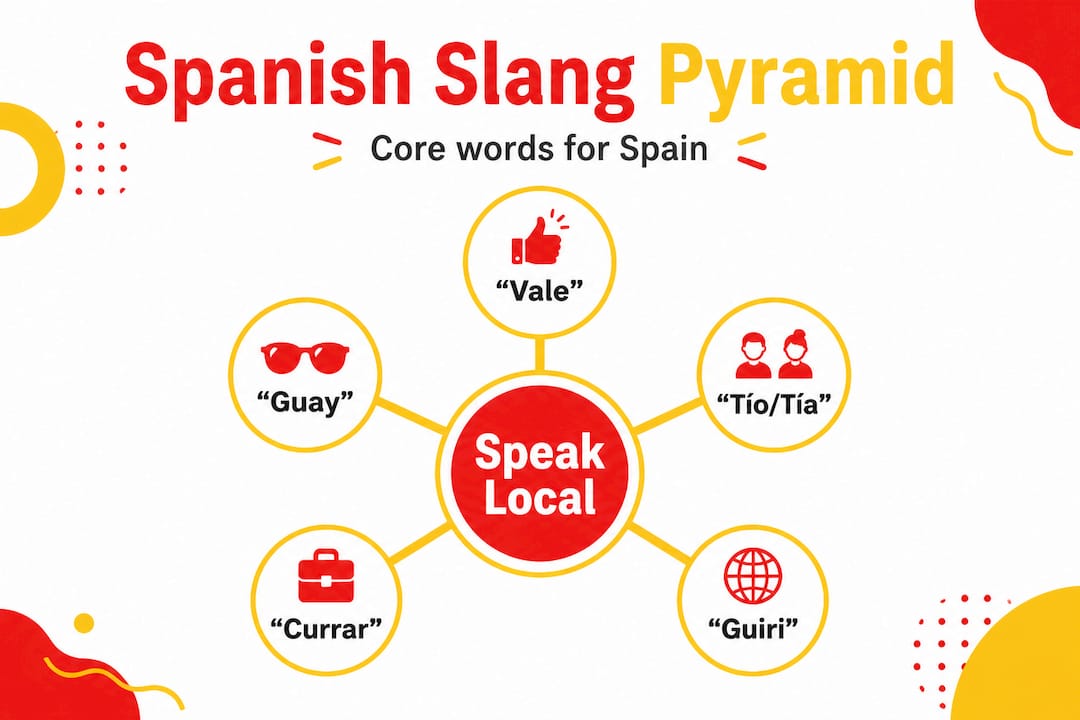
Spain-specific slang includes commonly used terms such as vale, guay, tío/tía, currar, and guiri, each with meanings that can differ significantly from Latin American usage. Learning these words in their Spanish context, not a generalised “Spanish” context, makes all the difference.
Here is a quick-reference table of key terms you will encounter:
| Slang word | Literal meaning | Actual usage | Typical context |
|---|---|---|---|
| Vale | It is worth | OK / Alright / Got it | Used constantly in everyday agreement |
| Guay | No literal equivalent | Cool / Great / Awesome | Complimenting something or someone |
| Tío / Tía | Uncle / Aunt | Mate / Dude / Pal | Informal address between friends |
| Currar | No literal equivalent | To work / To graft | Talking about work casually |
| Guiri | Foreign-sounding word | Foreigner (usually tourist) | Describing or joking about non-Spaniards |
| Mola | No literal equivalent | It is cool / I like it | Expressing approval of something |
| Flipar | No literal equivalent | To be amazed / To freak out | Reacting to surprising news |
| Tío bueno / Tía buena | Good uncle / Good aunt | Attractive man / Attractive woman | Used among friends, context-dependent |
It is worth pausing on a few of these. Vale is probably the single most useful word in everyday Spain. You will hear it used the way English speakers use “OK,” “right,” “sure,” and “got it” all rolled into one. Dropping a confident vale at the right moment immediately signals familiarity with how Spaniards actually speak.
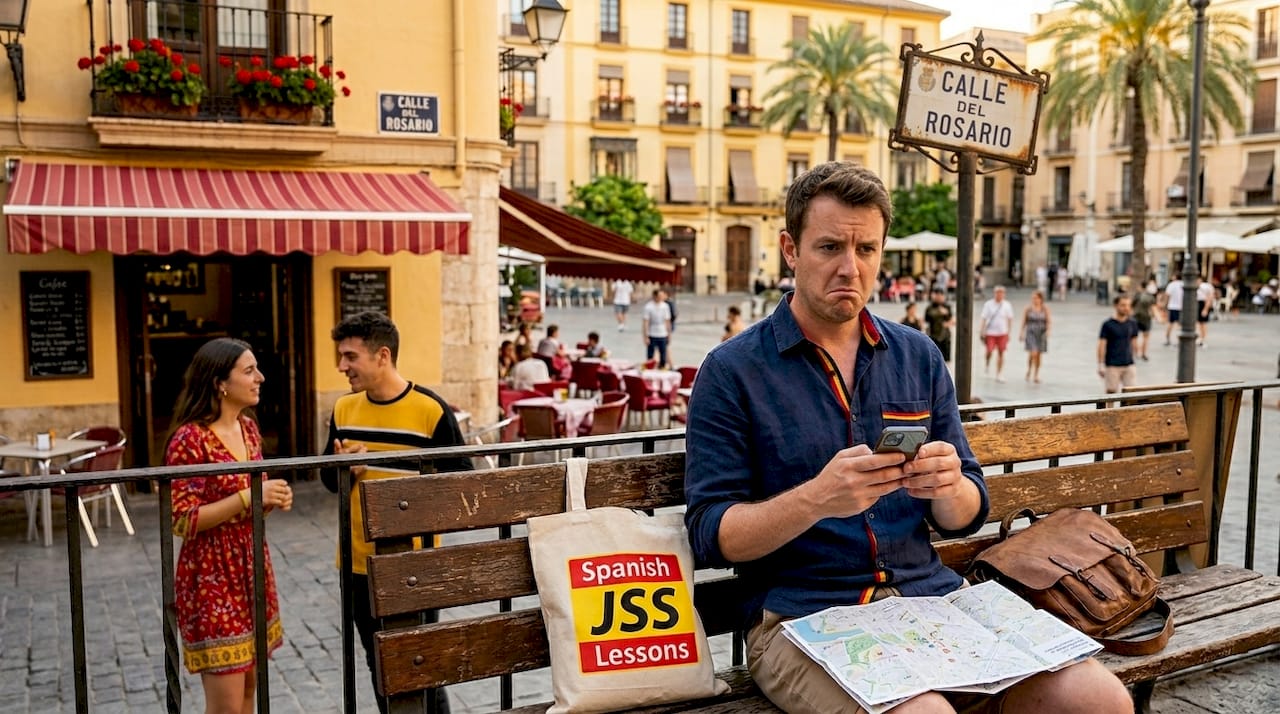
Guiri deserves special attention. It is used by Spaniards to refer to foreigners, often tourists, and it carries a light-hearted but pointed meaning. Hearing someone call you a guiri is not necessarily offensive, but it is a gentle reminder that you are not quite blending in yet. The goal, of course, is to stop being the guiri in the room.
Here is how a couple of these terms sound in natural conversation:
“¿Quedamos esta tarde?” (“Shall we meet this afternoon?”) “¡Vale, tío, sin problema!” (“Sure, mate, no problem!”)
“¿Qué tal la peli?” (“How was the film?”) “Mola mazo.” (“It was really cool.”)
Pro Tip: Before using a slang term, check whether the explanation you have found specifies that it is used in Spain rather than Latin America. A trustworthy source will note the difference. If you are unsure, ask a Spanish friend from Spain directly. They will almost certainly enjoy explaining it to you.
With these essential phrases in your toolkit, the next step is knowing when, not just what, to use them.
When and where to use Spanish slang
Knowing a word is only half the battle. Context and appropriateness matter: slang is generally suitable for informal situations but should be avoided in formal settings like academic writing or professional correspondence. Dropping slang in the wrong place is a bit like wearing flip-flops to a job interview. You might get away with it, but the impression it creates is not the one you want.
Understanding the lay of the land before opening your mouth with slang is a skill in itself. Here are some practical cues to read before you launch into informal territory:
- Who are you talking to? Friends, neighbours, and shopkeepers in a local market are fair game. A doctor, lawyer, or government official is not.
- What is the setting? A bar, a family gathering, or a casual walk with someone you know well is perfect. A formal meeting, a job application, or written communication is not.
- What is the age gap? Slang between peers feels natural. Using young people’s slang with an older Spaniard can feel slightly odd, though not offensive.
- What is the tone of the conversation? If the person you are speaking with is already relaxed and informal, matching their register works well. If they are being measured and polite, follow their lead.
- Is it a customer-facing situation? A chat with a friendly shopkeeper is fine for light, casual Spanish. A formal complaint or a legal matter warrants plain, clear language.
Being part of using conversational Spanish confidently is about reading people, not just words. Spaniards are generally warm and will not be offended if you get the register slightly wrong. But they will notice, and getting it right builds genuine rapport.
Pro Tip: Spend time listening before speaking. When you are in a Spanish environment, observe how locals adjust their language between different people. Notice how a shopkeeper talks differently to a regular customer versus someone who has just walked in. That shift in tone is exactly what you are trying to learn.
Understanding when to use slang sets you up for conversations that sound real and local. Now, let us see how to practise and keep learning effectively.
How to practise and master Spanish slang
Learning slang is not a one-off task. It is an ongoing habit. The good news is that with the right approach, it becomes genuinely enjoyable rather than a chore. Here is a practical step-by-step method:
- Listen first. Before you try to use any slang, spend time consuming Spanish spoken in Spain. Films, TV series, podcasts, and even YouTube channels from Spanish creators will flood your ears with natural, informal speech.
- Copy what you hear. When you catch a phrase that sounds natural and informal, write it down. Note the context: who said it, to whom, and in what situation.
- Check it is Spain-specific. Prefer resources that explicitly separate Spain versus Latin America usage and include clear meaning and usage notes. This prevents confusion and wasted effort.
- Use it in low-stakes situations. Try a new term with a friend, a local at a café, or someone you chat to regularly. The feedback you get, whether a smile or a puzzled look, teaches you more than any textbook.
- Review and update. Slang evolves. What was cool ten years ago might now sound dated. Stay curious and keep collecting new phrases from real interactions.
Here is a comparison of the most common resources for learning Spanish slang, so you can decide what fits your lifestyle:
| Resource type | Spain-specific? | Interactive? | Up to date? | Practical for adults? |
|---|---|---|---|---|
| Dedicated online courses | Often, if chosen carefully | Yes | Depends on the course | High |
| Language learning apps | Rarely Spain-focused | Yes | Variable | Medium |
| Spanish TV and films | Yes, if set in Spain | No | Mostly yes | High |
| Slang websites and blogs | Variable | No | Variable | Medium |
| Real-life conversations | Entirely yes | Fully | Always | Very high |
Real-life conversation sits at the top because nothing replaces the moment when a Spaniard laughs with you, not at you, because you used exactly the right word. There are solid ways to practise Spanish conversation that go well beyond flashcard apps, and pairing those with genuine exposure to spoken Spanish from Spain closes the gap between textbook knowledge and real fluency fast.
When you are ready to build the structural foundation alongside slang, exploring online learning steps designed specifically for adult learners makes the whole process clearer and less overwhelming. Pairing structured learning with dedicated spoken Spanish lessons builds both the vocabulary and the listening ability you need.
Mastering Spanish slang is a journey. So what should you know that most guides skip? Here is where long-term experience offers a unique take.
Why most learners struggle with Spanish slang and what actually works
Here is an uncomfortable truth: most Spanish courses do not teach you Spanish slang from Spain. They teach you a blended version of Spanish slang from everywhere, mixing Argentinian expressions with Mexican street talk and occasionally throwing in something from Madrid. The result is a confused learner who sounds like they have travelled to six countries at once.
The real problem is passive learning. Many people assume that if they watch enough Spanish TV or listen to enough podcasts, slang will simply seep in. It rarely does, at least not efficiently. Your brain filters out what it does not recognise as important. Without active engagement, slang becomes background noise.
What actually works is a combination of focused input and deliberate practice. Focus your listening on content made in Spain, set in Spain, and spoken by Spaniards. Do not settle for generic “Spanish language” resources. Ask yourself: does this source tell me whether this phrase is used in Spain or somewhere else entirely? If it does not, find one that does.
Building a personal collection of phrases you have heard in real situations is far more powerful than memorising a list. When you hear a Spaniard at the market use a word you do not recognise, write it down, look it up, and try it back out. This active collection habit, sometimes called “slang in the wild,” trains your ear and your memory simultaneously.
There are also real-life fluency tips that go beyond vocabulary and address the whole picture of communicating naturally in Spain. Slang is part of a larger skill set that includes listening speed, cultural awareness, and the confidence to speak even when you are not sure you have got it perfectly right. That last part matters enormously. Spaniards are forgiving of mistakes. They are charmed by effort. Getting something slightly wrong while clearly trying is far better than staying silent.
Continue your Spanish slang journey
Slang is just one piece of the puzzle, but it is a vivid, energising piece that transforms your Spanish from functional to genuinely enjoyable. The foundation matters too, and that is where a structured, Spain-focused approach pays off.
At James Spanish School, every lesson is built around real life in Spain, not exam preparation. The course covers sentence-building and ear-tuning so that fast native speech stops feeling like a wall of sound. You can explore the full range of online Spanish lessons at your own pace, available 24/7 on any device. For slang-specific support, the Spanish slang learning materials in the shop give you focused, Spain-specific resources. And when you are ready to put it all together in conversation, tips for speaking with locals will help you move from practising to actually connecting.
Frequently asked questions
Is Spanish slang the same in all Spanish-speaking countries?
No. Slang varies significantly by region and country, so learners aiming for conversations in Spain should focus specifically on Spain-based slang to avoid confusion.
Are slang words appropriate to use in any situation in Spain?
Spanish slang works well in informal, casual settings but should be avoided in formal or professional contexts such as legal appointments, medical consultations, or written correspondence.
What is the best way for beginners to learn Spanish slang?
Start with slang that is clearly labelled as Spain-specific, and practise it in real conversations as quickly as possible. Resources separating Spain from Latin America in their usage notes are the most reliable starting point.
How do I know if a slang word is Spain-specific?
Look for sources noting Spain-only usage rather than general Spanish, ask a native Spaniard directly, or check whether the explanation distinguishes between Spain and Latin American variants.