

Discover benefits learning Spanish
TL;DR:
- Knowing Spanish enhances daily life and cultural experiences in Spain, especially outside tourist areas.
- Active engagement, structured practice, and immersion with real conversations accelerate adult language learning.
- Spaced retrieval practice and meaningful interaction are proven methods for rapid, lasting Spanish proficiency.
Spanish is not just a language spoken far away. It is the daily reality for millions of people living in, moving to, or simply spending extended time in Spain. Over 500 million people speak it as their native tongue, making it one of the most spoken languages on earth. Yet a surprising number of English-speaking adults still arrive in Spain convinced that a smile and a slowly spoken English phrase will carry them through. Sometimes it does. Most of the time, it does not. This guide explains exactly what Spanish unlocks for you in real life, why its importance is only growing in 2026, and which learning methods actually deliver results for adult learners.
Table of Contents
- How speaking Spanish transforms travel and daily life in Spain
- Why Spanish is more important than ever in 2026
- What actually works for English-speaking adults: easier methods for real progress
- Does immersion in Spain actually speed up your Spanish?
- The uncomfortable truth about learning Spanish as an adult
- Take the next step: practical Spanish for your life in Spain
- Frequently asked questions
Key Takeaways
| Point | Details |
|---|---|
| Spanish is essential | Daily life and richer experiences in Spain rely on basic Spanish skills no matter your background. |
| Global reach | Over 630 million people speak Spanish, broadening your horizons at home and abroad. |
| Evidence-based practice | Techniques like Spaced Retrieval deliver far better adult results than old-school rote learning. |
| Immersion with intent | Simply being in Spain is not enough—structured, purposeful interaction accelerates genuine progress. |
| Start practical | Real-life Spanish starts with useful vocabulary and phrases you can use from day one. |
How speaking Spanish transforms travel and daily life in Spain
Having seen Spanish’s extraordinary reach, let us look at how using it opens real doors in Spain itself.
The most immediate benefit is practical. Spain is not a country where English is widely spoken outside major tourist zones. Walk into a local pharmacy in a small Andalusian town, visit a GP surgery in rural Catalonia, or try to negotiate a rental contract in Valencia, and the assumption is that you speak Spanish. These are not edge cases. They are the everyday situations that expats and long-term visitors encounter within the first weeks of arrival.
Consider the situations where Spanish makes a measurable difference:
- Groceries and markets: Local market traders, butchers, and fishmongers rarely speak English. Knowing how to ask for quantities, cuts of meat, or seasonal produce transforms a confusing transaction into a pleasant exchange.
- Medical appointments: Describing symptoms to a doctor or nurse in Spanish is not just convenient. In an emergency, it can be essential. Many health centres outside major cities have no English-speaking staff on duty.
- Bureaucracy and paperwork: Registering on the padrón (the local residents’ register), opening a bank account, or dealing with utility companies almost always requires Spanish. Relying on a translator for every interaction is expensive and slow.
- Finding housing: Landlords who speak only Spanish are common, particularly in residential rather than tourist-facing areas. Being able to ask questions, negotiate terms, and understand a contract puts you in a far stronger position.
- Making genuine friendships: Spanish neighbours, colleagues, and community members open up entirely differently when you make the effort to speak their language. The shift in warmth and trust is immediate and noticeable.
“Speaking even basic Spanish signals respect. It tells people that you have chosen to meet them on their terms, not yours. That single gesture changes how Spain receives you.”
The cultural dimension matters just as much as the practical one. Local festivals, community meetings, regional television, and the kind of conversation that happens in a bar over a coffee are all in Spanish. Access to these experiences gives life in Spain a richness and texture that is simply not available to those who remain inside an English-speaking bubble.
Spain also sits within a vast Spanish-speaking world. The 630 million Spanish speakers globally mean that your investment in the language pays dividends far beyond the Iberian Peninsula. Every conversation you have in Spain is also practice for Mexico City, Buenos Aires, or anywhere else Spanish is the first language of daily life.
Why Spanish is more important than ever in 2026
Now that we have explored the doors that Spanish opens in Spain, let us consider why its importance is only growing in 2026.
Spanish has quietly overtaken French and German as the most widely chosen second language across much of Europe. The reasons are not hard to find. Remote working has made it possible for professionals in their thirties, forties, and fifties to relocate to Spain without giving up their careers. Retirement abroad, once a niche option, is now a mainstream life choice for a significant number of British adults. Both groups need Spanish not for holidays but for the full, working fabric of their daily lives.
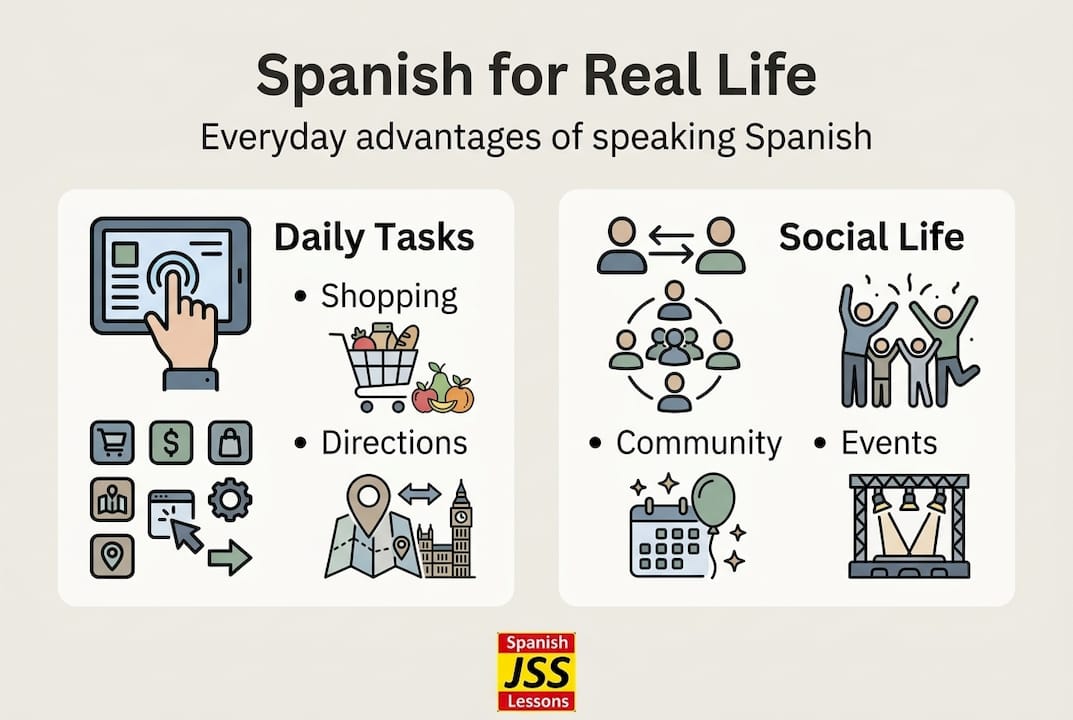
The comparison below shows clearly how Spanish skills affect real-life outcomes in Spain across common scenarios:
| Daily scenario | Without Spanish | With Spanish |
|---|---|---|
| Supermarket shopping | Guessing at labels, limited to tourist products | Full access to local produce, clear pricing conversations |
| Doctor’s appointment | Dependent on a translator or bilingual friend | Able to describe symptoms, understand advice, ask questions |
| Housing search | Restricted to English-language listings, often tourist-facing | Access to local rental market, direct negotiation with landlords |
| Making friends | Limited to expat community | Open relationships with Spanish neighbours and colleagues |
| Local bureaucracy | Delays, errors, frustration | Faster resolution, greater trust from officials |
| Cultural events | Excluded from most local activities | Full participation in festivals, clubs, and community life |
The picture is consistent across every row. Spanish skills do not just make life easier. They make a fundamentally different and richer life possible.
Pro Tip: You do not need to be fluent to start benefiting. Even a handful of well-chosen phrases and a willingness to try changes how Spanish people respond to you. Goodwill is earned by effort, not perfection. Start with the basics and build from there.
What actually works for English-speaking adults: easier methods for real progress
Understanding Spanish’s growing importance leads us to what works best for busy adults aiming for real proficiency.
Many adults carry a quietly painful memory of language learning from school: conjugation tables, grammar drills, textbooks that seemed designed to confuse rather than clarify. These methods frustrated a generation of learners and left many convinced that languages are simply not for them. That belief is wrong. The problem was never the learner. It was the method.
Modern research has changed the picture significantly. Spaced Retrieval Practice is now recognised as one of the most effective methods available for adult language learners. It works by training your brain to retrieve vocabulary and sentence structures at increasing intervals, which makes recall automatic rather than effortful. Research shows it can measurably improve spoken fluency measures including how smoothly you speak and how quickly you can produce sentences. For adults learning Spanish for real conversations rather than academic exams, this is exactly the kind of progress that matters.
Here is how to begin practising Spanish with more impact and less wasted time:
- Start with survival sentences. Prioritise the phrases you will actually use in the first weeks: greetings, shopping requests, ordering food, asking for directions, and explaining a basic problem. These build immediate confidence and create real-world opportunities to practise.
- Use spaced repetition daily. Even fifteen minutes of retrieval-based practice each day outperforms two hours of passive listening at the weekend. Consistency beats intensity every time.
- Tune your ear early. Spanish speakers at native speed can sound like a wall of sound to a beginner. Training your ear to separate words and recognise common phrases is a specific skill, and it needs specific practice. Exploring audio Spanish lessons designed for this purpose can accelerate that process considerably.
- Practise speaking out loud from day one. Thinking in Spanish and speaking Spanish are different skills. Many learners can read and translate well but freeze when asked to produce a sentence on the spot. Speaking aloud, even alone, builds the muscle memory you need.
- Seek feedback and correct your errors. Errors are not failures. They are the most efficient learning signal available. Understanding common adult learning challenges helps you anticipate where confusion typically strikes and plan around it.
The table below ranks common learning strategies by both their proven effectiveness and how practical they are for a busy adult:
| Learning strategy | Effectiveness | Ease of implementation |
|---|---|---|
| Spaced Retrieval Practice | Very high | Moderate (needs good materials) |
| Real-world conversation practice | High | Moderate (requires a partner or context) |
| Audio and ear-tuning lessons | High | Easy (fits into any routine) |
| Structured sentence-building | High | Moderate (needs clear instruction) |
| Grammar drills from a textbook | Low to moderate | Low (time-consuming, demotivating) |
| Passive listening (music, TV) | Low alone | Easy (enjoyable but insufficient alone) |
Pro Tip: Focus on vocabulary that appears repeatedly in your daily life in Spain. Fifty high-frequency words and ten reliable sentence structures will serve you better in real conversations than five hundred words you cannot recall under pressure.
Does immersion in Spain actually speed up your Spanish?
Once you know which learning method to pick, you might wonder whether simply moving to Spain is the ultimate shortcut.
The honest answer is: sometimes, but only under specific conditions. Immersion has a powerful reputation, and it is not entirely undeserved. Being surrounded by Spanish all day does expose you to patterns, rhythms, and vocabulary that a classroom alone cannot replicate. However, research tells a more nuanced story.
Studies of learners abroad show that spending a semester in Spain can improve overall Spanish proficiency, but the gains are uneven. Complexity in speaking tends to improve, meaning learners can attempt longer and more varied sentences. However, fluency and accuracy do not necessarily follow at the same pace. In other words, you might find yourself saying more but still making consistent errors and still struggling to follow a fast reply.
Not all immersion experiences are equal. Here is a realistic look at what different types of immersion actually deliver:
- Language school in Spain: Structured and effective for grammar foundations, but you often spend breaks and evenings speaking English with other foreign students.
- Living with a Spanish-speaking family: One of the most effective forms of immersion, providing constant, meaningful interaction in a natural setting.
- Volunteering in a Spanish community: Excellent for real-world vocabulary and listening, particularly if the role involves regular conversation with locals.
- Renting alone and working remotely in English: The least effective form of immersion. You are physically in Spain but linguistically still at home.
“Presence in a country is not the same as engagement with its language. Immersion works when it forces you into conversation, not just into proximity.”
The key variable is structured interaction. Passive exposure, hearing Spanish in the background while shopping or watching television, builds familiarity. It does not build fluency. What builds fluency is being placed in situations where you must respond, in real time, to a real person. That is why structured online Spanish lessons taken before and during your time in Spain consistently outperform the ‘sink or swim’ approach for adult learners.
The smartest strategy combines preparation before arrival with active engagement after. Begin building sentence structures and ear-tuning skills before you land. Then use Spain itself as your practice ground, seeking out conversations rather than avoiding them.
The uncomfortable truth about learning Spanish as an adult
After examining how immersion plays out in real-world Spain, it is time for some hard-won truths about what actually works.
Most adults who struggle with Spanish are not struggling because they are too old or because the language is too difficult. They are struggling because they are relying on passive methods and expecting active results. Listening to a Spanish podcast while cooking is pleasant. It is not practice. Scrolling through a vocabulary app for ten minutes feels productive. On its own, it is not enough.
The plateau that so many adult learners hit is almost always the result of the same pattern: a period of initial enthusiasm, followed by a drift into passive absorption, followed by frustration that the language is not sticking. The solution is straightforward even if it is not always comfortable. You have to put yourself in situations where you are required to speak, listen, and respond. Not controlled, predictable exercises but genuine exchanges where you cannot predict what comes next.
This means accepting that you will sometimes not understand. You will sometimes give the wrong word. A Spanish reply will occasionally arrive at the machine-gun speed of a native speaker, and you will feel momentarily lost. These moments are not evidence that you cannot do it. They are the learning itself. Understanding why adults struggle with Spanish is the first step towards removing those obstacles deliberately rather than accidentally.
The adults who make genuine, lasting progress share one characteristic. They give themselves permission to be imperfect early and often. They treat a misunderstood sentence as information, not humiliation. They keep raising the stakes by asking for more complex directions, joining a local club, reading a regional newspaper, or picking up the phone to call a Spanish tradesman rather than sending a message.
Structure matters enormously, particularly at the start. A clear method that builds sentence logic in plain English, without drowning you in grammatical terminology you never needed to learn your first language, changes the experience completely. Progress is measurable. Confidence builds. And Spain, in all its warmth and complexity, becomes genuinely accessible.
Take the next step: practical Spanish for your life in Spain
If you are ready to move beyond the English-only barrier and start building real, usable Spanish, the resources at James Spanish School are designed precisely for that goal.
James Bretherton has lived in Spain for 40 years and built a 100-lesson course around the skills that actually matter in daily Spanish life. From sentence-building to ear-tuning, every lesson is practical and available on demand, 24/7, on any device. There is no expiry date and no pressure. For practical Spanish tips that go straight to the heart of real-life fluency, or to browse the full range of online Spanish lessons designed for English-speaking adults, the school’s resources are ready when you are. You can also explore essential starter resources to get moving without delay. Real life in Spain is waiting.
Frequently asked questions
Can you live in Spain only speaking English?
It is possible in heavily tourist-facing areas, but everyday life, bureaucracy, and genuine social integration all require at least some Spanish. The 630 million native and second-language speakers worldwide confirm that Spanish is the dominant working language in Spain, not English.
How long does it take for adults to speak practical Spanish?
With consistent daily practice using evidence-backed approaches, most adults can handle basic real-life situations within three to six months. Spaced Retrieval Practice in particular has been shown to measurably improve spoken fluency and recall speed in adult learners.
Is immersion always the fastest way to learn Spanish?
Only when immersion includes structured, meaningful interaction with native speakers. Simply living in Spain without active engagement produces limited gains, as research on study-abroad outcomes confirms.
What method is best for learning Spanish quickly as an adult?
Spaced Retrieval Practice is consistently shown to boost spoken fluency and automatic recall for adult learners, making it significantly more effective than passive listening or rote grammar study alone.