

TL;DR:
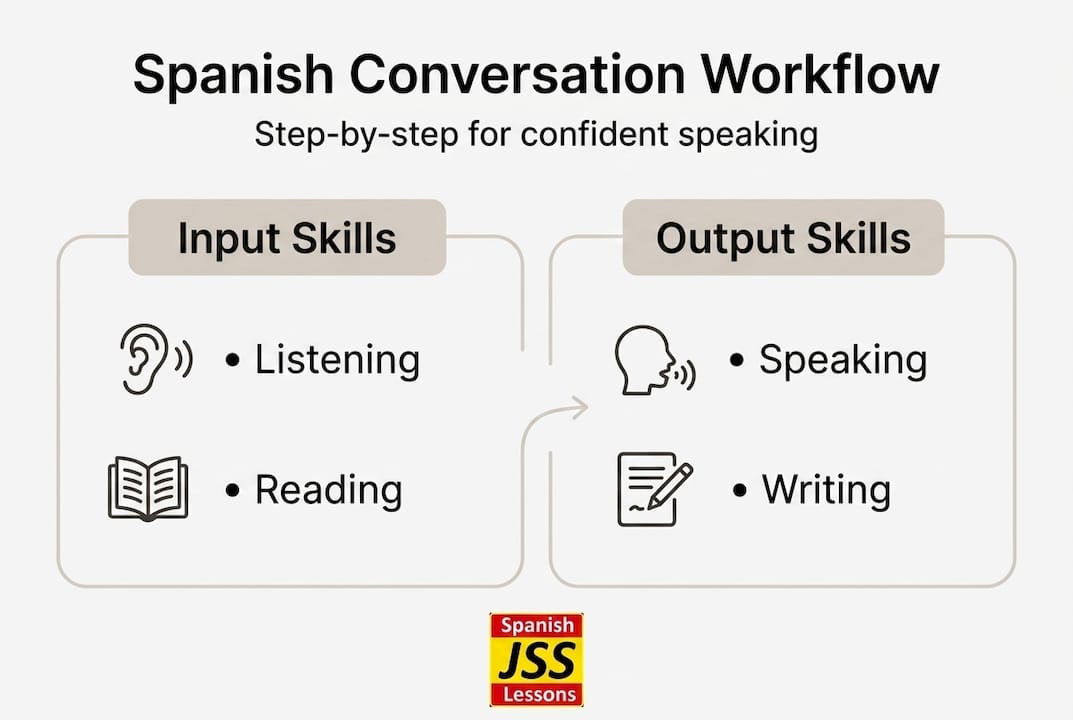
- Adults should combine input and output practice for effective Spanish conversation skills.
- Using AI chatbots reduces embarrassment and boosts confidence early on.
- Embracing mistakes and improvisation accelerates fluency in real-life conversations.
Many English-speaking adults find themselves stuck in a frustrating gap: they’ve worked through lessons, memorised phrases, and perhaps even passed a course, yet the moment a native speaker replies at full speed, confidence evaporates. Real conversational Spanish in everyday Spain feels a world away from classroom exercises. This guide lays out a structured, culturally aware workflow that bridges exactly that gap. You’ll discover what you need to begin, how to practise effectively, which tools reduce embarrassment, which common mistakes to sidestep, and how to measure whether you’re genuinely moving forward.
Table of Contents
- What you need to start your Spanish conversation workflow
- Step-by-step workflow: from input to speaking confidently
- Common mistakes and how to avoid them in Spanish conversation
- Tracking your progress and fine-tuning your workflow
- Why your Spanish conversation workflow should feel improvisational
- Take your Spanish conversation workflow even further
- Frequently asked questions
Key Takeaways
| Point | Details |
|---|---|
| Blend input and output | Listening first, then speaking, creates a robust foundation for real conversation. |
| Use supportive tools | Specialised AI language tools and human tutors together reduce anxiety and improve feedback. |
| Avoid rigidity | Focusing only on memorisation or perfection hinders actual communication. |
| Track small wins | Measuring progress by comprehension and speaking time keeps motivation high. |
| Adjust your workflow | Regularly update your materials and techniques to keep learning fun and effective. |
What you need to start your Spanish conversation workflow
Before your very first real conversation, it pays to get organised. Rushing into speaking without the right foundations is a bit like setting off on a long drive without checking the fuel. A little preparation goes a long way.
The essentials before you begin
Here is what you genuinely need in place before starting your workflow:
- A clear, specific goal. “Get by in Spain” is too vague. “Order food confidently, ask for directions, and chat with my neighbour” is something you can actually plan around.
- A reliable device: a smartphone, tablet, or laptop with a stable internet connection. Almost all the best modern tools are online.
- A realistic time commitment. Even 20 to 30 minutes a day produces steady progress. Irregular marathon sessions are far less effective.
- Basic awareness of how Spanish sentences are put together. You do not need to master grammar terminology, but understanding that Spanish word order sometimes differs from English prevents early confusion. Exploring beginner Spanish basics is a useful first move.
- An openness to imperfection. Errors are not failures. They are data points that tell you what to work on next.
- Cultural curiosity. Spain is not Latin America, and Spanish habits, rhythms, and social norms shape conversations in ways that pure vocabulary study never covers. Knowing that a Spanish builder takes a mid-morning break, for example, prepares you for real-life timing and small talk.
Tools worth having from the start
| Tool | Best for | Limitation |
|---|---|---|
| AI language bot (e.g. WordAmigo) | Low-pressure speaking practice, 24/7 availability | Cannot pick up on tone or regional accent nuances |
| Human tutor | Authentic feedback, spontaneous conversation | Scheduling and cost constraints |
| Listening resources (stories, videos) | Building “ear” for natural speed and rhythm | Passive without output practice |
| Mobile phrasebook | Quick reference in real situations | Can encourage script reliance |
Research confirms that AI language bots reduce embarrassment in early practice and are best combined with human tutors who can catch the subtler points of nuance and tone. Think of language bots as your rehearsal space and human interaction as the stage.
Pro Tip: Do not wait until you feel “ready” to start speaking. Early output, even clumsy and halting, rewires your brain far more quickly than another week of silent reading. Comfort grows through doing, not through waiting.
The mindset piece matters more than most guides admit. Adults often carry a fear of looking foolish that children simply do not have. Reframing mistakes as useful, expected, and even entertaining is not just positive thinking. It is the most efficient strategy you have.
Step-by-step workflow: from input to speaking confidently
With your resources gathered, it is time to get hands-on and follow a structured yet flexible workflow. This is not a rigid programme. Think of it as a loop you return to and refine, rather than a straight line you walk once.
The five-stage workflow
- Listen to relevant stories and videos. Begin each session with Spanish input that is slightly above your current comfort level. Stories, short videos, or audio Spanish lessons work particularly well. The goal is to train your ear to recognise natural rhythm, connected speech, and common phrases before you attempt to reproduce them.
- Shadow and echo sentences. After listening, replay short sections and repeat them out loud immediately. This is called shadowing, and it is one of the most powerful techniques in language learning. You are not translating. You are mirroring the sound, speed, and shape of real Spanish speech.
- Practise with an AI language bot. Use a conversational AI tool to simulate real exchanges. Ask for directions, practise ordering a coffee, or role-play a conversation with a Spanish landlord. The low-pressure environment means you can make mistakes, try again, and experiment without anxiety.
- Shift to human interaction. Once you have rehearsed a scenario several times with an AI language Chatbot, attempt it with a real person. This might be a tutor, a language exchange partner, or eventually someone in Spain itself. Human interaction adds unpredictability and spontaneity that no chatbot can fully replicate.
- Reflect and repeat. After each session, spend five minutes noting what felt difficult and what surprised you. Then loop back to step one with those specific gaps in mind. Building spoken Spanish skills requires this kind of deliberate, reflective repetition.
Suggested time and activity guide
| Stage | Time per session | Core activity |
|---|---|---|
| Listen | 10 minutes | Stories, podcasts, or short videos |
| Shadow | 5 to 10 minutes | Echo sentences, mimic rhythm |
| AI practice | 10 minutes | Simulated conversations |
| Human interaction | 15 to 30 minutes | Tutors or language partners |
| Reflection | 5 minutes | Note gaps and wins |
There is a long-running debate in language learning circles about whether comprehensible input, the process of acquiring a language through stories and listening, is better than structured conversation practice. The honest answer is that both approaches work well, and they work best together. Input fills your bank of sounds and phrases; output forces you to retrieve and use them under real conditions.

Pro Tip: Alternating between input and output within a single session, rather than doing a week of listening followed by a week of speaking, significantly improves retention. Your brain consolidates new language faster when it has to both absorb and produce it close together.
Common mistakes and how to avoid them in Spanish conversation
As you work through the steps, be aware of pitfalls that can derail your progress. Most of these traps are not about Spanish at all. They are about habits of thinking that get in the way.
The most common pitfalls
- Overemphasising memorisation. Memorising long lists of vocabulary or scripted dialogues feels productive. In practice, it rarely transfers to real conversation because natural speech is unpredictable and context-dependent. Knowing fifty words for emotions is less useful than knowing how to ask someone to repeat themselves slowly.
- Translating word for word. English and Spanish have different rhythms and structures. Attempting to translate in your head as you speak produces slow, unnatural output and often leads to errors. The goal is to think in Spanish patterns, not to convert English thoughts.
- Avoiding mistakes at all costs. Perfectionism is the enemy of fluency. If you wait until a sentence feels correct before speaking, you will rarely speak at all. Mistakes are the mechanism through which you improve.
- Skipping listening practice. Many learners want to jump straight to speaking, but without sufficient input, your ear cannot process the machine-gun speed of native replies. Listening is not passive. It is the foundation on which speaking is built.
- Relying entirely on scripts. Phrasebooks and memorised sentences are useful starting points, but real conversation rarely follows a script. If someone gives you an unexpected answer, a script leaves you stranded.
“The most effective learners combine listening-based input with regular speaking practice. Neither method alone produces the fluency that comes from using both in an integrated, ongoing cycle.” This principle, drawn from research into comprehensible input versus structured output, applies regardless of your starting level or age.
Practical solutions
Shift your focus from memorising answers to developing comprehension strategies. Learn phrases like ¿Puede repetir más despacio? (Can you repeat that more slowly?) and No entiendo bien (I don’t quite understand). These tools keep a conversation alive even when you’re lost.
Prioritise communication over correctness. A sentence with a small grammatical error that communicates your meaning is a success. A perfect sentence you never utter is worthless. The Spanish people you encounter in daily life are far more interested in connecting with you than in judging your tenses.
Adopt a flexible, iterative approach. Try something, notice what happened, adjust, and try again. This loop is not just a learning strategy. It is how all natural language acquisition works.
Tracking your progress and fine-tuning your workflow
Avoiding these traps puts you in a strong position. But how do you know you’re truly improving? Progress in conversation can feel invisible, especially when you’re in the middle of it.
What genuine progress looks like
Real conversational progress is not just about knowing more words. It shows up in several ways: you understand more of what you hear without needing to translate; you feel less anxious before a conversation; you recover more quickly when you don’t understand something; and real-life interactions in Spain begin to feel manageable rather than terrifying.
Simple metrics to track each week
- Total minutes spent speaking (aim for steady growth over four to six weeks)
- Number of new phrases used naturally in a conversation
- Number of successful real-life interactions, however brief
- Comfort level on a simple 1 to 10 scale before and after speaking sessions
- Comprehension rate during listening practice (rough estimate: how much did you follow?)
These measures are not scientific. They do not need to be. They give you a directional sense of movement, and that is enough to stay motivated.
Tools for tracking and fine-tuning
Use a simple journal to log your sessions. Note what went well, what caused difficulty, and what you want to revisit. Tutors can offer structured feedback on recurring errors. AI language chatbots are also surprisingly useful here: AI language chatbots provide low-pressure feedback on phrasing and can highlight patterns in your errors without any social awkwardness.
Review your approach to reinforce Spanish skills each month. If listening feels comfortable but speaking still lags, shift more time to output. If you’re speaking freely but not understanding replies, increase your input time. Adjust, do not abandon.
Pro Tip: Revisit listening material or conversation recordings from four to six weeks ago. Noticing how much more you understand now is one of the most motivating things you can do. It makes the progress that felt invisible suddenly very visible.
Understanding what real-life Spanish conversation means in everyday contexts, from the health centre to the hardware shop, helps you calibrate your targets realistically. The goal is not academic perfection. It is functional confidence in the situations that actually matter to you.
Why your Spanish conversation workflow should feel improvisational
Fine-tuning your workflow naturally raises this question: what does a good conversation actually feel like? Most guides focus on structure but miss something vital. Real conversation is improvisational by nature. It never goes quite the way you planned.
This is not a problem. It is the point. Rigid scripts create brittle learners who freeze the moment a conversation veers off-piste. The adults who make the fastest gains are those who treat speaking Spanish as a creative, flexible process, not a performance they must get right.
AI language tools have a genuine role here. They let you rehearse twenty different versions of the same scenario: the plumber who arrives late, the pharmacist who speaks quickly, the neighbour who wants to discuss local politics. You can experiment without stakes. Then, when you move to human interaction, you are not rehearsing a script. You are drawing on a broader repertoire.
Mastering Spanish small talk is a perfect example of where improvisation matters more than preparation. Small talk is spontaneous, culturally loaded, and intensely local. No phrasebook covers it adequately. But a learner who has played with enough conversational scenarios, and who has given themselves permission to stumble, will navigate it far better than someone who memorised a hundred perfectly structured sentences.
Even with limited daily practice time, adults can make rapid, genuine gains. The key is staying adaptive, staying playful, and remembering that every slightly awkward exchange is teaching you something that no lesson plan could.
Take your Spanish conversation workflow even further
For learners seeking to accelerate their progress or connect with a supportive learning environment, James Spanish School offers a practical, accessible next step.

James Bretherton has spent 40 years living and working in Spain, and his courses are built around the Spanish you actually need: conversations with neighbours, tradesmen, health workers, and local officials. The 100-lesson course blends sentence-building with ear-tuning, helping you both speak and follow fast native speech. Everything is on demand, available on any device, with no countdown clocks or expiry dates. Explore the full range of resources for Spanish conversation workflow, browse flexible online Spanish lessons, or read the online practical Spanish fluency guide to find the right starting point for you.
Frequently asked questions
What is the main difference between comprehensible input and conversation practice in Spanish learning?
Comprehensible input focuses on absorbing Spanish through stories and videos, while conversation practice focuses on producing spoken Spanish; combining both methods consistently delivers the best real-world results.
Are AI language chatbots effective for improving Spanish conversation skills?
Yes, AI language chatbots enable low-pressure practice that reduces embarrassment and builds confidence, particularly when combined with occasional sessions with a human tutor who can address subtler nuances.
How can I measure my improvement in Spanish conversation?
Track your weekly speaking minutes, the number of new phrases you use naturally, your comfort level before conversations, and how well you follow spoken Spanish without needing to translate everything.
What mindset is best for learning Spanish conversation as an adult?
Embrace mistakes as useful data and prioritise communicating your meaning over producing grammatically perfect sentences. This shift alone accelerates progress significantly.
Do I need to memorise scripts to hold real conversations in Spanish?
No. Flexibility and responsiveness serve you far better than fixed scripts, which tend to fail the moment a real conversation takes an unexpected turn.