

How to understand fast Spanish
TL;DR:
- The brain adapts quickly to fast Spanish after exposure to just 10–15 sentences.
- Listening at 170–190 words per minute optimizes ear training for real-life comprehension.
- Combining rhythm awareness with grammar knowledge enhances understanding of rapid, natural Spanish speech.
You’re standing at a market stall in Valencia, asking for two kilos of oranges. The stallholder replies and it sounds like a wall of sound at machine-gun speed. You catch “sí” and maybe a number, but the rest vanishes before your brain can process it. This is the moment that stops so many English speakers in their tracks. The good news is that understanding fast spoken Spanish is a learnable skill, not a gift you’re either born with or not. Research confirms the brain adapts to rapid speech surprisingly quickly, and this article will show you exactly how to make that happen.
Table of Contents
- Why fast Spanish feels impossible (and what’s really happening)
- Key requirements: What you need before tackling fast spoken Spanish
- Step-by-step: How to train your ear for real-life fast Spanish
- Common pitfalls and how to overcome them
- How to know you’re making progress (and what results feel like)
- Why most advice for mastering fast Spanish misses the real point
- Take your Spanish listening skills further
- Frequently asked questions
Key Takeaways
| Point | Details |
|---|---|
| Quick adaptation | Your brain adapts to fast Spanish after about 10–15 sentences of exposure, so short focused practice works. |
| Optimal training speed | Training your ear at 170–190 wpm matches real-world conversation speeds and boosts comprehension. |
| Rhythm matters | Listening to fast languages with similar rhythms, even without full understanding, helps you adapt to fast Spanish. |
| Focus on meaning | It’s normal not to catch every word—target main ideas and key phrases instead. |
| Grammar supports prediction | Knowing basic Spanish grammar lets you anticipate what comes next during rapid speech. |
Why fast Spanish feels impossible (and what’s really happening)
Many learners assume they’re simply not talented at languages when fast Spanish leaves them baffled. The reality is more interesting and far more encouraging than that.
The brain’s difficulty with rapid Spanish is not primarily about the raw speed of the words. It is about rhythm and chunking. Spanish is a syllable-timed language, meaning each syllable receives roughly equal stress. English, by contrast, is stress-timed, with some syllables punched hard and others swallowed. Your brain has spent decades processing English rhythm, so Spanish rhythm feels alien even when you know the vocabulary.
When native speakers talk, they also blend words together in a process linguists call connected speech. “¿Cómo estás?” becomes something closer to “comoestás” at full speed. Prepositions and articles melt into the words around them. If you’ve only ever heard Spanish delivered at classroom pace, real-life conversation sounds like a completely different language.
Here is where the science becomes genuinely encouraging. Research shows that after just 10–15 sentences of exposure to fast speech, the brain begins to recalibrate. This is neuroplasticity at work. Your listening system starts building new templates for fast input, even before you consciously understand every word. Understanding why Spanish listening trips people up is explored in detail at why Spanish listening is hard, and the explanation may well surprise you.
| Speech rate | Effect on comprehension |
|---|---|
| Below 150 wpm | Easy for most learners; feels artificial |
| 150–170 wpm | Comfortable; still slow by native standards |
| 170–190 wpm | Natural radio pace; optimal for ear-training |
| Above 200 wpm | Challenging even for advanced learners |
“The brain does not need perfect comprehension to begin adapting. Exposure to the rhythm and pace of fast speech starts rewiring your listening templates almost immediately.” Rodero, 2016.
Pro Tip: Listen to Radio Nacional de España for just ten minutes a day. You do not need to understand everything. The rhythm exposure alone begins training your ear at the optimal 170–190 words per minute pace.
Key requirements: What you need before tackling fast spoken Spanish
With these challenges in mind, here is what you need in your toolkit before jumping into speedy conversation.
Think of fast Spanish listening like navigating a busy motorway. You do not just leap onto the M25 on your first driving lesson. You need core skills in place first: a baseline vocabulary, a feel for sentence structure, and the mental stamina to stay focussed when things move quickly.
Baseline vocabulary and grammar
Before attempting fast audio, you need enough vocabulary to recognise key words even when they are blurred by speed. More importantly, knowing basic sentence structure allows your brain to predict what is coming next. If you hear “¿Cuánto…” you know a question about quantity follows. If you hear “Tengo que…” you expect an obligation or intention. These grammar tips for conversations form the scaffolding your listening brain needs to stay ahead of the sound.

Research confirms that rhythm-based adaptation is partly independent of linguistic knowledge, meaning your ear can improve even when your grammar is still developing. However, combining rhythm exposure with grammar knowledge accelerates progress significantly, because grammar feeds your prediction skills.
Attention control
Fast listening requires deliberate concentration. Wandering attention is the enemy of comprehension. Techniques like mindfulness listening (focussing entirely on the audio without multitasking) and short, intense practice sessions outperform long, passive background listening.
The right materials
Not all practice tools are equal. Here is a straightforward comparison:
| Tool | Best for | Limitation |
|---|---|---|
| Slow audio with transcript | Building confidence, learning vocabulary | Does not train fast-speech rhythm |
| Native-speed audio with transcript | Connecting sound to text | Can feel overwhelming at first |
| Podcasts for learners | Graded listening | Often too slow for real-life preparation |
| Real Spanish radio | Authentic fast rhythm | No safety net if you get lost |
| Conversation clubs or exchanges | Real interaction and feedback | Requires scheduling and confidence |
Bullet points for building your toolkit:
- Build a core vocabulary of 500 to 800 high-frequency words before diving into rapid audio
- Practise Spanish conversation regularly to connect listening with production
- Use transcripts to verify what you heard, not as a crutch to read along
- Choose materials set in Spain rather than Latin America, to match the accent and rhythm you will actually encounter
Pro Tip: Record a ten-second clip of a native Spanish speaker, then try to write down every word you heard. Check against the transcript. Do this daily for two weeks and you will notice a measurable shift in what you catch.
Step-by-step: How to train your ear for real-life fast Spanish
Once you have gathered your baseline tools, it is time to put them to work with this proven training sequence.
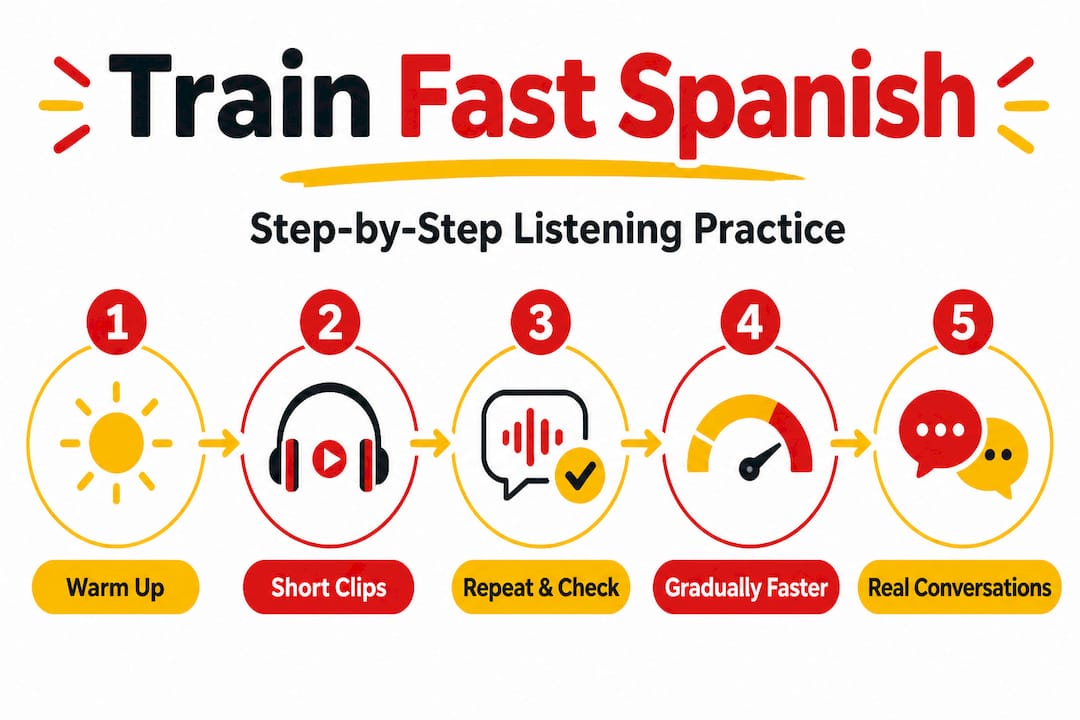
The research is clear: the brain adapts after 10–15 sentences of fast speech, and the sweet spot for training is between 170 and 190 words per minute. These are not arbitrary figures. They represent natural radio broadcast pace in Spain, precisely the speed you will encounter when your builder rings to confirm the morning visit, or when the pharmacist rattles off instructions for your prescription.
A practical ear-training sequence:
- Start with short bursts. Choose a clip of real Spanish audio that is between 30 and 60 seconds long. Listen without stopping and simply note the words or phrases you recognise. Do not attempt to catch everything on the first listen.
- Listen a second time and note the rhythm. Focus on where the speech speeds up, where words blend together, and where the speaker pauses. You are training your ear to map the physical shape of fast Spanish, not just decode individual words.
- Read the transcript after listening. Identify the words you missed and look at why you missed them. Were they blended with adjacent words? Were they an unfamiliar word? Were they a common filler word like “pues” or “bueno” that you simply did not expect?
- Listen again with the transcript open. Follow along and allow your eye to show your ear what it was missing. This is the moment adaptation accelerates most rapidly.
- Gradually increase playback speed. Most apps and podcast players allow you to set speed to 1.25x or 1.5x. After working at natural pace, pushing slightly above 190 wpm will make normal speed feel slower and clearer when you return to it.
- Alternate active and passive sessions. Active listening with full attention is the core work. Passive listening, playing Spanish radio while cooking or walking, maintains familiarity with the rhythm without draining your concentration reserves.
- Join a conversation group or exchange. Real interaction brings unpredictability, which is precisely what you need to develop genuine fluency. You can explore mastering fast listening skills for more structured approaches to this step.
Statistic to keep in mind: Natural spoken Spanish in Spain averages 170–190 wpm, meaning a one-minute conversation typically contains as many words as a full page of standard text. Training with audio Spanish lessons designed for this pace gives your brain the raw material it needs to adapt.
Pro Tip: Use the “10-15 sentence rule” every day. Find a new 10-sentence clip, listen three times with the transcript, and then move on. Consistency across many short sessions beats occasional marathon listening every single time.
Common pitfalls and how to overcome them
Even with good strategies, nearly everyone hits roadblocks. These are the stumbles and how you can get over them.
Audio fog. This is the sensation where everything sounds like one long, undifferentiated stream of noise. It is normal, especially in the early weeks. The brain simply has not built enough templates for fast Spanish yet. The fix is patience and consistent short-burst exposure. Do not skip ahead to harder material; stay at a level where you catch at least 30 to 40 per cent of the content.
Missing transitions and connectors. Words like “sin embargo,” “aunque,” or “a ver” hold conversations together structurally. When you miss them, the logic of what follows collapses. Make a specific study list of the twenty most common Spanish conversational connectors and practise spotting them in audio.
Confidence dips. This is perhaps the most damaging pitfall because it can stop you practising altogether. Research confirms that second-language listening adapts more slowly at high speech rates than first-language listening, so progress feels uneven. Track small wins: the number of words you catch in a 30-second clip, the moment the fog lifts sooner than it did last week.
- Focus on gist and key words, not every syllable
- Keep a progress log with specific examples of what you understood
- Pair listening with context, watch a short Spanish video clip where body language and setting give you visual clues
- Review practical fluency tips to top up your strategies when motivation dips
Lack of real-world context. Classroom audio is often stripped of background noise, regional accent, and emotional tone. Real conversations in a Spanish bar or market are messier. Introduce some of this messiness deliberately by choosing recordings made in real environments rather than studios.
“Missing individual words is not failure. Understanding the message despite missing words is the actual goal. Train for gist first, precision second.”
Pro Tip: When you miss a word in a real conversation, do not freeze. Nod, keep listening, and use the next sentence to reorient yourself. Stopping to ask for repetition every thirty seconds kills the flow for both speakers and chips away at your confidence.
How to know you’re making progress (and what results feel like)
Finally, after all your effort, here is how to check how far you have come and what you should expect.
Progress with fast Spanish listening does not arrive all at once. It tends to come in quiet, cumulative steps that you notice in hindsight. One afternoon you realise the pharmacist’s instructions made sense without you having to ask for a repeat. A week later, you follow most of a radio weather forecast. These moments matter enormously.
Research confirms that rhythm-based adaptation begins after just 10–15 sentences, but consolidation across different speakers, accents, and contexts takes longer. Setting clear markers for progress helps enormously.
| Progress milestone | Typical timeframe |
|---|---|
| Catching gist in short clips | 2–4 weeks of daily practice |
| Recognising numbers and key phrases in real exchanges | 4–8 weeks |
| Following radio with general understanding | 2–3 months |
| Sustaining a natural-pace conversation | 3–6 months |
A self-test checklist for tracking improvement:
- Listen to a 30-second clip. How many complete phrases do you catch on the first listen?
- After listening twice, can you summarise the main point in one English sentence?
- Can you identify at least two specific words or numbers from the clip?
- Does the second listen feel noticeably clearer than the first?
- When you open the transcript, are you recognising more than you initially thought you heard?
If you score positively on three or more of these after six weeks of daily practice, you are on track. Reinforcing what you have built through structured conversational fluency work helps lock in these gains and keeps momentum alive.
Why most advice for mastering fast Spanish misses the real point
Most guides on understanding fast Spanish focus on one thing: repetition drills. Listen to the same clip fifty times and you will eventually understand it. There is a kernel of truth there, but it fundamentally misunderstands how listening fluency is built.
Drilling the same clip gives you recognition of that clip. It does not build the transferable rhythm-mapping skill your brain needs to handle a completely new speaker on a different topic at a different pace. Real adaptation requires variety, not volume.
The deeper issue is that most people skip the role of grammar in listening. This is a critical error. When you understand basic sentence structure, your brain stops trying to process every sound in sequence. Instead, it begins to predict. It hears “Necesito que…” and already anticipates a subjunctive verb form and a request. It hears “Hace falta…” and expects a statement of need. This predictive listening is the engine room of fast comprehension, and it only works when rhythm awareness and structural knowledge work together.
Research supports this: rhythm-based adaptation is partly domain-general, meaning it crosses languages, but combining it with grammar knowledge for prediction is what produces genuine, flexible comprehension in real life.
The practical implication is this. Stop spending an hour on one perfect clip. Spend that hour on six different clips at natural speed, using grammar knowledge to anticipate structure and rhythm awareness to smooth the gaps. That combination, as explored more fully in the approach to improving fast Spanish listening, is what actually moves the needle.
Take your Spanish listening skills further
If you have recognised yourself in any of the scenarios above, whether it is the market stall moment or the foggy phone call with a Spanish official, then structured support makes an enormous difference.

James Spanish School offers specially designed Spanish listening practice tools built specifically for English-speaking adults living in or moving to Spain. The 100-lesson course blends sentence-building with dedicated ear-tuning at natural Spanish speed, so you are practising the exact pace you will encounter in real life. All lessons are available on demand through Spanish online lessons, accessible 24 hours a day on any device, with no time pressure and no expiry date. Read the practical online Spanish guide to see how the course structure supports exactly the kind of progress this article describes.
Frequently asked questions
How many sentences does it take for the brain to adapt to fast Spanish speech?
Research shows the brain begins to adapt noticeably after listening to just 10–15 sentences at a natural fast speed, though sustained improvement builds over weeks of consistent practice.
What is the optimal speed for practising fast Spanish listening?
Effective ear-training occurs at natural radio speeds of 170–190 words per minute, which is precisely the pace used in Spanish broadcasts and everyday conversations in Spain.
Should I worry if I don’t catch every word when listening to fast Spanish?
No. Focus on general meaning and key phrases, because second-language listeners adapt more slowly at high speed than native speakers, and even advanced learners routinely miss individual words at full pace.
Does listening to other fast languages help understand Spanish?
It can. Research shows that exposure to similar rhythms from languages like Catalan helps the brain adapt to fast Spanish, even when the listener does not understand that other language fully.
How important is grammar for understanding rapid Spanish?
Very important. Combining grammar with listening practice allows the brain to predict what is coming next in a sentence, which dramatically improves comprehension of speech at fast, natural speeds.
Recommended
- What is fast Spanish listening? Improve real-life Spanish: master fast listening skills.
- Real-life Spanish conversation: what it means and how to use it
- Understand and use conversational Spanish with confidence
- Mastering Spanish small talk: real-world fluency
- The Most Unconventional Ways to Learn a New Language – Linda Mandarin