

Why review Spanish fundamentals
TL;DR:
- Revisiting Spanish fundamentals anchors progress and reduces common errors.
- Core grammar and vocabulary underpin everyday conversations and fluency.
- Combining targeted review with real practice enhances confidence, comprehension, and fluency.
Most adults who reach an intermediate level of Spanish feel they have earned the right to leave the basics behind. They have done the beginner lessons, learned a few hundred words, and can order a coffee without a dictionary. So why does conversation still feel like wading through treacle the moment a native speaker replies at full speed? The answer, more often than not, traces directly back to foundations that were never fully secured. Reviewing Spanish fundamentals is not a step backwards. It is the move that unlocks the progress you have been waiting for.
Table of Contents
- Why the fundamentals still matter – even after you’ve moved past ‘beginner’
- What ‘Spanish fundamentals’ really include for daily conversation
- How reviewing fundamentals boosts your confidence and fluency
- Practical ways to review Spanish fundamentals (and stick with it)
- Why most learners underestimate the power of reviewing basics
- Ready to build your Spanish foundation for real-life conversation?
- Frequently asked questions
Key Takeaways
| Point | Details |
|---|---|
| Fundamentals matter | Reinforcing Spanish basics underpins real conversational success at all levels. |
| Effective approach | Combining targeted review with meaningful practice accelerates progress. |
| Practical strategies | Regular review routines and active practice help you stick with fundamentals. |
| Mindset shift | Embracing fundamentals is a strategic move, not just for beginners. |
Why the fundamentals still matter – even after you’ve moved past ‘beginner’
There is a widespread belief in language learning that fundamentals belong to beginners. Once you can string a sentence together, surely you move on to more interesting territory? In practice, this thinking causes more problems than it solves. Core Spanish grammar and vocabulary underpin every single level of communication, from a quick exchange with your neighbour to a more involved conversation with a health worker or council official. Skip the groundwork and you build your Spanish on sand.
The most revealing thing about spoken Spanish mistakes is where they actually come from. A significant proportion of errors made by intermediate and advanced learners are not caused by unfamiliar vocabulary or complex grammar. They trace back to small, foundational slips: a verb conjugated in the wrong person, a noun with the wrong gender attached, a connector missed or muddled. These are not beginner errors in the dismissive sense. They are the kind of gaps that open up when learners rush past core material without fully consolidating it.
There is an important and honest debate in language learning about the best approach. As focus on form research suggests, some learners argue for prioritising immersion and input first, delaying explicit grammar attention until it feels necessary. The evidence, however, tends to support a middle path: meaningful practice with targeted attention to form as needs arise. In other words, you need real conversation and structured review working together. Neither extreme alone gets you where you want to be.
The areas that even intermediate speakers most commonly overlook include:
- Verb conjugations, particularly in the present, past (preterite and imperfect), and the near future
- Gender agreement between nouns and adjectives, which changes meaning and sounds jarring when wrong
- Essential connectors such as pero, porque, entonces, and aunque, which are the glue of natural speech
- Question words and the word order that follows them
- Ser versus estar, the classic sticking point that catches learners repeatedly
Reviewing these areas through grammar tips for real conversations gives you a structured way to patch those gaps rather than hoping they will fill themselves over time.
What ‘Spanish fundamentals’ really include for daily conversation
When we talk about fundamentals, we are not talking about abstract grammar rules you would find in an academic textbook. We mean the practical building blocks that appear in every real-world exchange: shopping at the market, asking a neighbour about the rubbish collection day, explaining a symptom to a doctor, or checking a bill with a tradesman. These are exactly the situations where a wobbly foundation becomes immediately obvious.
The table below shows how core grammar topics connect directly to daily life in Spain:
| Grammar topic | Daily-life application |
|---|---|
| Present tense conjugations | Ordering in a café, describing what you do day to day |
| Gender and adjective agreement | Describing a flat, a car, or a health complaint accurately |
| Past tense | Telling a neighbour what happened, reporting a problem |
| Imperfect tense | Explaining what things used to be like, setting scene in a story |
| Near future (ir a + infinitive) | Making plans, discussing appointments |
| Ser versus estar | Describing people, places, states, and conditions |
| Question words | Asking directions, finding out opening hours, querying a bill |
| Essential connectors | Linking ideas in conversation without sounding robotic |
Beyond grammar, high-frequency vocabulary is just as critical. The words and phrases below appear so often in spoken Spanish that fluency without them is nearly impossible:
- High-frequency verbs: tener, hacer, ir, querer, poder, saber, necesitar, volver
- Essential connectors: además, sin embargo, por eso, bueno, entonces, o sea
- Question words: ¿qué?, ¿dónde?, ¿cuándo?, ¿cómo?, ¿cuánto?, ¿quién?, ¿por qué?
- Polite expressions: ¿me puede decir…?, ¿tiene…?, ¿podría…?, gracias, de nada, por favor
These elements come up in Spanish practice lessons time and again because they are the engine room of daily conversation. Solid control of this material means you can improvise, clarify, and redirect a conversation rather than freezing the moment it goes off-script.
How reviewing fundamentals boosts your confidence and fluency
The benefits of revisiting core material are tangible and they show up quickly. Here are the most significant gains that learners experience when they take the time to review systematically:
- Less hesitation in conversation. When conjugations and gender agreements are automatic, your mental energy goes towards meaning rather than mechanics. Conversation starts to feel like a flow rather than a series of calculations.
- Fewer embarrassing errors. Mistakes in gender and verb form are often the ones that cause real confusion. Removing them makes your Spanish clearer and more trustworthy to native ears.
- Greater freedom to express yourself. With a solid foundation, you can experiment. You can try new vocabulary, attempt humour, or explain something nuanced, without the whole structure collapsing under you.
- Improved listening comprehension. When you understand grammar patterns deeply, you recognise them in fast speech. The machine gun speed of native replies becomes less overwhelming because you know what to listen for.
- Increased overall confidence. Confidence in conversation is not about knowing every word. It is about trusting the structure underneath you. Review builds that trust.
The difference between approaching conversation with and without a strong foundation is stark:
| Situation | Without strong fundamentals | With strong fundamentals |
|---|---|---|
| A shopkeeper speaks quickly | Panic, nod, and hope for the best | Catch the key verbs and nouns, respond appropriately |
| A neighbour asks a question | Understand maybe 40%, answer vaguely | Understand the structure, ask for clarification confidently |
| A tradesman explains a problem | Blank look, rely on gestures | Follow the explanation, ask relevant follow-up questions |
| A health worker gives instructions | Miss critical details, feel anxious | Understand tense and instruction clearly |
The focus on form evidence base supports this kind of targeted review precisely because it is not about rote memorisation. It is about noticing gaps and filling them with purpose.
Pro Tip: Keep a short list of your most common errors, the ones that keep returning in conversation or writing. Review just those points for ten minutes before a practice session. Targeted attention to your personal weak spots moves you forward faster than general study. Resources that help you reinforce Spanish skills and explore module-based Spanish learning can make this process much more structured and effective.
Practical ways to review Spanish fundamentals (and stick with it)
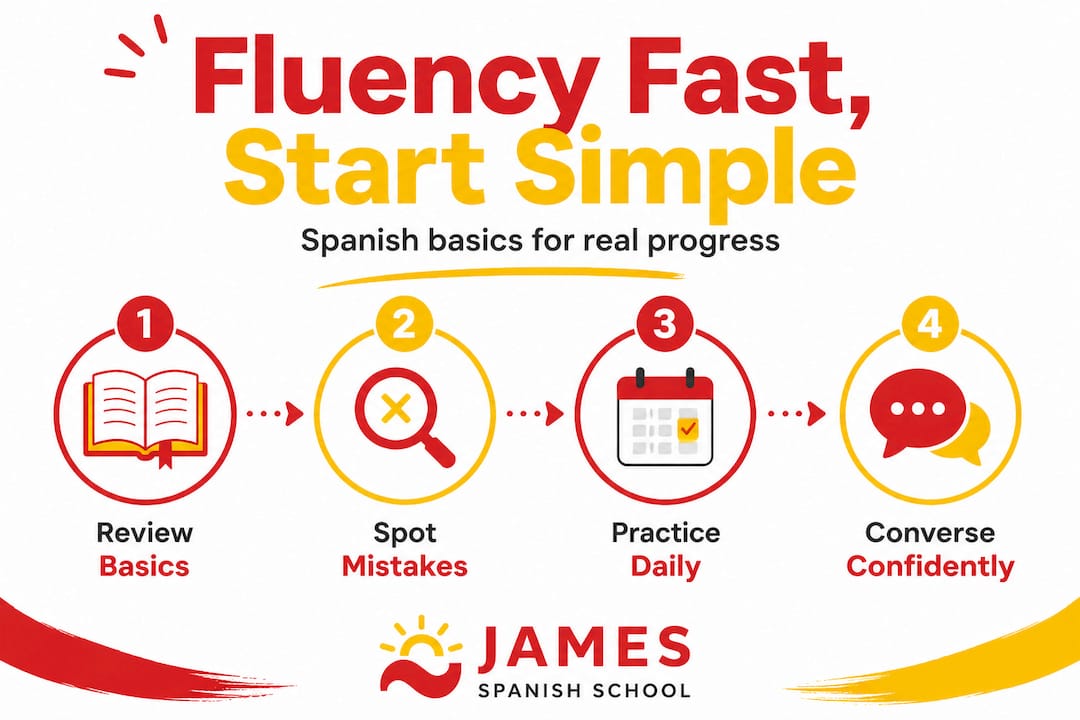
Knowing you should review your fundamentals is one thing. Actually doing it consistently is another. Here is a step-by-step approach that keeps review manageable and genuinely useful:
- Start easy, build up complexity. Begin with the grammar areas you feel most confident about. Confirm that your understanding is solid, then move to the areas that feel shakier. This builds momentum and prevents early discouragement.
- Use spaced repetition. Rather than marathon study sessions, return to core topics regularly at increasing intervals. A quick ten-minute review of verb conjugations three times a week beats a two-hour session once a month, every time.
- Test yourself with real sentences. Do not just read rules. Construct sentences about your actual daily life: what you did yesterday, what you need from the shops, how you would describe your home to a new neighbour. Real context makes grammar stick.
- Practise with spoken Spanish. Listening to native speech, even in short bursts, trains your ear to recognise the patterns you are reviewing. The practice lessons for beginners at James Spanish School are specifically designed to connect structured review with real listening practice.
- Review after difficult conversations. When a real-life exchange did not go as planned, note down what went wrong and look it up. This kind of post-conversation reflection is extraordinarily effective because the memory is fresh and the motivation is real.
The evidence consistently points in the same direction: the most reliable route to conversational fluency combines meaningful, real-world practice with periodic, targeted attention to the forms that underpin that conversation. As focus on form research confirms, this middle path is not a compromise. It is the smart approach that serious adult learners use to make lasting progress.
Pro Tip: Find a study partner or join a guided course where someone else provides accountability and structure. Reviewing fundamentals alone is possible, but having a framework, and a community around you, makes it dramatically easier to stay on track and to notice the progress you are making.
Why most learners underestimate the power of reviewing basics
Here is the uncomfortable truth that most language learning resources are reluctant to say plainly: the majority of adult learners who plateau do so not because Spanish is too difficult, but because they moved forward before they were genuinely ready. They treated fundamentals as a waiting room rather than a foundation, something to pass through on the way to the real learning. That mindset is the single biggest obstacle to conversational fluency.
At James Spanish School, we regularly see learners who have studied Spanish for years and still struggle to follow a fast conversation or construct a sentence under pressure. When we explore where the problem lies, it almost always comes back to the same core areas: verb forms that were memorised but never internalised, gender agreements that are applied inconsistently, connectors that simply never made it into active use. These are not advanced problems. They are foundational ones.
The turning point for these learners almost always comes when they agree to go back. Not all the way back, not to square one, but to the specific points where the cracks appeared. Within a short time of targeted, purposeful review, their conversation changes noticeably. Hesitation reduces. Sentences feel more natural. The anxiety that accompanies real-world exchanges starts to lift.
This is not a remedial process. It is a strategic one. Returning to basics is what experienced language teachers do when a learner is stuck, and it is what fluent adult learners do instinctively when they hit a rough patch. As the focus on form debate makes clear, even those who advocate primarily for immersion acknowledge the value of periodic attention to form. The most effective learners are not those who charge ahead regardless. They are the ones who pay attention to what is working and what is not, and adjust accordingly.
Reviewing your practice lessons for beginners or revisiting real conversation grammar tips is not an admission of failure. It is the mark of a learner who understands how progress actually works.
Ready to build your Spanish foundation for real-life conversation?
If this article has resonated with you, the most useful next step is to start reviewing in a structured, purposeful way. James Spanish School’s 100-lesson online course is built specifically for English-speaking adults who want to use Spanish in daily life, not to pass exams.

The course includes both sentence-building and ear-tuning lessons, so you develop the ability to construct sentences and follow native speakers when they respond. You can explore detailed grammar tips for real conversations, work through guided practice lessons at your own pace, and browse the full range of options in our starter course shop. Everything is available on demand, with no expiry date and no pressure. Just practical Spanish that works in real life.
Frequently asked questions
Is reviewing fundamentals only for beginners?
No, revisiting Spanish basics benefits learners at every level and is one of the most reliable ways to prevent the common mistakes that hold intermediate speakers back. The focus on form research confirms that targeted review is a smart strategy, not a remedial one.
How often should I review Spanish grammar?
Regular, short review sessions of ten to fifteen minutes, done daily or several times a week, are far more effective than occasional long sessions. This kind of consistent attention builds the automatic recall that real conversation demands.
What’s the best way to reinforce Spanish basics for conversation?
Combine focused grammar review with meaningful practice through speaking and listening exercises. Studying rules in isolation is far less effective than applying them immediately in real sentence construction and active listening, as the middle path approach consistently demonstrates.
Can I improve my Spanish conversational skills just by immersion?
Immersion is genuinely valuable, but combining it with periodic fundamentals review yields faster and more reliable progress. Without some structured attention to form, gaps in grammar and vocabulary tend to fossilise and become harder to correct over time.
Recommended
- Why repeat Spanish lessons boosts fluency: 5 key facts
- Practical Spanish tips for real-life fluency in Spain
- How to learn Spanish online: practical steps for fluency
- What is fast Spanish listening? Improve real-life Spanish: master fast listening skills.
- Developing a Habit in Learning a New Language – Linda Mandarin