

TL;DR:
- European Spanish primarily refers to Castilian, the standard spoken in Spain that features distinct pronunciation, grammar, and vocabulary differences from Latin American Spanish. To effectively learn it, focus on regional accents, practice the “th” sound, and use authentic listening materials from Spain, while embracing regional variations and real-world interactions. Starting with the Castilian standard builds confidence and provides a foundation that can adapt to Spain’s diverse linguistic landscape.
You’ve probably heard Spanish spoken on holiday in Barcelona, caught a few words of a Mexican soap opera, or tried a phrase from an app and been met with a puzzled look. The experience catches many English-speaking learners off guard: Spanish is not one single, uniform language. European Spanish, spoken across mainland Spain, carries its own sounds, grammar patterns, and vocabulary that set it apart from the Spanish of Latin America. Understanding those differences before you start learning can save months of confusion and point you straight towards the skills that actually matter in real life.
Table of Contents
- Defining European Spanish: What does it mean?
- Key differences: European Spanish vs Latin American Spanish
- Regional varieties within Spain: What to expect
- Best ways to learn European Spanish effectively
- Why mastering European Spanish isn’t just about textbooks
- Take the next step: Learn European Spanish confidently
- Frequently asked questions
Key Takeaways
| Point | Details |
|---|---|
| Spanish varies by region | European Spanish is not a single form but a collection of regional accents and traditions, mainly standardised around Castilian. |
| Pronunciation and grammar differ | Key distinctions like the ‘th’ sound and ‘vosotros’ use set European Spanish apart from Latin American variants. |
| Learning context matters | Exposure to real spoken Spanish from Spain, especially through modern resources, is crucial for fluency. |
| Master core differences | Focus on pronunciation, everyday vocabulary, and plural forms to communicate effectively in Spain. |
Defining European Spanish: What does it mean?
With the stage set around why confusion arises, let’s clear up what “European Spanish” really means.
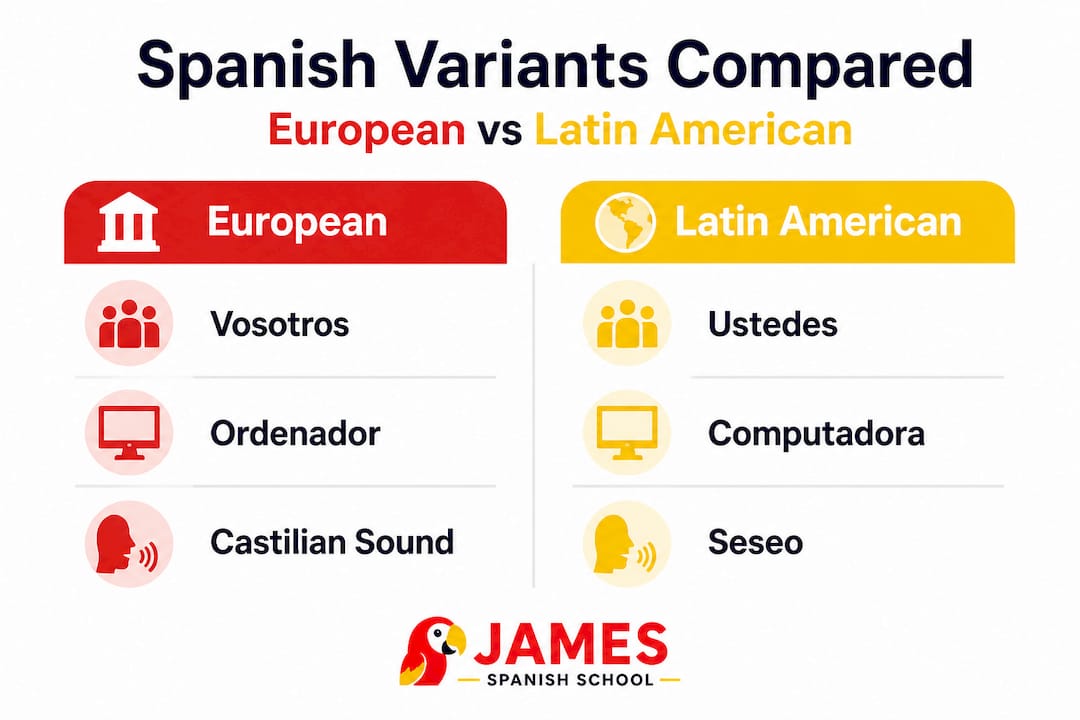
The term is most commonly used to refer to Castilian (Castellano), the variety associated with central and northern Spain. It is the Spanish you hear on national news broadcasts, in government offices, and in most formal written communication across the country. When language schools, dictionaries, and textbooks market a course as “European Spanish,” they are generally pointing learners towards this Castilian standard.
However, the picture is more layered than a simple label suggests. Spain is home to a remarkable range of regional languages and dialects, and the linguistic landscape shifts noticeably as you travel from north to south or east to west. The following features are broadly associated with European Spanish:
- The distinctive “th” sound (called distinción) applied to the letters “c” and “z”
- Use of vosotros (informal plural “you”) alongside the formal ustedes
- Specific vocabulary choices, such as ordenador for computer rather than computadora
- A generally faster, more clipped speech rhythm compared with many Latin American varieties
- Leísmo: using the pronoun le in certain contexts where Latin American speakers use lo
It is worth noting, as European Spanish research confirms, that “European Spanish” is often used as a stand-in for Spain-wide norms, when in fact Spain contains regional varieties with different pronunciation and vocabulary. What you learn may sound most like a specific sub-region rather than “all of Spain.”
“If you’re learning European Spanish to live or travel in Spain, aim for the Castilian standard first. It gives you a neutral, widely understood foundation, and you can tune your ear to regional accents from there.”
The practical takeaway is clear: start with the Castilian standard, build your confidence with practical spoken Spanish, and trust that regional variety will become manageable with exposure and practice.
Key differences: European Spanish vs Latin American Spanish
Now that we understand what “European Spanish” refers to, let’s see how it directly compares to other variants.
The gap between European and Latin American Spanish is real and learner-noticeable. It is not simply a matter of accent, like the difference between a Scottish and an Australian English speaker. Some of the differences affect grammar, meaning that the forms you practise will look and sound genuinely different depending on which variety you choose.
Pronunciation
One of the first things English-speaking learners notice is the famous “th” sound found in central and northern Spain. Distinción means the letters “c” (before “e” or “i”) and “z” are pronounced like the English “th” in think. So gracias becomes “gra-thias” and cerveza becomes “ther-ve-tha.” Latin America uses seseo, pronouncing both letters as a simple “s.” Neither is wrong; they are simply different systems, and knowing which one you are aiming for from day one prevents real confusion.
Grammar
Spain uses vosotros for informal plural “you,” while Latin America uses ustedes for both formal and informal contexts. This is not a minor footnote. In Spain, you will hear vosotros constantly in conversation, in restaurants, between friends, and in any casual group setting. Latin American courses often skip vosotros entirely, leaving learners in Spain genuinely stuck when locals use it. Explore European Spanish grammar tips to get a solid grounding in these forms early.
Vocabulary
Some everyday words are simply different. Here is a quick comparison:
| Concept | European Spanish | Latin American Spanish |
|---|---|---|
| Computer | Ordenador | Computadora |
| Car | Coche | Carro / Auto |
| Mobile phone | Móvil | Celular |
| Flat / apartment | Piso | Departamento / Apartamento |
| Juice | Zumo | Jugo |
| Swimming pool | Piscina | Alberca (Mexico) / Pileta (Argentina) |
These vocabulary gaps can genuinely trip you up at the supermarket or when chatting with neighbours, so knowing the Spanish variants matters for day-to-day life. Understanding why Spanish is accessible for English speakers makes it easier to focus on these specific differences rather than feeling overwhelmed by the language as a whole.
A summary of the key contrasts
- Pronunciation: Distinción (“th” for c/z) in central/northern Spain vs seseo (“s” sound) in Latin America
- Pronouns: Vosotros for informal plural “you” in Spain vs ustedes everywhere in Latin America
- Vocabulary: Many everyday words differ, particularly for technology, transport, and household items
- Verb tenses: Spain tends to use the present perfect (he comido) more readily where Latin America often defaults to the simple past (comí)
- Speed and rhythm: European Spanish, particularly in fast conversational settings, can feel rapid and clipped to new learners
Pro Tip: If you are planning to live in Spain or spend extended time there, commit to the European Spanish variety from the start. Switching mid-learning is possible but slow. Clear intent from day one builds more solid instincts.
Regional varieties within Spain: What to expect
Having seen the main differences, it’s time to zoom in on Spain itself, because regional variety is greater than you might expect.

Spain is a country of striking geographical and cultural contrasts, and its language reflects that diversity. Even once you have focused on European Spanish as your target, you will encounter a broad range of accents and local speech habits as you travel across the country.
The main regional varieties
| Region | Key features |
|---|---|
| Castilian (Madrid, north and centre) | Clearest distinción, considered the standard; widely taught |
| Andalusian (south: Seville, Málaga, Granada) | Seseo or ceceo, faster speech, dropped consonants |
| Canarian (Canary Islands) | Similar to Latin American Spanish; seseo used |
| Northern regional varieties (Basque Country, Navarre) | Mild Castilian accent; some Basque influence on phrasing |
| Catalan-influenced Spanish (Barcelona, Valencia) | Distinct intonation patterns; some Catalan vocabulary crossover |
As regional Spanish data confirms, what you learn as “European Spanish” may sound most like a specific sub-region rather than a unified national standard.
The important point for learners is this: most structured courses default to the Madrid/Castilian neutral accent, which gives you an excellent foundation. However, if you plan to move to Andalusia or spend time on the coast, you will benefit enormously from real spoken Spanish in Spain that reflects the accents you will actually encounter.
Here is what to keep in mind about regional variety:
- Andalusian speakers often drop the “s” at the end of words or syllables, making ¿Cómo estás? sound closer to ¿Cómo ehtá?
- In parts of the south, ceceo is used, where “s” sounds are replaced with a “th” sound, the reverse of standard distinción
- Canarian Spanish shares several features with Caribbean Spanish, which can catch learners off guard if they expected the Madrid standard
- Barcelona residents often have a softer, more musical intonation due to Catalan influence
Exploring regional Spanish resources can help you tune your ear to these variations so that real conversations in different parts of Spain do not feel like starting from scratch.
Best ways to learn European Spanish effectively
To help you put this knowledge into action, let’s explore the best strategies for learning European Spanish.
Knowing the theory is one thing. Building the kind of fluency that lets you chat with your local shopkeeper, understand your builder’s instructions, or follow a conversation at the bar requires consistent, targeted practice. Here are the strategies that genuinely move the needle.
- Immerse yourself in Spain-specific audio. The distinción sound with “c” and “z” pronounced as “th” needs to become automatic, not effortful. Spanish radio, podcasts from Spain, and audio Spanish lessons build the sound recognition that no grammar chart can replicate. Aim for at least 20 minutes of listening per day.
- Practise vosotros from day one. Many popular apps and Latin American courses skip vosotros entirely. Do not let this form feel foreign when you arrive in Spain. Work through the conjugations regularly, in both the present tense and the imperative (¡Venid aquí!), until they feel natural.
- Use context-rich materials. Spanish films, TV series, and real dialogue recordings expose you to how sentences actually work in conversation rather than in isolation. Learning Spanish in context is far more effective than memorising long vocabulary lists because your brain stores words and phrases alongside the situations where they occur.
- Address listening challenges head on. Many learners feel confident reading Spanish but hit a wall when native speakers talk at full speed. Overcoming Spanish listening challenges takes deliberate effort, including focused listening exercises that train your ear to catch fast-spoken speech rather than waiting for a slow, classroom pace.
- Follow a structured online pathway. Random learning slows progress. Structured online Spanish learning steps that move systematically from sentence-building to real conversation give you clear milestones and prevent the frustrating “plateau” that many adult learners hit after the basics.
Pro Tip: Watch short Spanish TV clips without subtitles first, then check your understanding with subtitles on. This trains your ear more effectively than always relying on the written support to follow along.
Why mastering European Spanish isn’t just about textbooks
Having shared the main tips, here is what most guides overlook about real European Spanish learning.
There is a pattern that appears in learner after learner: someone spends six months studying grammar tables diligently, learns their conjugations, memorises vocabulary lists, and then arrives in Spain and understands almost nothing of what people say to them. The grammar knowledge is there. The real-world fluency is not. Why does this happen?
The core issue is that fluency is not the same as rule-knowledge. A Spanish speaker does not consciously select their verb endings any more than you consciously choose your English grammar mid-sentence. Fluency is pattern recognition and automatic recall, built through repeated, meaningful exposure and through making mistakes without embarrassment. The textbook lays the groundwork, but it cannot do the real work for you.
European Spanish presents a specific version of this challenge, because as European Spanish research points out, even Spain itself contains regional varieties that differ from the textbook standard. No course can prepare you for every regional accent. What a good course can do is build the structural confidence and ear-tuning habits that allow you to adapt.
The learners who progress fastest are not the ones who never make errors. They are the ones who interact with real Spanish speakers regularly, laugh at misunderstandings, and treat every conversation as useful data. Accepting regional quirks and unexpected accent shifts accelerates confidence in a way that no grammar revision session can match. Building real skills for everyday fluency means embracing the living, breathing, sometimes unpredictable nature of the language as it is actually spoken.
This is not a reason to skip the structured learning. It is a reason to pair structured learning with genuine interaction and real-world listening from the very beginning, not as an afterthought once you feel “ready.”
Take the next step: Learn European Spanish confidently
With a clear sense of what European Spanish involves, here is how you can jump-start your learning.
James Spanish School is built specifically for English-speaking adults who want to speak Spanish in real life in Spain, not pass an academic exam. The 100-lesson course combines sentence-building with dedicated ear-tuning, so you develop both sides of fluency together. James Bretherton, a dual-native speaker with 40 years of life in Spain, strips away the grammar jargon and explains everything in plain English, using a method called Radical Simplification.
Start by grounding yourself in European Spanish grammar tips that target the forms you will actually use with neighbours, tradesmen, and local officials. Then build your confidence with practical Spanish fluency tips designed around the real situations you will face in Spain. When you are ready to go further, explore the full range of online Spanish lessons available on demand, day or night, at whatever pace suits you.
Frequently asked questions
Is European Spanish harder to learn than Latin American Spanish?
European Spanish involves distinct pronunciation and grammar forms, including distinción where “c” and “z” sound like “th”, but both variants are equally accessible for motivated learners and the choice depends entirely on where and how you plan to use the language.
Can I use Latin American Spanish in Spain?
Yes, you will be understood, but locals will notice pronunciation and vocabulary differences, particularly in casual speech, and certain grammar forms such as vosotros will feel absent from your conversation in ways that stand out to native Spanish speakers.
What regions are covered by European Spanish?
European Spanish generally refers to the language standard used in mainland Spain, especially central and northern regions, though as Spain’s regional varieties confirm, the standard may not reflect the full range of accents and dialects found across the country.
Should I learn vosotros for travel in Spain?
Absolutely yes. Spain uses vosotros for informal plural “you” in daily conversation across most regions, so learning and recognising this form is essential rather than optional if you want to follow and participate in natural speech.
Recommended
- Practical spoken Spanish: real skills for everyday fluency
- Real-life Spanish conversation: what it means and how to use it
- Essential European Spanish grammar tips for real conversations
- Practical Spanish tips for real-life fluency in Spain
- Top Factors to Consider When Learning a Foreign Language – Linda Mandarin