

What is mobile Spanish learning
TL;DR:
- Mobile Spanish learning quickly develops conversational skills, with significant progress achievable in around 15 hours.
- Pairing apps with real-life practice and structured guidance enhances fluency, bridging digital practice with community interactions.
Fifteen hours. That is all it takes for a complete beginner to match the Spanish conversational output of a first-semester university student, according to recent app-based studies. For English-speaking adults living in Spain, that figure is both startling and deeply encouraging. Mobile-Assisted Language Learning (MALL) uses smartphone apps to teach European Spanish through immersive, practical methods built for everyday conversations. This article cuts through the noise, examines what the research actually shows, compares the main approaches, and gives you concrete strategies to make mobile Spanish learning work in real life, not just on a screen.
Table of Contents
- Understanding mobile Spanish learning: beyond flashcards
- How mobile apps drive measurable Spanish progress
- Comparing learning app styles: immersion, gamification, and hybrid models
- Expert tips: making mobile Spanish learning stick
- A fresh perspective: mobile learning is the start, not the finish line
- Your next steps to Spanish fluency
- Frequently asked questions
Key Takeaways
| Point | Details |
|---|---|
| Digital immersion works | Mobile Spanish learning offers immersive techniques ideal for rapid, practical use in Spain. |
| Apps aren’t enough alone | Research shows combining digital learning with in-person conversation is key to lasting fluency. |
| Customise your approach | Match learning app style and support to your skill level, goals, and digital comfort. |
| Measurable results possible | With focused practice, adults can reach conversational milestones faster than with traditional classroom methods alone. |
Understanding mobile Spanish learning: beyond flashcards
Mobile Spanish learning is not simply a digital version of an old-fashioned phrasebook. It represents a genuine shift in how adults acquire language, and understanding that shift is the first step towards using it well.
“Mobile-Assisted Language Learning (MALL) focuses on immersive, conversational Spanish learning via smartphones, placing real-world communication at the centre of the experience rather than rote memorisation.” ScienceDirect
Traditional classroom methods tend to follow a predictable pattern: grammar rules first, then vocabulary lists, then slow, controlled speaking practice. Mobile learning flips that sequence. The best apps drop you into listening and responding straight away, mirroring how children absorb their first language through repeated, contextual exposure rather than conjugation tables.
For adults living in Spain, this distinction matters enormously. Your goals are not academic. You want to handle the pharmacy, negotiate with the plumber, chat with your neighbour over the fence, and follow what the local council notice actually says. That kind of real-life Spanish fluency demands a different kind of practice than passing a written exam.
What sets mobile learning apart from older methods:
- On-demand access: lessons at 6 a.m., during a lunch break, or at midnight, with no commute to a class
- Audio-rich content: listening and speaking features that train your ear for natural, flowing speech
- Personalised pacing: repeat a lesson ten times without embarrassment or time pressure
- Contextual vocabulary: words presented in realistic scenarios rather than isolated lists
- Micro-learning sessions: five to fifteen minutes of focused practice that fits around a busy day
Each of these features addresses a specific frustration that adult learners describe repeatedly. Mobile platforms do not eliminate the hard work of learning Spanish, but they remove many of the practical barriers that cause adults to give up.
How mobile apps drive measurable Spanish progress
It is one thing to say mobile learning is effective. It is another to show you exactly what the numbers look like.
| App / study | Study institution | Time invested | Key outcome |
|---|---|---|---|
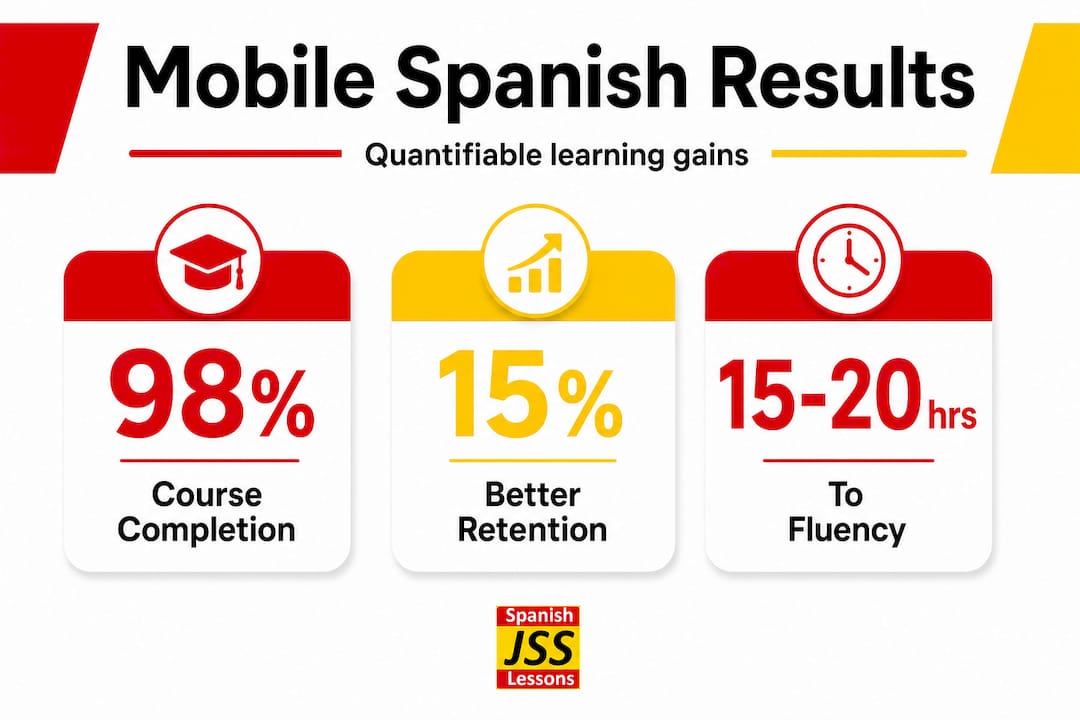
| Babbel | NYU, 2023 | 15 hours | 98% grammar precision in target areas |
| Busuu | Independent research | 15 hours | Equivalent to one full university semester |
| General MALL apps | Multiple studies | Ongoing | 15% higher vocab retention vs traditional methods |
These figures are not marketing claims. The Babbel and Busuu data show that focused, structured app use over roughly 15 hours produces grammar precision of 98% and speaking gains 20% faster than traditional beginner instruction. For a retired professional who has been telling themselves they are “too old to learn languages,” these numbers offer genuine reassurance.
15%
That is how much higher vocabulary retention is for adult learners using MALL apps compared with those following traditional classroom instruction alone.
The reasons behind that retention boost are not mysterious. Apps typically use spaced repetition systems (SRS), a method that presents words at precisely the right intervals to move them from short-term into long-term memory. Think of it like watering a plant on a schedule rather than flooding it once and hoping for the best. The timing is everything.
Where apps perform particularly well:
- Building a foundational vocabulary of 500 to 1,000 high-frequency words
- Drilling sentence patterns until they feel automatic
- Training correct pronunciation through audio feedback
- Keeping learners motivated through streaks and progress tracking
Where apps show clear limits:
- Handling the machine-gun speed of a native speaker mid-flow
- Understanding regional accents and colloquial expressions
- Responding spontaneously in an unscripted conversation
- Grasping the cultural context behind what is being said
Pro Tip: Aim for 15 focused minutes per day over a sustained period rather than sporadic hour-long sessions. Consistency beats intensity when it comes to vocabulary retention.
Building conversational Spanish confidence requires understanding both what apps do brilliantly and where they need reinforcement.
Comparing learning app styles: immersion, gamification, and hybrid models
Not all mobile Spanish apps work the same way. Choosing the right style for your situation can mean the difference between steady progress and frustrating stagnation.
| App style | Best for | Strengths | Weaknesses |
|---|---|---|---|
| Full immersion (Spanish-only from day 1) | Motivated, intermediate learners | Rapid ear adjustment, authentic exposure | Can overwhelm true beginners |
| Gamified (points, streaks, levels) | Habit-building beginners | Motivation, consistency, low anxiety | Shallow conversational depth at higher levels |
| Hybrid (structured lessons plus human elements) | Adults wanting real fluency | Depth, culture, speaking confidence | Requires more time investment |
Full immersion apps, such as Palteca, plunge you into Spanish from the very first session with no English explanations. For a motivated learner who already has some exposure to the language, this approach accelerates ear-tuning dramatically. You stop waiting for a translation and start processing meaning directly in Spanish. However, for a complete beginner who struggles to distinguish where one word ends and the next begins, total immersion can feel like being thrown into deep water before learning to swim.
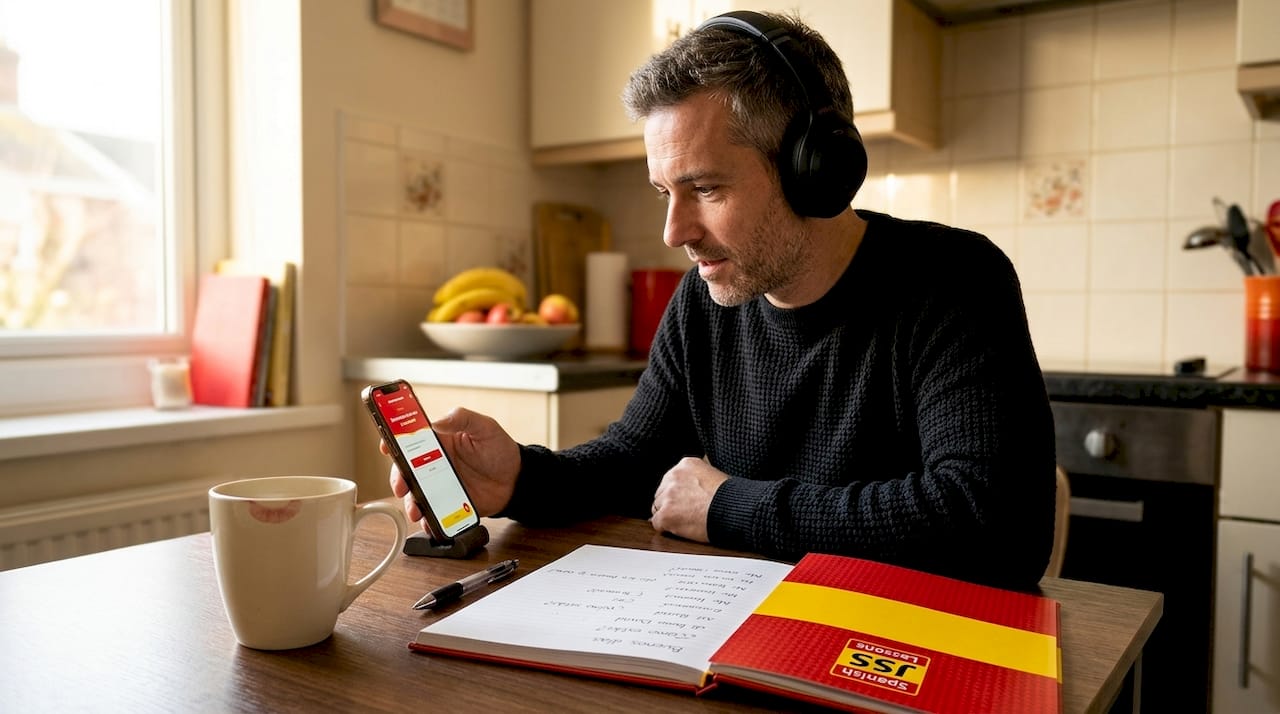
Gamified apps take the opposite approach. They wrap learning in rewards, encouraging daily habits through streaks, badges, and leaderboards. The motivational architecture is clever and genuinely effective at keeping beginners engaged during the fragile early weeks. The problem is that gamification tends to prioritise the experience of learning over the depth of it. You can maintain a 300-day streak and still freeze when the checkout assistant at the supermarket speaks at normal conversational speed.
Hybrid models combine structured lessons with real human interaction. These are, for most adults in Spain, the most practical route to genuine fluency. They give you the flexibility of app-based practice while ensuring that the gaps apps cannot fill are addressed by a real person or a professionally designed speaking programme.
When deciding which style suits you, consider:
- Your starting level: complete beginners often need some English explanation before full immersion becomes useful
- Your daily schedule: gamified apps work well for people who can only spare five minutes; hybrid models reward those with fifteen to thirty minutes
- Your specific goals: chatting socially differs from navigating a medical appointment or a legal document
- Your anxiety level: some adults find total immersion liberating; others find it paralysing
The honest answer is that most adults in Spain benefit from a blend. Start with a structured approach that explains Spanish through plain English, build vocabulary and sentence patterns, then add immersion experiences as your confidence grows. Finding the right way to practise Spanish conversation is what bridges the gap between digital learning and living the language.
Expert tips: making mobile Spanish learning stick
Knowing which apps to use is only half the battle. The bigger challenge is building the habits and supporting conditions that turn mobile practice into lasting fluency.
- Pair your app with a structured course. Research is unambiguous on this point: hybrid approaches combining apps with tutors achieve 68% conversational fluency compared to just 3% for apps used in isolation. That gap is enormous. It means app-only learners are almost certain to plateau well before they reach genuine conversational ability.
- Use spaced repetition deliberately. SRS works best when you engage actively rather than passively. When a word appears for review, try to recall it before the answer appears. That moment of effortful retrieval is where the memory gets reinforced most powerfully.
- Listen to real Spanish every day. Apps provide controlled audio. Real fluency requires exposure to uncontrolled speech: radio programmes, television, market conversations, your neighbour’s phone call through the garden wall. Even ten minutes of unscripted listening daily accelerates your ear-tuning far beyond what any app can replicate alone.
- Balance independence with guidance. Expert analysis suggests that optimal adult learning involves roughly 60 to 70% autonomous practice balanced with structured guidance. Too much hand-holding creates dependency. Too much independence, without feedback, embeds errors. The sweet spot is somewhere in the middle, where you are confident enough to explore but supported enough to correct mistakes before they solidify.
- Address digital literacy honestly. Not every adult finds apps intuitive. If navigating menus, managing notifications, or troubleshooting audio problems adds friction to your learning, that friction will eventually win. Choose an app with a clean, simple interface, and do not be embarrassed to ask for help getting set up.
Pro Tip: Create a step-by-step Spanish workflow for each day: five minutes of SRS vocabulary review, ten minutes of structured lesson content, and five minutes of real-audio listening. That twenty-minute daily habit, maintained consistently, will outperform most hour-long weekly sessions.
One further element that many adults overlook is the value of going back over material. Repeating a lesson is not a sign of failure. It is how memory consolidates. The best learning systems, digital or otherwise, are built to encourage that kind of reinforcement of Spanish skills without making you feel as though you are moving backwards.
A fresh perspective: mobile learning is the start, not the finish line
Here is something most language app marketing will never tell you. Mobile learning is an extraordinary engine for building momentum, but momentum is not the same as fluency. The adults who make the most impressive progress are not the ones who found the best app. They are the ones who used an app to lower their anxiety enough to start having real conversations.
There is a pattern that repeats itself constantly among English speakers in Spain. Someone downloads an app, works through it conscientiously, builds a solid foundation of vocabulary and grammar patterns, then hits a wall the moment a native speaker replies at full speed with an unfamiliar turn of phrase. The app prepared them for a controlled environment. Life in Spain is anything but controlled.
The solution is not to dismiss mobile learning. It is to see it clearly for what it is: a remarkable springboard. The flexibility of audio Spanish practice on a phone or tablet means you can build real foundations at your own pace, in your own time, without the anxiety of a classroom setting. That matters enormously for adult learners who have spent decades feeling embarrassed about not speaking Spanish despite living here.
What mobile learning cannot do is replicate the complexity of a real human exchange, the cultural subtext of a comment about the weather, or the warmth of a conversation that wanders unexpectedly into territory no app predicted. Those experiences require you to step away from the screen and into your community.
The wisest approach is this: use mobile learning to build confidence, then spend that confidence in real interactions. Let the app be the rehearsal room. Let Spain be the stage.
Your next steps to Spanish fluency
If mobile learning has opened the door, the right structured support will take you all the way through it. James Spanish School is built specifically for English-speaking adults in Spain who want practical, everyday fluency, not exam results. James Bretherton’s method of Radical Simplification removes the intimidating grammar terminology and replaces it with plain English explanations that actually make sense to adult learners.
The Spanish vocabulary builder powered by the WordAmigo system uses AI-driven spaced repetition to embed words and pronunciation permanently, addressing the exact frustrations that mobile apps alone cannot solve. For those ready to go further, the spoken Spanish practice modules are available on demand, 24/7, with no expiry date and no pressure. Everything is designed around real life in Spain: neighbours, tradesmen, health workers, and local bureaucracy.
Frequently asked questions
How quickly can I become conversationally fluent using mobile Spanish apps?
With consistent daily use, adults can reach basic conversational fluency within 15 to 20 hours using leading apps, though Babbel and Busuu studies confirm that pairing apps with real speaking opportunities accelerates and deepens those gains significantly.
Do apps alone make you fluent in Spanish for life in Spain?
Apps build an impressive foundation, but research shows that hybrid approaches combining digital tools with human guidance achieve 68% conversational fluency compared to just 3% for app-only learners.
What features should I look for in a Spanish learning app as an adult in Spain?
Prioritise apps with practical conversation modules, spaced repetition, and real-life scenarios built for European Spanish via MALL, rather than generic language tools designed for travellers or classroom students.
How can I make mobile Spanish learning more effective for cultural engagement?
Pair your daily app practice with face-to-face conversations, local media such as Spanish radio or television, and culturally grounded learning materials that explain the context behind what people say, not just the words themselves.
Is mobile learning suitable if I struggle with digital apps?
A basic level of digital comfort helps, but MALL engagement does require some digital literacy, and blending a user-friendly app with a well-structured course or human support makes mobile learning accessible even for those who are less confident with technology.