

TL;DR:
- Learning polite phrases and market-specific vocabulary helps travelers communicate confidently in Spanish shops. Training your ear to understand fast, natural speech is essential for real-world conversations.
Spanish vocabulary for shopping is the set of words and phrases English-speaking travellers and expats need to communicate confidently in Spanish markets and shops. Without it, even a simple trip to the market becomes a guessing game. With the right phrases, you get better service, avoid misunderstandings, and start to feel genuinely at home in Spain. This guide covers everything from polite openers to market bargaining, checkout questions, and handling returns, so you can walk into any Spanish shop and hold your own.
1. Core polite phrases for asking for help in Spanish shops
Politeness is the single most effective tool in any Spanish shop. Polite “usted” forms such as “¿Me puede ayudar?” are recommended by language guides for travellers and expats to improve customer service interactions. Using “usted” instead of “tú” signals respect, and Spanish shop staff respond warmly to it.
The phrases below form your foundation. Learn these before anything else:
- ¿Me puede ayudar? (“Can you help me?”) — your go-to opener in any shop
- Por favor (“Please”) — attach it to almost any request
- Muchas gracias (“Thank you very much”) — always close an exchange with this
- Disculpe (“Excuse me”) — use it to get a shop assistant’s attention politely
- ¿Tiene…? (“Do you have…?”) — the simplest way to ask for a product
- No entiendo (“I don’t understand”) — honest and always appreciated
- ¿Puede repetir más despacio? (“Can you repeat more slowly?”) — vital when the reply comes at machine-gun speed
Courtesy phrases such as “por favor,” “gracias,” and “disculpe” make shopping exchanges smoother and more pleasant. That is not just politeness for its own sake. It genuinely changes how staff treat you, and in smaller local shops, it builds the kind of rapport that gets you the best produce or the last item in stock.
Pro Tip: Mastering polite defaults like “por favor” and the “usted” form is more effective than memorising long word lists. Two or three well-delivered phrases beat twenty hesitant ones every time.
2. Sizes, colours, and trying on clothes
Clothing shops require a specific set of phrases. Knowing how to ask about sizes and colours, and how to request the fitting room, saves you from a lot of awkward miming.
Key phrases for clothing:
- ¿Tiene otra talla? (“Do you have another size?”)
- ¿Lo tienen en otro color? (“Do you have it in another colour?”)
- ¿Dónde está el probador? (“Where is the fitting room?”)
- ¿Puedo probármelo? (“Can I try it on?”)
- Me queda bien (“It fits me well”)
- Me queda pequeño / grande (“It’s too small / too big for me”)
- ¿Tiene una talla más grande / más pequeña? (“Do you have a size bigger / smaller?”)
The key size words to remember are: talla (size), pequeño (small), mediano (medium), and grande (large). Spanish clothing sizes follow European sizing, so a UK size 12 is typically a Spanish size 40 in women’s clothing. Knowing this before you go in saves confusion at the till.
Colour vocabulary is straightforward but worth drilling. Rojo (red), azul (blue), verde (green), negro (black), blanco (white), and gris (grey) cover most situations. If you want a specific shade, point and say “¿Lo tiene en este color?” (“Do you have it in this colour?”) while gesturing at a reference item.
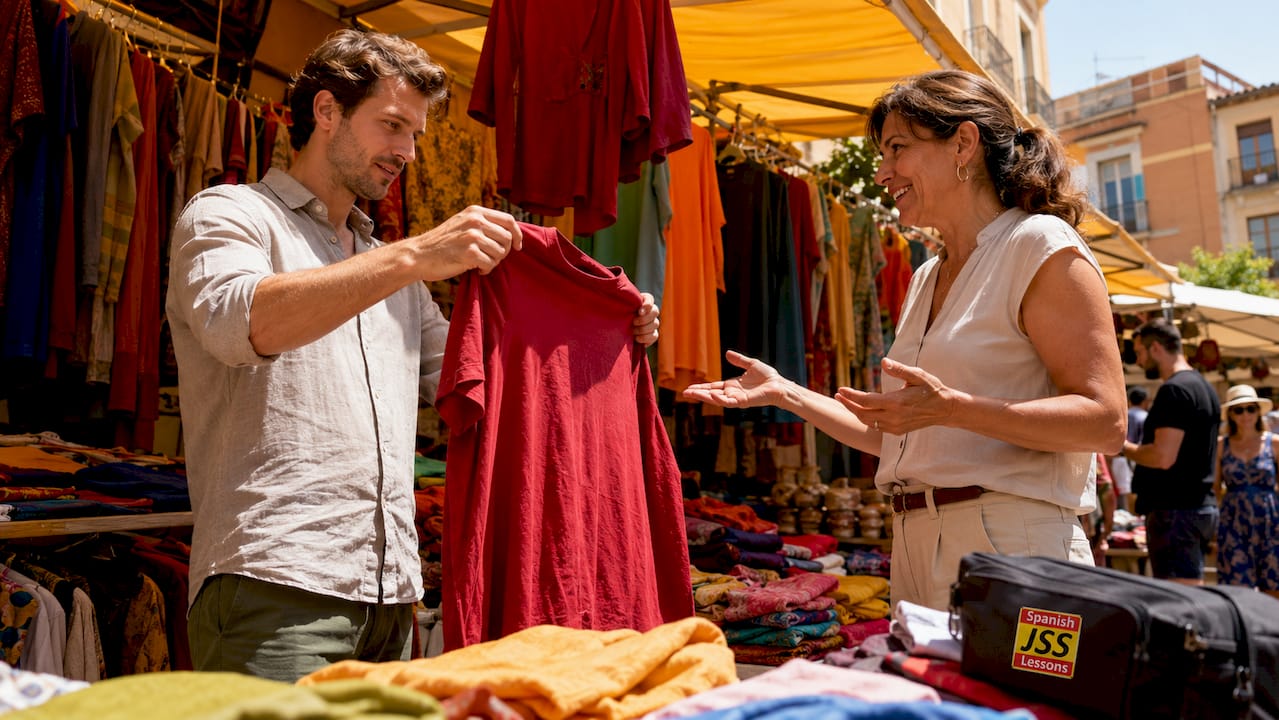
Pro Tip: In smaller boutiques, staff often bring items directly to you once you ask. A simple “¿Tiene algo similar en azul?” (“Do you have something similar in blue?”) can open up options that are not on display.
3. How to ask for prices and manage payment in Spanish
Price and payment questions are the most frequently used shopping phrases in Spanish. Key checkout phrases such as “¿Cuánto cuesta?,” “¿Aceptan tarjeta?,” and “¿Tiene descuento?” appear in every practical guide to shopping interactions. Getting these right means the transaction flows without awkwardness.
- ¿Cuánto cuesta? (“How much does it cost?”) — standard in any fixed-price shop
- ¿Cuánto es en total? (“How much is it in total?”) — use at the checkout
- ¿Aceptan tarjeta? (“Do you accept card?”) — always worth asking in smaller shops
- ¿Puedo pagar con tarjeta? (“Can I pay by card?”) — a slightly more polite variant
- ¿Tiene cambio? (“Do you have change?”) — useful when paying with a large note
- ¿Tiene descuento? (“Do you have a discount?”) — direct and perfectly acceptable
- ¿Hay alguna oferta? (“Is there any offer on?”) — good for spotting sales
- La cuenta, por favor (“The bill, please”) — used in shops as well as restaurants
Sale vocabulary is worth knowing separately. Descuento means discount, oferta means a special offer, and rebaja refers specifically to sale-season reductions. Spanish shops run formal sales periods, called las rebajas, typically in january and july. Spotting a “Rebajas” sign in a window tells you prices have dropped significantly.
Context-dependent vocabulary matters here. “¿Cuánto cuesta?” works perfectly in a fixed-price shop, but sounds slightly odd at a market stall where prices fluctuate. The market equivalent comes in the next section.
Pro Tip: Many smaller Spanish shops still prefer cash. Always carry some euros, and keep small notes handy. Asking “¿Aceptan tarjeta?” before you reach the till avoids an embarrassing scramble.
4. Market phrases for fresh produce and weighted items
Local Spanish markets operate on different rules from high-street shops. Shopping vocabulary is highly context-dependent, and using the right phrases for markets versus fixed-price stores makes a real difference to how interactions go.
The key phrase for price at a market is “¿A cuánto está el kilo de…?” (“How much is a kilo of…?”). This is the standard phrase for produce pricing by weight, and it signals to the stallholder that you know how markets work. Compare it with “¿Cuánto cuesta?” which implies a fixed, labelled price.
For ordering quantities, the verb “Póngame” is the most natural and polite way to request items by weight. It is preferred over “Deme” because it sounds less abrupt. Use it like this:
- Póngame un kilo de manzanas (“Give me a kilo of apples”)
- Póngame medio kilo de queso (“Give me half a kilo of cheese”)
- Póngame doscientos gramos de jamón (“Give me 200 grams of ham”)
Key market nouns to know:
- Manzana (apple), naranja (orange), tomate (tomato)
- Queso (cheese), jamón (ham), pollo (chicken)
- Panadería (bakery), carnicería (butcher’s), frutería (fruit stall)
- Mercado (market), puesto (stall)
The expression “hacer la compra” is the standard Spanish phrase for doing the weekly grocery shop. Using it naturally in conversation signals cultural fluency and builds local rapport. Saying “Vengo a hacer la compra” (“I’ve come to do the shopping”) to a regular stallholder marks you as someone who belongs, not just a passing tourist.
| Market phrase | Meaning | When to use |
|---|---|---|
| ¿A cuánto está el kilo? | How much per kilo? | Fresh produce with variable prices |
| Póngame un kilo de… | Give me a kilo of… | Ordering by weight |
| ¿Está fresco? | Is it fresh? | Checking quality of fish or meat |
| ¿Qué me recomienda? | What do you recommend? | Asking for the stallholder’s best pick |
5. Handling returns, exchanges, and problems politely
Returns and exchanges require calm, clear language. Spanish shop staff are generally helpful, but the process goes more smoothly when you use the right phrases from the start.
Core phrases for returns and exchanges:
- Quisiera devolver esto (“I would like to return this”) — polite and direct
- Quiero cambiar esto (“I want to exchange this”) — use when swapping for a different size or colour
- ¿Cuál es la política de devoluciones? (“What is the returns policy?”) — ask this before you hand anything over
- Tengo el recibo (“I have the receipt”) — always lead with this; it speeds everything up
- Está defectuoso (“It is faulty”) — use when describing a product problem
- No funciona (“It doesn’t work”) — straightforward for electrical or mechanical items
- Me gustaría un reembolso (“I would like a refund”) — clear and polite
The tone matters as much as the words. Spanish customer service culture values calm, respectful dialogue. Raising your voice or showing frustration rarely helps and often slows things down. A quiet “Disculpe, tengo un problema con esto” (“Excuse me, I have a problem with this”) opens the conversation far better than a blunt complaint.
Keep your receipt. Spanish shops are not legally required to accept returns without one, and many smaller shops will simply decline. The phrase “¿Puedo cambiar esto si no me queda bien?” (“Can I exchange this if it doesn’t fit?”) is worth asking at the point of purchase, before you leave the shop.
6. Tuning your ear to fast spoken Spanish in shops
The hardest part of shopping in Spanish is not speaking. It is understanding the reply. Effective vocabulary learning focuses on listening to rapid, combined native phrases rather than textbook isolated words. Shop assistants in Spain speak quickly, run words together, and use regional expressions that no phrasebook covers.
The phrase “¿Algo más?” (“Anything else?”) is one of the most common things you will hear at a market or bakery counter. It comes fast and sounds like one word. Knowing it in advance means you can answer “No, gracias, es todo” (“No, thank you, that’s everything”) without freezing. Similarly, “¿Tiene la tarjeta de fidelidad?” (“Do you have a loyalty card?”) is a standard checkout question in supermarkets. You will hear it every single time.
Tuning your ear to quick, combined spoken phrases used by native shop assistants is a skill that develops separately from vocabulary. You can know every word on this page and still struggle when a cashier fires three sentences at you in four seconds. The solution is deliberate listening practice, not more word lists. James Spanish School’s 100-lesson course dedicates a full strand to ear-tuning, training you to follow fast, natural Spanish as it actually sounds in shops, markets, and everyday life. The fast Spanish comprehension strategies in that course are built specifically for this problem.
Key takeaways
Mastering Spanish shopping vocabulary means learning polite phrases first, context-specific terms second, and training your ear to follow fast native speech third.
| Point | Details |
|---|---|
| Politeness opens doors | Use “usted” forms and “por favor” in every interaction to get better service. |
| Context changes the phrase | “¿Cuánto cuesta?” suits fixed-price shops; “¿A cuánto está el kilo?” suits markets. |
| “Póngame” sounds local | Use “Póngame un kilo de…” at market stalls to sound natural and polite. |
| Keep your receipt | Returns without a receipt are not guaranteed in Spanish shops; always ask the policy first. |
| Ear-tuning is non-negotiable | Fast spoken replies are the real challenge; deliberate listening practice solves it. |
Build your shopping Spanish with James Spanish School
Knowing the phrases is one thing. Feeling confident enough to use them in a busy market or at a supermarket checkout is another. James Spanish School is built for exactly this situation.
The JSS vocabulary and conversation courses are designed for English-speaking adults living in or travelling to Spain. James Bretherton, a dual-native speaker with 40 years in Spain, teaches you the phrases that actually come up in shops, markets, and daily life, not the ones that fill textbooks. The WordAmigo system uses strategic repetition to lock vocabulary into long-term memory, and the ear-tuning lessons train you to follow fast, natural Spanish replies. Everything is on demand, available 24/7 on your phone, tablet, or laptop. There is no expiry date and no pressure. You learn at your pace, repeat what you need, and build real confidence one conversation at a time.
FAQ
What are the most useful Spanish phrases for shopping?
“¿Me puede ayudar?,” “¿Cuánto cuesta?,” “¿Aceptan tarjeta?,” and “Por favor” cover the majority of everyday shopping interactions. Polite “usted” forms consistently produce better service responses.
How do I ask for prices at a Spanish market?
Use “¿A cuánto está el kilo de…?” for fresh produce sold by weight. This phrase signals you understand market pricing, unlike “¿Cuánto cuesta?,” which implies a fixed label price.
What does “hacer la compra” mean?
“Hacer la compra” is the standard Spanish expression for doing the weekly grocery shop. Using it naturally marks you as culturally aware and builds rapport with local stallholders.
How do I return something in a Spanish shop?
Say “Quisiera devolver esto” and present your receipt. Always ask “¿Cuál es la política de devoluciones?” before purchasing, as smaller shops are not required to accept returns without proof of purchase.
Why do I struggle to understand shop assistants even when I know the words?
Native Spanish speakers combine words and speak quickly in natural conversation. Listening to rapid spoken phrases rather than isolated textbook words is the recommended approach for building real comprehension in shops and markets.