

TL;DR:
- Mastering Spanish greetings involves understanding social context, time of day, and formality levels.
- Using “Hola” as a universal greeting works anytime, with formal and informal situations alike.
- Properly pairing greetings with polite questions and introductions builds confidence in real conversations.
Knowing how to greet in Spanish is the single most important conversational skill you can build before setting foot in a Spanish-speaking country. A greeting is not just a formality. It signals respect, sets the tone for everything that follows, and tells the person you are speaking to that you understand their culture. Spanish has a clear system of greetings tied to time of day, social context, and the relationship between speakers. Master that system, and every conversation starts on solid ground.
What are the common Spanish greetings and their meanings?
The most versatile Spanish greeting is Hola, meaning “hello.” Hola works universally for friends, family, strangers, and colleagues alike, regardless of the time of day or the level of formality. That makes it the safest starting point for any learner.
Beyond Hola, Spanish greeting phrases are organised by time of day:
- Buenos días — “Good morning.” Used from sunrise until noon.
- Buenas tardes — “Good afternoon.” Used from noon until early evening.
- Buenas noches — “Good evening” or “Good night.” Used from evening onwards, and also as a farewell at night.
- Buenas — An informal shortening of any of the above, used casually throughout the day.
Casual greetings go further than simple hellos. Informal phrases like ¿Qué tal? (“How’s it going?”), ¿Qué pasa? (“What’s happening?”), and the regional ¿Cómo andas? (“How are you getting on?”) add warmth and familiarity among peers. These expressions are common among friends and younger speakers, but they are not appropriate in formal or professional settings.
Knowing the right response matters just as much as the greeting itself. When someone says ¿Qué tal?, a natural reply is Bien, gracias (“Fine, thanks”) or Muy bien (“Very well”). Pairing a greeting with a polite inquiry, such as Buenos días, ¿cómo está usted?, creates a positive first impression and shows genuine social awareness.

How do formal and informal Spanish greetings differ?
The formal and informal divide in Spanish is not just about vocabulary. It reflects a social code that Spanish speakers take seriously. Using greetings correctly signals respect and shapes how people perceive you from the very first exchange.
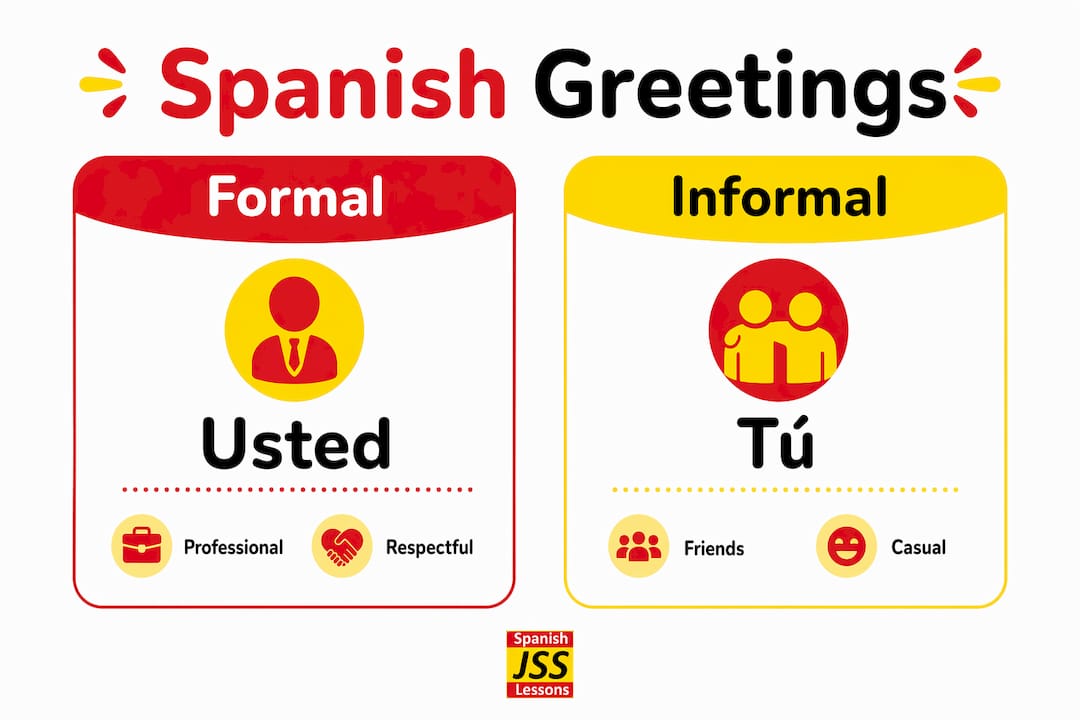
The key difference lies in the pronoun used to address someone. Tú is informal, used with friends, family, children, and peers. Usted is formal, used with strangers, elders, authority figures, and in professional settings. That pronoun choice changes the greeting phrase that follows.
Formal greetings and phrases:
- ¿Cómo está usted? — “How are you?” (formal, to a stranger or elder)
- ¿Cómo está? — “How are you?” (formal, slightly less explicit but still polite)
- Mucho gusto — “Pleased to meet you” (formal introduction)
- Buenos días, señor / señora — “Good morning, sir / madam”
Informal greetings and phrases:
- ¿Cómo estás? — “How are you?” (informal, to a friend or peer)
- ¿Qué tal? — “How’s it going?” (casual, among friends)
- ¡Hola! ¿Qué pasa? — “Hey! What’s up?” (very casual, among close friends)
The formal usted form is standard in professional settings and when addressing elders. Switching to tú too early can come across as presumptuous or disrespectful. Spanish speakers will usually signal when it is appropriate to drop the formality.
Pro Tip: When you are unsure which level of formality to use, err on the formal side. Using usted with someone who expected tú is easily forgiven. The reverse is far more likely to cause offence, particularly with authority figures or older people.
How do you greet someone at different times of day in Spanish?
Time-based greetings are a cornerstone of Spanish politeness. Choosing the right one shows that you are paying attention, not just reciting a phrase from a phrasebook.
| Time of day | Spanish greeting | English meaning | Notes |
|---|---|---|---|
| Morning to noon | Buenos días | Good morning | Formal and informal use |
| Noon to evening | Buenas tardes | Good afternoon | Switches at midday |
| Evening and night | Buenas noches | Good evening / Good night | Also used as a farewell |
| Any time (casual) | Buenas | Hi / Hello | Informal shortening |
Buenos días covers the morning until noon, at which point Buenas tardes takes over and runs through to early evening. Buenas noches begins at dusk and doubles as a farewell when leaving at night. That dual function surprises many English speakers, who are used to “good night” meaning only a goodbye.
A well-constructed greeting pairs the time-of-day phrase with a polite inquiry. The typical sequence runs: greeting, then time-of-day phrase, then inquiry. For example: Hola, buenas tardes, ¿cómo está usted? This three-part structure is natural in Spanish and sounds far more fluent than a bare Hola alone.
Regional habits also affect timing. In Spain, lunch runs late and the working day extends into the evening, so Buenas tardes is often heard well into what English speakers would consider late afternoon. Adapting to local rhythms is part of Spanish cultural habits that make a real difference to how you are received.
How do you introduce yourself and respond to greetings in Spanish?
A greeting opens the door. An introduction keeps the conversation going. These two skills work together, and learning them as a pair is far more effective than practising them separately.
- State your name. Use Me llamo… (“My name is…”) or the simpler Soy… (“I am…”). For example: Me llamo Sarah or Soy David. Both are correct; Me llamo is slightly more formal.
- Ask for the other person’s name. Use ¿Cómo te llamas? in informal settings (“What’s your name?”) or ¿Cómo se llama usted? in formal ones. The formal and informal name questions follow the same tú versus usted rule as greetings.
- Express pleasure at meeting them. Mucho gusto means “Pleased to meet you” and works in any context. Encantado (said by a man) or Encantada (said by a woman) means “Delighted to meet you” and carries a slightly warmer tone.
- Respond to their greeting. If someone asks ¿Cómo estás?, reply with Bien, gracias, ¿y tú? (“Fine, thanks, and you?”). In a formal exchange, use Bien, gracias, ¿y usted? The reciprocal question is expected and its absence can feel abrupt.
- Close the introduction politely. Phrases like Un placer (“A pleasure”) or Igualmente (“Likewise”) wrap up an introduction naturally. They signal that the exchange has been positive and leave a good impression.
Practising these five steps as a sequence builds conversational confidence faster than memorising isolated phrases. The structure is consistent, so once you know it, you can apply it in any social or professional setting.
Tips for practising Spanish greetings and avoiding common mistakes
Greetings are simple in theory and surprisingly easy to get wrong in practice. A few consistent habits make the difference between sounding natural and sounding like a tourist reading from a card.
- Always greet before asking anything. Neglecting a greeting in a shop, office, or social setting reads as rude in Spanish culture. Walk in, say Buenos días, and then make your request.
- Match your greeting to the setting. Use ¿Qué tal? with a friend at a café. Use Buenos días, ¿cómo está usted? with a doctor or official. The mismatch is immediately noticeable.
- Learn the physical customs alongside the words. In Spain, two kisses on the cheek (one on each side) are standard between women and between men and women in social settings. Men typically shake hands. Knowing this prevents awkward hesitation when the moment arrives.
- Practise with audio, not just text. Spanish pronunciation shifts significantly by region. Audio resources that expose you to real spoken greetings help your ear adjust to the rhythm and speed of native speech.
- Spanish greetings vary by region, so what sounds natural in Madrid may differ from what you hear in Seville or Valencia. Exposure to regional variation builds flexibility.
Pro Tip: Record yourself saying a greeting sequence, then compare it to a native speaker. The gap between what you think you sound like and what you actually sound like is where most pronunciation errors hide. Improving your pronunciation early prevents bad habits from becoming permanent.
James Spanish School: structured learning for real conversations
Memorising a list of phrases gets you started. Building the confidence to use them naturally in real situations takes structured practice. James Spanish School was founded by James Bretherton, a dual-native speaker who has lived in Spain for 40 years. The 100-lesson course uses Radical Simplification, stripping out grammar jargon and teaching Spanish structure through plain English. Lessons cover sentence-building and ear-tuning, so you can follow fast native speech, not just recite rehearsed lines. The WordAmigo system uses strategic repetition to lock vocabulary and pronunciation into long-term memory. You can access everything on demand, 24/7, on any device. Explore the full course and start building real conversational skills from the ground up.
FAQ
What is the most common way to say hello in Spanish?
Hola is the most widely used Spanish greeting and works in every situation, formal or informal. It can be combined with a time-of-day phrase such as Buenos días for a more complete and polished greeting.
When should I use formal versus informal Spanish greetings?
Use formal greetings with strangers, elders, officials, and in professional settings. Use informal greetings with friends, family, and peers. When in doubt, default to the formal usted form to avoid causing offence.
What does “Buenas noches” mean and when do I use it?
Buenas noches means “Good evening” or “Good night.” It is used as a greeting from dusk onwards and also serves as a farewell when leaving at night.
How do I introduce myself in Spanish?
Say Me llamo followed by your name, or use Soy for a simpler version. Follow with Mucho gusto or Encantado/Encantada to express that you are pleased to meet the other person.
Is it rude to skip a greeting in Spanish?
Yes. Entering a shop, office, or social gathering without greeting first is considered impolite in Spanish-speaking cultures. A brief Buenos días or Hola before making any request is the expected norm.
Key takeaways
Greeting correctly in Spanish requires matching your phrase to the time of day, the level of formality, and the social context of the interaction.
| Point | Details |
|---|---|
| Start with Hola or a time phrase | Hola, Buenos días, Buenas tardes, and Buenas noches cover every situation. |
| Match formality to context | Use usted with strangers and elders; use tú with friends and peers. |
| Pair greetings with polite inquiries | A greeting followed by ¿Cómo está? sounds natural and respectful to native speakers. |
| Learn introductions alongside greetings | Me llamo, Mucho gusto, and Encantado/a complete the opening exchange. |
| Practise with audio and real speech | Hearing greetings spoken at native speed builds the ear-tuning needed for real conversations. |