

TL;DR:
- Learning key Spanish phrases for shops helps you navigate interactions politely and confidently. Starting with greetings like “Hola” or “Buenos días” creates a positive impression, while asking about prices with “¿Cuánto cuesta?” ensures clear communication. Bargaining is reserved for markets, not regular shops, and mastering core verbs like comprar and buscar unlocks most shopping conversations.
Knowing the key Spanish phrases for shops is the single most effective preparation you can make before stepping into a Spanish store or market. Spanish retail culture places real value on greeting, politeness, and brief human exchange. Walk in without a word and you signal indifference. Open with “Buenos días” and the shopkeeper’s whole manner shifts. This guide covers essential vocabulary for retail situations: greetings, price enquiries, sizes and colours, payment, and market bargaining. Each section gives you the exact words, the cultural context, and the confidence to use them.
1. Essential greetings and polite expressions for shops in Spain
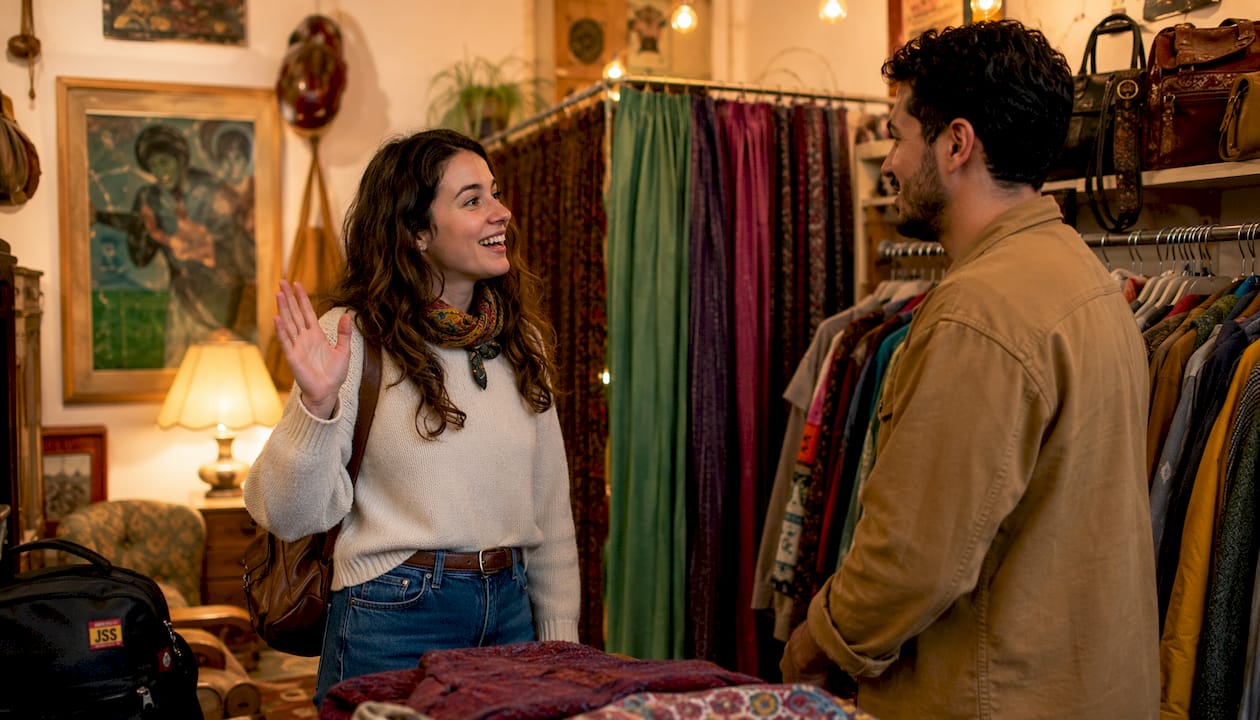
Greeting shopkeepers with “Hola” or “Buenos días” is culturally required in Spain. It sets a positive tone before you ask for anything. Skipping the greeting reads as rude, even in a busy supermarket.
The core greetings you need are:
- Hola — Hello (works any time of day)
- Buenos días — Good morning (use until around 2PM)
- Buenas tardes — Good afternoon/evening (from 2PM onwards)
- Buenas noches — Good evening/night (after dark, less common in shops)
Once you have greeted the shopkeeper, polite requests become much easier. The phrase ¿Me puede ayudar? (“Can you help me?”) signals respect and gets a warm response. You can also use “Disculpe” to get someone’s attention politely, much like “Excuse me” in English.
A few phrases carry you a long way:
- Por favor — Please
- Gracias — Thank you
- De nada — You’re welcome
- Disculpe — Excuse me
- ¿Puede ayudarme? — Can you help me?
Spanish shops use both formal address (“usted”) and informal address (“tú”). In most shops, staff will use “usted” with adult customers as a sign of respect. At neighbourhood markets, you may hear “tú” from the first word. Neither is wrong. Follow the shopkeeper’s lead and you will never cause offence.
Pro Tip: Start every shop visit with at least one greeting word. Even a simple “Hola” before you speak English opens doors. Shopkeepers across Spain respond far more helpfully when you make that small effort.
2. How to ask about prices and quantities
Price enquiries are the engine room of any shopping conversation. The two core phrases are ¿Cuánto cuesta? for a single item and “¿Cuánto cuestan?” for multiple items. The verb changes because Spanish matches singular and plural. Getting this right sounds natural and shows you know what you are doing.
For markets where goods are sold by weight, the phrasing shifts. Use “¿A cuánto está el kilo de…?” followed by the product name. For example, “¿A cuánto está el kilo de tomates?” asks the price per kilo of tomatoes. This phrasing is specific to weight-based selling and marks you as someone who shops at markets regularly.
| Situation | Phrase to use |
|---|---|
| One item, fixed price | ¿Cuánto cuesta? |
| Several items, fixed price | ¿Cuánto cuestan? |
| Market product sold by weight | ¿A cuánto está el kilo de…? |
| Total bill at checkout | ¿Cuánto es todo? |
| Specific quantity request | Un kilo / Medio kilo / Cien gramos |
Prices in most Spanish shops are fixed and labelled. Bargaining in a standard retail shop is not appropriate. Save negotiation for flea markets and some independent market stalls, where it is both polite and expected.
Pro Tip: When buying at a market stall, say the quantity first, then the product. “Medio kilo de queso, por favor” flows naturally and gives the vendor exactly the information they need without any back-and-forth.
3. Common phrases for sizes, colours, and trying on items
Clothing shops require a specific set of phrases, and asking about sizes and colours confidently makes the difference between finding what you want and leaving empty-handed. The good news is that a handful of phrases covers almost every situation.
For sizes, use these:
- ¿Tiene otra talla? — Do you have another size?
- ¿Hay talla más grande? — Is there a larger size?
- ¿Hay talla más pequeña? — Is there a smaller size?
- ¿Tiene una talla [número]? — Do you have a size [number]?
For colour variations, the phrase “¿Lo tiene en otro color?” (“Do you have it in another colour?”) works for any item. If you want a specific colour, simply add it: “¿Lo tiene en azul?” or “¿Lo tiene en negro?”
For the fitting room:
- ¿Puedo probármelo? — Can I try it on?
- ¿Dónde está el probador? — Where is the fitting room?
Once you have tried something on, expressing how it fits is straightforward. “Me queda bien” means it fits well. “Me queda pequeño” means it is too small. “Me queda grande” means it is too big. These three phrases give the shop assistant everything they need to help you find the right item.
4. Spanish phrases for payment, receipts, and returns
Payment conversations follow a predictable pattern in Spanish shops. Payment phrases like “¿Aceptan tarjeta?” and “¿Puedo pagar con tarjeta?” both ask whether you can pay by card. The first is slightly more direct; the second is a touch more polite. Either works perfectly at a till.
Useful phrases for the checkout and beyond:
- ¿Aceptan tarjeta? — Do you accept card?
- ¿Puedo pagar con tarjeta? — Can I pay by card?
- ¿Me puede dar un recibo? — Can you give me a receipt?
- ¿Me puede envolver esto? — Can you wrap this for me?
- Quiero devolver esto — I would like to return this
- Quiero cambiar esto — I would like to exchange this
- ¿Cuál es la política de devoluciones? — What is the returns policy?
Returns and exchanges in Spain follow shop-specific policies, so asking “¿Cuál es la política de devoluciones?” before you buy an item saves confusion later. Most shops require the original receipt and will only accept returns within a set number of days.
Close every transaction warmly. “Muchas gracias” and “Hasta luego” (“Goodbye”) leave a good impression and make your next visit easier. Spanish shopkeepers remember regulars, and a friendly farewell goes a long way.
5. Useful phrases and cultural tips for markets and bargaining in Spain
Spanish markets operate by different rules from high-street shops. Bargaining is polite and expected in flea markets and some independent vendor settings, but it is not standard in labelled retail. Knowing where the line falls saves embarrassment on both sides.
At a market stall, these phrases get you started:
- ¿A cuánto están…? — How much are…?
- ¿Me da medio kilo? — Can you give me half a kilo?
- ¿Me da un poco más? — Can you give me a little more?
- ¿Me hace un descuento? — Can you give me a discount?
- ¿Me puede rebajar? — Can you bring the price down?
Subtle bargaining phrases like “¿Me hace un descuento?” work best when delivered with a smile and a relaxed tone. Aggressive negotiation is not the Spanish way. A light, friendly approach almost always gets a better result than a hard push.
Market shopkeepers frequently use informal address and affectionate nicknames such as “cariño” or “guapa.” This is a sign of warmth, not disrespect. It reflects a relaxed neighbourhood culture that is one of the genuine pleasures of shopping in Spain.
“¡Qué amable!” (“How kind!”) is one of the most useful phrases you can have ready at a market. When a vendor throws in an extra piece of fruit or rounds down the price, this response lands perfectly. It is warm, natural, and shows you understand the culture. Pair it with “¡Gracias!” and you will be remembered as a good customer.”
You can also practise music-based Spanish conversation to build the rhythm and flow of these market exchanges before you arrive at the stall. Hearing phrases in context, rather than reading them cold, makes a real difference to how naturally they come out.
6. Core verbs that power every shop conversation
Mastering a small set of verbs unlocks the majority of shop interactions. Core verbs like comprar (to buy), buscar (to look for), probarse (to try on), pagar (to pay), cambiar (to exchange), and devolver (to return) recur across almost every retail situation. Learning these six verbs with their basic conjugations gives you a framework you can build on.
The verb “buscar” is particularly useful. “Estoy buscando…” (“I am looking for…”) followed by any product name is a complete, polite sentence that any shop assistant understands immediately. You do not need to know the full grammar. You just need the pattern.
“Querer” (to want) and “necesitar” (to need) are equally powerful. “Quisiera…” is the polite form of “I would like…” and works in any shop context. “Necesito algo para…” (“I need something for…”) opens a conversation even when you do not know the exact word for the product. These patterns give you confidence in shops even at an early stage of learning.
Pro Tip: Learn the six core shopping verbs first: comprar, buscar, probarse, pagar, cambiar, devolver. Once you can use these in simple sentences, you can handle almost any shop situation, even if your vocabulary is still limited.
7. How to handle misunderstandings and ask for clarification
Misunderstandings happen, and knowing how to handle them politely is as important as knowing the phrases themselves. The phrase “No entiendo” (“I don’t understand”) is honest and direct. Follow it with “¿Puede repetir más despacio, por favor?” (“Can you repeat more slowly, please?”) and most shopkeepers will oblige without any irritation.
If you need something written down, “¿Me lo puede escribir?” (“Can you write it down for me?”) is perfectly acceptable. Many shopkeepers will show you the price on a calculator or their phone without being asked, especially if they sense a language gap.
You can also use everyday Spanish situations practice to prepare for these moments before they arise. Rehearsing the recovery phrases is just as valuable as rehearsing the main phrases. The shopkeeper’s machine-gun speed of reply is often the hardest part, and training your ear for it makes all the difference.
Key takeaways
Mastering essential Spanish shop phrases requires greetings, price enquiries, size and colour vocabulary, payment phrases, and market-specific bargaining expressions used with cultural awareness.
| Point | Details |
|---|---|
| Greet first, always | Open every shop visit with “Hola” or “Buenos días” before making any request. |
| Match the verb to the quantity | Use “cuesta” for one item and “cuestan” for several to sound natural and correct. |
| Bargain only at markets | Fixed-price shops do not expect negotiation; save “¿Me hace un descuento?” for market stalls. |
| Learn six core verbs | Comprar, buscar, probarse, pagar, cambiar, and devolver cover the majority of shop interactions. |
| Recover with confidence | “No entiendo” and “¿Puede repetir más despacio?” handle misunderstandings politely and effectively. |
Build your Spanish shopping confidence with James Spanish School
Knowing the phrases is the first step. Using them without hesitation in a real shop is the goal.
James Spanish School was built specifically for English-speaking adults living in Spain. The 100-lesson course covers real-life situations, including shopping conversations in Spanish, with audio lessons designed to train your ear for the speed of native speech. The WordAmigo system uses strategic repetition to lock vocabulary into long-term memory, so the phrases you learn today stay with you at the till tomorrow. You can study on your phone, tablet, or laptop, at any hour, with no expiry date on your access. Visit the James Spanish School shop to see the full range of courses and starter materials.
FAQ
What is the most important phrase to know in a Spanish shop?
“Hola” or “Buenos días” is the most important phrase. Greeting the shopkeeper before making any request is a cultural expectation in Spain and sets a positive tone for the entire interaction.
How do I ask the price of something in Spanish?
Use “¿Cuánto cuesta?” for a single item or “¿Cuánto cuestan?” for several items. At markets selling by weight, use “¿A cuánto está el kilo de…?” followed by the product name.
Is bargaining acceptable in Spanish shops?
Bargaining is not standard in most Spanish retail shops where prices are labelled. It is polite and expected at flea markets and some independent market stalls, where phrases like “¿Me hace un descuento?” are appropriate.
How do I ask to try something on in a Spanish clothes shop?
Say “¿Puedo probármelo?” to ask if you can try an item on, and “¿Dónde está el probador?” to ask where the fitting room is. Both phrases are understood in any clothing shop across Spain.
What should I say if I do not understand the shopkeeper’s reply?
Say “No entiendo” to signal you have not understood, then follow with “¿Puede repetir más despacio, por favor?” to ask the shopkeeper to repeat themselves more slowly. Most will respond helpfully.