

Why use immersive learning
TL;DR:
- Immersive learning greatly enhances transfer and motivation in adult European Spanish learners by focusing on real-life application.
- The WordAmigo System and Five-Step Retention Loop automate structured, multi-modal exposure, reinforcing vocabulary and pronunciation effectively.
Immersive learning is one of the most effective approaches you can take for vocabulary retention, pronunciation accuracy, and real conversational transfer — especially as a self-paced adult learner of European Spanish. A 2025 meta-analysis found effect sizes of g = 0.38 for knowledge acquisition, g = 0.61 for transfer, and g = 0.67 for motivation, meaning the biggest gains appear precisely where adult learners need them most: using what they have learned in real situations and staying motivated enough to keep going. A 2022 experimental study confirmed that higher-immersion formats produced better delayed retention than equivalent 2D video, with the delayed posttest occurring several weeks after the intervention. James Spanish School applies these principles directly through the WordAmigo System and its Five-Step Retention Loop, both designed to embed vocabulary and pronunciation through structured, repeated exposure across multiple modalities.
- Immersive methods produce larger gains in transfer and motivation than in raw knowledge scores.
- Delayed retention (on average about 19 days later, not just immediately after a lesson) is measurably stronger with higher-immersion formats.
- The WordAmigo System automates spaced exposure across listening, speaking, reading, and writing.
- The Five-Step Retention Loop targets the full memory cycle, not just initial exposure.
Table of Contents
- What does the research actually say about immersive learning?
- Concrete immersive methods that work inside a self-paced Spanish course
- How immersive learning helps English-speaking adults learning European Spanish
- A practical solo routine to get the most from immersive learning
- How to tell if a self-paced course really delivers immersive learning
- When self-study immersion isn’t enough and how to fill the gaps
- Key takeaways
- Ready-made immersive learning: how James Spanish School puts it into practice
What does the research actually say about immersive learning?
The meta-analysis evidence is clear on where immersion earns its keep. Knowledge gains are moderate (g = 0.38), but transfer — applying what you have learned in a new context — shows a substantially larger effect (g = 0.61), and motivation is larger still (g = 0.67). For a language learner, that hierarchy matters enormously: you are not just trying to pass a test; you want to hold a conversation with a Spanish neighbour or navigate a health appointment.
The 2022 IVR field-trip study adds a useful detail. The head-mounted display group showed higher presence, enjoyment, and interest than the 2D video group, and crucially, enjoyment mediated immediate retention while interest mediated delayed retention. Short, enjoyable immersive experiences are therefore a strong entry point for longer learning cycles — which is exactly how well-designed micro-lessons work.
There is, however, an authenticity dilemma worth knowing about. Higher authenticity boosts transfer and motivation, but it requires more scaffolding to support knowledge acquisition. Presence alone does not guarantee learning; instructional design that focuses attention and reduces unnecessary cognitive load is what converts an immersive experience into a durable skill.
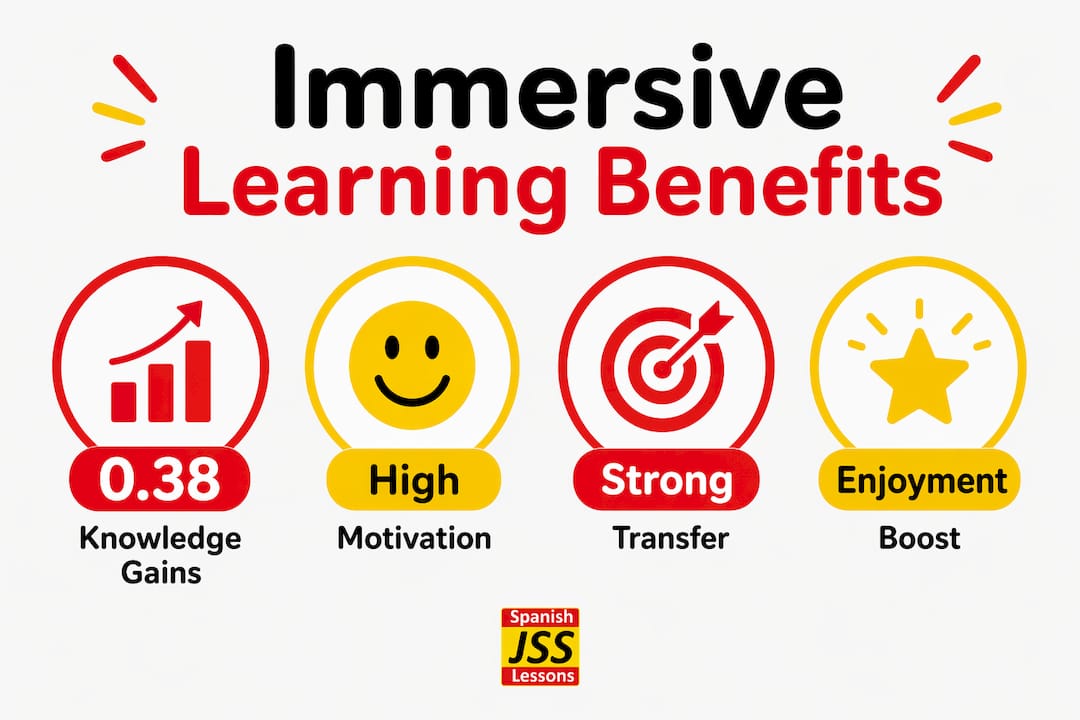
| Learning outcome | Effect size (g) | What it means for Spanish learners |
|---|---|---|
| Knowledge acquisition | 0.38 (moderate) | Vocabulary and grammar rules are learned, but gains are modest without practice |
| Transfer | 0.61 (large) | Learned vocabulary transfers to real conversations more reliably |
| Motivation | 0.67 (large) | Learners stay engaged and return to practice more consistently |
| Delayed retention | Higher with HMD vs 2D, about 19 days after lesson | Words and phrases stick for weeks after the lesson, not just the next day |
Concrete immersive methods that work inside a self-paced Spanish course
Not every immersive method requires a headset. For on-demand European Spanish study, the most practical techniques map directly onto how memory consolidates language.
- Guided shadowing: listen to a native phrase at natural speed, then repeat it immediately. This trains pronunciation motor memory and ear recognition simultaneously.
- Timed sentence-building drills: given a set of words, construct a grammatically correct sentence within a short window. Active recall under mild time pressure strengthens retrieval pathways.
- Simulated micro-dialogues: short, contextualised exchanges (a shop transaction, a doctor’s appointment) that place vocabulary in realistic situations rather than abstract lists.
- Pronunciation flash cards with audio: see the word, hear it spoken by a native, then record and compare your own attempt. The pronunciation flash cards in the James Spanish School system follow exactly this pattern.
- Audio-first ear-tuning sessions: three minutes of fast native speech with no transcript, training your ear before your eye. This is the engine room of listening comprehension.
- Spaced review cycles: vocabulary revisited at increasing intervals — the next day, three days later, a week later — so the brain is forced to retrieve rather than merely recognise.
“Immersive media per se do not necessarily improve learning; however, implementing effective instructional methods within immersive virtual environments can improve learning.” — Immersion Principle in Multimedia Learning
The practical implication: look for course interfaces that offer audio playback speed control, repeatable micro-dialogues, pronunciation scoring, and an integrated spaced repetition system. Without those features, you are watching a lesson, not doing one.
How immersive learning helps English-speaking adults learning European Spanish
For UK adults learning European Spanish, the benefits of immersive learning are specific and practical. The machine-gun speed of native replies is the single biggest shock for new learners; ear-tuning sessions that replicate that pace build tolerance and comprehension far faster than slow, textbook-paced audio. Pronunciation accuracy matters too — a mispronounced vowel in Spanish can change the meaning of a sentence entirely, and learning with native speakers of European Spanish gives you the authentic phonetic model you need.
The WordAmigo System was built specifically around these pain points. Developed with IT experts and English expats fully immersed in Spanish society, it uses AI-assisted strategic repetition to embed vocabulary and pronunciation across all four modalities: reading, listening, speaking, and writing. The Five-Step Retention Loop automates the full exposure cycle so you are not relying on willpower to revisit words — the system brings them back to you at the right moment.
James Bretherton, founder of James Spanish School, is a dual-native Spanish speaker who has lived in Spain for 40 years. His course is built around real-life situations — conversations with neighbours, tradesmen, health workers, and local officials — not academic exercises.
The course also carries a cast-iron guarantee: if a core lesson does not teach you anything new, James credits you with extra practice modules at no cost. Lifetime access means no countdown clock and no pressure — you repeat lessons as many times as you need.
A practical solo routine to get the most from immersive learning
A consistent, short daily routine outperforms occasional long sessions. Here is a weekly structure that works for self-paced European Spanish learners.
- Monday and Thursday — ear-tuning (10–15 minutes): play a short native-speed audio clip twice without a transcript, then once with. Note the phrases you missed. Use audio Spanish lessons designed for this purpose.
- Tuesday and Friday — sentence-building drills (10 minutes): five timed sentence-construction reps per session. Write the sentence, say it aloud, then check.
- Wednesday — pronunciation practice (15 minutes): work through pronunciation flash cards, record yourself, and compare against the native model.
- Saturday — simulated roleplay (10–20 minutes): attempt two or three simulated dialogue replies without pausing. Speed matters here; hesitation is the enemy.
- Sunday — spaced review (10 minutes): revisit vocabulary flagged earlier in the week. This is the session most learners skip — and the one that does the most work.
Immersive simulations can record behavioural data such as response timing and verbal choices, giving you a measurable record of improvement. A simple equivalent for solo learners: record your Saturday roleplay each week and compare recordings a month apart.
Pro Tip: Combine your simulated conversations with a short monthly check-in with a native speaker or tutor. Self-paced immersion builds the raw material; a real person catches the subtle pronunciation errors the system cannot flag.
How to tell if a self-paced course really delivers immersive learning
A course can claim to be immersive without actually being so. Use this checklist before you commit.
Green flags:
- Repeated, contextual audio at natural native speed
- Active speaking tasks, not just listening or reading
- Pronunciation scoring or a structured pronunciation practice mode
- Scaffolding: reflection prompts, cultural context, and guided review
- A measurable spaced repetition system built into the course
Red flags:
- Mostly passive video with no speaking component
- No pronunciation practice or feedback mechanism
- Vocabulary presented in isolated lists rather than real-life contexts
- No spaced review or progress tracking
| Course feature | Learning benefit |
|---|---|
| Contextual audio at native speed | Builds ear-tuning and real comprehension |
| Active speaking tasks | Activates retrieval and pronunciation motor memory |
| Pronunciation scoring | Closes the feedback loop on accuracy |
| Spaced repetition system | Converts short-term recall into long-term retention |
| Scaffolding and cultural context | Supports knowledge acquisition alongside transfer |
The language immersion guide from Tutoroo offers a useful practical primer on what genuine immersion looks like in a course context.
When self-study immersion isn’t enough and how to fill the gaps
Self-paced immersive learning has real limits. The most significant is corrective feedback: a well-designed system can flag a mispronounced word, but it cannot catch the subtle regional accent drift or the hesitation pattern that marks a learner as a non-native to a Spanish shopkeeper.
Limitations to be aware of:
- Less corrective feedback on subtle pronunciation errors
- Limited spontaneous interaction — real conversations are unpredictable in ways simulations are not
- Possible cognitive overload if immersive tasks are too complex without adequate scaffolding
Practical supplements:
- Monthly tutor check-ins focused on pronunciation accuracy
- Short conversation tandems with a native speaker (even 20 minutes fortnightly makes a difference)
- Targeted pronunciation clinics for specific sounds that Spanish learners from English backgrounds consistently struggle with (the rolled r, the soft j)
- Periodic real-world speaking practice — ordering in a Spanish restaurant, calling a Spanish-speaking contact
The authenticity dilemma identified in the research is relevant here: higher authenticity drives better transfer, but without scaffolding, cognitive overload can stall progress. If you hit a comprehension plateau that persists for more than two or three weeks despite regular practice, that is a signal to add a human feedback element rather than simply repeat the same immersive exercises.
Watch for these signs that a course needs supplementing: persistent comprehension gaps despite regular ear-tuning, repeated mispronunciation that practice alone does not correct, or no measurable spaced repetition built into the course structure.
Key takeaways
Immersive learning produces its largest gains in transfer and motivation, making it the right approach for adult learners who need to use Spanish in real life, not just pass a test. The Five-Step Retention Loop and WordAmigo System in James Spanish School’s course are concrete examples of this design applied to European Spanish.
| Point | Details |
|---|---|
| Transfer and motivation gains are largest | Meta-analysis shows larger effects for transfer and motivation compared to knowledge gains alone. |
| Delayed retention improves with immersion | Higher-immersion formats outperformed 2D video on a delayed posttest several weeks after the lesson. |
| Scaffolding is non-negotiable | Presence and authenticity alone are not enough; structured review and feedback convert immersion into lasting skill. |
| A consistent short routine beats occasional long sessions | Daily 10–20 minute micro-sessions with spaced review on a weekly cycle produce steady, measurable progress. |
| James Spanish School’s approach | The Five-Step Retention Loop and WordAmigo System automate the full immersive cycle for European Spanish learners. |
Ready-made immersive learning: how James Spanish School puts it into practice
If you want the immersive structure already built for you, James Spanish School’s course does the heavy lifting. The WordAmigo System uses AI-assisted strategic repetition to cycle vocabulary and pronunciation through reading, listening, speaking, and writing — the full Five-Step Retention Loop — so you are not managing your own review schedule. Every lesson is available on demand, 24/7, with no expiry date and no pressure.
James Bretherton’s 40 years living in Spain as a dual-native speaker means the course is built around the European Spanish you will actually hear: fast native speech, regional expressions, and the cultural context that makes conversations land naturally. The cast-iron guarantee backs every core lesson: if it does not teach you something new, you receive extra practice modules at no cost.
Explore the James Spanish School course and see how the WordAmigo System and Five-Step Retention Loop apply immersive learning to everyday European Spanish from day one.