

Understanding Spanish menu del dia
TL;DR:
- The menu del día is a fixed-price, multi-course lunch offered at most Spanish restaurants and is a cultural tradition. It includes a starter, main course, dessert or coffee, bread, and a drink, serving as an affordable way to enjoy local cuisine. Spotting an authentic one involves looking for a chalkboard menu, a room full of locals, and a location away from tourist hotspots.
The menú del día is a fixed-price, multi-course weekday lunch served at most Spanish restaurants, covering a first course, second course, dessert or coffee, bread, and a drink, all for one set price. It is not a tourist gimmick. As local dining experts confirm, it is a daily institution built around the working day, and understanding it properly is the single best way to eat well and cheaply in Spain.
Here is what you get, at a glance:
- Primer plato (first course): soup, salad, pasta, lentils, or similar
- Segundo plato (second course): meat, fish, or rice dish
- Postre o café: dessert or coffee, usually an either/or choice
- Pan: fresh bread, brought to the table
- Bebida: water, a glass of house wine, or a beer
Prices typically fall within a moderate range depending on the city and region. Service runs roughly 1:00–4:30 pm, with the local peak around 2:00–2:30 pm.
Pro Tip: Look for a handwritten chalkboard outside the door. That single detail tells you the menu changes daily and is built around what the market had that morning.
Table of Contents
- What does a menú del día actually include?
- How does the menú del día work day to day?
- When is it served, and how much does it cost?
- Where does the menú del día come from?
- How to find a good one and order with confidence
- Useful Spanish phrases for ordering the menú
- Key takeaways
- Ready to order with confidence in Spain?
- Useful sources
What does a menú del día actually include?
The standard structure is more generous than most visitors expect. You are not choosing from a single fixed set; restaurants typically offer 2–4 options per course, so you can pick based on appetite and what sounds good that day.
Typical components:
- First course options: gazpacho, mixed salad, lentil stew (lentejas), vegetable soup, pasta, or chickpea dishes
- Second course options: grilled chicken, pork loin (lomo de cerdo), hake (merluza), calamari, or a rice dish
- Dessert or coffee: flan, yoghurt, fresh fruit, or a café solo/cortado
- Bread: always included, often replenished without asking
- Drink: water, a small bottle of wine, or a draught beer
A sample lunch might look like this: mixed salad to start, followed by grilled hake with chips, a yoghurt, and a café solo, with a basket of bread and a glass of house red throughout. That is a substantial, balanced meal.
Regional variety shows up mainly in the second course. In Galicia, you will see more fish and seafood. In Castile, roast meats dominate. Along the Mediterranean coast, rice dishes and fresh vegetables appear far more often.
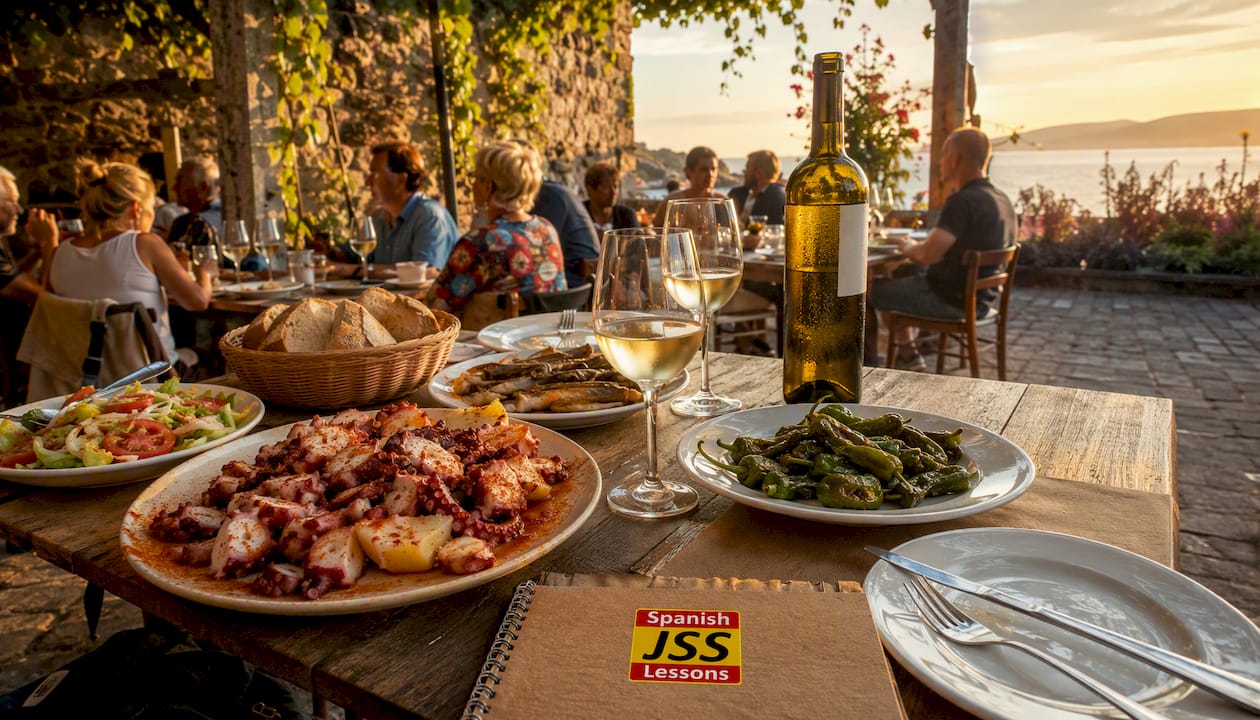
Pro Tip: A chalkboard menu outside is a strong signal the dishes are market-driven and freshly prepared. A laminated, pre-printed card often means the same dishes repeat all week.
How does the menú del día work day to day?
The ordering sequence is straightforward once you know it, and the pace is brisk. Kitchens prepare courses in advance to serve large numbers of workers efficiently, so expect courses to arrive and be cleared more quickly than you might be used to at dinner.
- Arrive between 1:30 and 3:00 pm for the best selection. Popular dishes sell out.
- Ask for the menú: say “¿Tienen el menú del día?” (Do you have the set menu?) if it is not already displayed.
- Choose your primer plato from the options the server lists or the board shows.
- Choose your segundo plato at the same time, or when the server returns.
- Decide on postre o café at the end of the meal.
- Request the bill with “La cuenta, por favor.”
Menú del día vs la carta vs plato combinado
These three are not the same thing, and confusing them costs money.
- Menú del día — the fixed-price multi-course lunch. Best value by a significant margin.
For a traveller at lunchtime, the menú del día wins on value almost every time. La carta makes sense when you are dining in the evening or want a dish the kitchen is specifically known for.
When is it served, and how much does it cost?
Spanish restaurants serve the menú del día from roughly 1:30 to 4:30 pm, though many kitchens stop taking orders closer to 3:30 pm. The real local peak is 2:00–2:30 pm, when office workers and tradespeople fill the dining room. Arrive at 1:00 pm and the kitchen may still be setting up; arrive at 4:00 pm and the popular dishes will be gone.
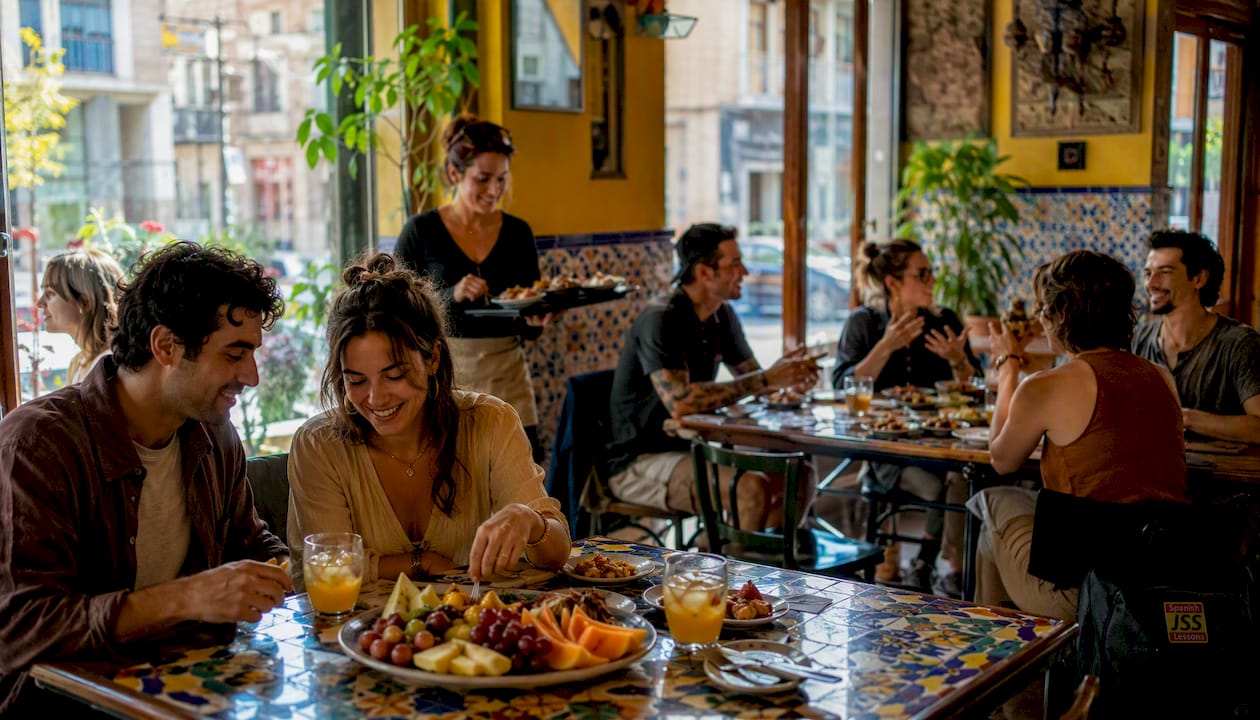
Prices across most Spanish cities currently run between €11 and €18, but regional differences are real:
| Region / Location | Typical price band |
|---|---|
| Inland cities (Madrid, Castile) | Prices in the lower to mid range |
| Andalucía, Galicia | Generally lower prices |
| Barcelona city centre | Mid to higher range |
| Balearic Islands, tourist areas | Tend to be more expensive |
| Neighbourhood venues off tourist strips | Usually cheaper than nearby tourist restaurants |
Tipping is not obligatory in Spain and is not expected for a menú del día. Rounding up or leaving small change is appreciated but never assumed. VAT (IVA) is almost always included in the displayed price; check the sign or menu for “IVA incluido” to confirm. The drink is usually included, but some venues charge separately for wine or beer. The sign outside will normally state “bebida incluida” if it is.
Worth knowing: Walking just two or three streets away from the main tourist squares typically drops the price by several euros and improves the quality. Locals do not eat on the main plaza.
Where does the menú del día come from?
The menú del día traces its origins to
introduced during the Franco era. The regulation required restaurants to offer an affordable fixed-price meal so that workers and visitors could eat a substantial midday meal without spending a significant portion of their daily wage. The specific regulation is no longer enforced, but the custom it created never went away.
That social function is still visible today. At 2:15 pm in any working neighbourhood, the dining room fills with builders, office staff, teachers, and shop workers. The meal is the main event of the day, not a quick bite. Understanding this changes how you look for a good menú. The best ones are not in the guidebooks; they are in the streets where people actually work.
Understanding genuine Spanish cultural habits around mealtimes makes this whole experience click into place. The menú del día is inseparable from the Spanish rhythm of the day.
Pro Tip: If the dining room is full of people in work clothes at 2:00 pm, you have found the right place. That crowd is the most reliable quality signal there is.
How to find a good one and order with confidence
Spotting an authentic menú del día takes about thirty seconds once you know what to look for.
Signs of authenticity:
- Handwritten chalkboard outside with today’s dishes listed
- Dining room packed with locals, especially workers, at lunchtime
- Location two or more streets away from the main tourist strip
- Menu changes visibly from day to day
- Price in the €11–€18 range for the area
Red flags:
- Laminated menus with photos of every dish
- Staff outside actively beckoning tourists in
- “Menú turístico” labelling rather than “menú del día”
- Prices significantly above the local norm with no obvious reason
Practical ordering tips:
- Arrive by 1:30 pm for the widest choice; the local peak is 2:00–2:30 pm so kitchens are fully running by then
- If a dish is sold out (“no queda”), ask what is still available rather than defaulting to la carta
- Splitting the bill is not common practice in Spain; it is simpler to pay as a group and divide informally
- Sobremesa: the post-meal conversation over coffee is part of the experience. Do not rush it; no one will hurry you out
Dietary restrictions: Tell the server before ordering, not after the dish arrives. Say “Soy alérgico/a a…” (I am allergic to…) or “No como carne” (I do not eat meat). For serious allergies, a written note in Spanish handed to the server is far more reliable than a spoken request in a busy kitchen. For group travel logistics and meal planning across multiple venues, the group travel dining guide covers practical strategies worth reading before you go.
Useful Spanish phrases for ordering the menú
These phrases cover the full sequence from walking in to paying the bill. The stressed syllable in each Spanish phrase is shown in bold.
- ¿Tienen el menú del día? — Do you have the set menu?
- ¿Me puede traer la carta? — Could you bring me the à la carte menu?
- De primer plato, quiero… — For my first course, I would like…
- De segundo, quiero… — For my second course, I would like…
- ¿Qué tienen de postre? — What do you have for dessert?
- En vez de postre, un café, por favor. — Instead of dessert, a coffee please.
- ¿Está incluida la bebida? — Is the drink included?
- ¿Tiene opciones sin gluten? — Do you have gluten-free options?
- Soy alérgico/a a los mariscos. — I am allergic to shellfish.
- No como carne. — I do not eat meat.
- La cuenta, por favor. — The bill, please.
- ¿Está el IVA incluido? — Is VAT included?
Pro Tip: If you have a severe allergy, write it out in Spanish on a card before you travel: “Soy alérgico/a a [ingredient]. Esto puede ser peligroso para mi salud.” Hand it directly to the server or kitchen staff. Spoken requests in a noisy dining room get missed; a written note does not.
Practising these phrases aloud before you travel makes a real difference. For structured pronunciation practice, mastering Spanish pronunciation is a good place to start.
Key takeaways
The menú del día is Spain’s working-lunch institution: a fixed-price, multi-course meal served 1:30–4:30 pm that offers far better value than à la carte dining, provided you know how to spot and order an authentic one.
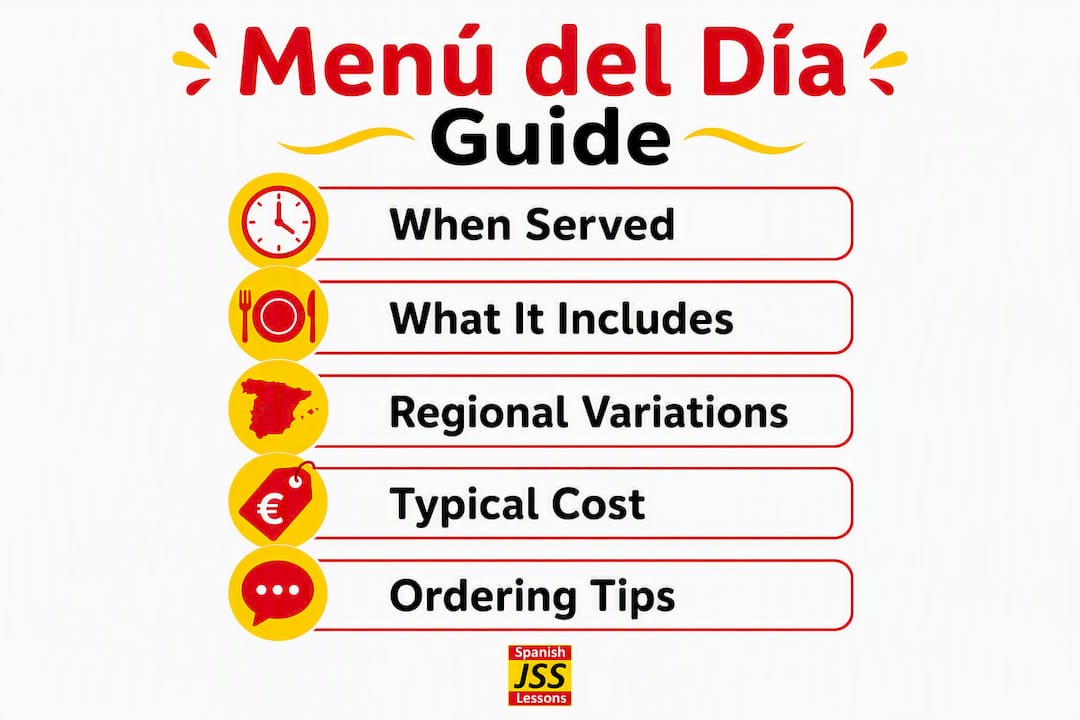
| Point | Details |
|---|---|
| What it includes | Primer plato, segundo plato, postre or café, bread, and a drink, all at one fixed price. |
| When to go | Arrive between 1:30 and 2:00 pm; the local peak is 2:00–2:30 pm and popular dishes sell out. |
| What it costs | Typically €11–€18 nationally; inland and neighbourhood venues are cheaper than tourist areas. |
| How to spot authenticity | Look for a handwritten chalkboard, a room full of workers, and a location off the main tourist street. |
| James Spanish School | Covers dining vocabulary, cultural habits, and pronunciation so you can order confidently from day one. |
Ready to order with confidence in Spain?
Knowing what a menú del día is gets you through the door. Knowing how to ask for it, substitute a coffee for dessert, or explain a dietary need is what makes the difference between a hesitant tourist and someone who feels genuinely at home.
James Spanish School’s self-paced online course covers exactly this kind of real-life Spanish: the vocabulary, the phrases, and the cultural context you need for everyday situations in Spain, including ordering lunch. Founded by James Bretherton, a dual-native speaker who has lived in Spain for 40 years, the course uses plain English to explain how Spanish actually works, with the WordAmigo system embedding vocabulary and pronunciation through strategic repetition. There is no expiry date, no pressure, and lifetime access from any device. Visit James Spanish School to see the full course and start practising the phrases that matter most.
Useful sources
- Menú del día — Wikipedia: clear overview of the format, serving times, and cultural role
- Menu del Día Explained — Spain Food Guide: cultural context and the worker-institution framing
- Menú del Día Guide — Spotahome: course choice structure and ordering guidance
- Menú del Día — Guidavera: concise definition and typical price range
- 10 Best Restaurants in Madrid Under €15 — Walks of Spain: neighbourhood scouting and timing advice
- Decoding the Spanish Menu — Seek Spain: price ranges and regional differences
- Menu del Dia Guide — Yishi Foods: regional price examples and worker culture context
-
: video source for the 1964 government decree
- The Spanish Dining Secret Locals Love — National Geographic: broader cultural framing of the midday meal tradition