

Breaking English thinking patterns Spanish
You can stop translating in your head by practising five repeatable mental habits: self-narration, micro-immersion bursts, phrase templates, associative vocabulary, and a cognitive intercept called “Catch, Check, Change.” Consistent daily practice leads many learners to notice their first untranslated Spanish sentences within a few weeks, with some able to hold short conversations without English translation after sustained effort.
Here is your one-line action plan: narrate your morning routine in Spanish, run two 10-minute immersion bursts, recycle three phrase templates in conversation, attach images to new words instead of English glosses, and intercept every translation urge with a three-step cognitive check.
Breaking English thinking patterns in Spanish is the central challenge of adult language learning, and it is not about intelligence. It is about replacing one automatic habit with another. The good news: longitudinal case studies confirm that thinking-for-speaking patterns can and do change with sustained practice, even in adult learners well past childhood acquisition.
- Self-narration: describe what you are doing, seeing, or feeling in simple Spanish sentences throughout the day.
- Micro-immersion bursts: two focused 10-minute windows of Spanish-only listening and shadowing.
- Phrase templates: five to eight ready-made sentence starters you recycle rather than construct from scratch.
- Associative vocabulary: link new words directly to images, sensations, or situations, never to English equivalents.
- Cognitive intercept: use the “Catch, Check, Change” method to interrupt the automatic urge to translate.
James Spanish School and its WordAmigo system are designed to support exactly this shift, embedding vocabulary and sentence structure through a Five-Step Retention Loop that covers reading, listening, speaking, and writing in short daily sessions.
Key takeaways
Stopping the translation habit requires five daily moves, a two-week starter plan, and a cognitive intercept that you practise until it becomes automatic.
| Point | Details |
|---|---|
| Five core moves | Self-narration, micro-immersion bursts, phrase templates, associative vocabulary, and the “Catch, Check, Change” intercept. |
| Realistic timeline | Most learners produce their first untranslated sentence within days 5–14; short conversations flow by weeks 10–12. |
| Daily time budget | 20–40 minutes daily, split into three 7–10 minute slots or one focused block, is enough to build the habit. |
| Biggest mistake to avoid | Practising vocabulary lists without sentence context delays direct thinking; attach every word to an image or situation instead. |
| James Spanish School | The Radical Simplification method and WordAmigo system are structured to build Spanish thinking patterns from the first lesson. |
Table of Contents
- 1. High-impact techniques you can practise today
- 2. How to build a two-week starter plan and track your progress
- 3. Conversation drills that stop translation in the moment
- 4. What typically stalls progress and how to fix it
- 5. The “Catch, Check, Change” method for interrupting the translation reflex
- James Spanish School: a structured path to thinking in Spanish
- Sources
1. High-impact techniques you can practise today
Breaking English thinking patterns in Spanish requires deliberate, structured practice rather than passive exposure. Research on concept-based instruction shows that targeted, explicit practice can produce measurable shifts in thinking-for-speaking patterns, often faster than immersion alone.
Self-narration and internal monologue
The most direct way to replace English thoughts is to narrate your immediate experience in Spanish. Start with the present tense and simple vocabulary. You do not need perfect sentences; you need frequent ones.
Sample scripts to copy immediately:
- Estoy haciendo el café. (I’m making the coffee.)
- Hace frío hoy. (It’s cold today.)
- Necesito ir al supermercado. (I need to go to the supermarket.)
- No sé la palabra, pero es una cosa para… (I don’t know the word, but it’s a thing for…)
That last line is the most useful. It trains you to describe around gaps rather than freeze and reach for English.
Phrase templates and response starters
Memorise a small set of templates and recycle them constantly. The goal is to reduce the cognitive load of construction during conversation so your brain stops reaching back to English.
Core templates worth learning first:
- Creo que… (I think that…)
- Lo que quiero decir es… (What I mean is…)
- ¿Puedes repetir más despacio? (Can you repeat more slowly?)
- No estoy seguro, pero… (I’m not sure, but…)
- Me parece que… (It seems to me that…)
Focused micro-immersion bursts
Short, high-quality Spanish-only windows beat long passive sessions. A mobile micro-practice approach works well here: pick a 10-minute slot, play a Spanish audio clip at natural speed, and shadow it aloud. Do not translate. If you miss a phrase, let it go and keep moving. The ear adjusts through repetition, not through comprehension checks.
Associative vocabulary
When you learn a new word, attach it to a vivid image, a physical sensation, or a specific situation rather than its English equivalent. The word lluvia (rain) should conjure the smell of wet pavement in your mind, not the English word “rain.” This direct link is what contextual vocabulary memorisation builds over time.

Pro Tip: Add a physical gesture or movement to new vocabulary. Reaching upward when you say “arriba” or tapping the table when you say “aquí” creates a sensory anchor that speeds recall and bypasses the English-translation reflex entirely.
Deliberate error-friendly practice
Fluency grows faster than accuracy in the early stages, and that is intentional. Prioritising correctness at every turn forces your brain back into translation mode as it searches for the “right” construction. Mistake-friendly practice means accepting imperfect output and keeping the Spanish flowing. Accuracy catches up once the habit of thinking in Spanish is established.
Daily micro-practice schedule:
- Morning (7–10 minutes): self-narration during breakfast or commute.
- Midday (7–10 minutes): shadowing one short audio clip; no translation allowed.
- Evening (7–10 minutes): recycle three phrase templates in a written note or voice memo.
Alternatively, one 20–30 minute block works equally well if your schedule suits it better.
2. How to build a two-week starter plan and track your progress
Transforming thought processes from English to Spanish does not happen in a single session. It follows a predictable arc, and knowing what to expect at each stage keeps motivation steady when progress feels slow.
Sustained L2 use produces gradual, measurable change in thinking-for-speaking patterns. The timeline below reflects what most adult learners experience with consistent daily practice of 20–40 minutes.
| Milestone | Typical timeframe | What it looks like |
|---|---|---|
| First untranslated sentence | Within the first two weeks | A simple phrase arrives in Spanish without an English draft first |
| Increasing number of responses without translation | After several weeks | Short replies and greetings flow more automatically |
| Comfortable short conversations | With continued practice | Short exchanges occur with fewer pauses for translation |
Two-week starter plan
Week 1: Build the narration habit
- Day 1–2: Learn and practise the five core phrase templates above.
- Day 3–4: Add morning self-narration (5 sentences about your routine).
- Day 5–6: Introduce one 10-minute shadowing burst per day.
- Day 7: Review the week. Note any phrase that arrived in Spanish without effort.
Week 2: Add the cognitive intercept and associative vocabulary
- Day 8–9: Practise the “Catch, Check, Change” intercept (covered in detail in section 6) every time you catch yourself translating.
- Day 10–11: Attach images to five new words per day using the associative method.
- Day 12–13: Combine narration and templates in a short role-play scene (ordering coffee, asking for directions).
- Day 14: Self-assess. Can you produce three sentences in Spanish without an English draft? That is your first measurable win.
Self-assessment checkpoints
Early wins to look for: greeting someone in Spanish without thinking about it first; describing a simple object without reaching for its English name; using a filler phrase (bueno, pues, a ver) naturally to buy thinking time. Each of these signals that a Spanish cognitive pattern is forming. Tracking and reinforcing these small gains is what converts them into durable habits.
3. Conversation drills that stop translation in the moment
Live speaking is where the translation reflex hits hardest. The machine-gun speed of native replies leaves no time for mental drafting in English, so the solution is to rehearse specific scenes until the responses become automatic.
Role-play scenes to rehearse
Three scenes cover the majority of everyday Spanish encounters:
- Ordering food or drink: Quiero un café con leche, por favor. ¿Tiene algo sin gluten?
- Asking for directions: Perdona, ¿sabes dónde está la farmacia más cercana?
- Telling a short story: Ayer fui al mercado y vi algo increíble…
Practise each scene by speaking aloud, not writing. The goal is to train the mouth and ear together so the response pathway bypasses the English-drafting stage.
Response templates for live conversation
These phrases reduce cognitive load at the moment you need it most:
- Exacto, eso es lo que quiero decir. (Exactly, that’s what I mean.)
- Déjame pensar un momento. (Let me think for a moment.)
- ¿Cómo se dice…? (How do you say…?)
- No sé la palabra exacta, pero es algo así como… (I don’t know the exact word, but it’s something like…)
For travel and everyday phrase practice, having a small bank of these ready-made lines means you never have to construct a sentence from zero under pressure.
Drills for spontaneous replies
Three techniques work well for practising without a partner:
- Echoing: repeat the last phrase a speaker says, then add one word of your own.
- Paraphrase: restate what you just heard in simpler Spanish words.
- Time-buying: use bueno, pues, or a ver to hold the floor while your brain catches up.
The fastest way to stop translating in conversation is not to think faster in Spanish, but to reduce the number of decisions your brain has to make in real time. Phrase templates, echoing, and time-buying phrases do exactly that: they keep the conversation moving in Spanish while your thinking catches up, rather than forcing a full stop while you draft in English.
Pro Tip: Record yourself doing a 60-second role-play scene, then listen back. You will immediately hear where you paused to translate. Those pauses are your practice targets for the next session.
4. What typically stalls progress and how to fix it
Most learners who struggle to stop translating are making one of four identifiable mistakes. Each has a direct fix.
Common mistakes:
- Over-focusing on literal accuracy at the expense of fluency.
- Practising vocabulary lists in isolation, without sentence context.
- Using bilingual exercises (English prompt, Spanish response) during speaking practice.
- Reaching for a translation app mid-conversation instead of describing around the gap.
Before and after: what to change
Mistake 1: Literal accuracy obsession
Before: You pause for 10 seconds constructing a grammatically perfect sentence.
After: You say the imperfect version immediately and keep talking. Accuracy improves through volume, not through pre-editing.
Mistake 2: Vocabulary lists without context
Before: You memorise lluvia = rain as a paired translation.
After: You picture a specific rainy afternoon and say lluvia aloud while imagining it. The English word never enters the process.
Mistake 3: Bilingual thinking exercises
Before: You read an English sentence and translate it into Spanish.
After: You describe a situation directly in Spanish, starting from the image or feeling, not from an English sentence.
Mistake 4: Translation apps during speaking
Before: You stop mid-conversation, open an app, and read out the translation.
After: You use a circumlocution phrase (es una cosa que se usa para…) and keep the Spanish flowing. The cultural nuances of natural Spanish phrasing also matter here: native speakers use description and approximation constantly.
Red flags that signal an entrenched translation habit
- Long pauses (more than 3–4 seconds) before every reply.
- Sentence-by-sentence literal rendering, where each Spanish sentence maps word-for-word to an English original.
- Reverting to English mid-sentence when a word is missing.
When you notice these, apply the cognitive intercept immediately: stop, breathe, and describe the idea in the simplest Spanish you have. Changing thought habits is a learnable skill; deliberate daily reflection accelerates the shift from knowing the technique to using it automatically.
Troubleshooting checklist for stalled learners
- Are you practising speaking aloud, or only reading and writing?
- Are your practice sessions daily, even if short?
- Are you using phrase templates in real or simulated conversation?
- Are you allowing imperfect output, or stopping to self-correct every sentence?
- Are you attaching new words to images and situations, not English glosses?
If the answer to any of these is no, that is your next adjustment. Deliberate, repeated practice of the interruption step is what converts an intermittent skill into an automatic one.
5. The “Catch, Check, Change” method for interrupting the translation reflex
The most reliable way to interrupt an automatic habit is not to suppress it but to notice it and redirect it. This is the principle behind the NHS-recommended approach to reframing unhelpful automatic thoughts, and it maps directly onto the translation reflex in language learning.
The three steps are:
- Catch: notice the moment you are about to translate. The signal is usually a pause, a mental reach for an English word, or a feeling of blankness.
- Check: ask yourself whether translation is actually needed, or whether you can describe the idea in simpler Spanish you already know.
- Change: replace the translation attempt with a simple Spanish description, a template phrase, or a circumlocution.
A daily timed micro-session
Practise this as a deliberate exercise for 5 minutes each morning:
- Think of a topic (your plans for the day, what you had for breakfast).
- Begin describing it in Spanish.
- Each time you feel the pull to translate, say aloud: “Espera, ¿cómo lo digo en español?” (Wait, how do I say it in Spanish?)
- Describe around the gap using words you already have.
- Note which gaps recurred. Those are your vocabulary targets for the day.
Cognitive defusion techniques work on a similar principle: rather than suppressing the urge to translate, you notice it as a passing thought and choose a different response. Defusion-style noticing phrases such as “Noto que quiero traducir esto” (I notice I want to translate this) reduce the automaticity of the reflex by creating a brief gap between the urge and the action.
Pro Tip: Pair the “Change” step with a physical cue: tap your knee, snap your fingers, or take a breath before you speak. The physical anchor reinforces the new response pathway and makes the intercept faster over time.
Combining this method with WordAmigo spaced exposures
The WordAmigo system uses strategic repetition across reading, listening, speaking, and writing to embed vocabulary directly, without the English-translation intermediary. Running a WordAmigo session immediately after your daily “Catch, Check, Change” micro-session reinforces the words you identified as gaps, closing the loop between the cognitive intercept and vocabulary retention.
James Spanish School: a structured path to thinking in Spanish
Stopping the translation habit is far easier when your learning structure is built around it from the start, rather than bolted on as an afterthought.
James Spanish School was founded by James Bretherton, a dual-native speaker who has lived in Spain for 40 years. The course uses a method called Radical Simplification: grammar terms are stripped away and Spanish sentence structure is explained through plain English logic, so learners build sentences from understanding rather than from memorised rules. That approach directly reduces the need for literal translation because you are learning how Spanish thinks, not just what Spanish says.
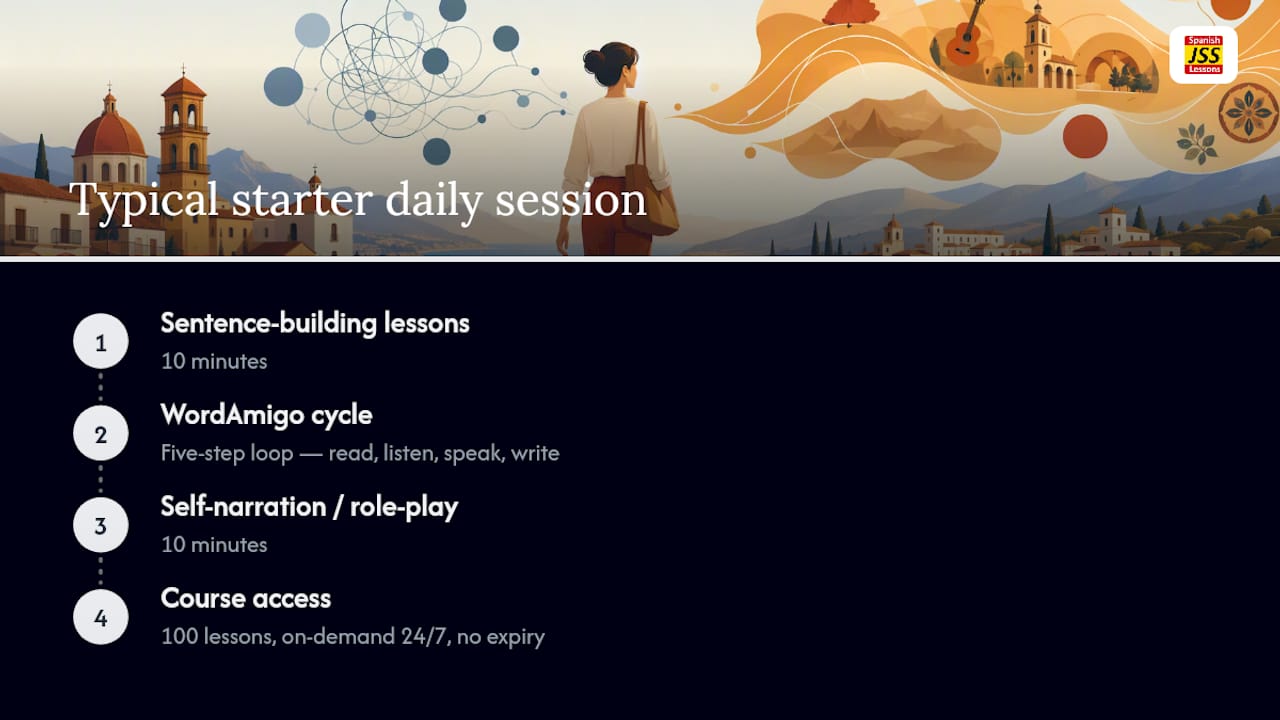
The WordAmigo system sits at the heart of vocabulary retention. Its Five-Step Retention Loop cycles new words through reading, listening, speaking, and writing in short, spaced sessions, permanently embedding them without the English-gloss intermediary. In a two-week starter plan, a typical daily session looks like this: 10 minutes of sentence-building lessons, one WordAmigo vocabulary cycle, and a 10-minute self-narration or role-play drill. The school’s 100 lessons are available on demand, 24/7, with no expiry date and no pressure from a countdown clock.
Ready to build the habit properly? Explore the James Spanish School courses and see how the Radical Simplification method and WordAmigo system fit into your daily routine from day one.
Sources
- Reframing unhelpful thoughts (Every Mind Matters) — NHS
- Changes in thinking for speaking: a longitudinal case study — SCIENCE@home
- Howtothink