

Guide to Spanish breakfast culture
TL;DR:
- Spanish breakfast is a light, social meal centered around a café rather than an elaborate kitchen table. Visiting a local bar for a tostada con tomate and café con leche between 10 and 11 AM offers an authentic and affordable start to the day.
Spanish breakfast is light, social, and built around the café rather than the kitchen table. The single best thing you can order the moment you walk into a local bar is a tostada con tomate and a café con leche. That combination is inexpensive in most Spanish cities and tells you everything about how mornings work here.
Here is what to expect at a glance:
- Two-stage rhythm: a small coffee or bite at home, followed by a mid-morning café stop around 10–11 AM, which is where the real social ritual happens.
- Price range: a tostada and coffee typically costs €2–€3 at a local bar; churros con chocolate at a churrería is moderately priced, usually a little higher.
- Where to go: a neighbourhood bar, a bakery (panadería), or a churrería. Skip the hotel buffet.
- What to expect: a short, unhurried pause rather than a full meal. Lunch is the main event in Spain.
Skip the Hotel Buffet: This Is How Spaniards Actually Eat Breakfast explains this two-stage rhythm clearly: the mid-morning café stop is less about hunger and more about connection, a pause built into the working day.
Table of Contents
- What do Spaniards actually eat for breakfast?
- When do Spaniards eat breakfast, and what is the etiquette?
- Useful Spanish phrases for ordering breakfast
- Key takeaways
- Speaking Spanish at the breakfast bar: how James Spanish School can help
- Useful sources
What do Spaniards actually eat for breakfast?
The classic Spanish breakfast dishes are simpler than most visitors expect, and that simplicity is the point. Quality ingredients do the work.
- Tostada con tomate / pa amb tomàquet: Toasted bread rubbed with ripe tomato, drizzled with good olive oil and finished with a pinch of salt. In Catalonia it is called pa amb tomàquet and the tomato is often grated directly onto the bread rather than rubbed. This is the backbone of the traditional Spanish breakfast and the dish you will see on almost every bar counter in the country.
- Churros con chocolate: Fried dough sticks served with thick, almost pudding-like hot chocolate. A weekend treat rather than a daily staple, and best found at a dedicated churrería. Madrid has a particularly strong churrería culture.
- Tortilla española: A dense potato and onion omelette, often served cold in a wedge on a small plate. Spain on a Fork’s recipe notes confirm that the authentic version uses olive oil generously and cooks the potato slowly before combining with egg.
- Pastries: Magdalenas (soft, lemon-scented muffins), napolitanas (puff pastry filled with chocolate), and ensaimadas (the spiral pastry from Mallorca, dusted with icing sugar). A quick dietary note: some traditional pastries, particularly in older bakeries, are made with lard (manteca). If you avoid pork products, ask: “¿Lleva manteca?” before ordering.
- Bocadillo or sandwich mixto: A crusty bread roll or a toasted sandwich, often filled with jamón, cheese, or both. Common in bars that serve a working crowd from early morning.
How to assemble a tostada con tomate at home: halve a ripe tomato and grate it directly onto toasted bread using a box grater, discarding the skin. Add a generous drizzle of extra-virgin olive oil and a pinch of coarse salt. That is the whole recipe.
Pro Tip: Avoid the hotel buffet for your first Spanish breakfast. A local bar will give you a fresher tostada, better coffee, and a more honest price, often for half what the hotel charges. Look for a place with a chalkboard menu and locals standing at the bar.
When do Spaniards eat breakfast, and what is the etiquette?
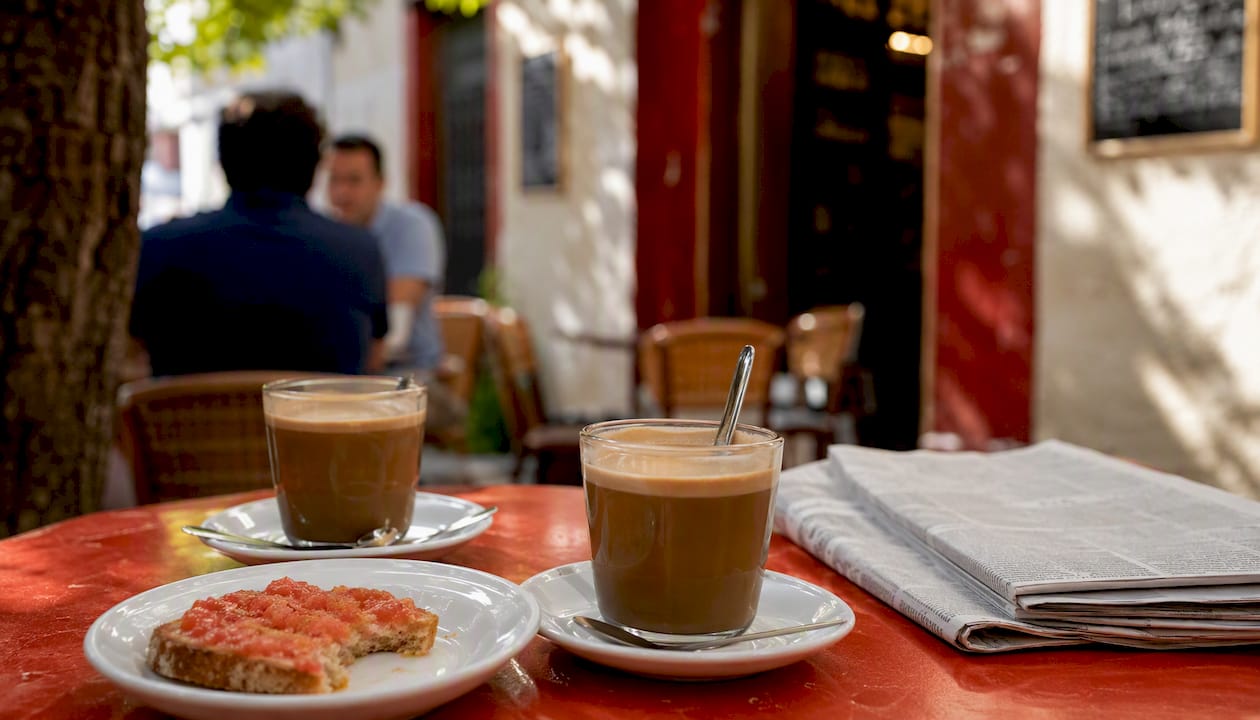
The Spanish breakfast habits in Spain follow a rhythm that surprises most British visitors. Cultural breakfast practices in Spain are shaped by the fact that lunch, not breakfast, is the main meal of the day.
Typical timing:
- 7–9 AM: A quick coffee at home, sometimes with a piece of toast or a biscuit. This is the primer desayuno, brief and functional.
- 10–11:30 AM: The mid-morning café stop. This is the social moment. Workers, tradespeople, and retirees all converge on local bars for a tostada and coffee. This is when you want to be there.
- 2–3:30 PM: La comida, the main meal of the day. Breakfast is deliberately light because this is what everyone is saving space for.
Etiquette at the bar:
- Standing at the bar is normal and often preferred. You get served faster, and it is where the conversation happens.
- Order when the barista catches your eye. There is no formal queuing system; a polite nod and a “buenos días” go a long way.
- Payment is usually at the end of your visit, not upfront. Ask for the bill with “La cuenta, por favor.”
- Tipping is appreciated but not obligatory. Leaving small coins on the counter is the local custom; a 10% tip is generous and not expected for a coffee and toast.
- Card payments are increasingly accepted, but many small neighbourhood bars still prefer cash. Carry a few euros.
The social function of the café stop is real. As Go Travel Light notes, locals use it to chat with neighbours, read the paper, or simply decompress before the working day accelerates. Rushing through it defeats the purpose.
Useful Spanish phrases for ordering breakfast
A handful of phrases, practised before you leave home, will transform your café experience. Amazing Food & Drink’s guide to Spanish breakfast notes that pan con tomate and churros are the two dishes most visitors want to order, and both are straightforward once you know the words.
Ready-to-use phrases:
- “Buenos días. Una tostada con tomate y aceite, por favor.” (Good morning. A tostada with tomato and oil, please.)
- “Un café con leche, por favor.” (A white coffee, please.)
- “Media tostada, por favor.” (Half a tostada, please — useful if you want a smaller portion.)
- “Una entera, por favor.” (A whole one, please.)
- “¿Tiene zumo de naranja natural?” (Do you have fresh orange juice?)
- “La cuenta, por favor.” (The bill, please.)
- “¿Lleva manteca?” (Does it contain lard? — for dietary checks on pastries.)
- “Sin gluten, ¿tiene algo?” (Do you have anything gluten-free?)
Dos and don’ts:
- Do greet the barista with “buenos días” when you walk in. It costs nothing and sets the tone.
- Do not ask for a “latte.” Order a café con leche instead.
- Do not wave or click your fingers to get attention. Make eye contact and wait.
- Do carry cash, especially in smaller towns and village bars.
For a deeper look at speaking Spanish fluently with locals, even a few practised phrases open doors that silence keeps firmly shut.
Key takeaways
Spanish breakfast is light, social, and café-centred: order a tostada con tomate and a café con leche at a local bar between 10 and 11 AM for the most authentic experience.
| Point | Details |
|---|---|
| Timing matters | The mid-morning café stop (10–11 AM) is the main breakfast moment; the early coffee at home is just a warm-up. |
| What to order first | A tostada con tomate and a café con leche: the combination costs €2–€3 at a local bar. |
| Where to eat | Choose a neighbourhood bar, churrería, or panadería over a hotel buffet for better quality and lower prices. |
| Regional differences | Each region has a signature dish: mollete in Andalusia, pa amb tomàquet in Catalonia, ensaimada in the Balearics. |
| James Spanish School | Learning a few ordering phrases before travel, using the James Spanish School course, makes every café stop more rewarding. |
Speaking Spanish at the breakfast bar: how James Spanish School can help
Knowing what to order is one thing. Saying it with confidence, understanding the reply, and having a brief friendly exchange with the barista is something else entirely, and that is where a few hours of structured preparation pays off far beyond the breakfast table.
James Spanish School was built specifically for English-speaking adults who want practical, real-life Spanish rather than academic grammar. The WordAmigo vocabulary system uses AI-powered strategic repetition to lock in words and pronunciation so they are there when you need them, not just when you are sitting quietly at home. Founder James Bretherton has lived in Spain for 40 years and the course reflects that: real café conversations, real ordering scenarios, real cultural context. If you want to walk into a Spanish bar and feel at ease rather than flustered, the James Spanish School course is the practical next step. Browse the full course options and start building your confidence before your trip.
Useful sources
- Skip the Hotel Buffet: This Is How Spaniards Actually Eat Breakfast
- What To Expect From Breakfasts In Spain: 5 Tips | WAW Travel
- What Spanish People Really Eat For Breakfast: Spanish Breakfast Recipes – 20 Traditional Breakfast In Spain To Try
- 16 Best Breakfasts in Spain – TasteAtlas
- Spanish Breakfast: pan con tomate, churros, and Morning Food Culture Unveiled – Amazing Food & Drink
- Exploring Spanish Breakfast Culture: Timing And Traditions In Spain | AnMeal
- The Authentic Tortilla Espaona | Spanish Potato & Onion Omelette
- A Typical Breakfast In Spain | Traditional Spanish Breakfast Recipe
- James Spanish School