

TL;DR:
- Knowing basic Spanish pool phrases helps you communicate easily in Spain and Latin America.
- Practicing common verbs and dialogues improves your fluency and confidence at the poolside.
Whether you are heading to a hotel pool in Málaga, joining a swimming class in Madrid, or simply want to chat with the lifeguard without freezing up, these Spanish phrases for swimming pools will get you talking straight away. The ten phrases below are the ones you will use most, each with a pronunciation cue and a quick context note drawn from practical pool phrase guides.
- La piscina (la pees-SEE-na) — “the swimming pool.” Use it to ask directions: ¿Dónde está la piscina? (Where is the pool?)
- ¿Puedo entrar? (PWEH-doh en-TRAR) — “May I get in?” Say this before stepping into a pool at a hotel or leisure centre.
- El agua está fría (el AH-gwah es-TAH FREE-ah) — “The water is cold.” Useful for small talk the moment you dip a toe in.
- ¿Dónde están los vestuarios? (VESS-twah-ree-ohs) — “Where are the changing rooms?” Stress the second syllable of vestuarios.
- ¡Ayuda! (ah-YOO-dah) — “Help!” The single most important word at any pool.
- No sé nadar (noh seh nah-DAR) — “I can’t swim.” Stress the final syllable of nadar.
- ¿Hay un socorrista? (ah-EE oon soh-koh-REES-tah) — “Is there a lifeguard?” Essential when arriving at an unfamiliar pool.
- Necesito una toalla (neh-seh-SEE-toh oo-nah toh-AH-yah) — “I need a towel.” The double l in toalla sounds like a y in European Spanish.
- ¿A qué hora cierra la piscina? (ah keh OH-rah see-EH-rah) — “What time does the pool close?”
- Prohibido correr (proh-ee-BEE-doh koh-REHR) — “No running.” You will see this on signs everywhere.
Pro Tip: Stress in Spanish almost always falls on the second-to-last syllable unless a written accent mark tells you otherwise. Knowing this one rule lets you pronounce most pool words correctly on the first attempt.
Table of Contents
- Which verbs do you need most at a pool?
- Two short dialogues for lessons and poolside conversations
- How does the word for “pool” change across Spanish-speaking countries?
- How to practise these phrases so they actually stick
- Key takeaways
- Ready for structured practice? James Spanish School can help
- Useful sources and quick references for further study
Which verbs do you need most at a pool?
A small set of high-frequency verbs covers almost every pool situation. The table below shows the present tense for yo (I), tú (you, informal) and usted (you, formal/polite), plus a common imperative form.
| Verb | Meaning | Yo | Tú | Usted | Imperative (tú) |
|---|---|---|---|---|---|
| nadar | to swim | nado | nadas | nada | nada |
| entrar | to enter/get in | entro | entras | entra | entra |
| salir | to get out/leave | salgo | sales | sale | sal |
| bucear | to dive/snorkel | buceo | buceas | bucea | bucea |
| flotar | to float | floto | flotas | flota | flota |
| tirarse | to jump in | me tiro | te tiras | se tira | tírate |
| ayudar | to help | ayudo | ayudas | ayuda | ayuda |
Usage notes worth remembering: Sal del agua means “Get out of the water” (informal command to a child or friend), while Salga del agua is the polite form you would use with a stranger or adult. Tírate (“Jump in!”) is the casual encouragement you hear at every pool party. Learner resources consistently highlight these imperative forms as the most practically useful for both safety commands and everyday poolside chat.
Two short dialogues for lessons and poolside conversations
These micro-dialogues show how real exchanges sound. Read them aloud, then swap roles.
Dialogue 1: Starting a lesson
Dialogue 2: Asking about the pool
Pronunciation tips for these dialogues: The word enseñarme (teach me) stresses the second syllable: en-seh-NYAR-meh. In principiante (beginner), stress falls on the fourth syllable: prin-see-pee-AN-teh. In European Spanish, c before e or i sounds like the English th in “think,” so cierra sounds like thee-EH-rah, not see-EH-rah. Pronunciation guidance for pool phrases consistently recommends focusing on this c/z distinction as the single most noticeable marker of European Spanish.
Pro Tip: Practise each dialogue by covering the English translation and reading only the Spanish aloud. Then swap: read the English and try to produce the Spanish from memory. This active recall loop is far more effective than passive reading.
How does the word for “pool” change across Spanish-speaking countries?
The term you use depends on where you are. Cambridge Dictionary notes piscina as the general standard, with alberca and pileta as established regional alternatives.
| Term | Region | Pronunciation cue |
|---|---|---|
| la piscina | Spain, most of Latin America | pees-SEE-na |
| la alberca | Mexico | al-BEHR-ka |
| la pileta | Argentina, Uruguay | pee-LEH-ta |
For European Spanish learners, piscina is always the safe default. If you travel to Mexico and say piscina, you will be understood; the reverse is equally true.
Pronunciation notes for European Spanish:
- C before e or i sounds like th (as in “think”): piscina = pees-THEE-na in Castilian Spanish.
- Z follows the same rule: natación = nah-tah-THYON.
- Stress falls on the second-to-last syllable unless a written accent overrides it.
Register note: Use tú with children, friends, and peers. Switch to usted with pool staff, lifeguards, and anyone you have not met before. ¿Puede ayudarme? (formal) lands better with a receptionist than ¿Puedes ayudarme? (informal).
How to practise these phrases so they actually stick
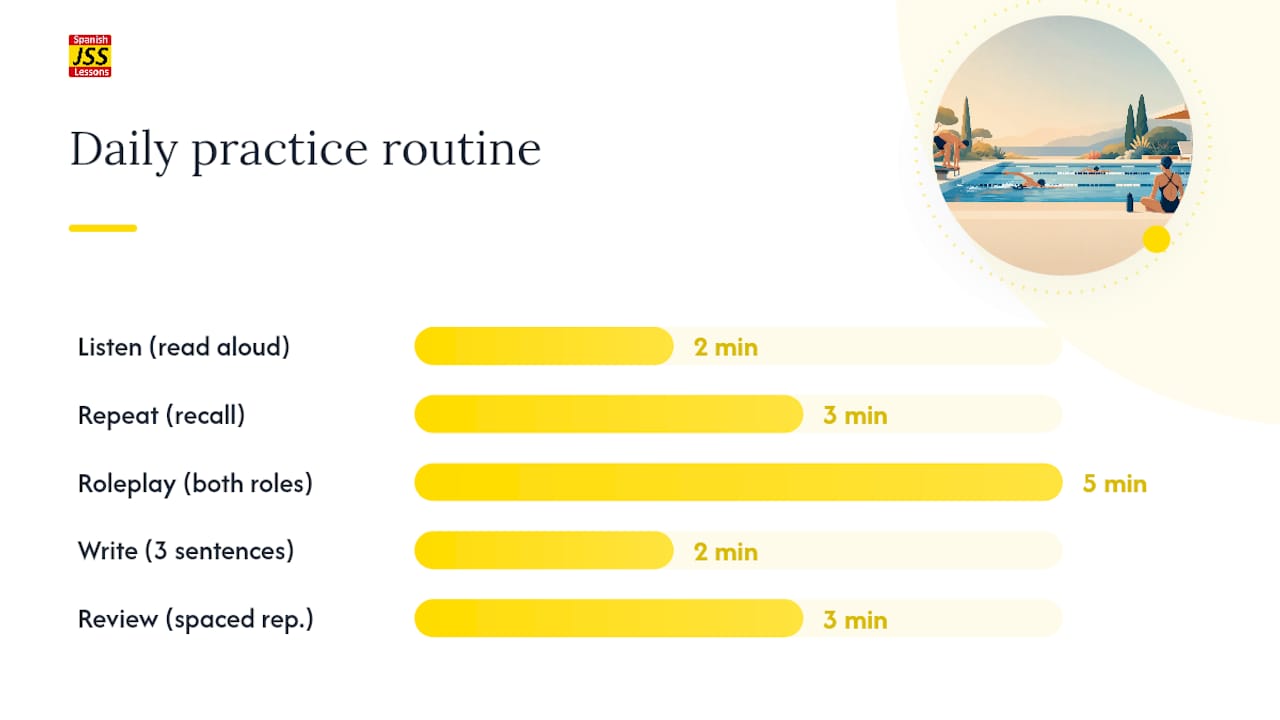
Passive reading gets you recognition. Spoken recall gets you fluency. A short, repeatable daily routine converts one into the other.
- Listen (2 minutes): Read each phrase aloud, then listen back to yourself or use an audio tool to check your stress placement.
- Repeat (3 minutes): Cover the English column and say the Spanish from memory. Flip the exercise: read the English and produce the Spanish.
- Roleplay (5 minutes): Run through one of the dialogues above, playing both roles. Change one detail each time (different time, different stroke, different request).
- Write (2 minutes): Write three sentences using today’s new words without looking at your notes.
- Review (3 minutes): Use spaced repetition to revisit yesterday’s phrases before adding new ones.
This five-step loop mirrors the WordAmigo retention system used in the James Spanish School course, which automates the review cycle across reading, listening, speaking, and writing so nothing slips through the gaps.
Practice checklist for pool phrases:
- Roleplay the reception dialogue until it feels automatic
- Shadow a native speaker saying ¿Puedo entrar? and El agua está fría
- Write the ten BLUF phrases from memory, then check
- Use real-world prompts: next time you pass a leisure centre, mentally name every visible feature in Spanish
Pro Tip: Focus on a small set of high-frequency verbs and nouns first, then practise them in short roleplays. This yields faster spoken recall than memorising long lists. SpanishStep’s phrase research supports exactly this approach for pool vocabulary.
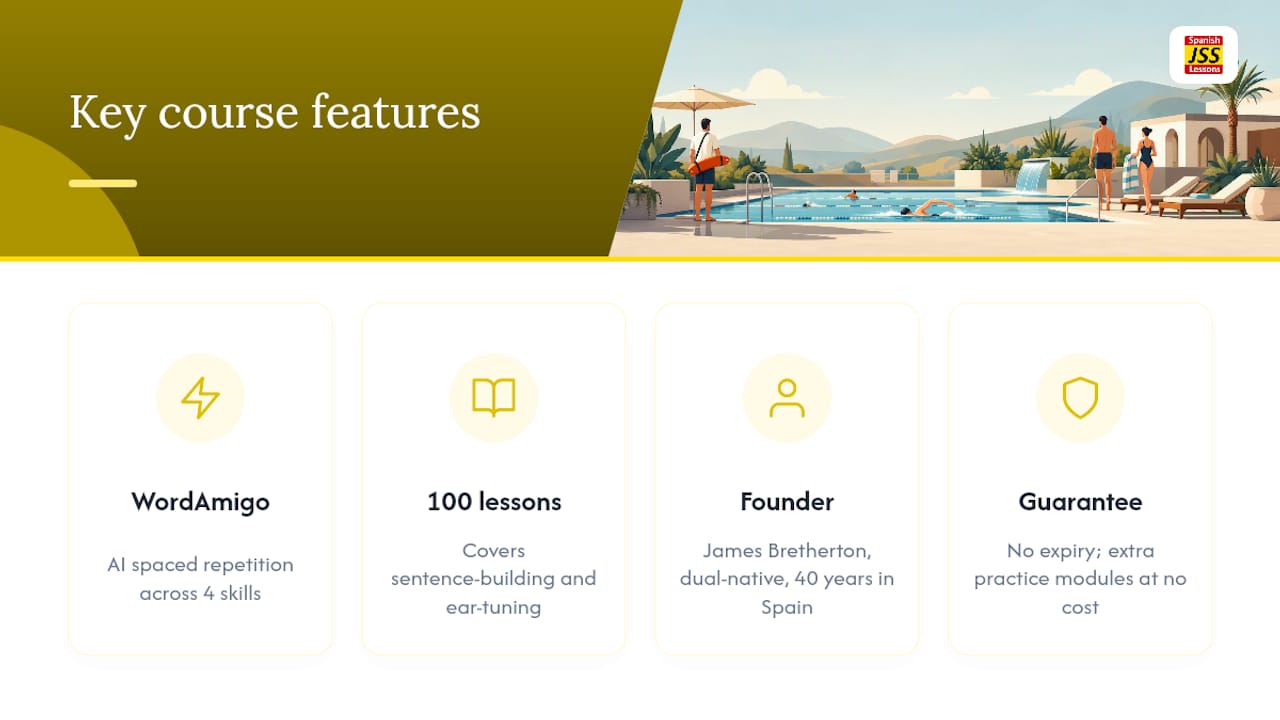
For learners who want structured spoken practice, the James Spanish School course provides 100 on-demand lessons covering sentence-building and ear-tuning, with lifetime access and no expiry date.
Key takeaways
Mastering a core set of Spanish pool phrases, from la piscina and ¡Ayuda! to el extremo profundo and Llamen a una ambulancia, gives you the confidence to handle lessons, emergencies, and everyday poolside conversations in Spain.
| Point | Details |
|---|---|
| Default word for “pool” | Use la piscina in Spain and most of Latin America; alberca in Mexico, pileta in Argentina. |
| Emergency phrases first | Memorise ¡Ayuda! and Llamen a una ambulancia before anything else; dial 999 or 112 in a real emergency. |
| Stress placement rule | Stress falls on the second-to-last syllable unless a written accent says otherwise — this covers most pool words. |
| Verbs to prioritise | Nadar, salir, ayudar, tirarse and flotar cover the vast majority of pool interactions. |
| James Spanish School | The WordAmigo system and 100-lesson course embed pool vocabulary and pronunciation through spaced repetition, with lifetime access. |
Ready for structured practice? James Spanish School can help
Learning a phrase list is a solid start. Keeping those phrases in your head six months later, and producing them at machine-gun speed when a lifeguard speaks to you, is a different challenge entirely.
James Spanish School’s course is built for exactly this gap. The WordAmigo system uses AI-powered spaced repetition to permanently embed vocabulary and pronunciation across reading, listening, speaking, and writing, so words like socorrista and vestuario stay with you rather than fading after a week. The 100-lesson course covers sentence-building and ear-tuning, with founder James Bretherton, a dual-native speaker with 40 years in Spain, guiding you through real-life conversations, not academic exercises. There is no expiry date, no countdown clock, and a cast-iron guarantee: if a core lesson teaches you nothing new, you receive extra practice modules at no cost. Browse the full course at James Spanish School and start building the spoken confidence that phrase lists alone cannot give you.
Useful sources and quick references for further study
These resources were used to compile the phrases, translations, and usage notes in this article.
- Cambridge Dictionary — swimming pool (English-Spanish)
- WordReference — swimming pool (English-Spanish)
- Collins Dictionary — swimming pool (English-Spanish)
- 30 Spanish phrases for swimming pool visits | SpanishStep
- Spanish phrases for swimming pool conversations | SpanishStep
- What to say in Spanish when entering a swimming pool | SpanishStep
- How To Say “Swimming Pool” In Spanish | FluentVista