

Audio repetition system for Spanish
An audio-first spaced repetition system (SRS) is the most effective method English-speaking learners can use to lock in Spanish vocabulary and pronunciation simultaneously. Start today with a daily routine of a short listening and speaking practice: listen to a word or phrase in native Spanish, recall its meaning without looking, then shadow it aloud. That single loop, repeated consistently, is what separates learners who remember from those who forget. James Bretherton, dual-native speaker and founder of James Spanish School, built WordAmigo specifically around this principle, with a cast-iron satisfaction guarantee: if a core lesson teaches you nothing new, you receive extra practice modules at no cost.
Key takeaways
An audio-first SRS is the most effective method for English-speaking learners to build Spanish vocabulary retention and pronunciation simultaneously, and 10–15 minutes of daily practice is enough to produce measurable progress within two to three weeks.
| Point | Details |
|---|---|
| Daily session length | 10–15 minutes daily outperforms longer, infrequent sessions for memory consolidation. |
| Review intervals | Start same-day, then 1, 3, 7, 14, and 30+ days; reset any card where pronunciation was unclear. |
| Active recall is non-negotiable | Always attempt a spoken response before revealing the answer; passive listening produces minimal retention. |
| Deck sourcing | Anki supports custom audio decks; Forvo and Tatoeba-style corpora provide native recordings for DIY builds. |
| WordAmigo | James Spanish School’s five-step retention loop automates scheduling, native audio, and pronunciation practice for English speakers. |
Table of Contents
- What is an audio-based spaced repetition system for Spanish?
- Why does audio plus spaced repetition improve memory and pronunciation?
- What review schedule works best for audio SRS?
- A daily audio-first SRS workflow you can follow in 10–25 minutes
- How to build or source high-quality audio SRS decks
- Specific pronunciation techniques to pair with your audio SRS
- Common mistakes with audio SRS and how to fix them
- Why WordAmigo is the recommended audio SRS for English-speaking learners
- A 4-week example study plan using an audio SRS
- WordAmigo and the James Spanish School course: your next step
- Sources
What is an audio-based spaced repetition system for Spanish?
Spaced repetition is the practice of reviewing material at carefully timed intervals, just before memory fades. An audio-first SRS applies that scheduling logic specifically to spoken items: native recordings, phrase-level sentences, or short dialogues rather than written flashcards. That distinction matters more than it might seem.
Text-only SRS trains visual recognition. You see “el ayuntamiento” and recall “town hall.” Useful, but it does nothing for the moment a Spanish neighbour says it at machine-gun speed. Audio SRS trains the ear-to-brain pathway directly, so recognition and production develop together.
Passive audio, such as playing a podcast in the background, is not the same thing. Passive listening lacks the active recall trigger that forces your brain to retrieve a word under mild pressure. Without that retrieval effort, the memory trace stays shallow.
Typical items in an audio SRS include:
- Single-word pronunciation cards: the spoken word plays; you recall meaning and repeat aloud.
- Phrase-level sentences: a short, natural sentence in European Spanish, timed to match real conversational pace.
- Short dialogues: two to four exchanges that train contextual listening alongside vocabulary.
- Clipped native audio: a two-to-five second extract from real speech, stripped of surrounding context, used to train phoneme recognition.
The key differentiator is the combination of scheduled review timing and active spoken response. That pairing is what makes an audio SRS a genuinely different tool from a playlist or a language podcast.
Why does audio plus spaced repetition improve memory and pronunciation?
Audio SRS pairs spaced retrieval with perceptual training for pronunciation, and that combination accelerates usable recall faster than either method alone. Here is why each element contributes.
Spacing and the retrieval effect. Memory consolidates most efficiently when you retrieve a word just before you would naturally forget it. Each successful retrieval at that moment strengthens the neural pathway more than ten passive re-reads. The SRS algorithm calculates that “just-before-forgetting” window automatically, so you spend review time where it counts.
Audio cues and listening-to-production links. When the review item is a spoken word rather than printed text, your brain builds a direct link between the sound pattern and the meaning. That link is what allows you to understand fast native speech. Listening and speaking share overlapping neural resources, so training one actively supports the other.
Pronunciation and prosody. European Spanish has a consistent, syllable-timed rhythm that English speakers find unfamiliar. Repeated exposure to native prosody, combined with active imitation, builds automatic speech patterns over time. ShadowingKit notes that shadowing was originally developed for conference interpreters and recommends 10–15 minutes daily as the practical sweet spot for building speech automaticity. That is a manageable commitment that fits around a working day or a retirement schedule equally well.
Research into top language learning methods consistently places spaced retrieval and active production among the highest-impact techniques for adult learners. Pairing both in a single audio session is simply efficient.
Pro Tip: Keep sessions short and consistent. Short daily audio SRS sessions outperform longer weekly sessions because memory consolidation happens during the gaps between practice, not during the practice itself.
What review schedule works best for audio SRS?
The standard SRS interval ladder works well for audio items, with one practical adjustment: audio cards that involve pronunciation need slightly more early repetition than pure vocabulary cards, because motor memory for speech builds more slowly than semantic recall.
| Review stage | Interval | Why it works for audio items |
|---|---|---|
| First exposure | Same session | Establishes the initial sound-to-meaning link |
| First review | 1 day later | Tests recall before overnight forgetting erases the trace |
| Second review | 3 days later | Strengthens the link after one consolidation cycle |
| Third review | 7 days later | Confirms retention across a full week |
| Fourth review | 14 days later | Moves the item toward medium-term memory |
| Long-term review | 30+ days | Periodic maintenance; item is considered retained |
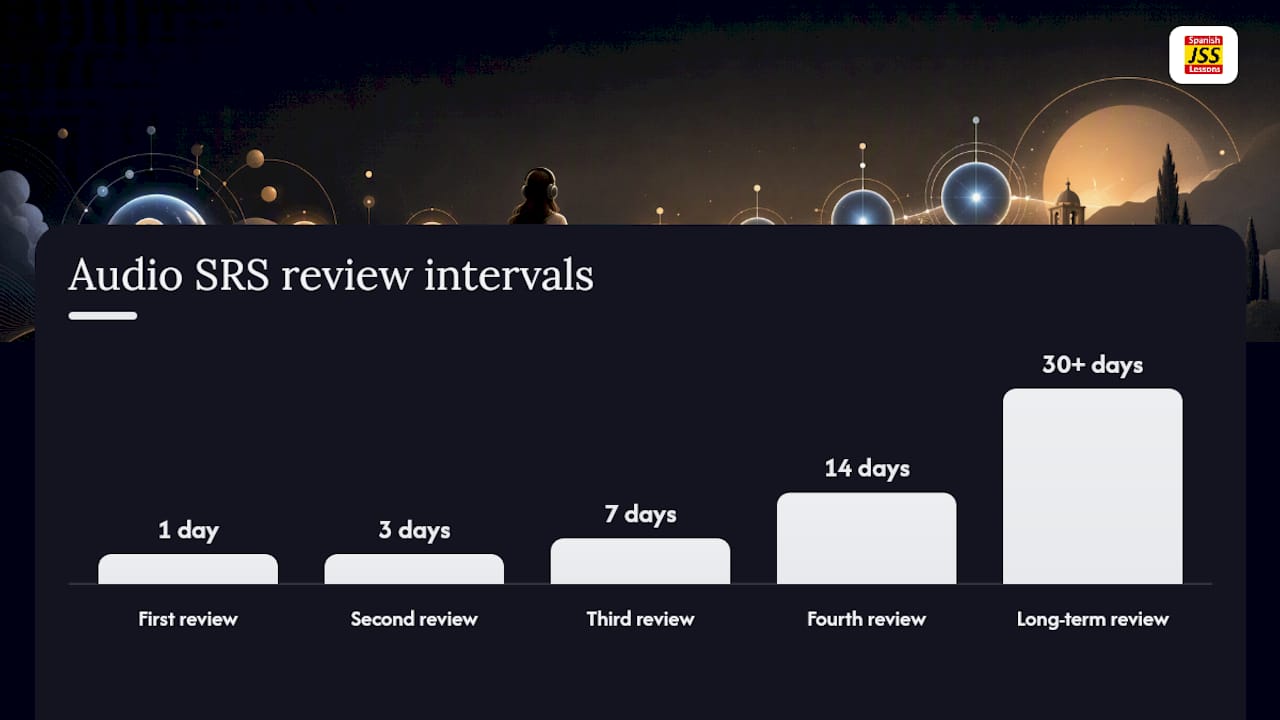
Adaptive adjustments. If you recall a word correctly and pronounce it cleanly, the interval extends. If you hesitate or mispronounce, the card resets to a shorter interval. Most SRS apps call this the “ease factor.” For audio cards specifically, apply a stricter pass criterion: correct meaning recall alone is not enough; the spoken response should also be intelligible. That keeps pronunciation from lagging behind vocabulary.
Fixed vs adaptive scheduling. Anki uses an adaptive algorithm that adjusts intervals based on your self-rated recall. That flexibility suits audio decks well because you can rate a card “hard” when the pronunciation felt wrong even if the meaning was right. Fixed-interval apps are simpler to start with but offer less precision over time.
For learners who want a ready-built system rather than a self-managed deck, WordAmigo automates the entire scheduling layer, removing the need to manage intervals manually.
A daily audio-first SRS workflow you can follow in 10–25 minutes
The simplest effective routine is: listen, recall, shadow, record, review. Total time: 10–25 minutes depending on your schedule. Here is how to structure it.
- Warm-up listening (2 minutes). Play three to five audio cards from your deck without attempting recall. This primes your ear and reduces the cold-start effect that makes early-session recall feel harder than it is.
- Active recall review (5–10 minutes). Work through your due cards. For each one: the audio plays, you recall the meaning silently, then say the word or phrase aloud before revealing the answer. Rate your response honestly, including pronunciation quality.
- Shadowing (3–5 minutes). Take three to five cards you found difficult and shadow them: play the audio and speak simultaneously, matching the speaker’s rhythm and intonation as closely as possible. ShadowingKit recommends this real-time imitation as the fastest route to automatic production.
- Self-recording (2–3 minutes). Record yourself saying five target words or phrases. Play back and compare against the native audio. You do not need specialist equipment; a phone microphone in a quiet room is sufficient.
- New items (3–5 minutes). Add three to five new cards and complete their first exposure. Keep new additions modest; flooding the deck creates review backlogs that erode motivation.
Time budgets by session length:
- 10 minutes: Steps 2 and 3 only. Skip warm-up and new items on very short days.
- 15 minutes: Steps 1–3, plus two to three new items.
- 25 minutes: Full five-step routine with self-recording.
For UK learners, the morning commute, a lunch break, or the fifteen minutes before bed are natural slots. The key is consistency over duration. Talkparty reports that learners often notice clearer comprehension within two to three weeks of 15-minute daily practice, which aligns with what James Spanish School learners typically experience.
Pro Tip: Use Listen Repeat to split a longer audio clip into sentence-length segments and loop each one precisely. Precise waveform selection and automatic sentence splitting make looped repetition far more efficient than replaying a whole file.
How to build or source high-quality audio SRS decks
Both approaches work: building your own audio cards gives you full control over speech variety and content relevance; sourcing existing decks saves time and gets you practising immediately. Choose based on your available time and how specific your vocabulary needs are.
Building your own audio cards
DIY recording produces the most targeted material. Keep each card to a single word or one short sentence (under eight seconds of audio). Record in a quiet room with your phone held 20–30 cm from your mouth. Name files consistently: speaker initials, accent region, speed, and item number (e.g., ES_CastilianStd_0.9x_0042). Add phonetic notes in the card metadata for sounds that differ sharply from English, such as the rolled “r” or the “j” sound.

For European Spanish specifically, prefer a Castilian accent in your recordings. That is the variety most relevant to learners planning to live in or visit Spain, and it is the accent James Spanish School teaches throughout its course.
Controlled text-to-speech (TTS) is a practical shortcut for building large decks quickly. Modern TTS voices for Spanish are accurate enough for vocabulary-level pronunciation, though they lack the natural prosody of a real speaker. Use TTS for initial deck building, then replace high-frequency cards with native recordings over time.
Sourcing existing audio material
Anki supports audio attachments on cards and hosts a community deck library where many Spanish decks include native audio. Quality varies, so preview a deck before committing to it. Check the speaker’s accent, audio clarity, and whether the items match European Spanish usage rather than Latin American variants.
Forvo is a pronunciation reference database where native speakers record individual words. It is useful for checking a specific word’s pronunciation before recording your own card. Tatoeba-style sentence corpora provide short, natural sentences with audio contributed by native speakers, which can be imported into Anki or similar platforms.
Escucha offers region-specific accents and instant comprehension feedback, making it a useful supplement for the listening side of your deck-sourcing workflow. For scenario-based audio that mirrors real-life situations, Comprehenzo provides CEFR-calibrated material aimed at learners who can read Spanish but struggle with native-speed speech.
Recording checklist:
- Script: one word or one sentence per card, maximum eight seconds
- Room: quiet, no echo (a wardrobe full of clothes works well)
- File naming: speaker, accent, speed, item number
- Metadata: phonetic notes for difficult sounds, CEFR level tag
- Licensing: if using third-party audio, confirm the licence permits educational use
Specific pronunciation techniques to pair with your audio SRS
Combine audio SRS with short, focused pronunciation drills for the best results. The SRS handles scheduling and retention; the drills convert passive recognition into clear, confident production.
- Shadowing. Play a sentence and speak simultaneously, matching the speaker’s rhythm, speed, and intonation in real time. Start at 0.7x speed if the natural pace feels too fast, then increase gradually. Talkparty supports adjustable speed from 0.7x to 1.3x, which makes this progression straightforward.
- Sentence chunking. Break a sentence into two or three meaningful chunks and master each chunk’s intonation before joining them. “Quiero un café” becomes “Quiero” + “un café,” each practised separately, then combined.
- Minimal pairs. Contrast sounds that English speakers confuse: “pero” (but) vs “perro” (dog), or “casa” (house) vs “caza” (hunt). Drill these in back-to-back pairs to sharpen phoneme discrimination.
- Slowed playback followed by normal replay. Listen at 0.7x to catch every phoneme clearly, then immediately replay at 1.0x to hear how those phonemes flow together at natural speed. The contrast trains your ear to bridge the gap between careful and natural speech.
A practical 10-minute pronunciation drill inside an SRS session might look like: two minutes of minimal-pair contrasts, three minutes of sentence chunking on today’s failed cards, and five minutes of full shadowing on a short dialogue. That is enough to produce noticeable improvement within a fortnight.
For a deeper look at pronunciation strategies that pair well with this kind of audio work, the James Spanish School pronunciation guide covers the specific sounds that trip up English speakers most often.
Pro Tip: Use Listen Repeat to trim silence from the start and end of a clip and loop exactly the phrase you want to master. Removing dead audio keeps your attention on the target sound and prevents the mind from drifting during repetition.
Common mistakes with audio SRS and how to fix them
Most problems with audio SRS are fixable with small changes to scheduling, audio quality, or active practice habits. The issues below account for the majority of learner frustration.
- Overreviewing. Adding too many new cards daily creates a review backlog within days. Fix: cap new cards at five per session until your daily review load stabilises below 20 minutes.
- Passive listening instead of active recall. Playing cards as background audio without attempting recall produces almost no retention benefit. Fix: always pause before the answer reveals and force a spoken response, even a hesitant one.
- Poor audio quality. Clipped, distorted, or echoey recordings confuse the ear and make pronunciation modelling impossible. Fix: re-record any card where the waveform shows clipping (a flat-topped peak in the audio editor) or where background noise is audible.
- Ignoring accent variety. Using Latin American audio for a European Spanish goal trains the wrong phonemes. Fix: audit your deck for speaker origin and replace non-Castilian cards if your target is Spain.
- Mismatched pacing. Cards recorded at unnaturally slow speed create a false sense of competence. Fix: once a word feels secure at slow speed, add a second card of the same item at natural pace.
- Skipping self-recording. Many learners review audio but never record themselves, so pronunciation errors go uncorrected for weeks. Fix: record five words per session and compare against the native model.
Quick troubleshooting checklist:
- Audio clipping: check waveform peaks; re-record if flat-topped.
- Wrong accent: verify speaker origin in card metadata.
- Items too long: split any card over eight seconds into two shorter cards.
- Calendar sync: if your SRS app is not syncing across devices, check cloud-sync settings before your next session to avoid duplicate reviews.
If you find listening comprehension itself is the sticking point rather than vocabulary recall, the James Spanish School article on why Spanish listening is hard addresses the specific reasons English speakers struggle and gives targeted fixes.
Why WordAmigo is the recommended audio SRS for English-speaking learners
WordAmigo is the recommended, ready solution because it combines SRS scheduling with native audio, pronunciation practice, and a five-step retention loop built specifically for English speakers learning European Spanish. You do not need to build decks, manage intervals, or source recordings. The system handles all of that.
The five-step retention loop
WordAmigo automates a full loop of exposure across reading, listening, speaking, and writing. Each step reinforces the previous one, so vocabulary and pronunciation are embedded together rather than learned separately and never connected.
The five steps work as follows:
- Reading: you see the word or phrase in context, building a visual anchor.
- Listening: native audio plays, training the ear-to-brain pathway directly.
- Speaking: you produce the word aloud, activating motor memory for pronunciation.
- Writing: you type or write the item, adding a kinaesthetic reinforcement layer.
- Spaced review: the system schedules the next review at the optimal interval, automatically adjusting based on your performance.
Each step maps to a measurable outcome. Listening accuracy improves through the audio and speaking steps. Vocabulary retention improves through the spaced review cycle. Pronunciation improves through the combination of native audio modelling and your own spoken production.
Trust signals and what to expect
James Bretherton has lived in Spain for 40 years and speaks Spanish as a dual native. WordAmigo was built in collaboration with IT specialists and long-term English expats fully immersed in Spanish society, specifically to address the frustrations those expats encountered: words that would not stay in memory and mispronunciation that native speakers struggled to understand.
The satisfaction guarantee is concrete: if a core lesson teaches you nothing new, James credits you with extra practice modules at no cost. Lifetime access means there is no countdown clock and no expiry date.
Pro Tip: Start with the WordAmigo pronunciation mode early in your learning. Pronunciation habits form early and are harder to correct later. Getting the sounds right from the start saves significant re-learning time.
A 2-week starter plan: spend the first week on 10-minute sessions covering the pronunciation mode and your first 30 vocabulary items through the five-step loop. In week two, extend to 15 minutes, add 10 new items every two days, and begin shadowing the audio from your review cards. By day 14, most learners have a stable daily review load and a clear sense of which sounds need extra drilling.
A 4-week example study plan using an audio SRS
A clear, repeatable 4-week routine scales from 10 to 25 minutes as your confidence grows. Use the weekly checkpoints below to measure progress and adjust your pace.
- Week 1 (10 minutes daily): Foundation.
Add five new audio cards per day. Complete active recall on all due cards. Shadow three cards aloud after each session. Target: 35 items in deck by day 7. - Week 2 (15 minutes daily): Build momentum.
Increase to eight new cards per day. Add a two-minute minimal-pairs drill to each session. Begin self-recording two to three words per day. Target: 90 items in deck by day 14. Checkpoint: are your self-recordings closer to the native model than in week one? - Week 3 (20 minutes daily): Consolidate and stretch.
Hold new cards at eight per day. Add a short dialogue card (four to six exchanges) to your deck. Spend five minutes per session on sentence chunking. Target: 150 items by day 21. Checkpoint: what percentage of your due cards are you passing on the first attempt? - Week 4 (20–25 minutes daily): Extend and measure.
Introduce scenario-based audio cards drawn from real-life situations (shops, health appointments, transport). Run a listening comprehension check: play a 60-second clip of natural Spanish speech and note how many words you recognise compared to week one. Target: 200+ items in deck. Checkpoint: retention rate on 30-day-interval cards.
The goal is a sustainable load, not the fastest possible deck size.
Pairing this plan with expert habit-formation advice for adult learners can help you build the consistency that makes the difference between a routine that lasts and one that fades after a fortnight.
WordAmigo and the James Spanish School course: your next step
Spending months building your own audio deck is a valid path. WordAmigo removes that friction entirely, giving you a professionally built, AI-scheduled audio SRS with native European Spanish recordings, a five-step retention loop, and lifetime access to every practice module.
The course is designed for English-speaking adults, particularly those living in or moving to Spain, who want practical conversational Spanish rather than academic grammar. Every lesson is available on demand, 24/7, on your phone, tablet, or laptop. There is no expiry date, no pressure from a countdown clock, and no need to manage intervals manually. James Bretherton’s 40 years of dual-native experience in Spain is built into every word selection and every cultural note.
The satisfaction guarantee means the risk sits with James, not with you. If a core lesson teaches you nothing new, you receive extra practice modules at no cost.
Browse the James Spanish School course and WordAmigo options to find the right starting point for your level and schedule.
Sources
The resources below cover the main categories: DIY deck-building platforms, listening practice tools, pronunciation references, and the James Spanish School course itself.
For a deeper grounding in how spaced repetition scheduling works before you build your first deck, the James Spanish School guide on spaced repetition for Spanish explains the theory and practical setup in plain English.