

Spanish for emergency services calls
Call 112. That single number reaches police, ambulance, and fire services anywhere in Spain. It is free, works from a locked phone, and does not require a SIM card. The moment someone answers, say these three things in order:
- Your exact location: “Estoy en…” (es-TOY en) — “I am at…”
- What has happened: “Ha habido un accidente / una emergencia médica” (ah ah-BEE-doh oon ak-see-DEN-teh / oo-nah eh-mer-HEN-see-ah MEH-dee-kah) — “There has been an accident / a medical emergency”
- How many people are affected: “Hay [number] personas” (eye [number] pehr-SOH-nahs) — “There are [number] people”
That is your first 15 seconds covered. Practising these lines before you ever need them is exactly what James Spanish School’s WordAmigo system is built for: short phrases, drilled to the point where they come out automatically under stress.
Key takeaways
In a Spanish emergency, the single most important action is dialling 112 and immediately stating your location, what has happened, and how many people are affected.
| Point | Details |
|---|---|
| The one number to call | 112 is free, works across all of Spain, and can be dialled from a locked phone without a SIM. |
| First three things to say | State your location (Estoy en…), the emergency type, and the number of people affected. |
| Answer operator questions briefly | Prepare short replies: No respira, Está inconsciente, Hay dos personas — one phrase per question. |
| Stay on the line | Keep updating the operator as the situation changes; even “un momento” maintains the connection. |
| James Spanish School and WordAmigo | Use the WordAmigo retention system to drill these phrases until they come out automatically under stress. |
Table of Contents
- What Spanish phrases do you need for each type of emergency?
- How do you answer the operator’s rapid questions in Spanish?
- Key words and numbers every caller should know by heart
- What should you do while waiting for help to arrive?
- How does calling 112 work in Spain, and what if you cannot speak Spanish?
- Practise these phrases before you ever need them
- Sources
What Spanish phrases do you need for each type of emergency?
The scripts below are grouped by scenario. Each gives you the Spanish phrase, a phonetic guide, and a plain English gloss. Save this page to your phone or print it out.
| Scenario | Spanish phrase | Phonetics | English meaning |
|---|---|---|---|
| Medical emergency | Ha habido una emergencia médica | ah ah-BEE-doh oo-nah eh-mer-HEN-see-ah MEH-dee-kah | There has been a medical emergency |
| Unconscious person | Hay una persona inconsciente | eye oo-nah pehr-SOH-nah in-kon-see-EN-teh | There is an unconscious person |
| Chest pain | Tiene dolor en el pecho | tee-EH-neh doh-LOR en el PEH-choh | He/she has chest pain |
| Severe bleeding | Está sangrando mucho | es-TAH san-GRAN-doh MOO-choh | He/she is bleeding heavily |
| Choking | Se está ahogando | seh es-TAH ah-oh-GAN-doh | He/she is choking |
| Not breathing | No respira | noh res-PEE-rah | He/she is not breathing |
| Fire | Hay un incendio | eye oon in-SEN-dee-oh | There is a fire |
| Road traffic accident | Ha habido un accidente de tráfico | ah ah-BEE-doh oon ak-see-DEN-teh deh TRAH-fee-koh | There has been a road traffic accident |
| Assault / burglary | Me están atacando / Han entrado en mi casa | meh es-TAN ah-tah-KAN-doh / an en-TRAH-doh en mee KAH-sah | I am being attacked / Someone has broken in |
For bystander situations, common Spanish distress shouts such as “¡Socorro!” (soh-KOH-rroh), “¡Auxilio!” (owk-SEE-lee-oh), and “¡Incendio!” (in-SEN-dee-oh) alert people nearby before you even dial.
A few short phrases to add detail once the operator is on the line:
- “Está inconsciente pero respira” — He/she is unconscious but breathing
- “Hay mucho humo” (eye MOO-choh OO-moh) — There is a lot of smoke
- “El coche está volcado” (el KOH-cheh es-TAH bol-KAH-doh) — The car has overturned
- “Necesito una ambulancia urgente” (neh-seh-SEE-toh oo-nah am-boo-LAN-see-ah oor-HEN-teh) — I need an ambulance urgently
How do you answer the operator’s rapid questions in Spanish?
Regional health guidance confirms that operators follow a set triage sequence. Knowing the questions in advance means you can reply in three words rather than fumbling for a sentence. Authorities advise staying calm and giving precise data: location, nature of the emergency, number of people, and your phone number.
- ¿Qué ha pasado? (What has happened?) — Reply: “Ha habido un accidente / una caída / un incendio”
- ¿Dónde está? (Where are you?) — Reply: “Estoy en [street/landmark/GPS coordinates]”
- ¿Cuántas personas? (How many people?) — Reply: “Hay [una / dos / tres] personas”
- ¿Respira? (Is he/she breathing?) — Reply: “Sí, respira” or “No respira”
- ¿Está consciente? (Is he/she conscious?) — Reply: “Está consciente” or “Está inconsciente”
- ¿Cuál es su número de teléfono? (What is your phone number?) — Read each digit individually in Spanish
If you do not know the street name, use landmarks or crossroads:
- “Estoy cerca de [landmark]” — I am near [landmark]
- “En el cruce de [street A] con [street B]” — At the junction of [street A] and [street B]
- “Mis coordenadas GPS son…” (mees koh-or-deh-NAH-dahs HEH-peh-EH-seh son) — My GPS coordinates are…
Open Google Maps, press and hold your location dot, and the coordinates appear at the top of the screen. Read them out digit by digit.
Key words and numbers every caller should know by heart
Core vocabulary for Spanish healthcare and emergency situations:
| Spanish | Phonetics | English |
|---|---|---|
| La ambulancia | lah am-boo-LAN-see-ah | The ambulance |
| Inconsciente | in-kon-see-EN-teh | Unconscious |
| Respira / No respira | res-PEE-rah / noh res-PEE-rah | Breathing / Not breathing |
| Dolor en el pecho | doh-LOR en el PEH-choh | Chest pain |
| Sangra / Sangrado | SAN-grah / san-GRAH-doh | Bleeding |
| El incendio | el in-SEN-dee-oh | The fire |
| La policía | lah poh-lee-SEE-ah | The police |
| ¡Ayuda! | ah-YOO-dah | Help! |
Numbers you will use most often: uno (1), dos (2), tres (3), cuatro (4), cinco (5), seis (6), siete (7), ocho (8), nueve (9), diez (10). For floors in a building: “Primer piso” (first floor), “Segundo piso” (second floor), “Planta baja” (ground floor).
Spanish vowels are consistent: A sounds like “ah”, E like “eh”, I like “ee”, O like “oh”, U like “oo”. That rule alone makes most words pronounceable on first sight. The letter J sounds like a strong English H, so “emergencia” is em-er-HEN-see-ah, not em-er-JEN-see-ah.
For difficult street names, spell them out using the Spanish alphabet. C is “seh”, G is “heh”, J is “hoh-tah”, LL is “EH-yeh”. Example: Calle Guillén becomes “KAH-yeh Ghee-YEN.”
Pro Tip: Practise saying “inconsciente” (in-kon-see-EN-teh) aloud five times before you need it. It is the word operators hear most often mispronounced, and a garbled version can cost seconds of clarification.
What should you do while waiting for help to arrive?
SAMUR’s dispatch guidance confirms that the call centre coordinates resources from the moment you hang up, so every update you give changes what is dispatched. Stay on the line and keep talking.
- Keep the casualty still and warm unless there is immediate danger (fire, traffic, gas).
- If the person is unconscious and not breathing, begin CPR if you are trained.
- Send someone to the road or building entrance to guide the ambulance in.
- Move bystanders back to give responders space on arrival.
- Do not give the casualty food or water.
Short update phrases to use as the situation changes:
- “Ha empeorado” (ah em-peh-oh-RAH-doh) — He/she has got worse
- “Sangra mucho” (SAN-grah MOO-choh) — He/she is bleeding heavily
- “Ha dejado de respirar” (ah deh-HAH-doh deh res-pee-RAR) — He/she has stopped breathing
- “Ya llegan” (yah YEH-gan) — They are arriving now (useful to confirm to the operator)
Pro Tip: Stay on the line even if you run out of Spanish. Silence tells the operator nothing; even saying “un momento” (oon moh-MEN-toh) keeps the channel open while you check on the casualty.
How does calling 112 work in Spain, and what if you cannot speak Spanish?
The 112 number is free, works across all of Spain, requires no area code, and can be dialled from a locked phone or a handset with no SIM. Autonomous communities operate their own dispatch centres, but the number is the same everywhere.
Many 112 centres have multilingual operators or access to telephone translators, and geolocation systems often supply your coordinates automatically. Say “Inglés, por favor” (een-GLAYS por fah-VOR) the moment the operator answers if you need English. Most centres will either switch language or patch in a translator within seconds.
If you genuinely cannot speak, two alternatives exist. Spain operates an SMS line for people who are deaf or hard of hearing, and the AlertCops app allows silent text-based alerts to police. AlertCops is a free download and lets you send your GPS location alongside a text description of the emergency.
A few practical points worth knowing:
- No area code is ever needed for 112.
- The call is free from any network, including roaming.
- If the line is busy (rare), try again immediately rather than waiting.
- Your British Embassy in Madrid (+34 91 714 6300) can assist in consular emergencies, though it is generally best to call 112 first for life-threatening situations.
Practise these phrases before you ever need them
Knowing the right Spanish phrase in theory and producing it under pressure are two very different things. The gap between them closes with repetition, and that is precisely what the WordAmigo system at James Spanish School is designed to close.
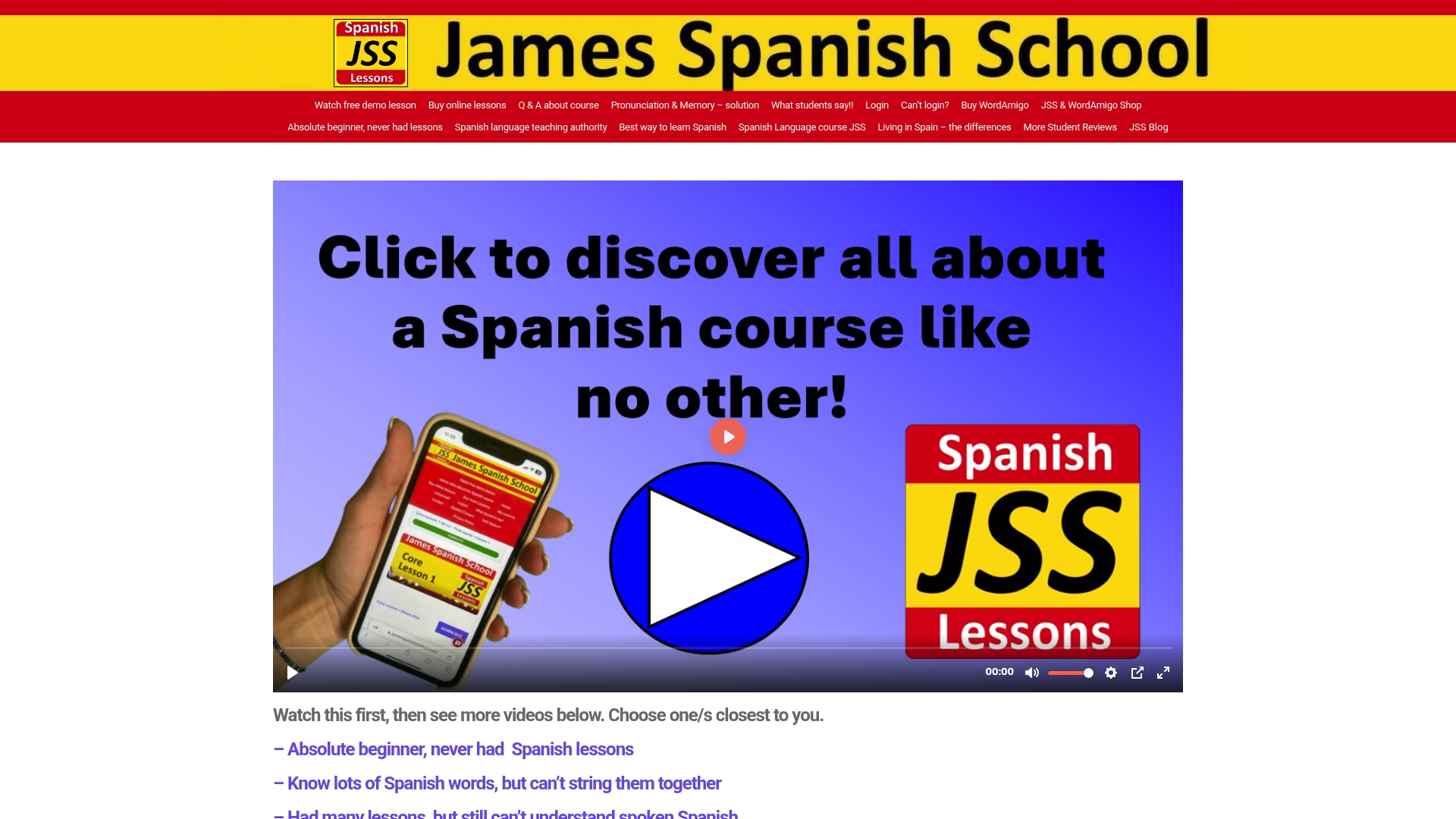
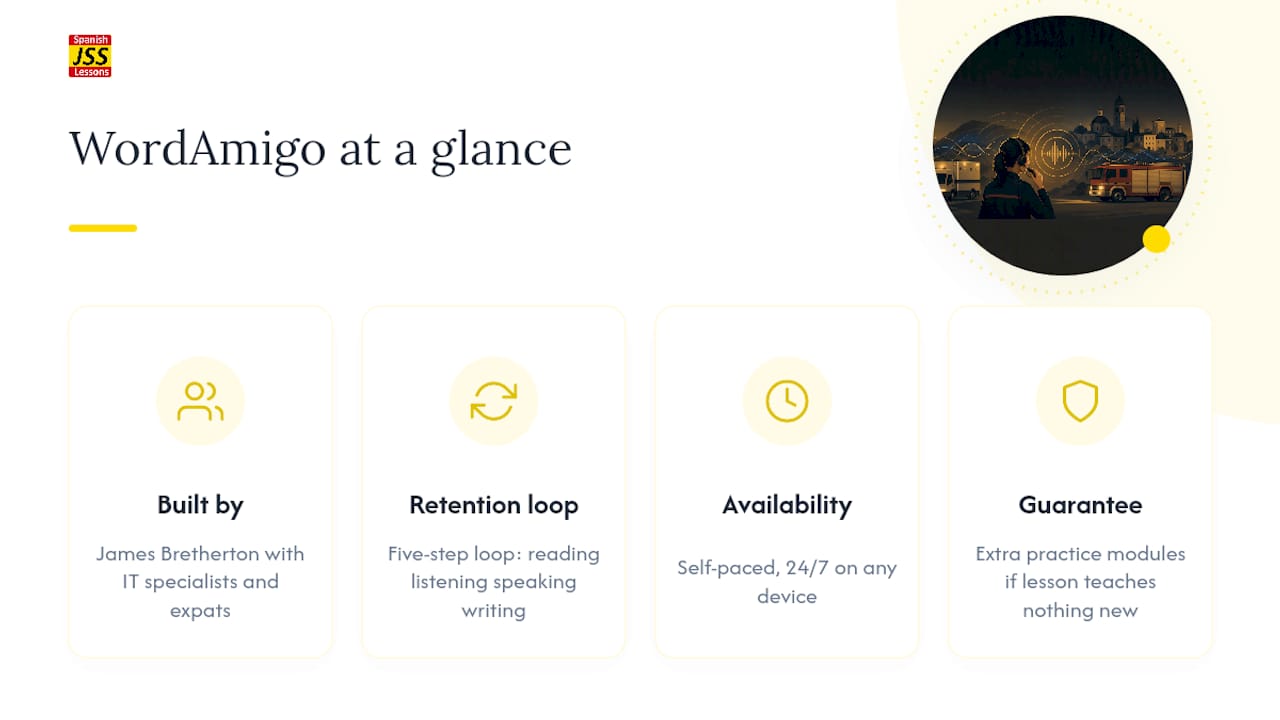
James Bretherton, a dual-native speaker with 40 years living in Spain, built WordAmigo with IT specialists and long-term expats to address the two problems that matter most in a crisis: words that vanish from memory when stress hits, and pronunciation that dispatchers cannot parse. The system runs a five-step retention loop across reading, listening, speaking, and writing, so phrases like “Estoy en…” and “No respira” become automatic rather than effortful. You can also explore the healthcare Spanish phrase guide on the James Spanish School site for additional medical vocabulary drilled in the same way.
The full course is self-paced, available 24/7 on any device, and carries a cast-iron guarantee: if a core lesson teaches you nothing new, James credits you with extra practice modules at no cost. For anyone living in Spain, that kind of confident, fast recall is not a luxury. Visit James Spanish School to enrol and start building the phrases that could matter most.
Sources
- Services provided through national emergency numbers (112) – Healthcare – Citizens – Your rights and obligations in the EU – Tu espacio europeo – Punto de Acceso General
- Qué hacer en situaciones de emergencia – Junta de Andalucía
- ¿Cuándo y cómo llamar? | Ciudadanos
- How to Call 112 in Spain: What to Say and What Happens Next – Spain Handbook
- Getting Emergency Help and Giving Warnings in Spanish – Dummies
This article is general information, not a substitute for advice from a qualified doctor. Consult a qualified healthcare professional about your own circumstances before acting on anything here.