

Visualisation techniques Spanish vocabulary
TL;DR:
- Visualisation techniques like the keyword method, pictorial imaging, and scene staging help learners retain Spanish vocabulary effectively. Pairing vivid images with active sentence production and spaced repetition enhances long-term memory of words. Using simple, bizarre snapshots and consistent review prevents forgetting and improves fluency.
The most effective visualisation techniques for Spanish vocabulary are the keyword method, direct pictorial imaging, scene or staging, object linking, mind-palace-lite, and pictorial sentence images. Use the keyword method for words with a clear English sound-alike; direct pictorial imaging for concrete nouns; scene or staging for collocations and phrases; object linking to chain two or three related words; mind-palace-lite to anchor a cluster of words to a single familiar room; and pictorial sentence images when you want to fix a whole sentence in memory at once.
If you have ten minutes right now, start with these three:
- Keyword method: find an English word that sounds like the Spanish word, then picture a bizarre scene connecting the two. Caballo (horse) sounds like “cab-eye-oh” — picture a horse driving a black cab with one enormous eye painted on the door.
- Direct pictorial image: for a concrete noun, close your eyes and see the object in vivid colour. La silla (chair) — picture a bright red chair tipping backwards.
- Scene or staging: place two or three new words inside a short mental film clip. A market stall, a noisy café, a building site — whatever feels real to you.
These three alone will cover the majority of everyday vocabulary you need for real life in Spain.
Table of Contents
- Why visualisation actually works for learning Spanish words
- Six visualisation techniques with worked Spanish examples
- How to visualise abstract words and sidestep false friends
- Combining visualisation with spaced repetition and a weekly study plan
- Common visualisation mistakes and how to fix them
- What the research says about visualisation and vocabulary retention
- Key takeaways
- How James Spanish School puts this into practice for you
Why visualisation actually works for learning Spanish words
Your brain does not store language and images in separate filing cabinets. When you pair a Spanish word with a vivid mental picture, you create what cognitive psychologists call a dual-coded memory trace: a verbal tag and a visual anchor locked together. Either one can retrieve the other. That is why visual aids improve recall far more reliably than text repetition alone.
Two other mechanisms amplify the effect. The distinctiveness effect means that a bizarre or emotionally charged image stands out in memory — your brain flags it as worth keeping. Elaborative encoding means that the more connections you build around a word (sound, image, emotion, context), the more retrieval routes you create. A word with five mental hooks is far harder to forget than one with just a translation.
Practical implications for every image you create:
- Make it salient. Exaggerate size, colour, or movement. A tiny word on a page is forgettable; a giant flaming mesa (table) is not.
- Make it immediate. The image should appear in your mind within two seconds of seeing the word. If it takes longer, simplify it.
- Make it absurd. Ordinary scenes fade. Ridiculous ones stick. The sillier the better.
Spaced repetition systems significantly improve long-term vocabulary retention compared with cramming, especially when paired with active usage. Visualisation gives each word a strong initial encoding; spaced repetition keeps it alive over weeks and months.
Six visualisation techniques with worked Spanish examples
1. The keyword method
What it is: Find an English word or phrase that sounds like the Spanish target word, then build a mental scene that links the sound-alike to the meaning.
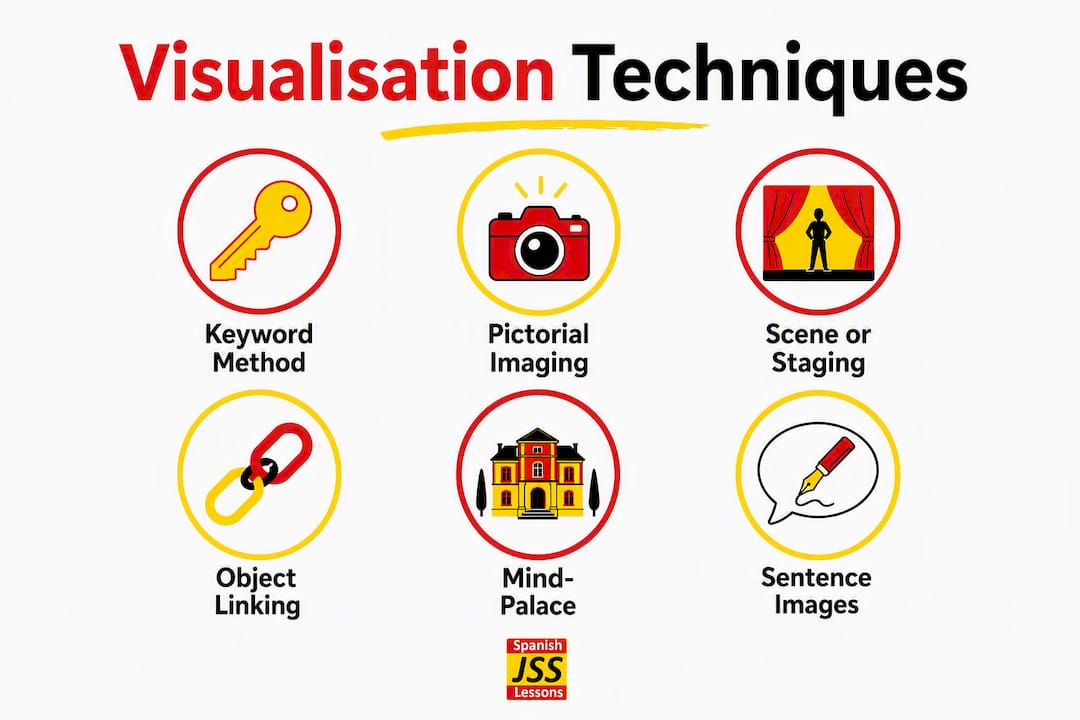
When to use it: Words with a clear phonetic echo in English. Works brilliantly for beginners and intermediate learners building core vocabulary.
Three-step recipe:
- Step 1: Say the Spanish word aloud and note what English word or syllable it reminds you of.
- Step 2: Create a bizarre image that features both the sound-alike and the actual meaning.
- Step 3: Embed that image in a short sentence you say to yourself.
Worked example: Mariposa (butterfly). It sounds a little like “marry a poser.” Picture a butterfly in a wedding dress marrying a man who keeps flexing in the mirror. Absurd — and therefore unforgettable. The keyword/visual substitution method links a Spanish form to a vivid mental image that bridges to the English meaning, facilitating quick and lasting retention.
2. Direct pictorial imaging
What it is: See the object itself, not a translation. Replace the English word in your mind with the Spanish label attached directly to the image.
When to use it: Concrete nouns — furniture, food, animals, body parts, everyday objects.
Three-step recipe:
- Step 1: Find or imagine a clear, colourful picture of the object.
- Step 2: See the Spanish word written across the image in large letters.
- Step 3: Hear yourself saying the word aloud as you look at the image.
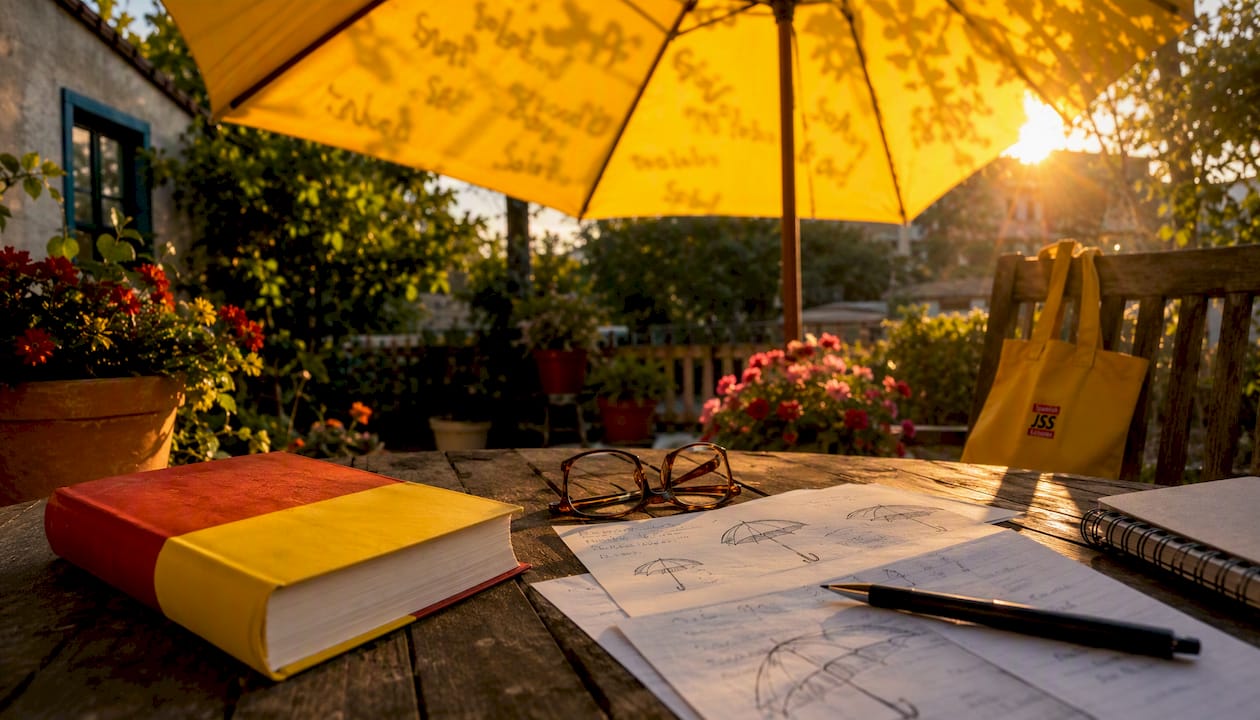
Worked example: El paraguas (umbrella). Picture a bright yellow umbrella with “EL PARAGUAS” printed in bold across the canopy, rain hammering down around it.
3. Scene or staging
What it is: Place several new words inside a short mental film clip, giving each word a role to play in the action.
When to use it: Collocations, verb-noun pairs, and thematic clusters (e.g. café vocabulary, market vocabulary).
Three-step recipe:
- Step 1: Choose a vivid, familiar setting (a Spanish market, a building site, a doctor’s waiting room).
- Step 2: Cast your new words as characters or objects in that scene.
- Step 3: Run the scene in your mind like a ten-second film clip.
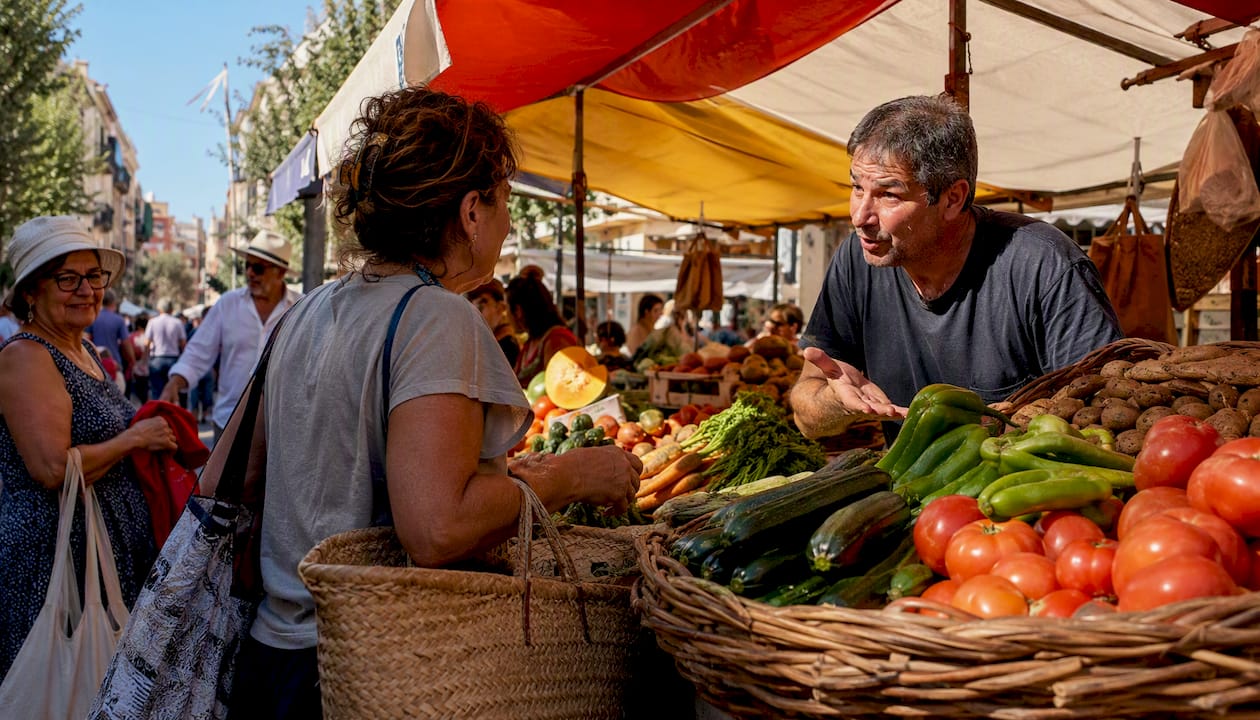
Worked example: Learning comprar (to buy), barato (cheap), and mercado (market) together. Picture yourself at a noisy outdoor market, haggling loudly over a pile of tomatoes, pointing at a sign that reads “BARATO” while handing over coins. One scene, three words, one review.
4. Object linking
What it is: Chain two or three words together by having the objects interact in a single image.
When to use it: Small clusters of related words, or any time you want to learn words in pairs rather than in isolation.
Three-step recipe:
- Step 1: Visualise the first object clearly.
- Step 2: Have the second object crash into, sit on top of, or grow out of the first.
- Step 3: Add a third object if needed, continuing the chain.
Worked example: La llave (key), la puerta (door), la casa (house). Picture an enormous key smashing through a door, which then falls onto a tiny house. The chain runs in sequence, so recalling one word pulls up the next.
5. Mind-palace-lite
What it is: A simplified version of the classical memory palace. Instead of an entire building, use a single familiar room and assign one word to each fixed location within it.
When to use it: Vocabulary clusters of five to ten words. Particularly useful for thematic sets — kitchen vocabulary, medical terms, directions.
Three-step recipe:
- Step 1: Choose a room you know perfectly (your kitchen, your living room).
- Step 2: Identify five to ten fixed anchor points in that room (front door, sofa, window, bookshelf, lamp).
- Step 3: Place one vivid image for each new word at each anchor point.
Worked example: Learning kitchen vocabulary. At the front door, a giant frigorífico (fridge) blocks the entrance. On the sofa, a sartén (frying pan) is frying an egg. At the window, a taza (cup) is balanced on the sill. Walk through the room mentally and each word appears in sequence. The memory palace technique can be adapted specifically for Spanish vocabulary, using fixed spatial anchors to compound and reinforce word recall.
6. Pictorial sentence images
What it is: Rather than imaging a single word, you visualise an entire sentence as a mini-scene, capturing grammar and meaning together.
When to use it: When you want to fix a sentence pattern in memory, or when learning a word that only makes sense in context.
Three-step recipe:
- Step 1: Read the sentence and identify the key action and the key objects.
- Step 2: Create a single image that shows the action happening between the objects.
- Step 3: Replay the image while saying the sentence aloud.
Worked example: Ella compra pan en la panadería (She buys bread at the bakery). Picture a woman in a red coat handing coins to a baker, a huge golden loaf between them, the word “PANADERÍA” on the shop sign behind her. One glance at that image and the sentence comes back whole.
Pro Tip: Keep every image to a single, bizarre snapshot. If you need more than five seconds to reconstruct it, it is too complicated. Aim for one glance, instant recall. Five quick reps in five minutes beats thirty minutes of slow, elaborate scene-building.
How to visualise abstract words and sidestep false friends
Abstract words — libertad (freedom), esperanza (hope), vergüenza (embarrassment) — have no physical object to picture. The fix is to anchor the concept to a sensory event that reliably triggers the feeling. For vergüenza, picture your face burning red as you mispronounce something in front of a Spanish shopkeeper. The physical sensation of embarrassment becomes the anchor. Map the concept to a bodily or emotional experience, not a dictionary definition.
For false friends, the risk runs the other way. Embarazada does not mean embarrassed — it means pregnant. Sensible does not mean sensible — it means sensitive. A learner who pictures the wrong meaning will reinforce the error every time they review.
Two reliable fixes:
- Contrast imaging: Create a scene that deliberately shows the wrong English meaning being corrected. For embarazada, picture someone saying “I’m embarrassed” while pointing at a pregnant woman, with a large red cross through the English word. The contrast burns the correction into memory.
- Stereo pairing: Hold both words side by side in one image. Embarazada (pregnant) next to avergonzada (embarrassed) — two women, clearly different situations, labelled in your mind.
Quick fixes for false friends:
- Always create a contrast image, never a straight translation image.
- Add the correct English meaning in bold text within the scene.
- Write a context sentence immediately after creating the image — production within 24 hours cements the correction.
Combining visualisation with spaced repetition and a weekly study plan
Visualisation gives a word a strong first impression. Spaced repetition keeps it from fading. The two methods work best as a sequence, not as alternatives.
A practical weekly timeline:
- Day 1 (Encounter and encode): Meet the word in context — a sentence, a short audio clip, a reading passage. Immediately create your visual image. Say the word aloud three times while holding the image in mind.
- Day 1 (Produce): Write one original sentence using the new word within the same session, or at the very latest within 24 hours. A study of 1,317 learners found that sentence-writing led to significantly better receptive and productive gains than receptive tasks such as definition-choosing.
- Day 2 (First SRS review): Review the word on a spaced repetition card. The card front shows the sentence with the target word blanked out; the back shows the full sentence plus your image cue.
- Day 5 (Second review): Same card, slightly longer interval.
- Day 14 (Third review): By now the word is moving from short-term to long-term memory.
Sentence-level SRS cards — full sentence on the front, meaning and context on the back — outperform isolated word-to-translation cards for transfer to real conversation. Pair that format with your visual image cue and you have a card that tests both recognition and production.
For tools, BoardMaster’s flashcard system automates spaced repetition intervals and supports image-based cards, which makes it straightforward to attach your visual cues to each review.
Prioritise high-frequency words before thematic expansion — the words you will hear most in everyday Spanish deserve your visual encoding effort first.
Pro Tip: Tag your visual cards by technique type (keyword, scene, contrast image) so you can spot which method is working best for you. Retire an image when you can recall the word instantly without it — that is the sign the word has moved to automatic retrieval.
Dos and don’ts for SRS integration:
- Do use sentence-level cards, not word-translation pairs.
- Do attach your visual image to the card as a note or sketch.
- Do produce a new sentence from memory before flipping the card.
- Don’t review more than 15–20 new visual cards in a single session — working memory has a ceiling.
- Don’t skip the production step and rely on recognition alone.
Common visualisation mistakes and how to fix them
Most learners who try visual memory techniques give up not because the method fails, but because they make one of five predictable errors.
- Overcomplicating the image. Fix: reduce every scene to a single, bizarre snapshot. One object, one action, one moment.
- Skipping production. Pictorial annotations and production tasks raise long-term retention compared with low-involvement receptive tasks. Seeing an image is not enough — write or say the word in a sentence every time.
- Using literal translations as the image. Picturing the English word written in Spanish font is not visualisation. The image must show the meaning, not the translation.
- Inconsistent review. A vivid image fades without reinforcement. Without spaced repetition, even the best mental picture loses its retrieval power within days.
- Ignoring context. A word learned in isolation rarely transfers to conversation. Always attach your image to a sentence, not a bare word.
Implementation checklist before each study session:
- [ ] Choose five to ten high-frequency target words.
- [ ] Create one clear, bizarre image per word (under 30 seconds each).
- [ ] Write one sentence per word immediately after imaging.
- [ ] Add each word to your SRS deck with the sentence and an image note.
- [ ] Schedule your first review for the following day.
What the research says about visualisation and vocabulary retention
The evidence is consistent: visualisation accelerates initial encoding; spaced repetition sustains it; active production converts passive recognition into usable vocabulary.
A practical combination of high-volume comprehensible input plus structured noticing plus sentence-level SRS outperforms any single method alone for rapid vocabulary growth. Visualisation sits at the encoding stage of that sequence, making the initial noticing event far more memorable.
The sentence-writing study of 1,317 participants across 27 mother tongues found productive tasks delivered significantly better gains than receptive ones. That finding directly supports the 24-hour production rule above. Comprehensible input works best above an 85% comprehension threshold; below that level, context loses its effectiveness and you are guessing rather than acquiring.
Useful sources for further reading:
- Efficacy of three vocabulary-learning activities in Spanish FL/L2
- Visualisation and word association for vocabulary acquisition
- How visual aids improve Spanish vocabulary retention
- Vocabulary learning strategies and vocabulary size in Spanish FL learners
Key takeaways
Visualisation techniques for Spanish vocabulary work best when paired with sentence-level production within 24 hours and a structured spaced repetition schedule.
| Point | Details |
|---|---|
| Choose the right technique | Use keyword method for sound-alikes, scene/staging for collocations, contrast images for false friends. |
| Keep images simple | One bizarre snapshot per word; if it takes more than five seconds to recall, simplify it. |
| Produce within 24 hours | Write or say a sentence using the new word the same day you create the image. |
| Use sentence-level SRS cards | Full-sentence cards with an image cue outperform bare word-translation pairs for real conversation. |
| James Spanish School’s WordAmigo | The WordAmigo system automates the full retention loop, pairing visual cues, audio, and spaced repetition in one place. |
How James Spanish School puts this into practice for you
Knowing the techniques is one thing. Having a system that runs them for you is another. James Spanish School was built around exactly this problem: words that refuse to stay in memory and pronunciation that leaves native speakers puzzled.
The WordAmigo vocabulary system packages sentence-level cards, pronunciation audio, and an AI-powered spaced repetition engine into a single retention loop. You encounter a word in context, hear it spoken correctly, attach your visual cue, and the system schedules your reviews automatically — no spreadsheet, no guesswork about when to revisit. James Bretherton, a dual-native speaker with 40 years of life in Spain, designed the course around real-life conversations: the kind you need with neighbours, tradesmen, health workers, and local officials, not exam scripts.
The full 100-lesson course covers sentence-building and ear-tuning alongside vocabulary, and comes with lifetime access and no countdown clock. If you want a ready-made system that puts these visualisation principles to work from day one, browse the course options and see which level fits where you are now.