

Expressing sympathy in Spanish
When you need to offer condolences or show empathy in Spanish, these are the phrases that matter most. Copy any of them directly:
- Lo siento (neutral, spoken) — “I’m sorry / I feel for you.” Works for almost any situation, from minor bad news to serious loss.
- Lo siento mucho (neutral, slightly stronger) — “I’m very sorry.” Add muchísimo for deeper weight.
- Mi más sentido pésame (formal, bereavement) — “My deepest condolences.” The standard formal phrase for a death; safe in any written or spoken context.
- Mis condolencias (formal, bereavement) — “My condolences.” Slightly shorter; equally respectful.
- Le acompaño en su dolor (formal, usted) — “I share in your pain.” Use with elders or people you address formally.
- Te acompaño en el sentimiento (neutral, tú) — “I’m with you in this.” Warm and personal for friends or family.
- Estoy contigo (informal, tú) — “I’m here for you.” Close relationships; spoken or WhatsApp.
- Qué pena (informal) — “What a shame / How sad.” Everyday empathy for minor misfortune.
- Qué lástima (informal) — “What a pity.” Similar weight to Qué pena; slightly more expressive.
- Vaya (very informal, spoken) — A soft, sympathetic “Oh no.” Low-key; use for small setbacks.
- Ánimo (informal) — “Hang in there / Keep going.” Encouraging; suits illness or a rough patch.
- Cuídate mucho (informal) — “Take good care of yourself.” Warm closing for someone going through difficulty.
Table of Contents
- How to choose the right phrase for the situation
- Phrases and sample messages for expressing condolences after a death
- Everyday sympathy phrases for illness, bad news, and small setbacks
- Cultural dos and don’ts when offering sympathy in Spanish
- Pronunciation help for the key phrases
- How to express sympathy for illness, job loss, and personal hardship
- How sympathy expressions differ across Spanish-speaking regions
- Key takeaways
- Where to practise these phrases with real structure
- Useful sources and further reading
How to choose the right phrase for the situation
Register and relationship are the two levers. Get those right and the exact wording matters far less than you think.
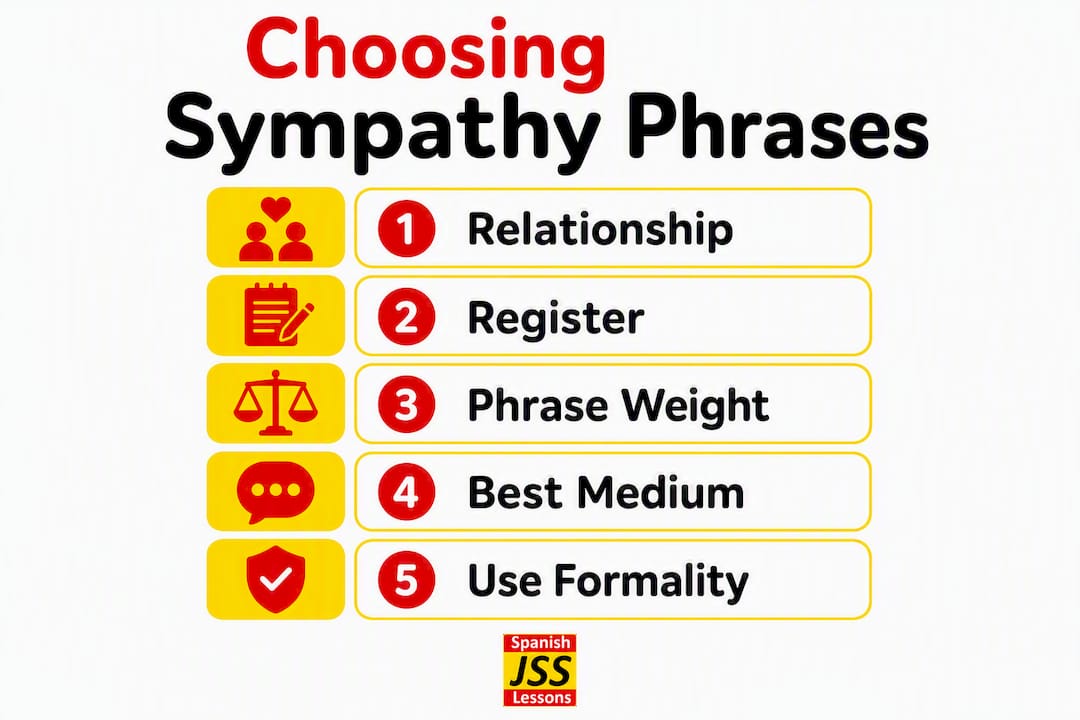
| Relationship | Register | Recommended phrase weight | Best medium |
|---|---|---|---|
| Close friend or family | Informal (tú) | Short, warm, personal | WhatsApp, spoken |
| Colleague or acquaintance | Neutral (tú or usted) | Moderate; avoid over-familiarity | Brief spoken line or short text |
| Elder, employer, or formal contact | Formal (usted) | Full formal phrase | Card, email, or spoken with usted |
| Unknown bereaved person | Formal (usted) | Stick to Mi más sentido pésame | Card or brief spoken |
When in doubt, usted is always safer. Spanish speakers will not take offence at formality; they may feel uncomfortable with unexpected informality. For informal expressions in European Spanish, the tú register opens up once a relationship is established.
For WhatsApp or text, keep the message to two or three sentences. Funeral.com recommends including a line that removes the pressure to reply: No hace falta que respondas (“No need to reply”). That single addition shows real consideration for the bereaved.
Phrases and sample messages for expressing condolences after a death
The Real Academia Española defines pésame as an expression that signals joining another person in their sorrow, not fixing it. That distinction shapes every phrase below.
Core formal phrases:
- Mi más sentido pésame — “My deepest condolences.” The gold standard; appropriate everywhere.
- Mis condolencias — “My condolences.” Slightly briefer; equally correct.
- Le acompaño en su dolor — “I share in your pain.” Formal; use with usted.
- Lamento profundamente su pérdida — “I deeply regret your loss.” Written contexts; cards or email.
- Estamos pensando en usted — “We are thinking of you.” Useful for a group or workplace message.
Sample card messages (formal):
Querida familia, reciban mi más sentido pésame por la pérdida de [nombre]. Lamento profundamente su pérdida y estoy a su disposición para lo que necesiten.
“Dear family, please accept my deepest condolences for the loss of [name]. I deeply regret your loss and am at your disposal for whatever you need.”
Con todo mi cariño, les acompaño en este momento tan difícil. Mis condolencias.
“With all my affection, I am with you in this very difficult time. My condolences.”
Sample WhatsApp message (closer relationship, tú):
Lo siento muchísimo. Sé que [nombre] era muy especial para ti. Estoy aquí para lo que necesites. No hace falta que respondas.
“I’m so very sorry. I know [name] was very special to you. I’m here for whatever you need. No need to reply.”
Safe sign-offs: Con todo mi cariño (“With all my affection”), Un abrazo muy fuerte (“A big hug”), or simply Con cariño (“With warmth”). Using the deceased’s name in your message, even once, makes it feel personal rather than formulaic.
Everyday sympathy phrases for illness, bad news, and small setbacks
Not every difficult moment is a bereavement. Language learners frequently ask for polite alternatives to blunt English expressions like “that’s awful” or “that sucks.” Here are the phrases that fill that gap naturally.
- Qué pena — “What a shame.” Versatile; suits job loss, a cancelled plan, or minor bad news.
- Qué lástima — “What a pity.” Slightly more expressive; interchangeable with Qué pena in most contexts.
- Lo siento — General sympathy; never wrong. Literally “I feel it,” which captures empathy well.
- Lo lamento — Slightly more formal than Lo siento; better in writing or with usted.
- Vaya — Soft, spoken sympathy for small setbacks. Think of it as a gentle “Oh dear.”
- Qué mal — “How awful / That’s bad.” Stronger than Qué pena; use for genuinely bad news.
- Ánimo — “Hang in there.” Suits illness, a tough week, or someone going through a hard patch.
- Espero que te mejores pronto — “I hope you feel better soon.” Illness, specifically.
- Cuenta conmigo — “Count on me / I’m here for you.” Warm offer of support.
Lo siento vs Lo lamento vs Perdón: Lo siento is your everyday go-to for sympathy. Lo lamento carries slightly more gravity and suits formal written contexts. Perdón means “I beg your pardon” or “excuse me” and is an apology for your own action, not an expression of sympathy. Mixing up Perdón and Lo siento is a common learner error that can sound oddly self-focused in a condolence setting.
Pro Tip: When practising these phrases aloud, focus on your tone first. A warm, unhurried delivery of a simple “Lo siento” lands better than a perfectly memorised but rushed formal phrase. Native speakers value warmth and presence above grammatical precision.
Cultural dos and don’ts when offering sympathy in Spanish
- Do name the loss directly. Saying sé que [nombre] era muy importante para ti (“I know [name] was very important to you”) shows you are present, not just polite.
- Do offer something concrete: Si necesitas que te lleve la compra, dímelo (“If you need me to do your shopping, just say”). Vague offers like “let me know if you need anything” create work for the bereaved.
- Do use usted when uncertain about formality. It costs nothing and signals respect.
- Do follow up. A short message a week or two later (“Sigo pensando en ti”) means a great deal.
- Don’t use Por lo menos… (“At least…”) or Está en un lugar mejor (“They’re in a better place”). Grief educators advise that silver-lining statements minimise loss rather than acknowledge it.
- Don’t compare losses or share your own grief story in the same breath.
- Don’t pepper a WhatsApp message with questions. Keep it simple and pressure-free.
On non-verbal gestures: in many Spanish-speaking cultures, a hand on the shoulder or a brief abrazo (hug) combined with a short phrase carries more comfort than a long speech. Match the gesture to your relationship and the setting. Eye contact matters too; looking away while speaking can read as discomfort rather than respect.
Pro Tip: End any written message with “No hace falta que respondas” (“No need to reply”). It removes the social burden from someone who may be exhausted by grief and shows you understand what they are going through.
Pronunciation help for the key phrases
Saying these phrases with a calm, steady voice matters as much as the words themselves. Here are phonetic guides using British English sounds:
| Phrase | Phonetic guide |
|---|---|
| Lo siento | loh SYEN-toh |
| Lo siento mucho | loh SYEN-toh MOO-choh |
| Mi más sentido pésame | mee mahs sen-TEE-doh PEH-sah-meh |
| Mis condolencias | mees kon-doh-LEN-thyahs |
| Te acompaño en el sentimiento | teh ah-kom-PAH-nyoh en el sen-tee-MYEN-toh |
| Le acompaño en su dolor | leh ah-kom-PAH-nyoh en soo doh-LOR |
| Qué pena | keh PEH-nah |
| Ánimo | AH-nee-moh |
For condolence settings, speak slowly and at a lower pitch than normal conversation. A short pause before and after the phrase gives it weight. Practise by saying each phrase three times aloud, deliberately, as if speaking to someone in the room. That cadence drill builds muscle memory faster than silent reading.
Pro Tip: In European Spanish (Spain), the “c” in condolencias is pronounced like the English “th” in “thin” (kon-doh-LEN-thyahs). In Latin American Spanish it sounds like an “s.” If you are learning for life in Spain, the “th” sound is the one to practise. James Spanish School’s pronunciation resources cover exactly this kind of regional distinction.
How to express sympathy for illness, job loss, and personal hardship
Bereavement phrases are too heavy for everyday difficulties. Match the weight of your words to the weight of the situation.
For illness, Espero que te mejores pronto (“I hope you feel better soon”) is the natural go-to. Add Cuídate mucho (“Take good care of yourself”) as a warm closing. For something more serious, Estoy pensando en ti (“I’m thinking of you”) works without overstating.
For job loss or professional setbacks, Lo siento mucho, sé que esto es muy difícil (“I’m very sorry, I know this is very hard”) acknowledges the difficulty without dramatising it. Follow with a concrete offer: Si puedo ayudarte con algo, dímelo (“If I can help with anything, just say”).

For personal hardship (a relationship breakdown, a difficult diagnosis, a family crisis), Estoy aquí para lo que necesites (“I’m here for whatever you need”) paired with Cuenta conmigo (“Count on me”) gives the person both emotional support and a practical signal. Avoid asking probing questions; let them lead.
For everyday polite Spanish in these situations, the rule is the same as for bereavement: acknowledge, offer, and remove pressure.
How sympathy expressions differ across Spanish-speaking regions
The core phrases (Lo siento, Mi más sentido pésame, Mis condolencias) are understood everywhere. Regional differences show up mainly in informal expressions and physical customs.

In Spain, Qué pena and Vaya are the most natural casual responses. Physical contact, a hug or a hand on the arm, is common and expected between people who know each other. The th pronunciation of “c” before “e” or “i” applies throughout.
In Mexico and much of Latin America, Lo siento mucho and Te acompaño en tu dolor are widely used. Qué lástima tends to appear more frequently than in Spain for everyday sympathy. Physical warmth is equally valued, though customs vary by family and region.
In Argentina, Mis condolencias and Te mando un abrazo (“Sending you a hug”) are common written closings. The vos pronoun replaces tú in informal speech, so Te acompaño becomes Te acompaño still (the phrase itself stays the same), but verb conjugations elsewhere in a message shift.
For learners focused on European Spanish for life in Spain, the Spain-specific register and pronunciation are the priority. The formal phrases travel universally; the informal ones are where regional flavour shows.
Key takeaways
Expressing sympathy in Spanish well comes down to three things: choosing the right register, keeping the message brief and sincere, and offering presence rather than solutions.
| Point | Details |
|---|---|
| Match register to relationship | Use usted with elders or formal contacts; tú with friends and family. When unsure, usted is always safe. |
| Keep messages short | Two to four sentences naming the loss, expressing care, and offering concrete help is the recommended format. |
| Avoid silver-lining phrases | Never use Por lo menos… or Está en un lugar mejor; acknowledge the loss directly instead. |
| Remove reply pressure | Add No hace falta que respondas to any WhatsApp or text message to show consideration. |
| James Spanish School | Structured pronunciation drills and phrase practice are available at the James Spanish School course shop. |
Where to practise these phrases with real structure
Knowing the phrases is one thing, and you can get extra help from Spanish Tutors Online if you prefer live one-to-one practice with a native speaker. Saying them naturally, with the right tone and pace, takes a little guided practice.
James Spanish School’s course is built specifically for English-speaking adults who want European Spanish that works in real life, not textbook exercises. The WordAmigo system uses strategic repetition to embed vocabulary and pronunciation so phrases like Mi más sentido pésame stay with you when you need them most. Founder James Bretherton, a dual-native speaker with 40 years in Spain, has built cultural guidance directly into the lessons, so you learn not just what to say but when and how. If you want to practise sympathy phrases alongside a full course in conversational European Spanish, visit the James Spanish School shop to see what is available.
Useful sources and further reading
- Funeral.com: How to give condolences in Spanish — etiquette guidance, sample messages, and what to avoid; supports the dos and don’ts section and WhatsApp templates.