

Telling time in Spanish guide
TL;DR:
- Spanish time phrases follow a simple rule: “es la” is used for one o’clock, and “son las” for all other times. To tell time, use “y” for minutes past the hour and “menos” for minutes to the next hour, with the 24-hour clock common in schedules. Practicing spoken phrases daily with native audio helps build accurate pronunciation, fluency, and confidence.
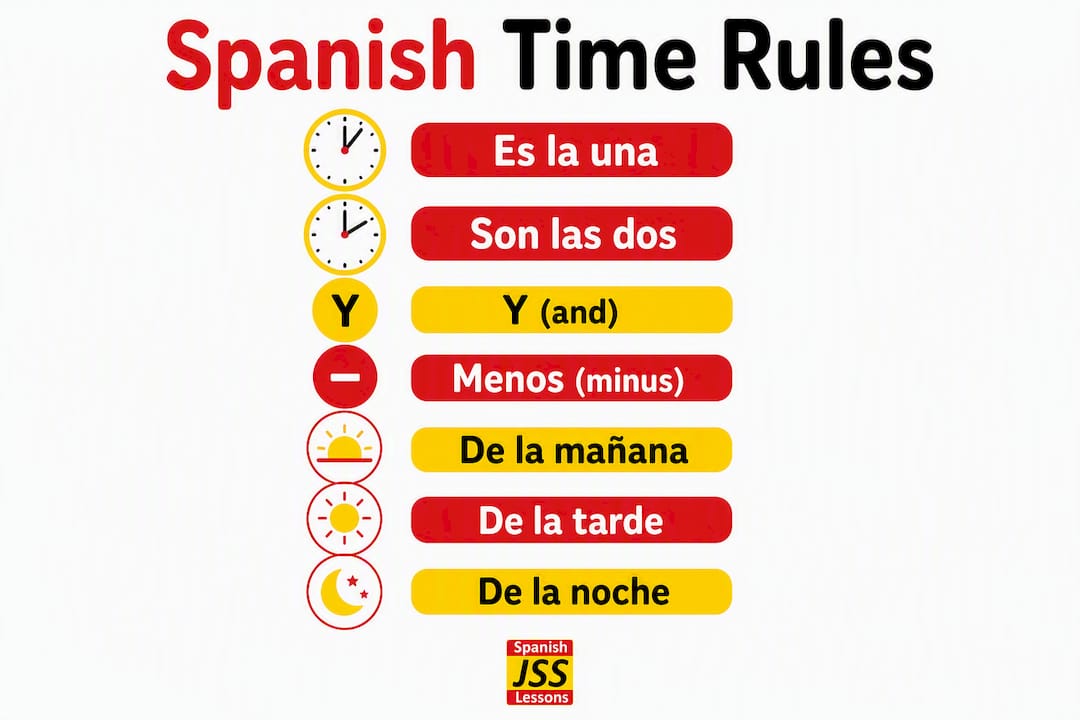
Spanish time phrases follow one simple formula: es la + hour for 1:00, and son las + hour for every other time. Three examples to use right now:
- Son las tres. — It’s three o’clock.
- Son las tres y diez. — It’s ten past three.
- Son las cuatro menos diez. — It’s ten to four.
The grammar behind this is the verb ser. Because hora (hour) is singular at one o’clock, you say es la una. For two through twelve, the plural son las applies. BBC Bitesize confirms that this rule holds in both formal and casual speech.
TL;DR
- Use y for minutes 1–30 (past the hour).
- Use menos for minutes 31–59 (to the next hour).
- Use the 24-hour clock when reading Spanish timetables and transport schedules.
Table of Contents
- How do you ask for the time in Spanish?
- Why Spanish uses es la for one o’clock and son las for everything else
- How do y and menos work for adding minutes?
- Quarter past, half past, and quarter to in Spanish
- Saying minutes in five-minute steps
- When do you use de la mañana, de la tarde, and de la noche?
- How do you say “at” a certain time in Spanish?
- How are times written in Spanish?
- Core time vocabulary and daily-routine sentences for shadowing
- A simple daily practice plan that actually builds fluency
- What does en punto mean and when do you use it?
- How do you say noon and midnight in Spanish?
- How to use audio and transcripts to sharpen your pronunciation
- Key takeaways
- Ready to speak Spanish with confidence?
How do you ask for the time in Spanish?
The go-to question is ¿Qué hora es? — literally “What hour is it?” For strangers or formal situations, add a polite opener:
- Disculpe, ¿qué hora es? — Excuse me, what time is it?
- Perdón, ¿tiene hora? — Sorry, do you have the time?
- ¿Me puede decir la hora? — Could you tell me the time?
Politeness matters here. As a UK learner speaking to someone you don’t know in Spain, Disculpe is the safest opener — it signals respect without sounding stiff.
Quick dialogues to shadow:
Dialogue 1
A: Disculpe, ¿qué hora es?
B: Son las dos y media.
(It’s half past two.)
Dialogue 2
A: Perdón, ¿tiene hora?
B: Sí, es la una menos cuarto.
(Yes, it’s quarter to one.)
Read these aloud several times. The rhythm of the reply is what your ear needs to lock onto.
Why Spanish uses es la for one o’clock and son las for everything else
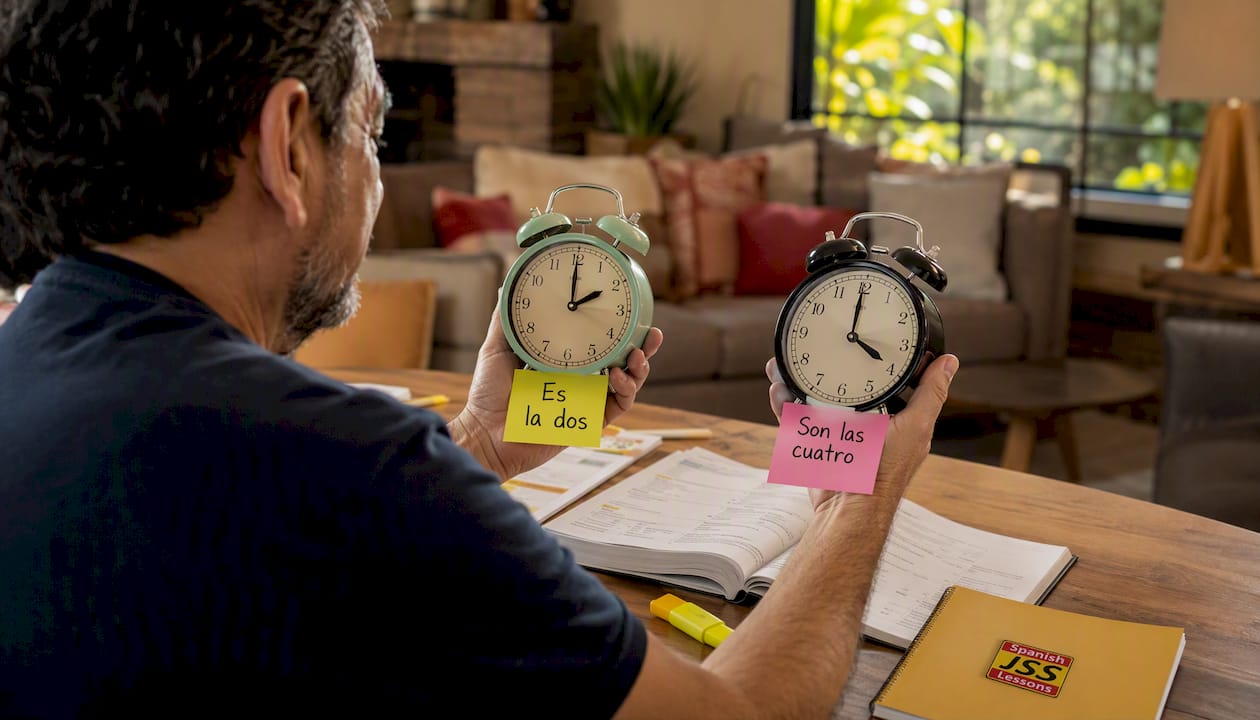
The rule is purely about singular versus plural. La hora is singular, so one o’clock takes a singular verb: es la una. Two o’clock onwards refers to multiple hours, so the verb becomes plural: son las dos, son las tres, and so on up to son las doce.
| Time | Spanish | English |
|---|---|---|
| 1:00 | Es la una | It’s one o’clock |
| 2:00 | Son las dos | It’s two o’clock |
| 5:00 | Son las cinco | It’s five o’clock |
| 9:00 | Son las nueve | It’s nine o’clock |
| 12:00 | Son las doce | It’s twelve o’clock |
One beginner trap: never use hay or está for telling the time. Only ser works here.
Pro Tip: When you say son las aloud, the ‘s’ at the end of son links naturally into las — it sounds like one flowing word. Practise the phrase as a single unit rather than three separate words.
How do y and menos work for adding minutes?
Minutes 1–30 attach to the hour with y (and). Minutes 31–59 use menos (minus), referencing the next hour rather than the current one. SpanishDict explains this subtraction system with clear examples: 3:10 becomes son las tres y diez, while 3:50 becomes son las cuatro menos diez.
Here is how to convert a tricky time step by step:
- Identify the hour shown on the clock: 3:40.
- Since 40 minutes is past the halfway point, look ahead to the next hour: 4.
- Subtract: 60 − 40 = 20 minutes remaining until four.
- Result: Son las cuatro menos veinte. (It’s twenty to four.)
A common mistake is saying son las tres y cuarenta — grammatically possible but rarely how native speakers phrase it. The natural form is son las cuatro menos veinte. BBC Bitesize notes that mastering menos forms early pays dividends for listening comprehension, because native speakers use them constantly.
Pro Tip: Write out five times between 3:30 and 3:59 and convert each one using the subtraction method. Do it daily for a week and the pattern becomes automatic.
Quarter past, half past, and quarter to in Spanish
Three short phrases cover the most common time expressions you will hear every day:
- Y cuarto — quarter past (Son las cinco y cuarto = 5:15)
- Y media — half past (Son las once y media = 11:30)
- Menos cuarto — quarter to (Es la una menos cuarto = 12:45)
These are the phrases SpanishDict highlights as the ones English speakers can rely on immediately. They are short, high-frequency, and heard in almost every conversation involving plans or appointments.
“Son las ocho y media” — It’s half past eight. This is the phrase you will hear at breakfast tables, in offices, and on the radio more than almost any other time expression. Get it into your mouth early and it will serve you for life.
For pronunciation, listen and repeat each phrase as a single breath unit. The JSS Audio Portal carries spoken practice tracks where you can shadow native European Spanish pronunciation at natural speed.
Saying minutes in five-minute steps
| Increment | Spanish | Example (3:xx) |
|---|---|---|
| :00 or :10 | y cinco | Son las tres y cinco |
| :10 | y diez | Son las tres y diez |
| :20 | y veinte | Son las tres y veinte |
| :20 or :30 | y veinticinco | Son las tres y veinticinco |
| :30 or :40 | menos veinticinco | Son las cuatro menos veinticinco |
| :40 | menos veinte | Son las cuatro menos veinte |
| :50 | menos diez | Son las cuatro menos diez |
- Cover the Spanish column and say each time aloud from the English.
- Then reverse: cover the English and translate from Spanish.
- Record yourself and play it back — your ear will catch errors your eye misses.
When do you use de la mañana, de la tarde, and de la noche?
These phrases replace AM and PM in spoken Spanish. In everyday speech in Spain, the phrases de la mañana, de la tarde, and de la noche roughly correspond to morning, afternoon/evening, and night, respectively, dividing the day into three broad parts without specific fixed hours.
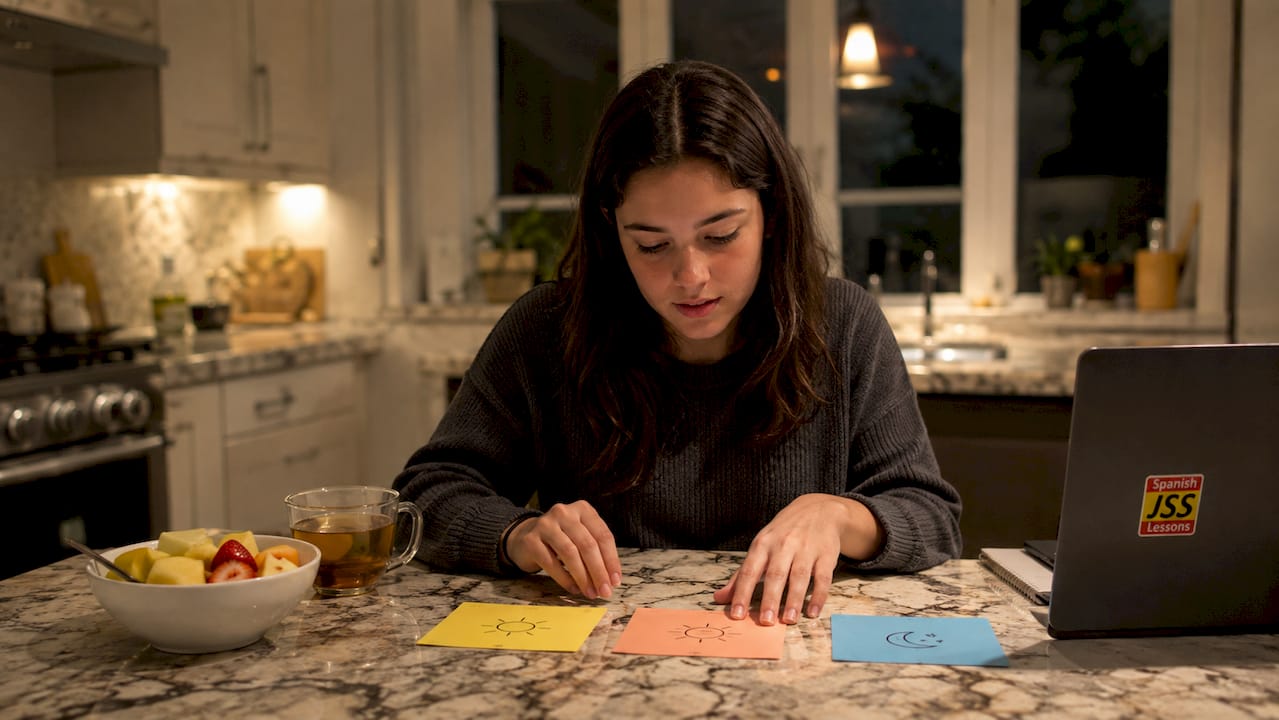
So las ocho de la mañana is 8 AM, and las ocho de la noche is 8 PM. Context usually makes it clear, but adding the phrase removes any ambiguity.
The 24-hour clock is a different matter. Lawless Spanish confirms it is standard for written timetables, TV listings, and opening hours across Spain. A train departure at 15:00 stays as quince horas in writing; spoken aloud, a Spanish person would say las tres de la tarde. For UK learners reading Spanish transport schedules, practise converting 24-hour numbers to their spoken 12-hour equivalents. International schools in Spain also use 24-hour notation on timetables, as outlined in resources like the Costa del Sol international schools guide.
How do you say “at” a certain time in Spanish?
Telling the current time uses es/son. Scheduling — saying when something happens — uses the preposition a with the definite article: a la una (singular) or a las dos, tres, etc. (plural). BBC Bitesize flags this as one of the most common learner errors.
- Me levanto a las siete. — I get up at seven.
- El concierto es a las nueve de la noche. — The concert is at nine in the evening.
- La reunión es a las quince. — The meeting is at 15:00.
- Comemos a las dos y media. — We eat at half past two.
The error to avoid: saying son las dos when you mean “at two o’clock.” Son las dos means “it IS two o’clock right now.” A las dos means “AT two o’clock” for a future event.
How are times written in Spanish?
Written Spanish uses a colon between hours and minutes: 15:30. Some publications use a full stop instead (15.30), but the colon is more common and is what you will see on official Spanish transport and government documents. Leading zeros appear in 24-hour notation: 01:00, 08:45.
Spoken equivalents of written times:
- 15:30 → Son las tres y media de la tarde
- 21:00 → Son las nueve de la noche
- 08:15 → Son las ocho y cuarto de la mañana
Pro Tip: When reading a Spanish train or bus timetable, subtract 12 from any hour above 12 to get the 12-hour equivalent, then add de la tarde or de la noche as appropriate. It takes seconds once the habit is formed.
Core time vocabulary and daily-routine sentences for shadowing
Essential words to know:
- La hora — the hour/time
- Los minutos — the minutes
- En punto — exactly on the hour
- Mediodía — noon
- Medianoche — midnight
- De la madrugada — in the early hours (roughly 1–5 AM)
- Sobre — around/approximately
- Más o menos — more or less
These expressions appear across learner resources and are particularly useful for timetables and everyday phrasing. SpanishDict’s time guide lists them as the core set every beginner needs.
A downloadable vocabulary list covering all of the above, with Spanish, English, and pronunciation notes, is available through the James Spanish School pronunciation vocabulary lists.
Ten shadowing sentences:
- Son las siete en punto de la mañana. — It’s exactly seven in the morning.
- Desayuno a las ocho y media. — I have breakfast at half past eight.
- El tren sale a las diez menos cuarto. — The train leaves at quarter to ten.
- Comemos a las dos de la tarde. — We eat at two in the afternoon.
- La farmacia cierra a las ocho de la tarde. — The pharmacy closes at eight in the evening.
- Son las doce. Es mediodía. — It’s twelve. It’s noon.
- Llego sobre las seis. — I’ll arrive at around six.
- Son las tres y cuarto de la tarde. — It’s quarter past three in the afternoon.
- El vuelo es a las catorce treinta. — The flight is at 14:30.
- Son las doce de la noche. Es medianoche. — It’s midnight.
Pro Tip: Counting fluently to 59 in Spanish removes hesitation when giving exact times. Run through the numbers 1–59 each morning while making coffee — Rosetta Stone’s beginner guide identifies this as the single biggest fluency booster for time-telling.
A simple daily practice plan that actually builds fluency
The most effective approach is short and consistent. Step 1: each morning, say the current time aloud in Spanish the moment you check your phone. Use the full phrase with the time-of-day marker: Son las ocho y cuarto de la mañana. Step 2: at midday, convert three times from a Spanish transport timetable or TV schedule into spoken 12-hour form. This trains the 24-hour conversion reflex that trips up so many UK learners. Step 3: in the evening, shadow two or three of the daily-routine sentences above, recording yourself and comparing to a native model.
Ten to fifteen minutes a day, done consistently, builds the ear-tuning that no single study session can replicate. James Bretherton, dual-native speaker and founder of James Spanish School, built the course’s spoken practice lessons around exactly this principle: short, repeated exposure to real spoken European Spanish rather than academic drills.
The WordAmigo system sits alongside these lessons as the vocabulary and pronunciation engine. It uses strategic repetition across reading, listening, speaking, and writing to embed words permanently, addressing the two frustrations adult learners report most: words that won’t stay in memory and pronunciation that native speakers struggle to follow.
Pro Tip: Pair practice with a partner using the couples course option — shadowing dialogues together accelerates both speaking and listening comprehension.
What does en punto mean and when do you use it?
En punto means “exactly” or “on the dot” and attaches to any on-the-hour time to emphasise precision. Son las tres en punto means “it’s exactly three o’clock.” Drop it when you are giving an approximate time, and add it when punctuality matters, such as confirming a meeting or a departure. You will hear it frequently in professional and formal contexts across Spain.
How do you say noon and midnight in Spanish?
Mediodía (noon) and medianoche (midnight) are standalone nouns, not built from the hour-plus-article structure. Both use es rather than son:
- Es mediodía. — It’s noon.
- Es medianoche. — It’s midnight.
Neither takes la or las before it. A common beginner slip is saying son las doce for both noon and midnight, which is technically understood but less precise. In everyday Spanish speech, mediodía and medianoche are the natural, preferred forms.
How to use audio and transcripts to sharpen your pronunciation
Reading time phrases is one thing; hearing them at natural speed is another. Native speakers often reduce y between the hour and minutes in fast speech, so son las tres y diez can sound closer to son las tres-y-diez as a single run. Lawless Spanish notes this reduction and recommends learning both the full and the reduced form.
The practical approach: find a short audio clip of a Spanish weather forecast or radio bulletin, pause after each time reference, and repeat it aloud. The JSS Audio Portal provides spoken European Spanish tracks built specifically for this kind of shadowing practice, with transcripts so you can check what you heard against what was said.
Key takeaways
Mastering Spanish time expressions requires three things: the es la/son las rule, the y/menos minute system, and consistent spoken practice with real European Spanish audio.
| Point | Details |
|---|---|
| Es la vs son las | Use es la only for 1:00; use son las for all other hours (2–12). |
| Y vs menos | Minutes 1–30 use y; minutes 31–59 use menos referencing the next hour. |
| Quarter and half phrases | Y cuarto, y media, and menos cuarto cover the most common spoken times. |
| Scheduling with a la(s) | Use a la una / a las dos for “at” a time; never use es/son for future events. |
| James Spanish School | The JSS course and WordAmigo system build time vocabulary through audio-led shadowing and strategic repetition. |
Ready to speak Spanish with confidence?
Knowing the rules is the starting point. Speaking them naturally, at the speed a native expects, is where most learners get stuck — and where guided audio practice makes the real difference.
James Spanish School’s self-paced course gives you 100 lessons in sentence-building and ear-tuning, built around real spoken European Spanish. The WordAmigo system permanently embeds vocabulary and pronunciation through a five-step repetition loop, so time phrases, numbers, and daily expressions stay with you rather than fading after a week. Lifetime access means you can revisit any lesson whenever you need a refresher, with no countdown clock and no pressure.
Visit the James Spanish School course page to see what is included and get started at your own pace.