

A handful of words will get you through your first match-day conversation in Spanish: fútbol (football), gol (goal), equipo (team), jugador (player), portero (goalkeeper), defensa (defender), centrocampista (midfielder) and delantero (forward). Learn those first. Everything else builds on them.
You don’t need a classroom to start using them either. Three phrases will carry you through most of a bar conversation:
- ¿Viste el partido? – Did you see the match?
- ¿Quién marcó? – Who scored?
- ¡Menudo gol! – What a goal!
One pronunciation note before anything else: fútbol carries its stress on the first syllable, “FOOT-bol,” not the second. And when you hear a commentator shout “¡Goooool!”, that stretched vowel isn’t a mistake. It’s the entire point.
Key Takeaways
Talking about football in Spanish comes down to learning a compact core vocabulary, then layering in colloquial phrases and regional variants through repeated listening practice.
| Point | Details |
|---|---|
| Master the core eight | Fútbol, gol, equipo, jugador, portero, defensa, centrocampista and delantero cover most basic exchanges. |
| Learn verbs as templates | Use subject plus verb plus object, such as “el delantero marcó un gol,” to build quick commentary. |
| Separate the two registers | Practise formal TV commentary vocabulary and informal bar slang separately, as they carry different tones. |
| Watch regional spelling | Fútbol keeps its accent in Spain, while futbol and arquero are common across Mexico and Latin America. |
| Build fluency systematically | James Spanish School’s WordAmigo system uses strategic repetition to embed vocabulary and pronunciation for lifetime access learners. |
Table of Contents
- Talking about football in Spanish starts with players and positions
- Verbs that describe the action on the pitch
- Fouls, cards and the language of match controversy
- Commentary phrases and slang that make you sound like a fan
- Tournaments, nicknames and small talk to start a conversation
- Pronunciation cheat sheet and regional differences
- What a native teacher wishes every learner knew
- Turn this vocabulary into fluent, natural conversation
- Sources
Talking about football in Spanish starts with players and positions
Once you’ve got the basics, the next skill is naming who’s doing what. Spanish football vocabulary for positions is more detailed than English in places, and getting it right makes you sound like you’ve actually watched the game rather than memorised a list.
- El portero or el guardameta – goalkeeper (Latin American Spanish often prefers arquero)
- El defensa – defender; el central specifically means centre back
- El lateral – full back, the defender who runs the flank
- El centrocampista or mediocentro – midfielder (you’ll also hear mediocampista in Latin America)
- El extremo – winger
- El delantero or delantero centro – forward, striker
According to Lawless Spanish’s vocabulary lists, these position terms form the backbone of most match commentary, so they’re worth drilling before anything more colourful. Try building a sentence: “El lateral hizo un pase perfecto al extremo” (the full back made a perfect pass to the winger). Praise works the same way: “El centrocampista jugó fenomenal hoy” (the midfielder played brilliantly today).
Verbs that describe the action on the pitch
Nouns tell you who’s playing. Verbs tell you what’s actually happening, and this is where fluent-sounding Spanish really starts to click.
- Pasar – to pass
- Chutar or disparar – to shoot
- Regatear – to dribble past an opponent
- Marcar – to score
- Rematar – to finish, to shoot at goal from a cross or rebound
- Cabecear – to head the ball
- Parar – to save (for goalkeepers)
- Interceptar – to intercept
- Despejar – to clear the ball
Slot these into a simple template: subject plus verb plus object. “El delantero marcó un gol” (the forward scored a goal). “El portero paró el penalti” (the goalkeeper saved the penalty). Master that pattern and you can describe almost anything that happens in ninety minutes.
Pro Tip: Native fans rarely use full conjugated sentences in the heat of the moment. Listen for shortened exclamations like “¡Qué pase!” (what a pass!) or just the bare infinitive shouted as an instruction, “¡Chutar!” (shoot!). Dropping the subject and rushing straight to the verb is exactly what real fans do, so don’t over-correct towards textbook grammar when you’re reacting live.
Fouls, cards and the language of match controversy
Every football conversation eventually turns to a bad decision, so referee vocabulary matters as much as attacking play. Fans in Spain will argue about these terms more passionately than almost anything else in the game.
- Falta – foul
- Penalti (also penal in Latin America) – penalty
- Fuera de juego – offside
- Tarjeta amarilla / tarjeta roja – yellow card / red card
- Prórroga – extra time
- Tanda de penaltis – penalty shootout
- Saque de esquina – corner kick
- Saque de banda – throw-in
- Saque de meta – goal kick
You’ll hear “fuera de juego” shouted from broadcast commentary and bar stools alike, usually followed by furious debate. If you want to argue a call yourself, try “¡Eso no fue falta!” (that wasn’t a foul!) or “El árbitro se equivocó” (the referee got it wrong).
Commentary phrases and slang that make you sound like a fan
This is where textbook Spanish and real Spanish football language diverge sharply. According to The Local’s guide to talking about football and the World Cup in Spanish, fans lean on a set of emotive exclamations that carry as much meaning as any grammar rule.
- ¡Gooooool! – Goal! (always elongated, never clipped)
- ¡Qué golazo! – What a screamer of a goal!
- ¡Vamos! – Come on!
- ¡Olé! – used for a beautifully executed piece of skill
- Hacer un caño / túnel – to nutmeg an opponent
- Piscinero – a diver, someone who exaggerates a fall
- Meterla por la escuadra – to smash it into the top corner
- Sudar la camiseta – to give everything, “sweat the shirt”
Vaia’s research on Spanish sports expressions points out that this vocabulary is emotional rather than technical. That’s the whole appeal, and it’s also why “¡árbitro vendido!” (crooked referee!) should stay firmly in the stands rather than a formal setting. If you want more of this register, James Spanish School’s guide to informal Spanish expressions covers where the line sits between playful banter and something ruder than you intended.
Tournaments, nicknames and small talk to start a conversation
Big tournaments bring their own vocabulary, and knowing it lets you follow group chats as easily as broadcasts.
- La selección – the national team
- El Mundial / la Copa del Mundo – the World Cup
- La Eurocopa – the European Championship
- La fase de grupos – the group stage
- Octavos – round of sixteen
- Semifinal and final – self-explanatory
Spain’s national side is nicknamed La Roja, and el clásico doesn’t only refer to Real Madrid versus Barcelona. It applies to any fierce local derby. For small talk, you’ll get more mileage from a handful of natural questions than any vocabulary list: “¿Vamos a ver el partido?” (shall we watch the match?), answered with “¡Claro, me apunto!” (of course, count me in!), or afterwards, “Me encantó cómo jugó el equipo” (I loved how the team played).
Pronunciation cheat sheet and regional differences
Stress fútbol on the first syllable, and let the “o” in ¡Gooooool! run as long as your breath allows. That elongation isn’t casual style. It’s how commentators build tension before the word lands.

Spelling and vocabulary shift by region too. SpanishNY’s World Cup vocabulary guide notes that futbol without the accent is standard in Mexico and Central America, while Spain keeps the accented fútbol. Goalkeepers go by portero in Spain, arquero across much of Latin America. You’ll hear mediocampista and centrocampista used interchangeably for midfielder, and penal instead of penalti in several Latin American countries. Practise by saying the phrases aloud, slowly at first, then at commentary speed.
What a native teacher wishes every learner knew
Football language splits cleanly into two registers, and mixing them up is the fastest way to sound stiff. Italki’s breakdown of Spanish soccer vocabulary makes exactly this point: what you hear a commentator say on television is rarely what you’ll hear shouted from the next table in a bar.
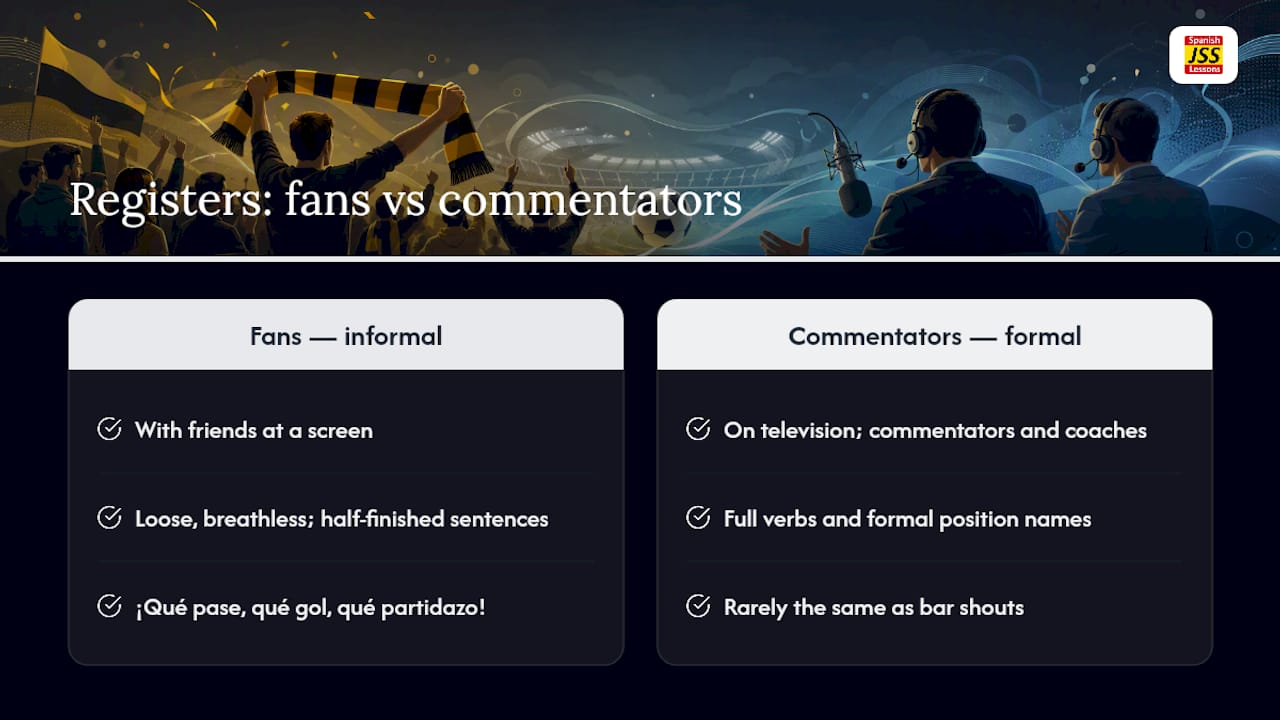
In front of a screen with friends, you’ll get away with a loose, breathless style, half-finished sentences, exclamations stacked on top of each other. On television, commentators still lean on full verbs and formal position names. Learn both, and switch depending on where you are.
Here’s a one-minute daily drill worth repeating: “¡Qué pase, qué gol, qué partidazo!” (what a pass, what a goal, what a match!). Say it out loud once a day until the rhythm feels automatic, then try it during an actual match. That’s the real test.
Turn this vocabulary into fluent, natural conversation
Knowing forty words is one thing. Producing them at conversational speed, without translating in your head first, is another skill entirely. That’s the gap James Spanish School’s course is built to close.
The course uses James Bretherton’s method of Radical Simplification to strip out grammar terminology you’ll never actually need, replacing it with plain English explanations of how Spanish sentences are actually built. Pronunciation gets particular attention through the WordAmigo system, an AI-powered tool that uses strategic repetition to lock vocabulary and pronunciation into memory, so words like fútbol, regatear and cabecear stop feeling foreign after a handful of sessions rather than months of practice. Because access is lifetime and fully on-demand, you can drill football phrases on your phone before kickoff or replay a lesson as many times as you need with no countdown clock pushing you along. If you’re ready to move from recognising these phrases to using them without hesitation, take a look at the full course details and see which starting point suits you.
Sources
- How to talk about football and the World Cup in Spanish
- Spanish soccer terms – Lawless Spanish
- Spanishny
- Sports expressions in Spanish – Vaia
- Spanish soccer vocabulary – italki blog