

Negative sentences in Spanish guide
Put “no” before the conjugated verb, and you have a negative sentence. That is the whole engine room of Spanish negation, and it works for almost every situation you will meet as a learner.
- Hablo español. → No hablo español. (I speak Spanish → I don’t speak Spanish.)
- Tengo tiempo. → No tengo tiempo. (I have time → I don’t have time.)
- Voy al mercado. → No voy al mercado. (I’m going to the market → I’m not going to the market.)
Master that single move and you can already negate any sentence built around one main verb. Everything else in this guide, from negative words to double negatives, builds on this one rule.
Key Takeaways
Correct Spanish negation depends on one stable rule: “no” precedes the verb, and any negative word placed after the verb requires that “no” to stay in the sentence.
| Point | Details |
|---|---|
| Master the core rule first | Put “no” before the conjugated verb for any basic negative sentence. |
| Learn the placement pairs | A negative word after the verb needs “no”; before the verb, “no” is dropped. |
| Embrace double negatives | Spanish stacks negatives for emphasis rather than cancelling them, as the RAE confirms. |
| Watch ningún agreement | “Ninguno” shortens to “ningún” before masculine singular nouns, a frequent learner slip. |
| Practise sentences aloud daily | James Spanish School’s sentence-building and WordAmigo lessons build this fluency through repetition. |
Table of Contents
- Negative sentences in Spanish guide: the core patterns
- What are the common negative words and where do they go?
- Why does Spanish use double negatives?
- How does ‘ni… ni’ work for neither and nor?
- Negating compound tenses and sentences with pronouns
- How do you answer a negative question in Spanish?
- Which fixed negative expressions do you actually need?
- What do English speakers get wrong most often?
- Quick practice: five negative sentences to translate
- Learn negation faster with structured practice
- Frequently asked questions about Spanish negation
- Sources
Negative sentences in Spanish guide: the core patterns
Once “no + verb” feels automatic, four related rules cover almost every negative sentence you will build.
- No before the verb handles simple negation: No entiendo. (I don’t understand.)
- A negative word after the verb needs “no” first: No veo a nadie. (I don’t see anyone.)
- A negative word before the verb drops “no” entirely: Nadie me llama. (Nobody calls me.)
- Spanish often stacks negatives for emphasis, unlike English: No compro nada nunca aquí. (I never buy anything here.)
The biggest trap for English speakers is assuming Spanish negation mirrors English word order. English drops “not” once it has “nobody” or “nothing” in the sentence. Spanish keeps “no” whenever the negative word trails the verb, and BBC Bitesize confirms this as the standard learner rule: place “no” before the verb, then follow the pattern with words like nada, nadie, or nunca.
What are the common negative words and where do they go?
Spanish has a compact set of negative words, and each one follows the same placement logic you have already learned.
- Nada (nothing): No quiero nada. / Nada me interesa. (I don’t want anything / Nothing interests me.)
- Nadie (nobody): No conozco a nadie. / Nadie contestó. (I don’t know anybody / Nobody answered.)
- Nunca / jamás (never): No he estado nunca allí. / Nunca he estado allí. (I have never been there.) “Jamás” is stronger and more formal than “nunca”.
- Tampoco (neither, not either): Yo tampoco quiero ir. / No quiero ir tampoco. (I don’t want to go either.)
- Ningún / ninguna (no, not any): No tengo ningún problema. (I don’t have any problem.)
- Ni (nor, not even): No como carne ni pescado. (I eat neither meat nor fish.)
SpanishDict’s guide to negation lists these same core words and stresses that “ningún” must agree in gender and number with the noun it modifies, shortening from “ninguno” before a masculine singular noun. Learn each word in a short phrase rather than in isolation. “No tengo nada” sticks in memory far better than the bare word “nada” ever will.
Why does Spanish use double negatives?
In English, two negatives cancel each other out. In Spanish, they reinforce the same negative idea, and this is one of the most useful facts in this whole guide because it stops learners second-guessing themselves mid-sentence.
- Wrong instinct (English logic): “No veo something” or dropping “no” because “nadie” already means nobody.
- Correct Spanish: No veo nada. (I don’t see anything.) No viene nadie. (Nobody is coming.)
- Stacked negation: Nunca le dice nada a nadie. (He never tells anybody anything.)
The Real Academia Española confirms that forms like “no vino nadie” and “no hice nada” are entirely standard, not sloppy speech. Spanish negative concord simply requires every element in the chain to agree that the sentence is negative.
Pro Tip: Stop translating word-for-word and instead picture “no” as a switch you flip once at the start of the sentence. Every negative word after that switch is just adding detail, not adding a second negation.

How does ‘ni… ni’ work for neither and nor?
“Ni… ni” links two negated items, and it behaves a little differently depending on whether it comes before or after the verb.
- Ni… ni before the verb drops “no”: Ni Juan ni María vinieron. (Neither Juan nor María came.)
- Ni… ni after the verb needs “no” first: No bebo ni café ni té. (I drink neither coffee nor tea.)
- “Ni siquiera” means “not even” and adds emphasis: Ni siquiera me saludó. (He didn’t even say hello to me.)
In everyday speech, “ni” often stands alone for extra punch: ¡Ni hablar! (No way!). Formal writing tends to keep the full “ni… ni” pairing, while spoken Spanish happily drops one “ni” when the meaning stays clear from context.
Negating compound tenses and sentences with pronouns
Compound tenses (haber + past participle) and pronoun-heavy sentences follow the same core rule, just with more words sitting between “no” and the main action.
- Compound tense: No he visto esa película. (I haven’t seen that film.) “No” goes before the auxiliary “he”, never between “he” and “visto”.
- With a direct object pronoun: No lo he visto. (I haven’t seen it.) The pronoun “lo” attaches to the verb group, and “no” still comes first.
- With an indirect object pronoun: No me llama nadie. (Nobody calls me.)
- With a reflexive verb: No me levanto temprano. (I don’t get up early.) No se acuerda de nada. (He doesn’t remember anything.)
The rule stays remarkably stable: “no” always precedes the entire verb phrase, however many pronouns or auxiliaries are stacked in front of the main verb. Our essential grammar tips for real conversations go deeper into pronoun order if this feels shaky.
How do you answer a negative question in Spanish?
¿Vienes? is a neutral question. ¿No vienes? carries an expectation, usually that the speaker assumed you were coming and is now surprised or checking.
- Neutral: ¿Tienes hambre? (Are you hungry?) → Sí, tengo hambre. / No, no tengo hambre.
- Negative, with expectation: ¿No tienes hambre? (You’re not hungry?) → No, no tengo hambre. (Confirming the negative, doubling “no” naturally.)
- Tag questions: ¿Verdad? and ¿No? both invite agreement: Hablas español, ¿verdad? (You speak Spanish, right?)
Academic work on Spanish negation notes that negative questions carry a pragmatic presumption that neutral questions lack, which is why native speakers often repeat “no” in their answer rather than leaving it ambiguous. For more on question structure generally, see our guide to Spanish question forms.
Which fixed negative expressions do you actually need?
A handful of set phrases appear constantly in daily Spanish, and they are worth memorising as whole chunks rather than working out from grammar rules each time.
- Ya no (not anymore): Ya no fumo. (I don’t smoke anymore.)
- Todavía no (not yet): Todavía no he comido. (I haven’t eaten yet.)
- En absoluto (not at all, formal): No me molesta en absoluto. (It doesn’t bother me at all.)
- Para nada (not at all, colloquial): No me gusta para nada. (I don’t like it at all.)
- Ni hablar (no way): a flat refusal, used in speech far more than writing.
The pair that trips learners up most is “también” versus “tampoco”: Yo también voy (I’m going too) versus Yo tampoco voy (I’m not going either). Get that pair wrong and you accidentally agree to something you meant to decline.
What do English speakers get wrong most often?
After years of teaching English-speaking adults, James Bretherton at James Spanish School sees the same handful of errors on repeat, and they are almost all fixable with a change of habit rather than more grammar study.
- Dropping “no” out of instinct because a negative word already appears later in the sentence. Say the sentence aloud slowly and check “no” is still there before the verb.
- Forgetting “ningún” apocopation. It shortens from “ninguno” to “ningún” before a masculine singular noun, so it’s ningún libro, not ninguno libro.
- Overthinking double negation. Treat “no + negative word” as one fixed template rather than two separate rules to reconcile.
- Missing “apenas” as a soft negative meaning “barely” or “hardly”: Apenas tengo dinero. (I barely have any money.) It sits before the verb like “no” but carries a softer, incomplete-negation feel.
Pro Tip: Practise negative sentences out loud every day for five minutes, using your own real complaints and preferences. “No tengo tiempo,” “no me gusta nada,” “nunca lo hago.” Real content sticks far better than textbook drills. Our guide to avoiding common Spanish mistakes covers more of these recurring slips.
Negation in the subjunctive follows the identical placement rule, with “no” simply sitting before whichever subjunctive form the sentence needs: Espero que no llueva. (I hope it doesn’t rain.) No creo que venga. (I don’t think he’s coming.) The trigger for subjunctive doesn’t change how negation works. It just adds another verb form to slot “no” in front of.
Quick practice: five negative sentences to translate
Work through these in under ten minutes, then check your answers.
- Translate: “I don’t have any money.” (Use ningún/ninguno.)
- Translate: “Nobody called me today.”
- Fill the gap: No ___ nada de español. (entender, yo form)
- Correct the error: No tengo dinero tampoco no.
- Translate: “I haven’t seen him yet.” (Use todavía and a compound tense.)
Answers:
- No tengo ningún dinero.
- Nadie me llamó hoy.
- entiendo → No entiendo nada de español.
- No tengo dinero tampoco. (The second “no” is redundant; “tampoco” already carries the negation once “no” has appeared once in the clause.)
- Todavía no lo he visto.
Exercise 4 is the one most learners get wrong on the first attempt, precisely because English instinct wants a “not” to match every negative word. Spanish only needs one “no” per clause when a word like “tampoco” is already doing negation work at the end.
Learn negation faster with structured practice
Grammar rules only become fluency once you have said them aloud, repeatedly, in real sentences, and that is exactly where most self-study stalls. James Spanish School’s sentence-building lessons are built around this exact gap: instead of memorising isolated rules, you practise full negative sentences using the WordAmigo repetition system until “no tengo,” “nadie viene,” and “nunca lo hago” come out without you pausing to translate.

The course pairs sentence-building modules with “ear-tuning” audio, so you hear negative sentences at natural conversational speed, not textbook pace, which is where most learners get caught out with native speakers. If double negation and word order have been holding your conversations back, the full course details are on the JSS shop page, with lifetime access so you can revisit the negation lessons as often as you need, with no countdown clock pushing you through material before it has sunk in.
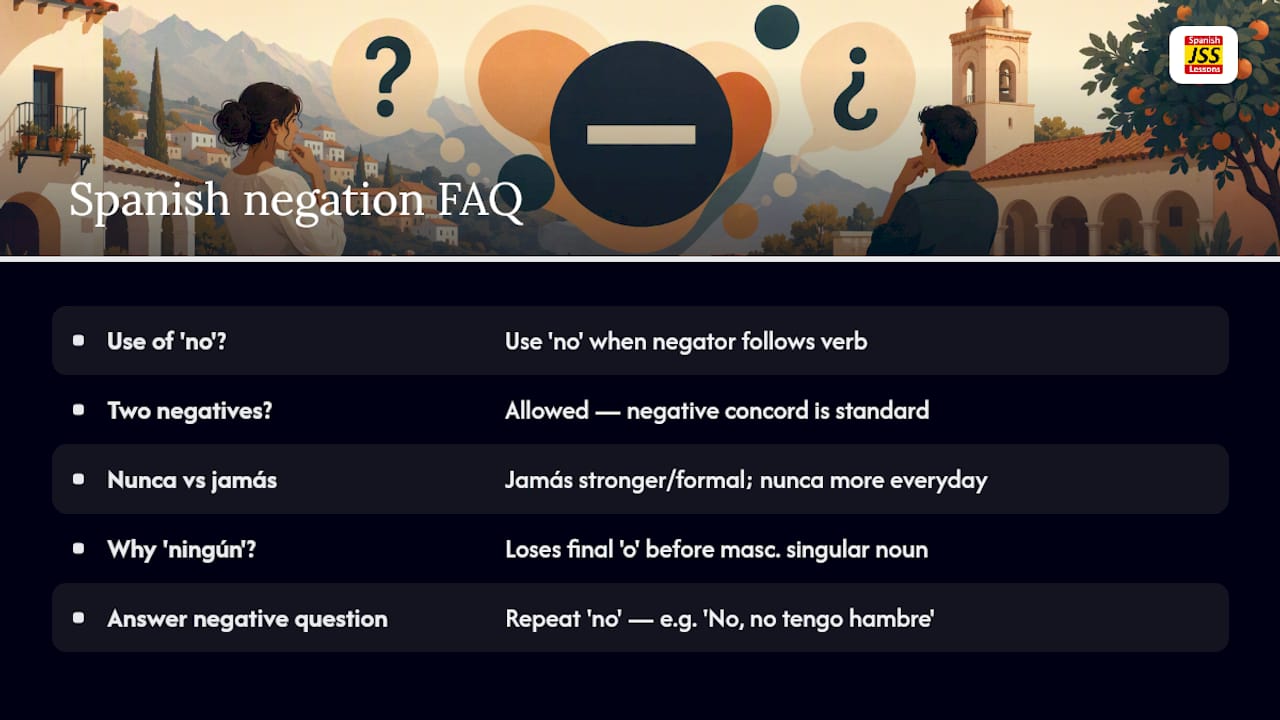
Frequently asked questions about Spanish negation
Do I always need “no” before a negative sentence?
Only when the negative word comes after the verb. If the negative word (nadie, nunca, tampoco) comes before the verb, “no” is dropped entirely.
Is it wrong to use two negative words in one Spanish sentence?
No. Spanish negative concord requires multiple negatives to reinforce, not cancel, the meaning, and the RAE lists this as standard usage.
What’s the difference between “nunca” and “jamás”?
Both mean “never”, but “jamás” is stronger and more formal. “Nunca” is the everyday choice in most conversation.
Why does “ningún” sometimes lose its final “o”?
It apocopates to “ningún” before a masculine singular noun, following the same pattern as “uno” becoming “un”.
How do I answer a negative question like “¿No tienes hambre?”
Confirm with “No, no tengo hambre” if you agree you’re not hungry, repeating “no” for clarity rather than a single ambiguous word.
Sources
Consult the RAE’s negative alternation guide for the definitive grammatical explanation, BBC Bitesize for learner-friendly summaries, and Spanishgrammar for extra practice patterns.