

Talking about past experiences Spanish
Use the preterite (pretérito indefinido) for completed, one-off events. Use the imperfect (pretérito imperfecto) for background, descriptions, and habits. In Spain, use the present perfect (pretérito perfecto compuesto) for things that happened recently or today. That three-way split covers the vast majority of situations you will face when talking about past experiences in Spanish.
Here are three paired examples to make it concrete:
- Completed event (preterite): “I went to the market yesterday.” → Fui al mercado ayer.
- Background/habit (imperfect): “When I was young, I always went to the market on Saturdays.” → Cuando era joven, siempre iba al mercado los sábados.
- Recent past, Spain (present perfect): “I’ve been to the market this morning.” → He ido al mercado esta mañana.
A quick regional note: in Spain, speakers routinely use the present perfect for anything that happened today or feels connected to now. In most of Latin America, the preterite handles those same situations. If you are learning European Spanish, as described by The English Nook, the present perfect is the natural choice for recent events in everyday conversation.
Key takeaways
The core rule for past tenses in European Spanish: use the preterite for completed events, the imperfect for background and habits, and the present perfect for recent or today-linked events in Spain.
| Point | Details |
|---|---|
| Preterite for completed actions | Use it for single, finished events with a clear time stamp: ayer, el lunes, una vez. |
| Imperfect for background and habit | Use it for descriptions, ongoing states, weather, age, and things you used to do regularly. |
| Present perfect in Spain | In European Spanish, use it for today’s events and recent results: hoy, esta semana, ya. |
| Time expressions are your guide | Words like de repente signal preterite; siempre and mientras signal imperfect. |
| James Spanish School | The sentence-building and ear-tuning course builds past-tense production and listening speed for European Spanish. |
Table of Contents
- How do you choose between the preterite, imperfect, and present perfect?
- How to form the preterite and imperfect: endings and the irregulars worth learning first
- Which time words signal which past tense?
- See both tenses in action: an annotated story
- Three practical drills to build past-tense fluency
- The mistakes learners make most often and how to fix them
- James Spanish School: structured practice for past-tense fluency
- Sources
How do you choose between the preterite, imperfect, and present perfect?
The fastest way to pick the right tense is to ask yourself a quick question before you speak. Think of it as a two-second mental checkpoint rather than a grammar exercise.
Signals that point to the preterite:
- A specific time stamp: ayer (yesterday), el lunes pasado (last Monday), en 2019
- A single, completed action: “I called her.” “He left.”
- A sequence of events that moved a story forward: “I arrived, sat down, and ordered.”
- A sudden change or interruption: “Suddenly, it started to rain.”
Signals that point to the imperfect:
- Ongoing background or atmosphere: “The sun was shining. The streets were quiet.”
- Age, time of day, or weather in the past: “It was three o’clock. She was twelve.”
- Habitual or repeated actions: “We used to eat late every night.”
- Descriptions of people, places, or feelings: “He seemed nervous. The house was old.”
Signals that point to the present perfect (Spain):
- Something that happened today: Esta mañana he tomado café. (I’ve had coffee this morning.)
- Life experience phrases: He vivido en Madrid. (I have lived in Madrid.)
- Very recent results: He perdido las llaves. (I’ve lost my keys.)
The Spanish Academy’s guide to discussing your life story frames it well: the preterite moves the plot forward, while the imperfect paints the scene. Think of them as two cameras running simultaneously. Camera one captures the action; camera two holds the background in frame.
Flow prompts to use in real conversation:
- “Is this a finished event with a clear time?” → preterite
- “Am I describing what things were like, or what someone used to do?” → imperfect
- “Did this happen today or does it feel connected to right now?” → present perfect (Spain)
Pro Tip: Write the three trigger questions on a sticky note and keep it near your study space. After two weeks of checking it before each sentence, the habit becomes automatic.
How to form the preterite and imperfect: endings and the irregulars worth learning first
Regular endings are the engine room of past-tense production. Learn these patterns and you can conjugate hundreds of verbs immediately.

Regular verb endings
| Pronoun | -AR preterite | -ER/-IR preterite | -AR imperfect | -ER/-IR imperfect |
|---|---|---|---|---|
| yo | -é | -í | -aba | -ía |
| tú | -aste | -iste | -abas | -ías |
| él/ella | -ó | -ió | -aba | -ía |
| nosotros | -amos | -imos | -ábamos | -íamos |
| vosotros | -asteis | -isteis | -abais | -íais |
| ellos | -aron | -ieron | -aban | -ían |
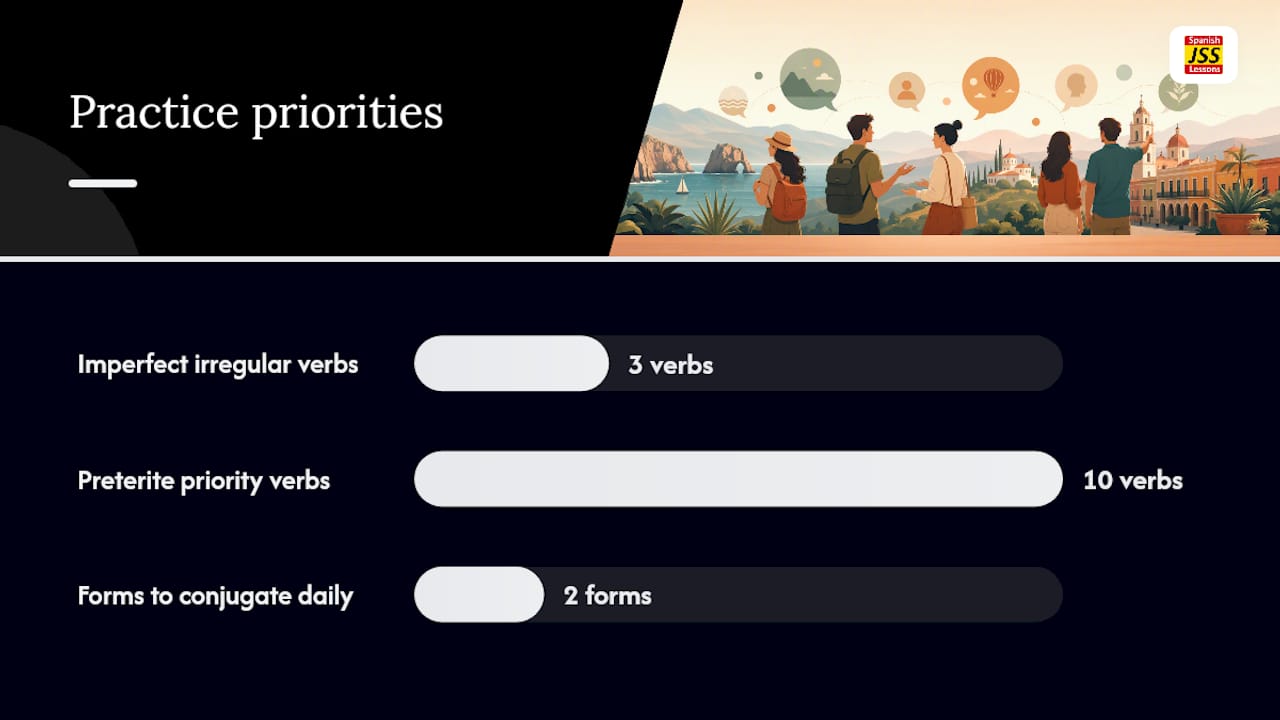
The imperfect is almost entirely regular. Only three verbs break the pattern: ser (era, eras, era…), ir (iba, ibas, iba…), and ver (veía, veías, veía…). That is genuinely good news for beginners.
The preterite has more irregulars, but a short list covers most of what you will actually say. According to Lingvist’s preterite guide, these are the high-frequency forms to prioritise:
- ser/ir → fui, fuiste, fue, fuimos, fuisteis, fueron (same forms for both verbs; context tells them apart)
- tener → tuve, tuviste, tuvo…
- estar → estuve, estuviste, estuvo…
- hacer → hice, hiciste, hizo…
- decir → dije, dijiste, dijo…
- poder → pude, pudiste, pudo…
- querer → quise, quisiste, quiso…
- dar → di, diste, dio…
- ver → vi, viste, vio…
- traer → traje, trajiste, trajo…
One verb, two meanings: querer in the preterite (quise) means “I tried to” or “I wanted to (and acted on it).” In the imperfect (quería), it means “I wanted to” as an ongoing feeling. Similarly, saber in the preterite (supe) means “I found out,” while sabía means “I knew.” These shifts in meaning are worth noting early.
Pronunciation points that affect how you sound:
- The preterite yo form ends in a stressed -é or -í: hablé, comí. The stress falls on the final syllable. Drop it and you sound like the present tense.
- Third-person plural endings -aron and -ieron carry the stress on the first syllable: HABlaron, COMieron. Many learners stress the wrong syllable.
- The imperfect endings -abas and -ías are soft and unstressed on the final syllable. Keeping them light and flowing is what makes imperfect speech sound natural rather than clipped.
Pro Tip: Pick the ten verbs above and conjugate just the yo and él/ella forms each morning before breakfast. Five minutes, ten verbs, two forms each. After a fortnight, those forms will come out without thinking.
Which time words signal which past tense?
Time expressions are your shortcut to sounding natural. Native speakers use them constantly, and they nearly always point to a specific tense. Grouping them by tense makes them far easier to remember.
Preterite triggers:
- ayer (yesterday) — Ayer llamé a mi hermana.
- anoche (last night) — Anoche cenamos fuera.
- el otro día (the other day) — El otro día vi una película estupenda.
- una vez (once) — Una vez perdí el tren.
- de repente (suddenly) — De repente empezó a llover.
Imperfect triggers:
- cuando era niño/a (when I was a child) — Cuando era niña, vivía en el campo.
- siempre (always, habitually) — Siempre tomábamos café después de comer.
- a menudo (often) — A menudo íbamos al mercado los sábados.
- mientras (while) — Mientras leía, sonó el teléfono.
- todos los días (every day) — Todos los días caminaba al trabajo.
Present perfect triggers (Spain):
- hoy (today) — Hoy he ido al médico.
- esta semana (this week) — Esta semana he trabajado mucho.
- ya (already) — Ya he comido.
- todavía no (not yet) — Todavía no he llamado.
Connectors are equally powerful for sequencing a past narrative: primero (first), luego (then), después (afterwards), al final (in the end). A simple timeline sentence using all four: Primero llegué al aeropuerto, luego facturé el equipaje, después esperé dos horas y al final subí al avión. That single sentence pattern is a template you can reuse for almost any story.
See both tenses in action: an annotated story
The Sampere blog’s “two-camera” metaphor captures the technique perfectly: one camera holds the background (imperfect), the other captures the action (preterite). Here is a short European Spanish anecdote with each clause labelled.
Notice how the story opens with two imperfect sentences to establish the mood, then switches to the preterite the moment something happens. The past perfect (había chocado) appears once to signal an action that was already complete before the main events. That structure, setting → interruption → action → reaction, is a template you can copy directly for your own stories.
Three practical drills to build past-tense fluency
Short, repeatable practice loops beat long study sessions. Cursa’s A2 practice guide recommends timeline and photo-description exercises as the most effective formats for this level. The three drills below are built on the same principle: produce, listen back, correct, repeat.
Drill 1: Sentence-finish (imperfect into preterite)
- Read the imperfect opening aloud.
- Finish the sentence with a preterite interruption.
- Check your answer, then repeat three times at natural speed.
Prompt: Estaba leyendo cuando…
Sample answer: Estaba leyendo cuando sonó el teléfono. (I was reading when the phone rang.)
Prompt: Dormía tranquilamente cuando…
Sample answer: Dormía tranquilamente cuando escuché un golpe en la puerta. (I was sleeping peacefully when I heard a knock at the door.)
Run five prompts per session. The spoken practice lessons at James Spanish School use a similar sentence-building loop that you can follow alongside these drills.
Drill 2: Timeline retell
- Write three events from your day or week in English.
- Put them in order using primero, luego, al final.
- Translate each into Spanish using the preterite.
- Say the full sequence aloud twice.
Sample: Primero fui al supermercado, luego preparé la comida y al final llamé a mi amigo. (First I went to the supermarket, then I prepared lunch, and finally I called my friend.)
Drill 3: Photo description
- Find any photo from a past trip or event.
- Describe the scene in two imperfect sentences (what it was like, what people were doing).
- Add two preterite sentences (what happened, what you did).
Sample: Había mucha gente en la plaza. Todos hablaban y reían. [Imperfect: scene] De repente empezó a tocar una banda de música. Nos quedamos a escuchar durante una hora. [Preterite: actions]
The real-life conversation scenarios listed on the James Spanish School site give you a ready supply of situations to use as photo-description or retell prompts.
Pro Tip: Ten minutes a day using these three drills, rotating one per day, gives faster speaking gains than a single long weekly session. Record yourself on your phone, play it back, and notice where you hesitate. That hesitation point is exactly where to drill next. The WordAmigo system inside James Spanish School’s course uses the same strategic repetition principle to lock in vocabulary and pronunciation alongside your tense practice.
The mistakes learners make most often and how to fix them
Most errors with past tenses in Spanish come from one source: English has one simple past tense, so learners reach for the preterite every time. Language Trainers’ analysis of common learner errors confirms that overusing the preterite and skipping imperfect background details is the single biggest reason stories sound flat and mechanical.
Common mistakes and quick fixes:
- Overusing the preterite for descriptions: “The house was big” → learners write La casa fue grande (wrong) instead of La casa era grande (correct). If you are describing what something was like, not what it did, use the imperfect.
- Confusing ser and estar in the past: Fue (preterite of ser) describes identity or a completed event (“It was a great film”). Estuvo (preterite of estar) describes a temporary state or location (“She was at the hospital”). Both translate as “was” in English, which is where the confusion starts.
- Using present perfect where preterite is expected in Latin America: If you are speaking with someone from Mexico or Argentina, He comido (I have eaten) for “I ate yesterday” will sound odd. In Latin America, Comí ayer is the natural form. In Spain, both are used, with the present perfect preferred for recent events.
- Literal translation of “used to”: English speakers often try to translate “used to” word for word. The imperfect handles it directly: “I used to live in Seville” → Vivía en Sevilla, not any construction with solía (though solía is also correct and worth knowing).
- Missing the stress on preterite endings: Saying hablo (I speak, present) and habló (he spoke, preterite) with the same stress makes them indistinguishable. The preterite third-person singular always carries the stress on the final syllable: habLÓ, comiÓ, viviÓ.
A Spain-specific note: when you are in Spain and something happened this morning, this week, or feels recent, the present perfect is the natural choice in conversation. Saying Fui al médico esta mañana instead of He ido al médico esta mañana will not confuse anyone, but the latter is what you will hear from locals.
James Spanish School: structured practice for past-tense fluency
Knowing the rules is one thing. Producing them at conversation speed, without pausing to conjugate in your head, is another challenge entirely. James Spanish School’s 100-lesson course is built around exactly that gap. The sentence-building half of the course trains you to construct past-tense sentences from the inside out, using plain English explanations rather than grammar terminology. The ear-tuning half helps you follow the fast, connected speech of native European Spanish speakers, so that when someone tells you a story using a mix of preterite and imperfect, you catch every tense shift.
Lifetime access means you can return to any past-tense lesson as many times as you need, with no countdown clock and no pressure. The WordAmigo system reinforces vocabulary and pronunciation through strategic repetition, so the verbs and time expressions from this article stay in memory rather than fading after a week. Visit James Spanish School’s course page to see the full lesson structure and start practising past tenses in context today.
Sources
These sources were used to prepare this article and are worth bookmarking for continued study.
- How to discuss your life story and background in Spanish | Spanish Academy
- How to tell a story in Spanish using the past tenses like a native | Sampere
- Cómo hablar del pasado en español — Talking About the Past in Spanish – The English Nook
- Describing Past Events and Experiences in Spanish (A2 Level) | Cursa