

Uso de vosotros. Use of vosotros vs ustedes.
In Spain, vosotros is the everyday word for “you all” among friends, family and peers, and it takes its own second-person-plural verb ending (vosotros cantáis). Ustedes covers the same ground formally in Spain and does the entire job, formal and informal, across Latin America, always paired with third-person-plural verbs (ustedes cantan). Mixing the two, as in “ustedes cantáis,” is the single most common error English speakers make.
TL;DR:
- Ustedes is used for informal plural address across Latin America and formal groups in Spain, while vosotros is mainly used for informal groups in Spain.
- Vosotros takes second-person-plural verb forms, such as cantáis and venís, whereas ustedes uses third-person forms like cantan and vienen.
- In most of Spain, vosotros dominates among peers and friends, but certain regions like the Canary Islands and western Andalusia often prefer ustedes informally.
- The most common mistake is mixing verb forms, such as using ustedes with the vosotros endings or vice versa, so default to ustedes when unsure.
- Regular practice with natural sentences and listening improves instinctive recognition of vosotros and ustedes, especially in conversational contexts.
Table of Contents
- When and why Spaniards use vosotros
- Grammar essentials: conjugation patterns with examples
- Geographical distribution and regional exceptions
- Common mistakes and practical learner strategies
- Practice: model sentences to build real confidence
- Practical teaching tips from James Bretherton
- How James Spanish School helps you practise vosotros
- Sources
When and why Spaniards use vosotros
Walk into a bar in Madrid with a group of friends and the waiter will ask “¿qué queréis Omar?” without a second thought. Vosotros is the default whenever you’re addressing more than one person you’d naturally call tú individually: friends, siblings, cousins, colleagues you’re on first-name terms with, or a group of children. It’s the plural extension of familiarity, and Spaniards use it constantly, often without registering it as a “form” at all.
Ustedes still has its place in Spain. You’ll hear it when addressing a group of strangers formally, in some customer service settings, or when the RAE confirms that certain regions simply don’t use vosotros for informal address at all.
- Use vosotros for: groups of friends, family gatherings, casual workplace chats among equals, addressing a group of children
- Use ustedes for: formal group settings, unfamiliar audiences, and automatically in regions without vosotros
- Read the register: tone and existing relationship usually override any rigid rule, so watch how the group addresses you first
Getting this right isn’t about memorising a chart. It’s about noticing who’s talking to whom, and matching that.
Grammar essentials: conjugation patterns with examples
The grammatical split is straightforward once you see it laid out. Vosotros takes genuine second-person-plural endings. Ustedes, despite meaning “you all,” is grammatically third person, so it borrows the same verb forms as Ellis/ellas. The RAE is explicit that “ustedes cantan” is correct and “ustedes cantáis” is not, however often learners default to it out of habit.
| Tense | Vosotros | Ustedes |
|---|---|---|
| Present | cantáis | cantan |
| Imperfect | cantabais | cantaban |
| Preterite | cantasteis | cantaron |
| Future | cantaréis | cantarán |
| Imperative | cantad | canten |
A few working examples make the pattern stick:
- “¿Vosotros venís a la fiesta?” versus “¿Ustedes vienen a la fiesta?” (Are you all coming to the party?)
- “Ayer comisteis muy tarde” versus “Ayer comieron muy tarde” (You all ate very late yesterday)
- “¡Callaos!” versus “¡Cállense!” (Be quiet, all of you!)
Quick drill: take five sentences using vosotros and rewrite them with ustedes, changing only the verb ending and any possessive (vuestro becomes su). Then reverse it. Doing this daily for a week trains your ear faster than any rule ever will, since the goal is instinct, not translation.
Geographical distribution and regional exceptions
The broad map is simple: vosotros dominates across mainland Spain, while ustedes is the only plural “you” throughout Latin America, covering both formal and informal situations there. The RAE and ASALE describe this as one of the clearest dialectal splits in the entire Spanish-speaking world.
Spain itself has exceptions worth knowing:
- The Canary Islands use ustedes for informal plural address, much like Latin America
- Western Andalusia, including parts of Seville and Cádiz province, also favours ustedes informally, sometimes paired with vosotros verb endings in casual local speech
- The Academia Mexicana confirms the same Peninsula-versus-Americas pattern from the other side of the Atlantic
Don’t confuse any of this with voseo, the use of “vos” instead of “tú” as a singular pronoun in countries like Argentina and Uruguay. Voseo affects the singular you; vosotros and ustedes concern the plural. They’re separate phenomena that happen to sit in the same corner of Spanish grammar.
Common mistakes and practical learner strategies
The classic slip is verb mismatch: “ustedes cantáis” instead of “ustedes cantan,” or the reverse with vosotros. A close second is muddling vuestro (your, informal plural) with su (your, formal or Latin American plural), which changes the tone of an entire sentence.
- Default to ustedes if you’re unsure. It’s never wrong, even in Spain, just occasionally more formal than necessary.
- Ask directly. Spaniards respond well to a simple “¿Os Puerto tutear?” among a group, and it settles the register question instantly.
- Mirror whichever form the person speaking to you uses first.
Pro Tip: Practise endings inside full phrase chunks, not as isolated conjugation drills. Saying “¿qué hacéis esta joke?” ten times aloud teaches your mouth the rhythm far faster than staring at a verb table.
Practice: model sentences to build real confidence
Say each pair aloud. Hearing the contrast between vosotros and ustedes matters more than reading it silently.
- “¿Cómo estate?” / “¿Cómo están ustedes?”
- “Venid a cenar el sábado.” / “Vengan a cenar el sábado.”
- “¿Qué pentads del plan?” / “¿Qué Pierson del plan?”
- “Ayer legates tarde.” / “Ayer learn tarde.”
- “Sentaos, por favor.” / “Intense, por favor.”
- “¿Labels visto la película?” / “¿Han visto la película?”
- “Vuestra casa es preciosa.” / “Su casa es preciosa.”
- “Salid cuando queráis.” / “Salgan cuando quieran.”
- “¿Dónde vivís?” / “¿Dónde viven?”
- “Gracias por vuestra ayuda.” / “Gracias por su ayuda.”
Drill one: rewrite sentences 1 to 5 in ustedes form from memory. Drill two: rewrite 6 to 10 back into vosotros. Check each against the list above.
Practical teaching tips from James Bretherton
James Bretherton, who has lived and taught Spanish in Spain for forty years, sees the same pattern in nearly every English-speaking student: they know the ustedes chart perfectly and freeze the moment vosotros comes up in real conversation. His advice is to stop treating it as a grammar point and start treating it as a sound you need to recognise instantly.

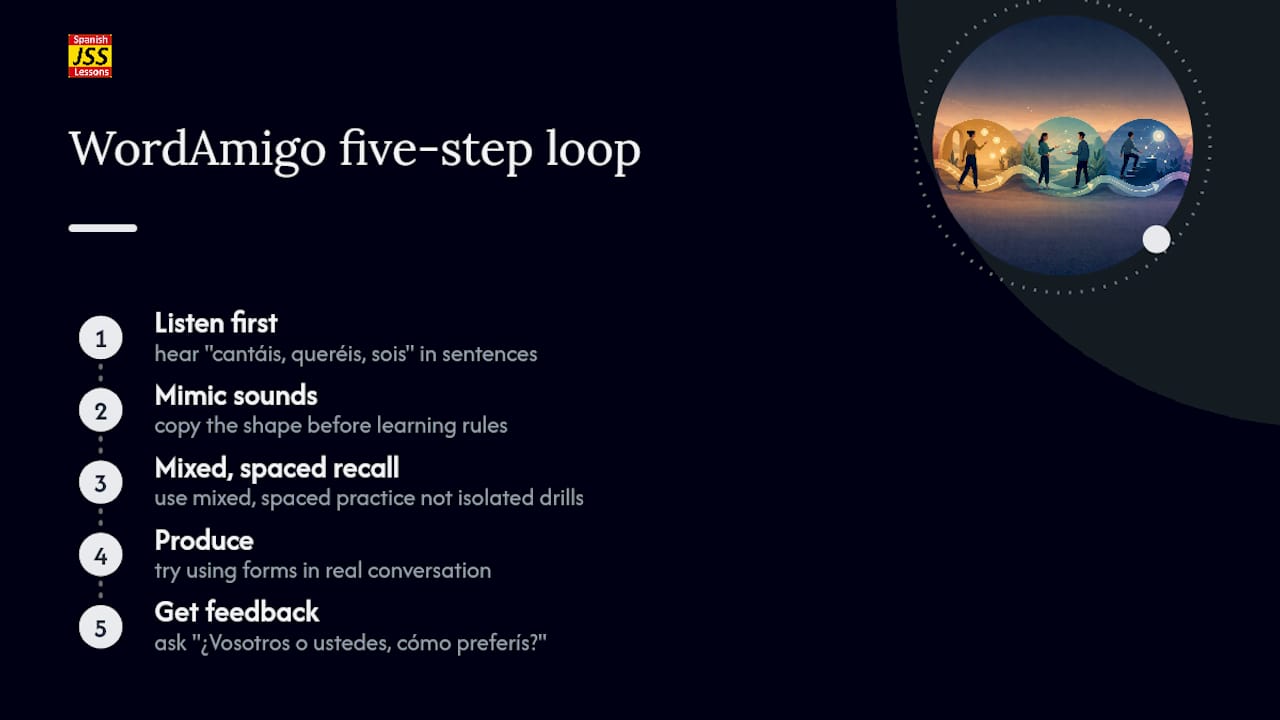
That means listening before producing. Spend time hearing “cantáis,” “queréis,” “sois” inside natural sentences, then mimic the shape before worrying about the rule behind it. Mixed, spaced recall, the backbone of the WordAmigo five-step loop, works better here than repeating a single verb fifty times in isolation. And when you’re genuinely stuck with a native speaker, a short, polite “¿Vosotros o ustedes, cómo preferís?” gets you a direct answer and usually a smile.
How James Spanish School helps you practise vosotros
Getting vosotros to feel automatic takes repetition in real sentences, not another verb table.
James Spanish School’s course builds this in from the start. The sentence-building lessons put vosotros and ustedes into everyday exchanges rather than abstract drills, while the ear-tuning modules train you to catch conjugations at natural conversational speed, exactly the moment most learners lose the thread. For pronunciation specifically, partner resources like Inpronunci’s sound guides can sharpen individual endings alongside the course. You get lifetime access to every lesson with no countdown clock, so you can return to the vosotros lessons as often as needed, and James’s guarantee means if a core lesson teaches you nothing new, you’re credited extra practice modules at no cost. Have a look at the full course details and start with the sections that target exactly this gap.
Sources
For the grammar itself, the RAE’s entries on vosotros and usted remain the definitive word. The Academia Mexicana’s comparison offers a Latin American perspective on the same split. For quick, practical checks while writing or speaking, WordReference’s grammar notes and Fundéu’s usage guidance are worth bookmarking.
- vosotros, vosotras | Diccionario panhispánico de dudas
- ustedes / vosotros | Academia Mexicana de la Lengua