

This article gives you ready-to-copy Spanish icebreakers for dating apps, chat, the classroom, and social or professional settings, plus short templates to personalise each one. You’ll also find culturally grounded advice from James Spanish School on tone, timing, and common mistakes to avoid.
TL;DR:
- Personalized openers that reference specific profile details significantly increase reply rates compared to generic greetings.
- Asking low-pressure, observation-based questions rather than statements encourages more engagement in both virtual and in-person conversations.
- Timing the message within a day or two of a post or match improves response chances, while delayed follow-ups are generally ineffective.
- Avoid overly direct or overtly sexual openers, as they risk alienating the other person or damaging rapport early on.
- Practicing pronunciation and intonation is crucial for natural delivery, with emphasis on stress, pitch, and rhythm to sound confident and genuine.
Table of Contents
- Frases rompehielos en español for dating and apps
- Icebreakers for chat and social media
- Icebreakers for classroom and group settings
- Phrases for social and professional in-person moments
- How to build and personalise your own opener
- Openers to avoid and how to recover
- Ready-to-copy templates you can adapt today
- Who’s behind these phrases
- Why icebreakers actually work
- Getting your pronunciation and delivery right
- Practise these phrases until they sound like you
- Sources
Frases rompehielos en español for dating and apps
Dating apps reward specificity, not generic charm. Editorial breakdowns of top-performing openers consistently show that messages split by tone work better than a single one-size-fits-all line, because a sincere opener and a flirty one land completely differently depending on the match. Below are openers grouped by tone, each with a note on when to fire it off.
Sincere openers:
- “¿Cuál ha sido tu mejor viaje hasta ahora?” — use when the profile shows travel photos.
- “Me ha llamado la atención tu foto en [lugar]. ¿Qué tal fue?” — use to reference a specific location shown.
- “¿Qué es lo que más te gusta de tu trabajo?” — safe, use once you’ve swapped a few messages.
- “Tu perro es precioso, ¿cómo se llama?” — use for pet photos, almost always gets a reply.
- “¿Qué música no puede faltar en tus altavoces un sábado por la noche?” — good for music-heavy profiles.
Funny openers:
- “Si fueras un plato español, ¿cuál serías y por qué?” — playful, works well as a first line.
- “Confiesa: ¿pizza con piña sí o no?” — light controversy, gets people talking fast.
- “¿Cuál es tu excusa favorita para llegar tarde?” — use once there’s a bit of banter already.
- “Necesito tu opinión experta: ¿churros con chocolate o con café?” — use if the bio mentions food.
- “¿Te consideras más de planes tranquilos o de aventuras raras?” — breaks the ice without pressure.
Playful/flirty openers:
- “Vale, tu sonrisa en la tercera foto me ha hecho parar de hacer scroll.” — direct compliment, use sparingly.
- “¿Qué tienes que hacer para conseguir una cita contigo?” — bold, use only if the profile signals openness to flirting.
- “Dime algo interesante de ti que no esté en tu perfil.” — invites a real answer instead of small talk.
- “¿Cuál es tu superpoder secreto?” — light, works across most profiles.
- “Apuesto a que tienes una historia buena detrás de esa foto.” — use for unusual or striking photos.
Personalising an opener in practice: if a profile shows someone hiking in the Pyrenees, don’t send line 1 word-for-word. Adapt it: “¿La foto de los Pirineos es reciente? Llevo tiempo queriendo ir.” That single tweak, referencing something visible in the profile, does more work than any generic line could. It shows you actually looked, and it gives the other person something concrete to answer rather than a flat “yes/no.”
Icebreakers for chat and social media
Digital messages fail for one reason more than any other: they’re generic. “Hola, ¿qué tal?” gets ignored because it asks nothing and references nothing. Messages that mention a visible detail from a profile or a recent post reply far more often than a flat greeting, because they show effort and give the reader something specific to respond to.
The structure that works: observation + low-pressure question. Notice something real (a post, a story, a bio line), then ask a question that’s easy to answer in one sentence. Here are 20 short openers built on that structure:
- “Vi que subiste una foto en Barcelona, ¿qué tal el viaje?”
- “Tu última historia parecía divertidísima, ¿dónde fue?”
- “¿Ese plato de tu post lo cocinaste tú?”
- “Me ha encantado la canción de tu story, ¿quién es?”
- “¿Qué tal la maratón que corriste el finde?”
- “Vi que sigues a [artista/equipo], ¿fuiste al concierto/partido?”
- “Tu perfil dice que te gusta el senderismo, ¿alguna ruta que recomiendes?”
- “¿Cómo se llama el sitio de tu última foto?”
- “Ese libro que mencionaste, ¿lo recomiendas?”
- “Vi tu comentario en el grupo, muy buena observación.”
- “¿Qué tal te fue con la mudanza que comentaste?”
- “Tu bio dice ‘amante del café’, ¿cuál es tu cafetería favorita?”
- “¿Qué tal el nuevo trabajo del que hablaste?”
- “Me sonó tu acento en el vídeo, ¿de dónde eres?”
- “Ese meme que compartiste me ha hecho el día.”
- “¿Sigues con el proyecto que mencionaste el otro día?”
- “Vi que te mudaste, ¿qué tal la nueva ciudad?”
- “¿Qué tal fue la boda de tu prima?”
- “Ese destino de tu última publicación está en mi lista, ¿qué tal fue?”
- “¿Cómo va esa serie que estabas viendo?”
Personalising the template: take “Vi que subiste una foto en Barcelona, ¿qué tal el viaje?” and swap in the real detail, “Vi que fuiste al Camp Nou, ¿viste algún gol bueno?” The formula stays fixed; the detail changes every time.
Pro Tip: Send your opener within a day or two of the post or match. A reference to something from three weeks ago reads as stalking rather than interest, and if there’s no reply within 48 hours, a single light follow-up (never two) is enough.
Icebreakers for classroom and group settings
Classroom icebreakers need one thing above all: a low barrier to speaking, as explained in how to participate in class discussions in a foreign language. Quick, repeatable activities like these consistently get more learners talking than open-ended “tell me about yourself” prompts, which intimidate beginners.
Teacher-friendly prompts:
- “¿Prefieres el mar o la montaña?”
- “¿Cuál es tu comida favorita?”
- “Si pudieras viajar a cualquier país, ¿a cuál irías?”
- “¿Qué harías con un millón de euros?”
- “¿Tienes mascota? Descríbela.”
- “¿Cuál es tu estación del año favorita?”
- “¿Qué serie estás viendo ahora mismo?”
- “¿Prefieres el desayuno dulce o salado?”
- “¿Cuál fue tu último viaje?”
- “¿Qué te gusta hacer los fines de semana?”
Mini-activities that work with mixed-ability groups:
- Would you rather — pairs choose between two options aloud, then explain why in one sentence.
- 4 Corners — label corners of the room with opinions; students walk to the one they agree with and defend it.
- Human bingo — a grid of traits (“le gusta el fútbol”, “ha viajado a Italia”) that students fill by asking classmates.
- Cadena de preguntas — one student asks a question, the next answers and asks a new one.
For beginners, scaffold the language first: teach “Me gusta…” and “Prefiero…” as fixed frames before asking open questions, and this guide to Spanish question forms breaks down exactly which structures suit novice speakers.
Phrases for social and professional in-person moments
Face-to-face icebreakers live or die on register. Neutral prompts work best in professional settings, where anything too personal can land awkwardly, while casual settings give you more room to play.
Casual (with friends, at a party):
- “¿Qué tal la fiesta?”
- “¿Conoces a mucha gente aquí?”
- “¿Te apetece una caña?” (common in Spain, less so elsewhere)
- “¿Cómo conoces al anfitrión?”
- “¿Ya has probado la comida?”
Neutral (mixed groups, casual work events):
- “¿A qué te dedicas?”
- “¿Cuánto tiempo llevas en la empresa?”
- “¿Es tu primera vez en un evento así?”
- “¿Qué te trae por aquí?”
- “¿Has estado antes en esta ciudad?”
Polite (formal or first-time professional contact):
- “Encantado/a de conocerle, ¿a qué se dedica?”
- “¿Cómo valora la conferencia hasta ahora?”
- “¿Le puedo hacer una pregunta sobre su ponencia?”
- “¿Qué le trae a este evento?”
- “Perdone, ¿es la primera vez que asiste?”
Neutral prompts avoid the personal territory that can put a colleague on the back foot in a team-building or work setting. Watch for closed body language or short answers; that’s your cue to move to a lighter topic or gracefully exit the conversation.
How to build and personalise your own opener
Every effective opener follows the same three-step shape: observation, then a low-pressure question, then an optional detail about yourself. Skip the observation and you get a flat greeting; skip the question and the other person has nothing to respond to.
- Generic: “Hola, ¿qué tal?” → Personalised: “Vi que corriste una maratón, ¿cómo te sentiste al terminar?”
- Generic: “¿Qué haces?” → Personalised: “Tu perfil dice que cocinas, ¿cuál es tu especialidad?”
- Generic: “Bonita foto” → Personalised: “Esa foto en la playa parece de otoño, ¿cuándo fue?”
- Generic: “¿De dónde eres?” → Personalised: “Tu acento suena del norte, ¿eres de Asturias?”
Reply rates rise sharply when a message mentions something specific and visible rather than a stock greeting, which is exactly why the observation step matters more than the question itself.
One note on register: regional word choice matters. “Cañas” for a small beer works in Spain but sounds odd in parts of Latin America, so match your vocabulary to where your conversation partner is actually from, and default to “usted” with strangers older than you or in formal settings.
Openers to avoid and how to recover
Some lines fail before they’ve even landed. Avoid these:
- “¿Qué buscas aquí?” — sounds interrogative, not curious.
- Anything overtly sexual as a first line — reads as disrespectful before any rapport exists.
- “Hola guapa/o” — reduces the other person to appearance and skips any real question.
- Copy-pasted compliments (“Me encanta tu sonrisa”) — obviously generic, easy to spot.
If a message lands badly, recover with something honest: “Perdona, esa pregunta sonó rara, ¿qué tal tu día?” works after an awkward first line. “Cambio de tema, ¿qué tal el finde?” resets after silence. “No pretendía sonar tan directo/a, ¿me cuentas algo de ti?” repairs an overly bold opener.
Ready-to-copy templates you can adapt today
Ten templates to fill in with your own details:
- “Vi que [detalle visible], ¿[pregunta relacionada]?”
- “Soy [nombre], me dedico a [profesión], ¿y tú?”
- “Si tuvieras que elegir entre [opción A] y [opción B], ¿cuál sería?”
- “¿Qué opinas de [tema ligero]?”
- “Tu foto de [lugar/actividad] me ha recordado a [breve anécdota].”
- “¿Cuál es tu [comida/canción/serie] favorita ahora mismo?”
- “Necesito tu consejo sobre [tema neutral].”
- “¿Qué tal [evento/situación reciente]?”
- “Me llamó la atención [detalle], ¿me cuentas más?”
- “¿Prefieres [opción A] o [opción B]? Yo elegiría [tu opción].”
Filled examples: “Vi que corres maratones, ¿cuál fue la más dura?” and “Soy Marta, me dedico al diseño gráfico, ¿y tú?”
Pro Tip: Keep each line under 12 words where you can. Native speakers naturally clip their sentences in casual chat, and a shorter opener reads as confident rather than rehearsed.
Who’s behind these phrases
James Bretherton, founder of James Spanish School, has lived in Spain for 40 years as a dual-native speaker, which shapes every cultural note in this list. His course uses Radical Simplification and the WordAmigo system to help English speakers build genuine spoken fluency rather than textbook Spanish.
One culture tip worth repeating: brevity beats polish. Spaniards tend to favour short, direct exchanges over long, formal openers, and region-specific vocabulary should be used cautiously outside its home area. Practising these lines aloud, with correct rhythm and stress, matters as much as choosing the right words, and pedagogical repetition is what turns a memorised phrase into a natural reply.
Why icebreakers actually work
An icebreaker’s real job isn’t to sound clever. It’s to lower the social risk of the first exchange, so both people feel safe enough to keep talking. A stranger’s brain treats the opening seconds of any interaction as a small threat assessment: is this safe, is this worth my attention, do I need an exit line ready? A well-chosen opener answers all three questions before the other person has to ask.
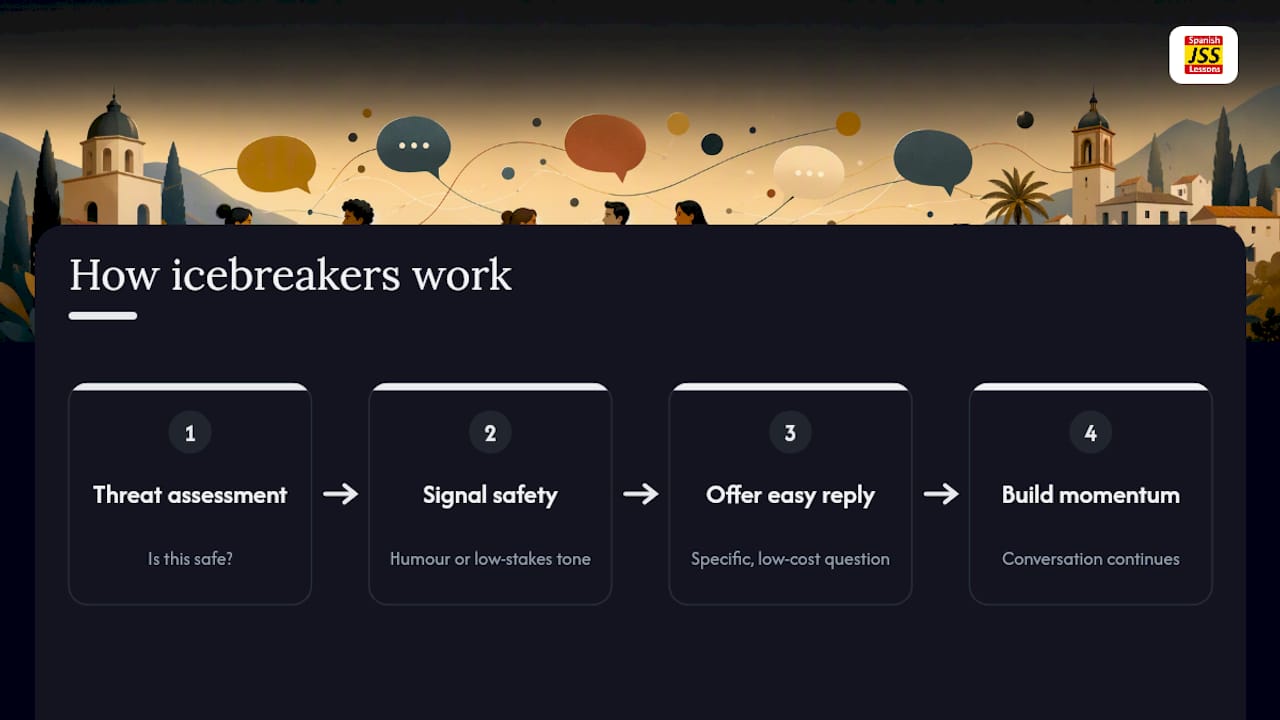
That’s why a question beats a statement. “Me gusta tu perfil” invites nothing back except a polite “gracias” and silence. “¿Qué tal el viaje a los Pirineos?” hands the other person an easy, specific thing to answer, and answering feels like less effort than it actually is. The exchange builds momentum from that first small, low-cost response.
Humour does something similar but through a different route: it signals that the interaction is low stakes, which relaxes the other person before any real information gets exchanged. That’s why funny openers on dating apps often outperform sincere ones in the first message, even though sincerity tends to build stronger connections once the conversation is rolling.
The same logic applies in a classroom. A shy student who’s asked “tell me about your life” freezes, because the question demands too much too soon. Asked “¿mar o montaña?” instead, that same student answers in two seconds, and the tiny win of a successful first reply makes the next question easier to attempt. Icebreakers work by shrinking the first step, not by being witty.
Getting your pronunciation and delivery right
A perfectly written opener falls flat if it’s delivered with hesitant, flat intonation, because Spanish relies heavily on rhythm to signal genuine interest rather than a recited line. A few habits make a real difference for non-native speakers.

Stress the right syllable. Spanish stress rules are largely predictable: words ending in a vowel, n, or s usually stress the second-to-last syllable (“viaje”, “pregunta”), while words ending in other consonants stress the last one (“ciudad”, “hablar”). Getting this wrong on a key word can make a question sound like a statement, or vice versa.
Rising intonation on questions matters more than in English. Spanish questions often start with an inverted question mark for a reason: the whole sentence structure shifts, and the rise in pitch toward the end needs to be clear and deliberate, not clipped.
Practise the line aloud, not just on the page. Reading “¿Qué tal el viaje?” silently teaches you nothing about how it sounds when spoken at a natural pace. Recording yourself and comparing it against a native speaker’s rhythm exposes gaps that silent reading never will.
Slow down consonant clusters. Words like “extranjero” or “construir” trip up learners who try to match native speed too soon. Native speakers themselves often simplify these clusters slightly in casual speech, so mimicking natural speed matters more than hitting textbook-perfect articulation.
Practise these phrases until they sound like you
Reading a list of openers is easy. Saying them naturally, at the right speed, with the right stress, without sounding like you’re reciting a script, is the actual skill, and it’s exactly what most self-teaching methods skip. James Spanish School builds this into its course through the WordAmigo system, which uses AI-driven spaced repetition to lock in vocabulary and pronunciation together, rather than treating them as separate problems.
Instead of memorising phrases and hoping they land, the course’s sentence-building and ear-tuning lessons train you to hear fast native replies and respond without freezing. Every lesson is on demand with no expiry date, so you can drill an opener until it’s automatic rather than rehearsed. If you want your Spanish icebreakers to sound as natural in a bar in Madrid as they do on the page, explore the full course here and start practising the exact structures covered in this guide.