

“Español a tu ritmo” means Spanish lessons structured entirely around your own schedule and pace, not a term’s timetable set by someone else. It is a self-paced, personalised learning model where you decide when to study, how fast to move through material, and which skills need more repetition. For English-speaking adults, James Spanish School delivers exactly this through a 100-lesson on-demand course paired with the WordAmigo retention system, both available with lifetime access.
What this looks like in practice:
- No fixed class times or countdown clocks pressuring you to keep up
- Lessons repeatable as often as needed until they genuinely stick
- A structured curriculum, not random videos, so pacing doesn’t mean aimless wandering
- Optional one-to-one practice when you want live conversation alongside solo study
To start, visit James Spanish School’s course shop and browse the available lesson packages or reserve a trial class.
Key Takeaways
Self-paced Spanish learning succeeds when structured lessons, targeted vocabulary, and live correction combine under a schedule you genuinely control.
| Point | Details |
|---|---|
| Define your CEFR goal | Map your target (travel, work, exams) to A1 to C2 outcomes rather than chasing vague fluency. |
| Structure beats random access | Look for sequenced lessons like sentence-building and ear-tuning, not a loose video library. |
| Protect momentum with routine | Short, frequent sessions anchored to an existing habit outperform occasional long study blocks. |
| Retention needs repetition and feedback | Spaced repetition plus corrective pronunciation practice locks in vocabulary that would otherwise fade. |
| James Spanish School matches the model | Its 100-lesson course, WordAmigo system, and lifetime access, available via the course shop, deliver structured self-paced learning built by a 40-year Spain resident. |
Table of Contents
- What does a self-paced, personalised Spanish course include?
- Who benefits, and what can you realistically expect by level?
- How do you fit Spanish study into a busy retirement or working life?
- Which learning methods actually move the needle for self-paced learners?
- How do you choose a self-paced Spanish course that fits your pace?
- Why James Spanish School fits the self-paced model
- Ready to start learning Spanish at your own pace?
- Sources
What does a self-paced, personalised Spanish course include?
A genuine self-paced course isn’t just pre-recorded videos dumped into a portal. It needs structure underneath the flexibility, or “at your own pace” becomes a polite way of saying “no plan at all.”
James Spanish School’s course splits its 100 lessons between two disciplines: sentence-building and ear-tuning. Sentence-building is the engine room of construction, where you learn how Spanish sentences actually go together using plain English explanations rather than grammar terminology nobody uses in real conversation. Ear-tuning trains your ability to follow the machine-gun speed of native replies, which is usually where classroom Spanish falls apart the moment you land in a real shop or café.
Expect these elements in a properly built self-paced offering:
- On-demand video and audio lessons you can replay endlessly
- Downloadable PDFs for reference between sessions
- A dedicated pronunciation mode with audio and text-based drills
- Lifetime access with no expiry date, so a slow month never costs you your progress
Modular practice matters here. Because lessons don’t disappear after a fixed window, you can spend three weeks on sentence-building, take a break, then return to ear-tuning without losing your place or paying again.
Who benefits, and what can you realistically expect by level?
Realistic expectations depend on your CEFR level and your actual goal, not a vague wish to become “fluent.” The Common European Framework of Reference gives a much more useful yardstick, and mapping your target against it turns “how long will this take” into “how soon can I do X.”
- A1 to A2 — ordering food, giving basic personal details, handling short transactional exchanges with shop staff or a pharmacist.
- B1 — holding a real conversation with a neighbour, explaining a problem to a tradesman, following most of a slow news report.
- B2 — managing work meetings, dealing with government paperwork, arguing your case with a utility company on the phone.
- C1 to C2 — near-native comprehension, catching regional accents and idiom, following fast group conversation without losing the thread.
Time to reach each level varies enormously depending on your goal and your prior language background. Research on Spanish learning timelines confirms outcomes shift by intensity, prior exposure to Romance languages, and how much genuine speaking practice you log rather than passive listening alone. Someone aiming to manage a house purchase needs different vocabulary, and often a shorter runway, than someone preparing for a formal qualification like SIELE. Defining the concrete task, rather than chasing an abstract sense of fluency, is what actually shortens the road.
How do you fit Spanish study into a busy retirement or working life?
Consistency beats intensity almost every time with language learning, and a self-paced course only works if you actually build a rhythm around it. Three sample weekly plans cover most learners’ realities:
- Tight schedule (3 to 4 hours a week): two 30 minute sentence-building sessions, two 20 minute ear-tuning sessions, and one WordAmigo vocabulary run over the weekend.
- Moderate availability (6 to 8 hours a week): daily 20 minute lessons on weekdays plus a longer Saturday session combining pronunciation drills with a one-to-one conversation slot.
- Full immersion push (10+ hours a week): daily lessons, background Spanish radio or podcasts during chores, and two weekly conversation practices to force active recall.
Passive exposure, such as Spanish television playing while you cook, reinforces what focused drills teach but never replaces them. Practical study routine tips from James Spanish School stress short, frequent sessions over occasional marathon revision, and speaking from your very first week rather than waiting until you feel “ready.”
Pro Tip: Anchor your Spanish session to an existing habit, such as your morning coffee or the commute, rather than trying to find a free half-hour cold. Habits stack far better than they start from nothing.

Which learning methods actually move the needle for self-paced learners?
Progress hinges on three things: what vocabulary you learn, how often you’re tested on it, and whether anyone corrects your pronunciation before a bad habit sets in.
Random vocabulary lists waste time. Words chosen for your actual life, dealing with a plumber, chatting to a neighbour, filling in a government form, stick because you use them within days of learning them. Spaced repetition then does the heavy lifting on memory, resurfacing words right before you’d naturally forget them rather than drilling everything equally.
- Focused, life-relevant vocabulary beats broad generic lists
- Spaced repetition timed to your own forgetting curve, not a fixed calendar
- Audio feedback that catches mispronunciation before it fossilises
- Corrective input from live practice, since self-correction alone rarely fixes accent
Blended models combining on-demand lessons with live practice and spaced repetition consistently outperform either approach used alone. James Spanish School’s WordAmigo system applies exactly this combination, using AI-driven repetition to lock in both vocabulary and pronunciation together rather than treating them as separate problems.
How do you choose a self-paced Spanish course that fits your pace?
Not every course marketed as flexible actually is. A short checklist protects you from paying for a subscription that quietly expires or a curriculum with no coherent structure underneath the marketing.
Check these five things before you buy:
- Curriculum alignment — does it map to CEFR levels, or is it a loose grab-bag of topics?
- Access policy — is it lifetime access, or does content vanish after twelve months?
- Live support — can you book one-to-one practice when self-study plateaus?
- Pronunciation tools — is there a genuine pronunciation mode, or just video playback?
- Trial or guarantee — can you test a lesson before committing your money?
Ask providers directly: “Is there lifetime access?”, “Can I book one-to-one conversation practice?”, and “Is there a demo of the pronunciation tool before I pay?” A provider’s institutional grounding matters too. Centres aligned with recognised frameworks such as those tracked by FEDELE tend to build curricula against a genuine standard rather than an arbitrary lesson order.
Why James Spanish School fits the self-paced model
James Spanish School was built by James Bretherton, a dual-native English and Spanish speaker who has lived in Spain for 40 years. That’s four decades of watching exactly where English-speaking adults get stuck, and building a course to remove those specific obstacles rather than repeating generic textbook grammar.
The method strips out grammar terminology that nobody uses when learning their first language, replacing it with plain English explanations of how Spanish structure actually works.
The course itself reflects that philosophy directly:
- 100 lessons split between sentence-building and ear-tuning, available on demand
- Lifetime access with no countdown clock and no expiry pressure
- The WordAmigo system, built with IT specialists and long-term expats, running a five-step retention loop across reading, listening, speaking, and writing
- A cast-iron guarantee: if a core lesson teaches you nothing new, James credits you with free extra practice modules
For routine-building and spoken practice specifically, the study routine guide and conversation practice resource extend the course material into daily habits.
Ready to start learning Spanish at your own pace?
If you’ve read this far, you already know what a proper self-paced course needs: structured lessons, genuine flexibility, a working pronunciation tool, and no penalty for taking your time. James Spanish School’s course was built around exactly that brief, not retrofitted from a classroom timetable.
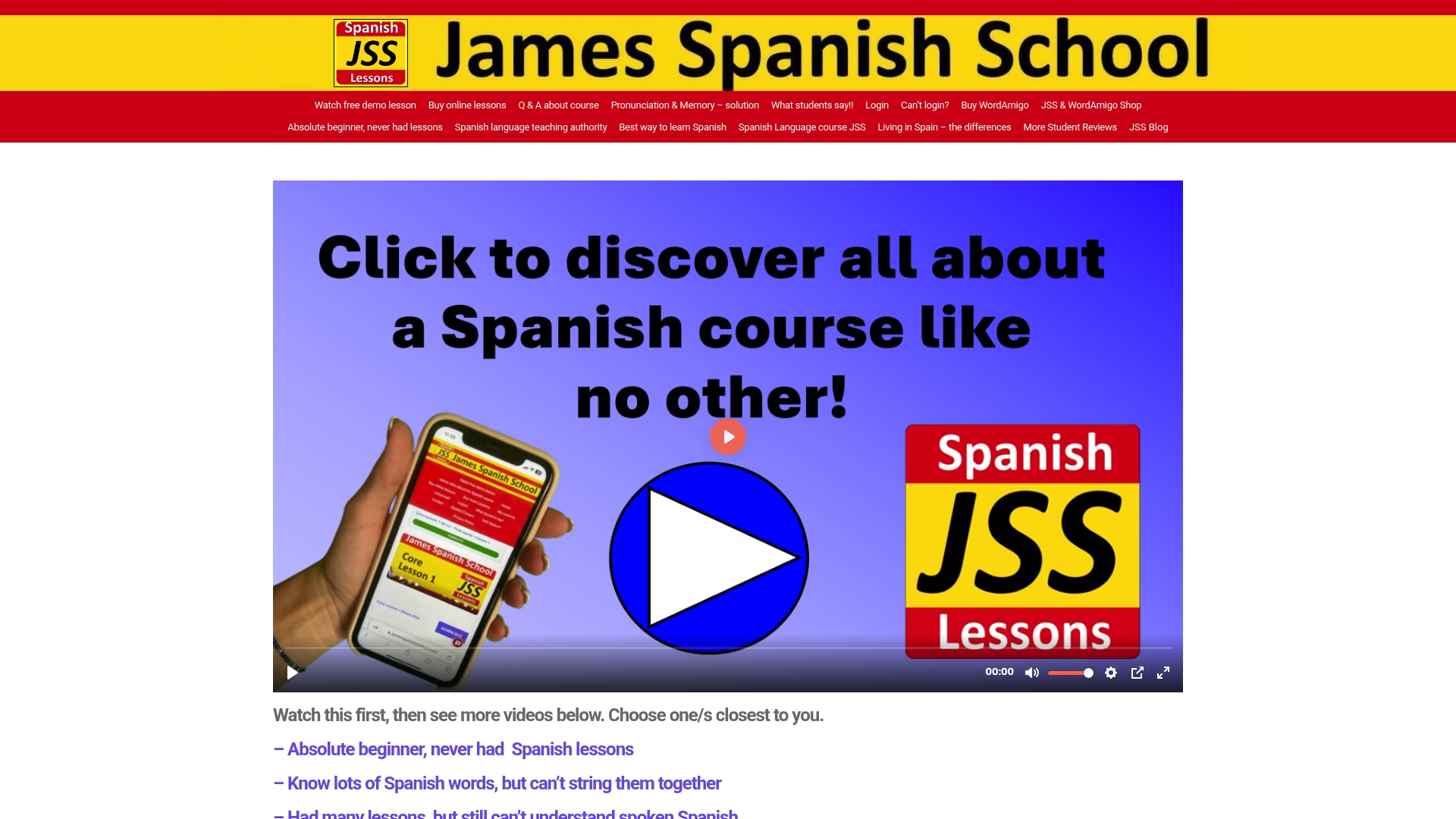
Reserving your place takes a few minutes. Visit the James Spanish School shop to browse the full 100-lesson course, check current pricing, and see how the WordAmigo system slots into your study routine. Once you’re in, access is instant and permanent, there’s no expiry date, no countdown, and no pressure to finish by a certain week. If a core lesson genuinely teaches you nothing new, James credits you with extra practice modules at no cost, so the risk sits with the school, not with you. The next step is simply to pick a package that matches your current level and start the first lesson today.