

Por vs para explicado facil
Por looks back. Para looks forward. That is the whole rule, and once it clicks, most of your confusion disappears.
Por points to a cause, a means, a duration, or a path behind an action, as in “Llegué tarde por la lluvia” (“I arrived late because of the rain”). Para points to a purpose, a destination, or a deadline ahead of it, as in “Estudio para aprender” (“I study in order to learn”). Every other rule in this guide is really just a variation on that one idea.
- Por = looking backward (cause, means, duration, through)
- Para = looking forward (purpose, destination, recipient, deadline)
Keep reading for the full breakdown, a memory trick that sticks, and exercises with answers so you can test yourself right now.
Key Takeaways
Choosing between por and para comes down to a single directional test: por explains what came before an action, para explains what it’s aiming toward.
| Point | Details |
|---|---|
| Core rule | Por looks backward (cause, means, duration, through); para looks forward (purpose, destination, deadline). |
| Duration vs deadline | Por marks a stretch of time (“una duración de unos días”); para marks a fixed point (“para una fecha límite próxima”). |
| Quick substitution test | Try “because of” for por and “in order to” or “by [date]” for para to check your choice. |
| Fixed phrases | Learn expressions like “por favor” and “para siempre” as whole chunks, not by rule. |
| Por mí vs para mí | Por mí means “if it were up to me”; para mí means “in my opinion” or “for me”. |
Table of Contents
- Uses of por: cause, means, duration, and exchange
- Uses of para: purpose, destination, and deadlines
- A visual trick for choosing por or para instantly
- Fixed expressions and tricky pairs you’ll hear constantly
- Practise por and para with instant answers
- Why English speakers keep mixing these up
- Who’s explaining this, and how James Spanish School teaches it
- Master por and para with structured practice
- Sources
Uses of por: cause, means, duration, and exchange
Por vs para explicado fácil starts here, because por carries more grammatical weight than most learners expect. It shows up whenever Spanish is explaining the reason behind something, the tool used to do it, how long it lasted, or a path travelled.
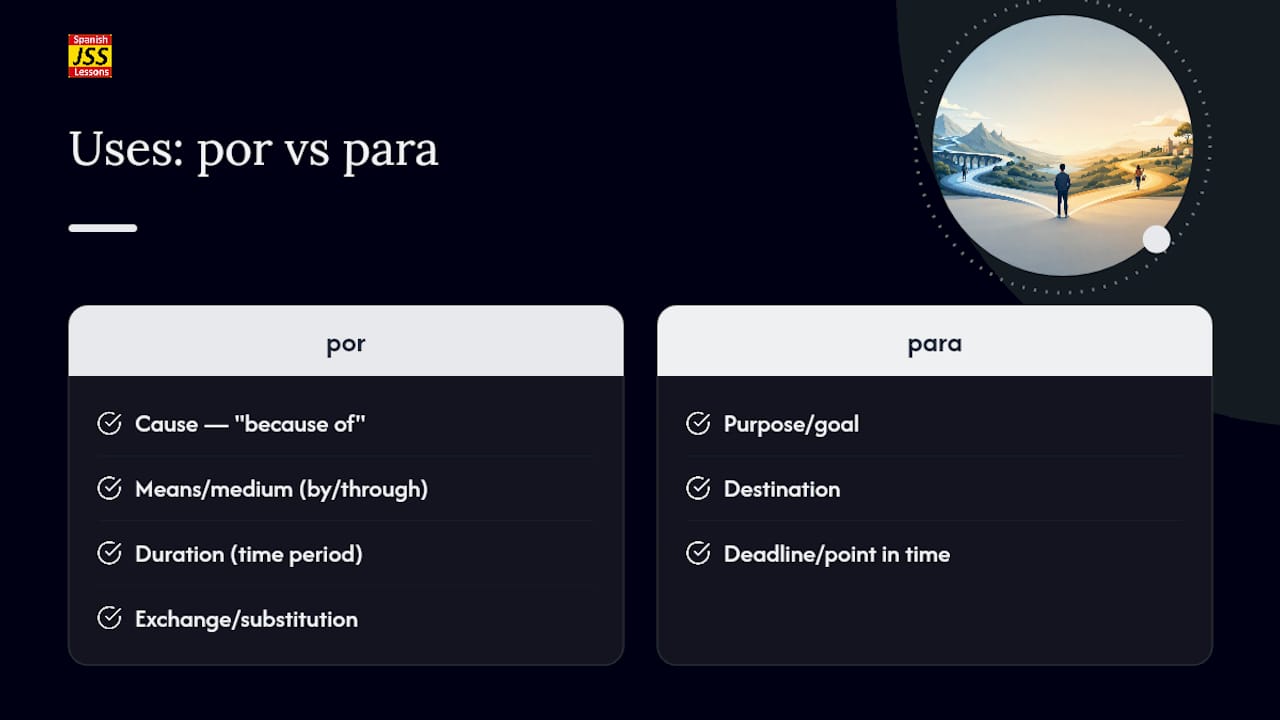
Cause or reason. “No salimos por la lluvia” (“We didn’t go out because of the rain”). If you can swap in “because of” in English, por is almost always correct.
Means or medium. “Te llamo por teléfono” (“I’ll call you by phone”), “Lo compré por internet” (“I bought it through the internet”). Por marks the channel something travels through.

Duration. “Estudié por unos días” (“I studied for three days”). Some textbooks claim Spanish drops por before time periods, but the Real Academia Española confirms that por with duration is fully documented and standard, so you can use it with confidence.
Movement through a place. “Caminamos por el parque” (“We walked through the park”). Compare that with heading to a destination, which needs para instead.

Exchange or substitution. “Pagué veinte euros por el libro” (“I paid twenty euros for the book”), “Gracias por tu ayuda” (“Thanks for your help”). One thing is being traded or swapped for another.
Try this now: “Trabajé ___ ocho horas ayer.” If you said por, you’re already thinking the right way, because eight hours is a duration, not a deadline.
Uses of para: purpose, destination, and deadlines
Where por explains a reason, para explains an aim. It answers “what for” or “by when”, and it always points somewhere ahead.
Purpose or goal. “Para + infinitive” is one of the most useful patterns in Spanish: “Estudio para aprender español” (“I study in order to learn Spanish”), “Uso una app para practicar” (“I use an app to practise”).
Recipient or destination. “Este regalo es para ti” (“This gift is for you”), “Salimos para Madrid mañana” (“We’re leaving for Madrid tomorrow”). The gift is heading toward a person; the trip is heading toward a city.
Deadlines. “Necesito el informe para una fecha límite próxima” (“I need the report by Friday”). This is the mirror image of por’s duration use, and mixing the two is the single most common learner slip.
Comparison or standard. “Para ser principiante, hablas muy bien” (“For a beginner, you speak very well”). Para sets up an expectation, then measures the person against it.
- Purpose: para + infinitive (“para trabajar” = “in order to work”)
- Recipient/destination: para + person or place
- Deadline: para + specific point in time
- Comparison: para + noun, measuring against a standard
Notice how the same sentence changes meaning depending on which one you pick. “Trabajo por mi hermano” means you’re covering his shift, doing his work in his place. “Trabajo para mi hermano” means he’s your boss. Same words, opposite relationship.
A visual trick for choosing por or para instantly
Picture two images. Por is a winding path behind you, the road that got you here: the cause, the method, the stretch of time you walked. Para is a cabin waiting ahead, the destination or goal you’re walking toward.
When you’re mid-sentence and unsure, run this two-question test:
- Question 1: Does the idea answer “why” (because of) or “what for” (in order to)? Because of points to por; in order to points to para.
- Question 2: If it’s neither, is it a stretch of time or a fixed point? A stretch is por (por dos semanas); a fixed point is para (para el lunes).
Pro Tip: If you can mentally replace the word with “because of,” use por. If “in order to” or “by [a specific date]” fits better, use para. This substitution trick works in almost every everyday sentence.
Try it: “Compré flores ___ mi madre” (a gift for her, so para) and “Lo hice ___ ella no podía” (because she couldn’t, so por).
Fixed expressions and tricky pairs you’ll hear constantly
Some por/para phrases are locked in place and don’t follow the logic above at all, so it’s faster to memorise them as whole chunks rather than analysing each one.
- Por favor (“please”), por ejemplo (“for example”), por supuesto (“of course”)
- Para siempre (“forever”), para colmo (“to top it all off”), para nada (“not at all”)
Por mí vs para mí trips up almost every English speaker at some point. “Por mí, está bien” means “as far as I’m concerned, that’s fine” or “if it were up to me”. “Para mí, es difícil” means “for me, it’s difficult”, stating your personal experience or opinion. Lingolia’s comparison of the two phrases is a useful reference if you want more contrast examples.
Certain verbs also lean toward one preposition by habit: luchar por (“to fight for a cause”), prepararse para (“to prepare for something”). Learning these as pairs saves you from rebuilding the logic every time.
Practise por and para with instant answers
Try these before checking the answers below. Say each sentence aloud; it helps the choice stick.
- Necesito terminar este trabajo ___ el jueves.
- Caminamos ___ la playa toda la tarde.
- Este café es ___ ti, lo pedí especial.
- Estudié español ___ seis meses antes de viajar.
Now translate these into Spanish, choosing the correct preposition:
- “I called you because of the storm.”
- “She’s saving money in order to travel.”
Answers:
- Para el jueves. It’s a deadline, a fixed point ahead.
- Por la playa. Movement through a place.
- Para ti. You’re the recipient.
- Por seis meses. A stretch of duration.
- “Te llamé por la tormenta.” Cause, because of the storm.
- “Ella ahorra dinero para viajar.” Purpose, para + infinitive.
The LibreTexts breakdown of por and para offers more of these gap-fill drills if you want extra reps after this set.
Why English speakers keep mixing these up
The word “for” is the root of nearly every mistake here, because English uses one word for jobs that Spanish splits into two. “I did it for you” could mean either preposition, depending on whether you mean “on your behalf” (por) or “as a gift to you” (para).
The fix is to stop translating “for” directly and instead test the sentence with “because of” or “in order to” first, as shown in the decision tree above. The second common error is swapping duration and deadline, saying para tres días when you mean a three day stretch, not a due date.
Pro Tip: Every time you catch yourself hesitating, say the sentence twice: once with “because of,” once with “in order to.” Whichever one sounds right in English usually tells you which preposition to use in Spanish.
For more patterns like these, James Spanish School’s guide on avoiding common Spanish mistakes covers other errors that trip up English speakers early on.
Who’s explaining this, and how James Spanish School teaches it
James Bretherton, a dual-native English and Spanish speaker who has lived in Spain for 40 years, founded James Spanish School after seeing how many adult learners got stuck on exactly this kind of rule. His approach, called Radical Simplification, strips out grammar terms that native speakers never think about and replaces them with plain English logic, much like the “backward vs forward” model used above.
The school’s WordAmigo system tackles the other half of the problem: even once you know por goes with duration, you need to hear and produce it correctly under real conversational pressure.
Radical Simplification means removing every grammar term you’d never use to explain English to a child, then rebuilding Spanish structure the same plain way.
- Sentence-building lessons drill the por/para choice inside real dialogue, not isolated worksheets.
- WordAmigo’s repetition loop targets the specific words learners forget fastest, including small connector words like these prepositions.
If you want to see how the method explains grammar generally, the school’s guide to clear Spanish explanations is a good starting point.
Master por and para with structured practice
Reading the rules gets you halfway there; using them under time pressure is what actually builds fluency. James Spanish School’s 100 lesson course pairs sentence-building drills with ear-tuning practice, so choices like por vs para stop being a pause-and-think moment and become instinct.
The course runs on lifetime access with no expiry date, which matters for a rule like this one that needs repeated exposure over weeks, not a single afternoon of study. If a core lesson doesn’t teach you something new, James backs it with extra practice modules at no cost.
You can browse the full course line-up on the James Spanish School shop. For live conversation practice to test what you’ve learned against a real speaker, TUTOROO’s Spanish tutors offer one-to-one sessions worth pairing with self-paced study.
Sources
The RAE’s own entry on por and para is the definitive prescriptive source for Spanish usage. Lingolia’s comparison page gives concise summaries with extra exercises, and LibreTexts offers a learner-friendly breakdown with more practice prompts if you want to keep drilling.
- Las preposiciones por y para | El buen uso del español | RAE – ASALE
- Por y para – Lingolia
- Por and para — LibreTexts (2026)