

The fastest, evidence backed way to quitar acento inglés en español is short daily drills targeting specific sounds and rhythm, paired with regular corrective feedback rather than passive listening alone. Expect measurable gains in 6 to 8 weeks, with major intelligibility improvements building over 6 to 12 months of consistent practice. Guided programmes can shortcut the process by structuring that practice for you.
TL;DR:
- Focusing on regular daily practice of targeted sounds like the trilled /rr/ and Spanish vowels can lead to noticeable improvement within 6 to 8 weeks.
- Incorporating personalized feedback, especially after 8 to 12 weeks of self-study, can significantly accelerate progress and correct persistent errors.
- Prioritizing rhythm and intonation training, such as syllable timing and linkage of words, makes a larger difference in reducing English-style speech than focusing solely on individual sounds.
- Using a structured program that combines shadowing, minimal pairs, articulatory drills, and self-recording provides a more effective path toward native pronunciation.
- To achieve true native-like fluency, consistent practice over 6 to 12 months, with emphasis on both phonetic accuracy and natural delivery, is essential.
Table of Contents
- Daily exercises to reduce your English accent in Spanish
- Which sounds matter most for a Spanish accent?
- Building a sustainable practice routine and timeline
- Why guided training accelerates accent reduction
- Why native Spanish speakers judge more than your sounds
- Get structured pronunciation practice with James Spanish School
- Sources
- FAQ
Daily exercises to reduce your English accent in Spanish
You don’t need an hour a day. You need the right fifteen minutes, repeated without fail. The five techniques below form the backbone of almost every effective accent reduction routine, and each one targets a different failure point in how English speakers produce Spanish sounds.
- Shadowing. Pick 30 to 60 seconds of native European Spanish audio, a news clip or podcast segment works well, listen once through without speaking, then mimic it aloud for three to five repetitions, matching rhythm and pitch as closely as the sounds themselves.
- Minimal pairs. Practise five to ten word pairs a day that differ by one sound only, such as “pero” versus “perro”, or “caso” versus “cazo”. This trains your ear and mouth simultaneously, which isolated vocabulary drilling never does.
- Articulatory drills. Work on tongue placement for the trilled /rr/, lip rounding for rounded vowels, dental contact for t and d, and the back of the throat friction needed for the Spanish j sound.
- Prosody and rhythm training. Tap out syllables with your hand or use a metronome while reading aloud, forcing each syllable to occupy roughly equal time. This single habit does more to disguise an English accent than most learners expect.
- Self-feedback through recording. Record yourself reading a short passage, then compare it against the original native audio. This kind of low-cost diagnostic loop is recommended by practitioners as a first step before seeking a specialist.
Passive exposure, just watching Spanish television without active repetition, rarely shifts an accent on its own, because the mouth never practises the new movements. Active production is what rewires the habit.
Pro Tip: Record the same 30-second passage every Sunday for eight weeks and keep every file. Listening back to week one against week eight is often the single most motivating exercise in this entire routine.

Classroom phonetics resources consistently show that drills for trills, dental consonants, and vowel purity work best when practised regularly with corrective feedback, not as one-off exercises. For a deeper walkthrough of routines and pronunciation modes, James Spanish School’s practical pronunciation guide breaks these drills down further.
Which sounds matter most for a Spanish accent?
Not every sound deserves equal attention. Some phonetic gaps are cosmetic, others are the reason a Spanish shopkeeper asks you to repeat yourself twice. Here is where to spend your time.
- Vowels. Spanish has five pure, stable vowel sounds. English has closer to twelve, many of them gliding diphthongs. When you say “no” in English, your mouth moves through the vowel; in Spanish, “no” stays fixed. This single habit, letting vowels glide, is one of the clearest giveaways of an Anglophone accent.
- The trilled /rr/ and tapped /ɾ/. “Perro” needs a true trill; “pero” needs a single quick tap of the tongue against the ridge behind your teeth. Confusing the two changes the word entirely, not just the accent.
- The velar fricative /x/. The Spanish j and soft g (as in “jamón” or “gente”) come from friction at the back of the throat, closer to a Scottish “loch” than the English h.
- Dental t and d. English speakers place these sounds further back, against the ridge behind the teeth. Spanish t and d touch the back of the top front teeth, giving a noticeably softer, flatter sound.
- B and v. Spanish treats these as the same sound, a soft bilabial approximant, not the hard English distinction between lip-only v and full-closure b.
Rhythm often outweighs individual sounds in how “foreign” you’re perceived to be. English is stress-timed, meaning stressed syllables land at roughly even intervals and everything else compresses around them. Spanish is syllable-timed, so each syllable gets roughly equal duration, regardless of stress. This difference explains why a learner with near-perfect individual sounds can still sound unmistakably English the moment they string a sentence together.
Proprioception, your physical awareness of where your tongue and lips sit, closes the gap between knowing a rule and producing it automatically. Mirror work while practising the trill, or lightly touching your throat to feel the vibration during /x/, speeds up that transfer far more than listening alone.
Building a sustainable practice routine and timeline
Fifteen minutes, done daily without exception, beats an hour once a week almost every time. Consistency builds the muscle memory that occasional cramming never reaches.
A workable daily structure looks like this:
- Warm-up (2 minutes). Loosen your jaw and lips, then run through five vowel sounds slowly and deliberately.
- Focused articulatory drill (5 minutes). Pick one target, the trill, the j sound, or dental t/d, and repeat a short word list aloud.
- Shadowing (5 minutes). Mimic a fresh 30 to 60 second audio clip, matching rhythm as much as sound.
- Review and recording (3 minutes). Record a short passage and note one thing to fix tomorrow.
Weekly, rotate which sound or rhythm pattern you prioritise, and keep a short error log so patterns become obvious. Run an informal intelligibility check, reading a passage to a native speaker or comparing your recording against native audio, at week 4 and again at week 8.
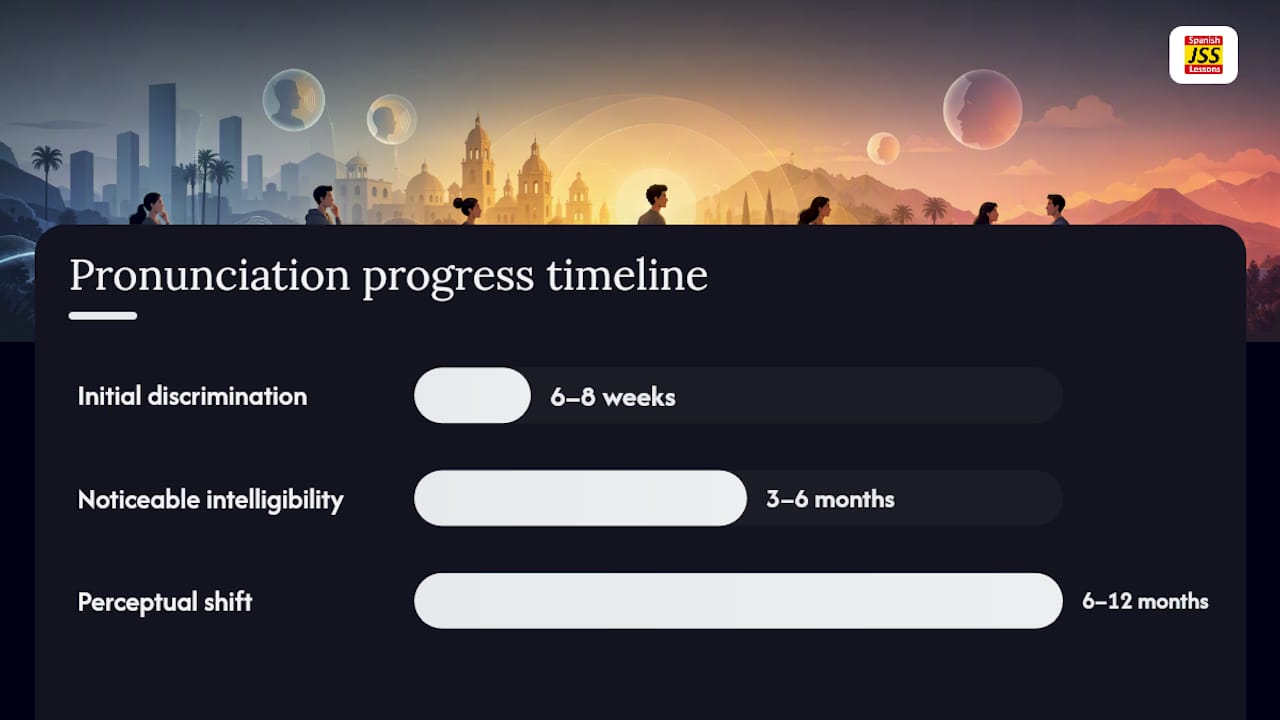
Expect this rough progression: initial discrimination gains (you start hearing your own mistakes) at 6 to 8 weeks, noticeable intelligibility improvement between 3 and 6 months, and the larger perceptual shift, where native speakers stop noticing an accent at all, arriving somewhere in the 6 to 12 month range with consistent daily practice.
Pro Tip: If your progress stalls for more than three or four weeks despite daily practice, that’s usually not a motivation problem. It’s a sign a specific articulatory habit needs correcting by someone who can hear what you can’t.
If a particular sound refuses to shift after eight to twelve weeks of focused drilling, that’s the point to bring in guided feedback rather than pushing on alone.
Why guided training accelerates accent reduction
Self-study gets you far, but it has a ceiling: you cannot always hear your own mistakes, and no amount of repetition fixes a habit you don’t know you have. That’s the gap structured, guided instruction closes.
A certain Spanish school was founded by a dual-native speaker who has lived in Spain for four decades and built a method around Radical Simplification, teaching Spanish structure through plain English rather than grammar terminology most adult learners never use anyway. The course pairs sentence-building with dedicated “ear-tuning” work, aimed at helping English speakers follow and reproduce natural, fast spoken Spanish.
For pronunciation, a system using a Five-Step Retention Loop cycles vocabulary and sounds through reading, listening, speaking, and writing so pronunciation sticks rather than fading after a single lesson. That loop maps directly onto the daily routine above:
- On-demand pronunciation modules give you fresh drill material whenever your fifteen minutes fall in the day.
- The JSS Audio Portal provides native audio for shadowing practice, available around the clock.
- Repeated exposure through the retention loop reinforces exactly the kind of active practice that passive listening alone can’t deliver.
Course and pronunciation resources are available through the shop and course hub.
Why native Spanish speakers judge more than your sounds
Pronunciation isn’t purely acoustic. Native Spanish speakers read tone, pace, and delivery as social signals, and getting these wrong can make your accent feel stronger than your actual phonemes warrant.
Speaking too slowly, common among learners concentrating hard on each sound, often reads as hesitant or overly formal rather than careful. Spanish conversational rhythm favours a brisker, more continuous flow, with words linked together rather than pronounced as separate units. Learning to link “los amigos” into something closer to “losamigos” changes how natural you sound far more than perfecting any single vowel.
Intonation carries meaning too. English speakers often flatten questions or raise pitch in places that sound uncertain or overly polite in Spanish, where direct statements and questions follow distinct, more pronounced pitch patterns. Volume and directness also differ: what feels assertive in English can land as perfectly normal in Spanish, and unnecessary softening can actually make you harder to follow, not more polite.
None of this means abandoning courtesy, it means recognising that a “foreign” impression often comes from pacing and delivery choices as much as from any single mispronounced consonant. Matching the rhythm of the room, not just the dictionary pronunciation, closes that last gap.
Get structured pronunciation practice with James Spanish School
This program offers a fixed, one-time cost route to native-level pronunciation instead of an open-ended cycle of apps and tutors you pay for indefinitely. Where generic apps drill vocabulary without any structured rhythm or feedback loop, this system was built specifically around the Five-Step Retention Loop described above, reading, listening, speaking, and writing cycled together so your pronunciation gains actually stick.
The course splits time between sentence-building and ear-tuning, so the listening skills you need to catch fast native speech develop alongside your own pronunciation. Everything runs on demand, with no expiry date and no countdown pressure, so a short session fits into a lunch break or a quiet evening equally well. If a core lesson teaches you nothing new, extra practice modules may be provided at no cost, offering a guarantee built around real progress rather than course completion for its own sake.
This suits learners preparing for life in Spain rather than an exam: everyday conversations with neighbours, tradesmen, and shop staff, not textbook dialogues. Explore the WordAmigo system for individual learners or browse the full course shop to start your first pronunciation module today.
Sources
This guide draws on clinical practitioner consensus from Logopeda Barcelona on realistic timelines and feedback loops, classroom phonetics research from the Cervantes Institute on articulatory technique and authentic listening, and comparative phonetic analysis from Multimedia-English on vowel systems and syllable timing. Together they cover the clinical, pedagogical, and acoustic angles behind every drill in this article.
- Cómo trabajar tu acento al hablar otro idioma con un logopeda | Logopeda Barcelona
- La enseñanza de la pronunciación en el aula: Una experiencia con estudiantes anglohablantes
- Phonetics: English vs Spanish – Multimedia‑English
FAQ
How long does it take to lose an English accent in Spanish?
Most learners see measurable discrimination gains within 6 to 8 weeks of daily practice, with major intelligibility improvements building between 3 and 12 months depending on consistency and whether feedback is involved.
What is the single most effective exercise for accent reduction?
Shadowing, listening to a short clip of native Spanish and immediately mimicking it aloud, is widely considered the most effective single exercise, because it trains sound, rhythm, and intonation together rather than in isolation.
Do I need a teacher, or can I fix my accent alone?
Self-study handles most of the work, but guided feedback becomes valuable once progress stalls, typically after 8 to 12 weeks, since learners often cannot hear their own persistent errors.
Which sounds cause the biggest English accent in Spanish?
The trilled /rr/, the velar /x/ sound in words like “jamón”, vowel diphthongisation, and stress-timed rhythm carried over from English are the most common and most noticeable sources of an English accent.
Can James Spanish School help with pronunciation specifically?
Yes. James Spanish School’s WordAmigo system uses a Five-Step Retention Loop combining reading, listening, speaking, and writing, with on-demand audio and pronunciation modules designed for exactly this kind of daily drilling.