

Audios español peninsular
The fastest route to authentic peninsular Spanish audio runs through three sources: podcasts recorded in Spain, institutional audio banks from the Instituto Cervantes and RAE, and labelled speech corpora such as Mozilla Common Voice. Start with an episode of Erre que ELE or the Cervantes series En sintonía, choose one with a transcript, and listen twice: once for gist, once tracking every word on the page.
TL;DR:
- Only sources explicitly labeled as peninsular Spanish, such as Spanish-made podcasts and official institutional audio banks, reliably train your ear for precise regional sounds.
- Matching audio speed, clarity, and complexity to your CEFR level is essential to maintain motivation and ensure effective listening practice.
- Structured listening routines, including multiple passes and shadowing, significantly improve comprehension and pronunciation over passive, single-exposure listening.
- The /θ/ sound in words like “gracias” or “cinco” clearly distinguishes peninsular from Latin American pronunciation and should be a key listening focus.
- Building a base with neutral regional audio and gradually introducing regional accents helps adapt your ear without overwhelming it early in your learning journey.
Table of Contents
- Where to find authentic peninsular audio: podcasts, teacher banks and corpora
- How do you choose peninsular audio for your level?
- How should you practise with peninsular Spanish audio?
- Academic and corpus resources for deeper phonetic study
- How James Spanish School supports peninsular listening practice
- Peninsular Spanish audio versus Latin American Spanish audio
- Common vocabulary and expressions unique to peninsular Spanish
- How do you handle regional variation within peninsular Spanish?
- Sources
- FAQ
Where to find authentic peninsular audio: podcasts, teacher banks and corpora
Not all Spanish audio online is Spanish audio from Spain. A huge share of freely available material is recorded in Mexico or Colombia, which is fine for general fluency but won’t train your ear for peninsular rhythm, vosotros forms, or the famous /θ/ sound in “cinco” and “gracias”. You need sources that explicitly label their accent.
Three categories cover almost everything worth your time:
- Podcasts made in Spain. Erre que ELE and Español con Jose are widely available on Spotify and iVoox, with episodes graded from intermediate colloquial chat to more advanced cultural discussion.
- Institutional teacher banks. The Instituto Cervantes’ CVC platform runs En sintonía con el español, pairing each episode with a teacher-student conversation and a “document” recording like an interview or debate, plus a full learner space of preparation, listening, and checking activities. HablaCultura and various DELE-prep sites follow a similar model.
- Open speech corpora. Mozilla Common Voice’s Spanish dataset tags clips by region, including “surpeninsular”, “nortepeninsular” and “centrosurpeninsular” codes, giving you access to genuine Spain-accented recordings you can isolate and repeat.
Only the first two categories reliably come with transcripts. If reading along while you listen matters to you, Cervantes’ materials and well-established podcasts with published show notes are your safest bet; corpora are built for extraction and drilling, not comprehension practice. For a broader sense of what “authentic” actually sounds like versus scripted textbook Spanish, it’s worth reading about what counts as native-like Spanish listening before you commit to a resource.
How do you choose peninsular audio for your level?
Picking the wrong audio wastes more motivation than any other single mistake learners make. A B1 learner who grabs an unscripted radio debate at native speed will feel defeated in ninety seconds, not because their Spanish is weak, but because the material was never matched to their stage.
Run every new resource through this quick filter before committing:
- Check the speed and register first. Scripted, presenter-led audio is slower and clearer than two friends talking over each other in a bar.
- Confirm a transcript exists. No transcript means no way to check what you actually understood versus what you guessed.
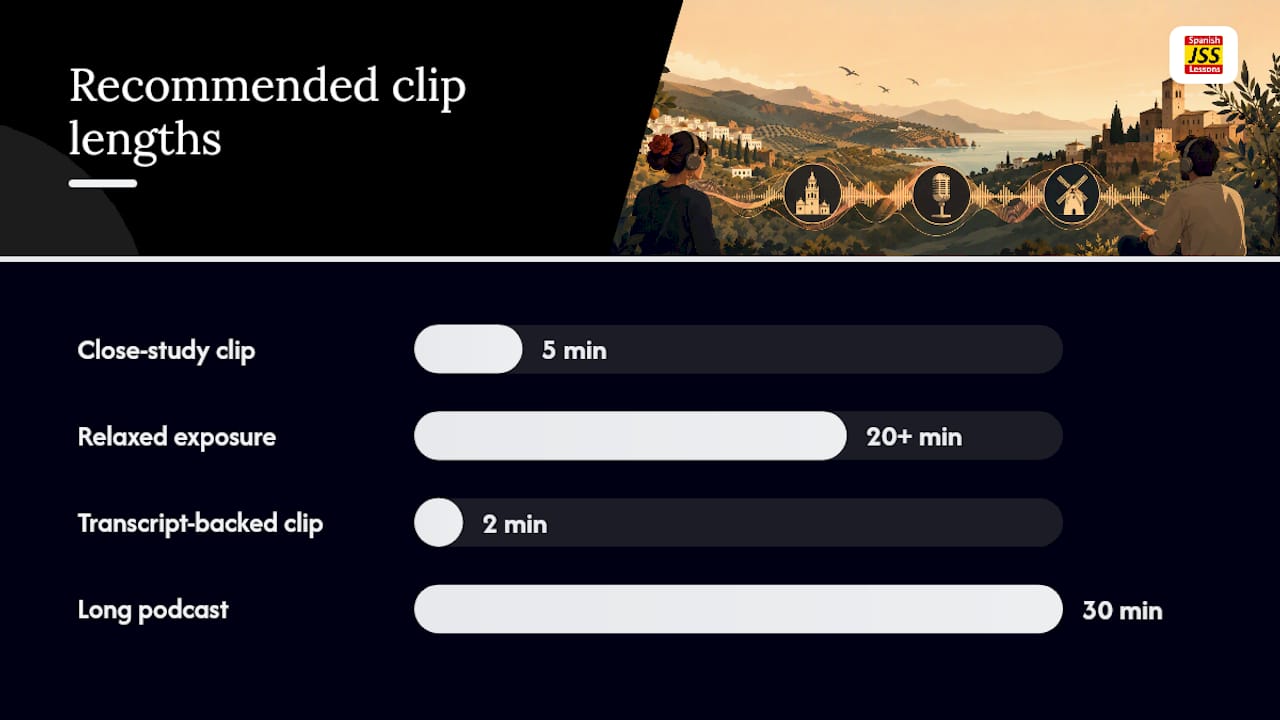
- Look at episode length. Five minutes for close study, twenty-plus minutes for relaxed exposure listening.
- Listen for speaker variety. One narrator is easier than a panel of four regional voices switching mid-sentence.
- Match the CEFR level to the source. A2 learners want Cervantes-style guided dialogues; B1 learners can handle graded podcast segments; B2 and above should push into unscripted interviews and debate-style “document” audio.
Pro Tip: Prefer short clips with a transcript when you’re studying detail. Save longer, unscripted monologues for later, once your goal shifts from understanding every word to simply tuning your ear to natural speed.
The mistake most self-taught learners make is treating every piece of audio the same way. A two-minute transcript-backed clip deserves five careful passes; a thirty-minute podcast deserves one relaxed listen without pausing every few seconds to look something up.
How should you practise with peninsular Spanish audio?
Listening on a loop without a method barely moves your comprehension. What works is a structured sequence that forces your brain to process the same audio at different levels of detail.
- Pass one: gist. Listen once without pausing. Aim only to catch the topic and the speaker’s general attitude.
- Pass two: detail. Listen again with the transcript open, checking specific phrases you missed and marking anything unclear.
- Pass three: micro. Isolate a single sentence and listen only to that, focusing on how sounds run together, where /θ/ appears, and where syllables drop in fast connected speech.
- Shadow it. Play the clip at slightly reduced speed and speak along in real time, matching rhythm and intonation rather than just pronunciation.
- Transcribe the hard bits. For genuinely difficult sounds, use IPA symbols and, if you want real precision, open the clip in Praat to mark boundaries on a spectrogram, a workflow phoneticians use for exactly this kind of central peninsular sound analysis.
Pro Tip: Don’t shadow an entire episode. Pick the ten seconds that tripped you up, loop just that, and shadow it fifteen times before moving on.
Vocabulary picked up this way sticks far better when it’s reinforced through spaced repetition rather than a single exposure. This is precisely the gap that structured audio repetition systems are designed to close, feeding words back to you at increasing intervals until they’re locked in rather than fading after a day. If you want a deeper breakdown of the shadowing and multi-pass approach, mastering fast Spanish listening covers the technique in more depth, and understanding fast Spanish for real conversations extends it to live conversation.
Academic and corpus resources for deeper phonetic study
Once you’ve exhausted podcasts and teacher banks, corpus material takes you further into the mechanics of the accent itself.
- RAE’s “Las voces del español. Tiempo y espacio” is the standout resource here. It sits alongside the Real Academia Española’s grammar and includes multimedia sections such as “El español hoy,” phonetics lessons, and genuine recordings across Spanish varieties, making it the clearest authoritative source for anchoring an IPA symbol to an actual sound.
- Mozilla Common Voice, again, earns its place for volume: over 1.68 million labelled clips and 2,278 hours of recorded Spanish, with peninsular accent tags you can filter directly.
- CEEEL1, a smaller specialised corpus of emotional expression in central peninsular speech, gives you 38 recordings of young native speakers performing narrative tasks, useful specifically for studying prosody and intonation rather than vocabulary.
The practical workflow: pull a short WAV clip from a labelled corpus, build a TextGrid in Praat, mark the boundaries, transcribe with IPA, then turn the awkward segment into a shadowing drill. It’s slower than passive listening, but it’s how phoneticians actually train an ear on a specific accent rather than a general impression of it.
How James Spanish School supports peninsular listening practice
James Bretherton built an online Spanish course after four decades living in Spain, focusing it around European Spanish rather than a generic, pan-regional version of the language. That distinction matters for anyone using podcasts and corpora to train their ear on peninsular sound patterns specifically.
The course structure mirrors much of what works in the practice routines above:
- Ear-tuning lessons designed to get you following fast spoken Spanish rather than the slowed, over-enunciated Spanish common in classroom recordings.
- WordAmigo, an AI-driven audio repetition system that feeds vocabulary and pronunciation back to you on a spaced schedule, the same principle behind effective corpus-drilling, but automated.
- Mobile-ready lessons with lifetime access, so a shadowing session or a transcription drill can happen on a phone during a coffee break, with no expiry date pushing you to rush.
If you’ve been sampling free peninsular audio and want a structured path that builds on it, the full course is available here.
Peninsular Spanish audio versus Latin American Spanish audio
The biggest audible difference is the /θ/ sound. Peninsular speakers pronounce “cinco,” “gracias,” and “cielo” with a sound close to the English “th” in “think,” while almost all Latin American varieties use an /s/ sound instead. If a recording makes “casa” and “caza” sound different, you’re listening to Spain.
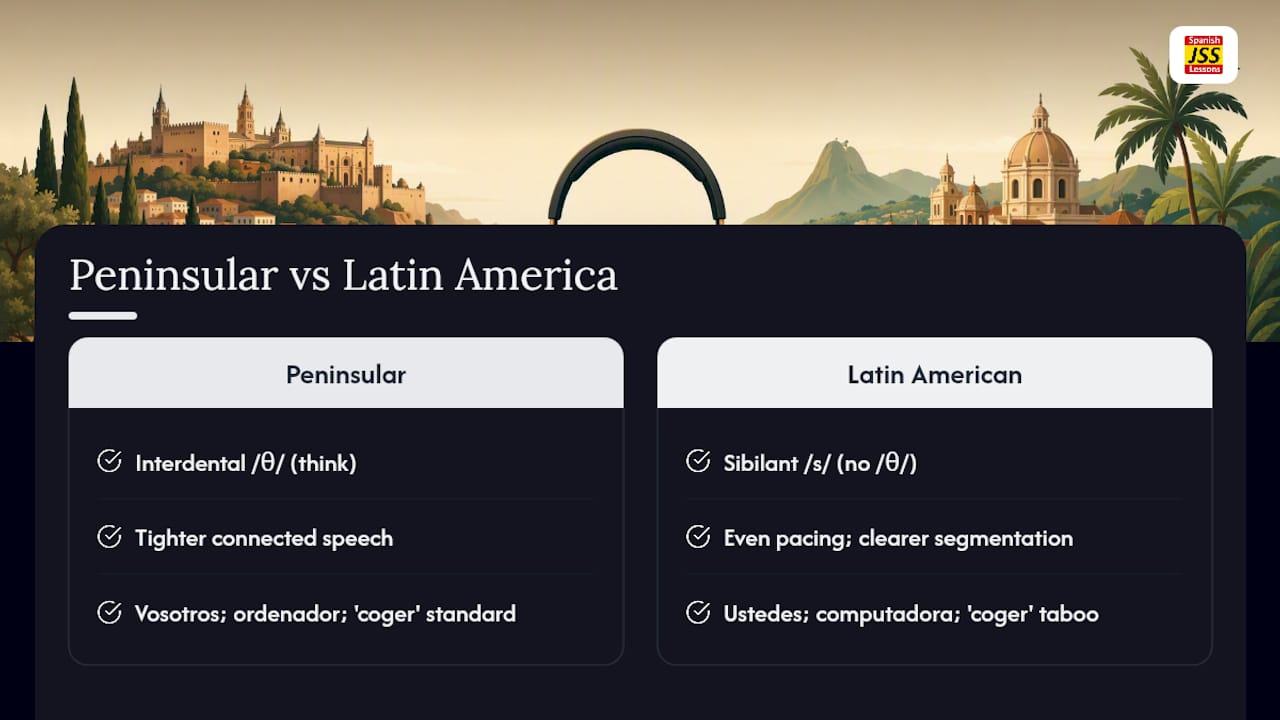
Rhythm and speed differ too. Peninsular Spanish, particularly in central and northern regions, tends to run words together in tighter connected speech, with vowels sometimes swallowed between consonants. Many Latin American varieties, Mexican Spanish especially, are often described by learners as more evenly paced and easier to segment word by word, which is partly why so much beginner-level audio online defaults to a Latin American accent.
Vocabulary and grammar diverge sharply as well. Peninsular Spanish uses vosotros as the informal “you all,” a form almost entirely absent from Latin American speech, which relies on ustedes in every register. Everyday words split too: coger (to take/grab) is completely standard in Spain but carries a vulgar meaning in several Latin American countries, while ordenador (computer) is Spain’s term against the Latin American computadora.
None of this makes one variety harder than the other, but it does mean you can’t mix your sources carelessly. An hour of Mexican podcast followed by an hour of Cervantes audio will train two different ears at once. If your goal is Spain specifically, stay peninsular until your comprehension is solid, then branch out.
Common vocabulary and expressions unique to peninsular Spanish
Certain everyday words will trip up learners who studied Latin American Spanish before moving to peninsular sources, even at a fairly advanced level. A handful come up constantly in Spain-produced podcasts and interviews.
Vale replaces “okay” in almost every casual context, used far more often than the Latin American “está bien.” Tío/tía means “mate” or “dude” between friends, not literally “uncle/aunt,” and appears constantly in unscripted conversational audio. Guay means “cool” or “great,” a word you’ll hear in nearly every casual podcast segment aimed at younger speakers. Móvil is the standard word for mobile phone, where Latin American Spanish generally uses celular.
Food and daily-life vocabulary shifts too: piso for flat/apartment instead of departamento, and coche for car instead of carro or auto. Peninsular Spanish also leans on ¿qué tal? as a universal greeting and check-in, functioning almost like “how’s it going” does in English, endlessly flexible and used with strangers and friends alike.
None of this vocabulary is exotic once you’ve heard it a dozen times in context, which is exactly why authentic audio beats a vocabulary list. A textbook can tell you vale means “okay.” A podcast shows you it also works as a filler, a way to close a conversation, and a mild expression of surprise, depending entirely on tone. That’s the kind of nuance you only pick up by listening to real Spaniards talk, not by memorising a translation table.
How do you handle regional variation within peninsular Spanish?
Peninsular Spanish is not one accent. Madrid, Andalusia, and the north each sound noticeably different, and if your only exposure has been the relatively neutral, media-standard accent used in most Cervantes recordings, an Andalusian podcast can feel like a different language for the first few minutes.
Andalusian Spanish often drops final consonants, particularly the /s/ at the end of words, and softens or merges sounds that are crisp elsewhere in Spain. Northern varieties, closer to what most institutional audio uses as a baseline, tend to preserve consonants more fully and pronounce more deliberately. Madrid sits closer to that northern standard but moves faster in casual speech, especially among younger speakers in unscripted contexts.
The practical fix isn’t to master every variant before you start. It’s to build a strong base with a neutral, well-articulated accent, the kind Cervantes’ teacher-student dialogues or Common Voice’s labelled “nortepeninsular” and “centrosurpeninsular” clips provide, and then deliberately introduce variation once that base is solid. Listen to one Andalusian-accented podcast segment a week alongside your regular material rather than switching entirely; your ear adapts faster through contrast than through immersion in a single unfamiliar accent from day one.
Treat regional accents the way you’d treat a new genre of music: familiar structure, unfamiliar delivery. Once you recognise the pattern, the surprise disappears.
Sources
- CVC. En sintonía con el español. Presentación.
- Common Voice Scripted Speech 26.0 – Spanish | Mozilla Data Collective
- Las voces del español. Tiempo y espacio | Real Academia Española
- Transcripción fonética – Español peninsular central
FAQ
Do peninsular Spanish podcasts come with transcripts?
Many do, particularly institutional resources: Cervantes’ En sintonía publishes printable transcripts alongside every episode, and several independent podcasts include show notes with key vocabulary.
What’s the best peninsular podcast for beginners?
En sintonía is the safest starting point for A2 to B1 learners because it pairs a slower teacher-student dialogue with structured activities, while Erre que ELE suits learners closer to B1/B2 who want more natural colloquial pace.
What’s the quickest way to hear the peninsular /θ/ sound?
Listen for the word “gracias” or “cinco” in any recording tagged as peninsular on Mozilla Common Voice; the “th” sound distinguishes it instantly from Latin American pronunciation.
How often should I listen to peninsular audio to see progress?
Short daily sessions of ten to fifteen minutes, using the three-pass method (gist, detail, micro), build comprehension faster than occasional long sessions, because spaced exposure embeds sounds and vocabulary more reliably than cramming.
Can I use Mozilla Common Voice clips for classroom teaching?
Yes, but check the specific licence attached to the clips you plan to use or redistribute; some educational audio resources are released under terms such as Creative Commons BY-NC-ND, which restricts commercial and derivative use.