

No avanzo en español!
“No avanzo” means “I am not advancing” or “I am not making progress.” It is the first-person singular present indicative of the verb avanzar, negated by no. Spanish speakers use it for stalled traffic, a stuck project, or a plateaued language learner, and English speakers searching this phrase are usually somewhere on that last list.
TL;DR:
- “No avanzo” can mean being stuck in grammar, vocabulary, or progress, depending on context, and often pairs with “en” plus a noun indicating stagnation.
- The present tense conjugation of “avanzar” varies by person, with “yo avanzo” used for “I am not advancing,” and the stress in “avanzáis” should be placed on the final syllable.
- Alternatives like “estoy atascado” or “no progreso” may sound more natural and are suited for different types of stalls, such as mental blocks or project dead ends.
- Context-rich examples show “no avanzo” used for projects, learning, traffic, or negotiations, emphasizing the common collocation with “en” plus a noun.
- Active speaking practice, such as recording short sentences daily with focus on key verbs, is essential to overcoming the recognition-recall gap behind feeling stuck.
Table of Contents
- What does ‘avanzar’ actually mean in Spanish?
- How do you conjugate ‘avanzar’ in the present tense?
- What are the best alternatives to ‘no avanzo’?
- What do example sentences with ‘no avanzo’ look like?
- Why do you feel stuck when learning Spanish?
- What daily practice actually moves you forward?
- Ready to stop saying ‘no avanzo’ about your Spanish?
- Where these definitions and tips come from
- Sources
- FAQ
What does ‘avanzar’ actually mean in Spanish?
Avanzar carries several linked senses, and English does not always map them onto one word. The Real Academia Española defines it around physical forward movement, general progress or improvement, and the passing of time, three ideas that in English split between “advance,” “progress,” and “move on.”
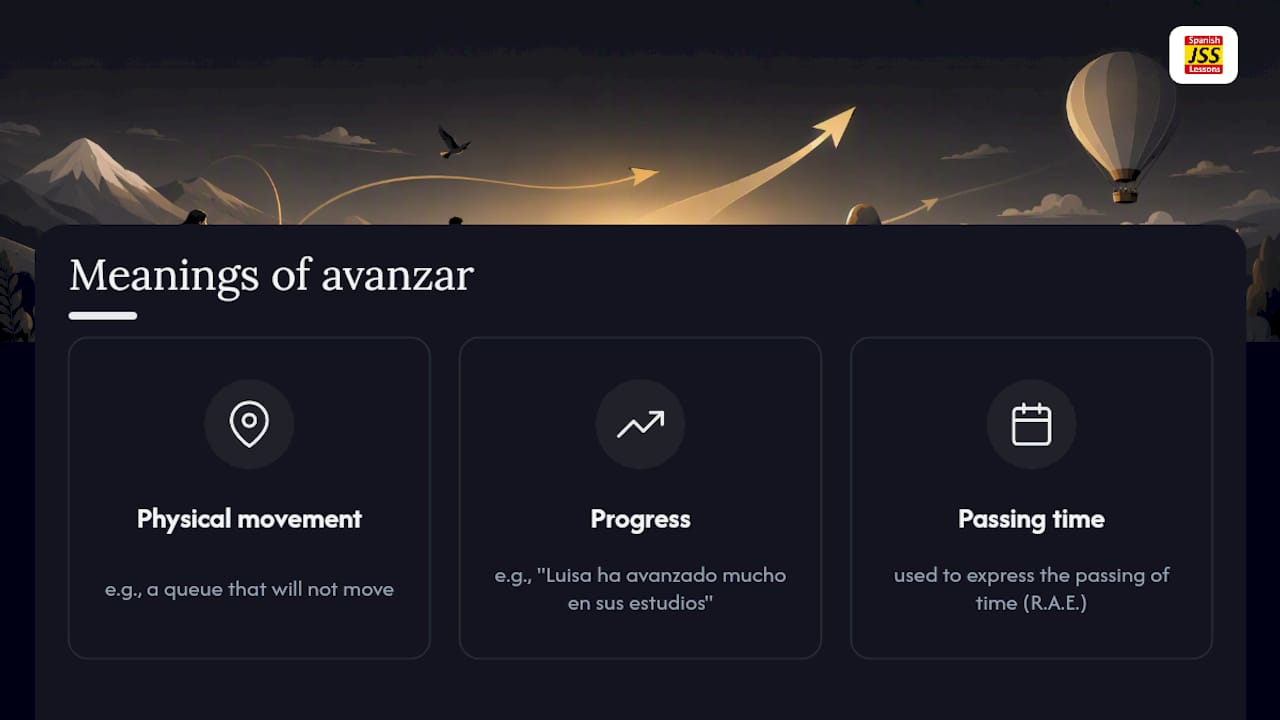
That range explains why “no avanzo” can describe a queue that will not move, a translation project going nowhere, or a learner who feels frozen on the same grammar point for months. Context decides the best English rendering.
WordReference backs this with examples like “Luisa ha avanzado much en sus estudios” (Luisa has progressed a lot in her studies), confirming the figurative sense is standard, not a stretch. In everyday European Spanish, the word is neutral and works equally in a text message to a friend or a formal report to a manager.
How do you conjugate ‘avanzar’ in the present tense?
The form you need for “no avanzo” is the first-person singular of the present indicative, but you will meet its siblings constantly in conversation. Here is the full set, drawn from the RAE entry:
| Person | Form | Meaning with “no” |
|---|---|---|
| Yo | avanzo | I am not advancing |
| Tú | avanzas | You are not advancing |
| Usted / él / ella | avanza | You (formal) / he / she is not advancing |
| Nosotros | avanzamos | We are not advancing |
| Vosotros | avanzáis | You all are not advancing |
| Ustedes / ellos / ellas | avanzan | They / you all (formal) are not advancing |
The gerund is avanzando and the past participle is avanzado, both essential for compound tenses. Negation slots neatly in front: “no he avanzado” (I haven’t progressed) or “no estoy avanzando” (I’m not progressing right now), forms confirmed by conjugation references like Reverso.
Pro Tip: Vosotros speakers often trip on the stress in “avanzáis.” Put the emphasis on the final “áis,” not the middle syllable. It sounds almost like “ah-van-SICE” if you exaggerate it while practising aloud.
What are the best alternatives to ‘no avanzo’?
“No avanzo” is not the only phrase Spanish speakers reach for when things have stalled, and picking the right one makes you sound noticeably more natural.
- Estoy atascado/atascada (I’m stuck): the most common phrase for feeling blocked, whether physically or mentally, and gender-marked for the speaker. Cambridge Dictionary lists this as a direct translation of “stuck.”
- Estoy atrapado/atrapada (I’m trapped): stronger than atascado, implying you feel genuinely caught, not just slowed down. Use it for frustration, not for a minor delay.
- No progreso (I’m not progressing): a near-synonym of “no avanzo,” slightly more formal and common in academic or professional writing.
- Estoy en un punto muerto (I’ve hit a dead end, literally “a dead point”): ideal for describing a negotiation, a relationship, or a project that has completely frozen.
- No consigo avanzar (I can’t manage to move forward): adds a sense of effort and failure, useful when you have genuinely tried and failed to progress.
What do example sentences with ‘no avanzo’ look like?
Seeing the phrase in context does more for retention than any rule list. Here are examples spanning work, study, and everyday frustration.
- No avanzo en el proyecto. — I’m not making progress on the project.
- No avanzo en mi español. — I’m not progressing in my Spanish.
- El tráfico no avanza. — The traffic isn’t moving.
- No avanzo con la lectura de este libro. — I’m not getting anywhere with reading this book.
- Estoy atascado en el segundo capítulo. — I’m stuck on the second chapter, a translation confirmed by SpanishDict.
- La fila no avanza nada. — The queue isn’t moving at all.
- No avanzamos en las negociaciones. — We’re not making headway in the negotiations.
- Siento que no avanzo, aunque estudio todos los días. — I feel like I’m not progressing, even though I study every day.
- No avanzo lo suficiente para el examen. — I’m not progressing enough for the exam.
- Mi jefe pregunta por qué no avanzo con el informe. — My boss is asking why I’m not getting anywhere with the report.
- No avanzo nada en esta cola. — I’m getting nowhere in this queue.
- ¿Por qué no avanzas más rápido? — Why aren’t you moving forward faster?
That collocation with en (“no avanzo en…”) is the one to memorise. It attaches to almost any noun and instantly names what has stalled.
Why do you feel stuck when learning Spanish?
Feeling frozen usually has nothing to do with intelligence and everything to do with a gap between recognition and recall. You understand a word when you read it, but the same word vanishes the moment you need to produce it in conversation, a pattern explained clearly by Grow Spanish.
Three friction points show up again and again among learners who feel they no avanzan:
- Vocabulary retrieval — you recognise words on a page but cannot pull them out of memory fast enough to speak.
- Pronunciation fear — hesitation before speaking, worried a word will come out wrong, which slows every sentence to a crawl.
- Conjugation hesitation — pausing mid-sentence to work out avanzo versus avanzas breaks the flow of real conversation.
The fix for all three is the same: shift from passive review to active production. Build sentences out loud, keep a short monthly recording to compare your own progress, and set micro-goals that force you to speak, not just read.
Pro Tip: Record thirty seconds of yourself speaking Spanish once a month. You won’t notice daily change, but stacking four or five recordings side by side makes the improvement undeniable.
What daily practice actually moves you forward?
A short, repeatable routine beats an occasional marathon study session every time. Try this for five to ten minutes a day:
- Pick three verbs you keep hesitating on, including avanzar if it is one of them.
- Build five original sentences with each verb, mixing tenses where you can.
- Read every sentence aloud, then record yourself on your phone.
- Play it back immediately and correct anything that sounded hesitant or wrong.
This mirrors what James Spanish School calls the Five-Step Retention Loop inside its WordAmigo system, a method built around cycling vocabulary through reading, listening, speaking, and writing so it moves from passive recognition into genuine recall. Mixed-modality repetition like this is what closes the exact gap that makes learners feel they no avanzan. For a fuller walk-through of sentence construction, the guide on building Spanish sentences is worth bookmarking, alongside tips on memorising Spanish vocabulary for the retrieval side of the loop.
Ready to stop saying ‘no avanzo’ about your Spanish?
If you have read this far because you genuinely feel stuck, a structured course solves what scattered practice cannot: consistency.
An online Spanish course was created specifically for English-speaking adults who want everyday spoken Spanish, not academic grammar drills. The course removes unused grammar terminology and includes lessons focused on sentence-building and ear-tuning with a memory and pronunciation system discussed earlier. All lessons remain accessible on your phone or laptop without an expiry date, so there is no pressure from a countdown clock. There is a satisfaction guarantee that provides extra practice modules if a core lesson does not teach anything new. See the full course details on the James Spanish School course page.
Where these definitions and tips come from
- Real Academia Española — the official Spanish dictionary entry for avanzar, including full present indicative conjugation.
- Cambridge Dictionary — English-Spanish translations for “stuck,” including atascado/da and atrapado/da.
- WordReference — usage notes and figurative examples for avanzar.
- SpanishDict — bilingual example sentences for everyday “stuck” phrases.
- Grow Spanish — the recognition-versus-recall explanation behind feeling stuck while learning.
Sources
- avanzar | Definición | Diccionario de la lengua española
- stuck | English-Spanish | Cambridge Dictionary
- Wordreference
- I am stuck in Spanish | English to Spanish Translation – SpanishDict
- Why Your Spanish Study Isn’t Working ⁄ Grow Spanish
FAQ
What does “avanzo” mean?
“Avanzo” is the first-person singular present indicative of avanzar, meaning “I advance,” “I progress,” or “I move forward,” according to the Real Academia Española. Negated with “no,” it becomes “I am not advancing” or “I am not making progress.”
What does “vanean” mean?
“Vanean” is not a standard conjugated form of any common Spanish verb, and it does not appear in major dictionaries such as the RAE. It may be a misspelling or mishearing of another word; if you encountered it in a specific context, checking the surrounding sentence will usually reveal the intended term.
What are synonyms for “avanzo”?
Close alternatives include progreso (I progress), adelanto (I move ahead), and phrases like estoy atascado/atascada (I’m stuck) when the sense is figurative stagnation rather than movement, as listed by Cambridge Dictionary. The right choice depends on whether you mean physical movement, career progress, or a learning plateau.
Is it “avanzar” or “abanzar”?
The correct spelling is always “avanzar,” with a “v.” “Abanzar” is a common misspelling with no standing in Spanish, confirmed by the RAE entry for the verb.
How does James Spanish School help if I feel stuck?
James Spanish School addresses the recognition-versus-recall gap directly through active sentence-building and the WordAmigo retention system, rather than more passive grammar study. Full course details sit on the James Spanish School shop page.