

Separar palabras en español, when it comes to listening, means recognising where one spoken word ends and the next begins inside a stream of connected Spanish, not splitting written words into syllables. Start by tuning your ear to intonational chunks rather than individual words, and by practising a handful of common linking patterns out loud. James Bretherton of James Spanish School has spent 40 years listening to and teaching exactly this skill.
TL;DR:
- Recognizing where words end involves understanding intonational phrases, not just splitting written words into syllables, which helps adapt to fast spoken Spanish.
- Listening for linking patterns like enlace, sinalefa, and resyllabification is crucial, as they cause boundaries to blur in fluent speech, especially in Latin American accents.
- Practicing segmentation through chunking, shadowing slowed audio, and minimal pair drills can significantly improve auditory recognition of connected speech.
- Spanish accents influence boundary clarity, with Peninsular Spanish having more distinct syllable limits than Caribbean or Andalusian varieties, which soften or omit final s sounds.
- Structured ear-tuning courses with repetitive, graded practice reduce confusion and build automatic word separation skills faster than unstructured exposure.
Table of Contents
- Why Spanish sounds merged: intonational phrases and sandhi
- Three phenomena to listen for: enlace, sinalefa, resyllabification
- Practical drills you can do today to separate words by ear
- Common confusions, quick fixes and cultural listening tips
- How word separation shifts across Spanish accents
- Learn faster with James Spanish School’s ear‑tuning course
- Sources
- FAQ
Why Spanish sounds merged: intonational phrases and sandhi
Spanish does not arrive in your ear as neat, separated words. It arrives in intonational phrases, groups of words spoken under one breath and one pitch pattern, with the individual words fused together at their edges. Trying to catch each word as a discrete unit is the wrong target. The right target is the phrase, because that is genuinely how connected speech phenomena like resyllabification and syllable contraction operate, and they are the biggest reason Spanish feels fast.
Resyllabification is the process by which sounds regroup across word boundaries so that syllables no longer match the words on a page. Add sandhi, the set of predictable sound changes that happen at those boundaries (an s voicing to a z sound before a voiced consonant, for instance), and the written word map stops matching what actually leaves a native speaker’s mouth. Sandhi phenomena in Spanish documents these shifts in detail, and once you know they follow rules rather than happening at random, the “wall of sound” effect starts to feel less mysterious.
None of this is a native speaker being lazy. It is the normal mechanics of fluent speech in any language, and Spanish simply does more of it, more consistently, than English does.
Three phenomena to listen for: enlace, sinalefa, resyllabification
Three specific patterns account for most of what makes Spanish word boundaries slippery. Learn to spot these three and you have covered the bulk of connected speech.
- Enlace (consonant linking): a word‑final consonant slides onto the vowel that starts the next word. Los amigos is heard as something closer to “losamigos”, one smooth run rather than two words with a gap.
- Sinalefa (vowel fusion): two vowels either side of a word boundary merge into a single syllable. Mi amigo collapses towards “miamigo”, and this fusion is strongest when the vowel involved is an unstressed i or u, a pattern worth actively hunting for in recordings.
- Resyllabification with consonant change: sounds don’t just link, they can shift enough to create real ambiguity. Tienes alas and tiene salas can sound near‑identical in fast speech (“you have wings” versus “he has rooms”), and only context tells you which one you actually heard.
Native speakers do break these links deliberately, and it’s worth knowing when. Emphasis, correction, and formal announcements (train station platforms, for example) all tend to slow the linking down and restore some separation between words, which is exactly why announcers sound clearer than the person next to you on the train.
Practical drills you can do today to separate words by ear
Segmentation is a trainable skill, not a talent you either have or lack. Structured, repeated exposure to sound patterns builds the auditory sensitivity that lets you catch boundaries you’d currently miss. Here is a routine you can run this week.
- Chunk by intonational phrase. Take thirty seconds of Spanish audio (a podcast, a slowed YouTube clip) and mark, on paper, where you hear a breath or a pitch drop. Those marks are your phrase boundaries. Listen again and try to say each chunk as one continuous sound rather than a list of words.
- Shadow with slowed playback. Drop the audio to around 0.75x speed, listen to one phrase, pause, and repeat it aloud immediately, copying the linking rather than pronouncing each word separately. Move back up to full speed only once the shadowed version sounds natural.
- Build minimal‑pair and ambiguous‑phrase drills. Write out pairs like tienes alas / tiene salas, record yourself saying both, and test whether a friend or tutor can tell them apart from sound alone. This is the fastest way to feel, rather than just understand, where ambiguity lives.
- Run focused listening hunts. Take a short recording and hunt specifically for one phenomenon at a time: today, every enlace; tomorrow, every sinalefa. Mimicking short phrases as single units while doing this trains your mouth and ear together.
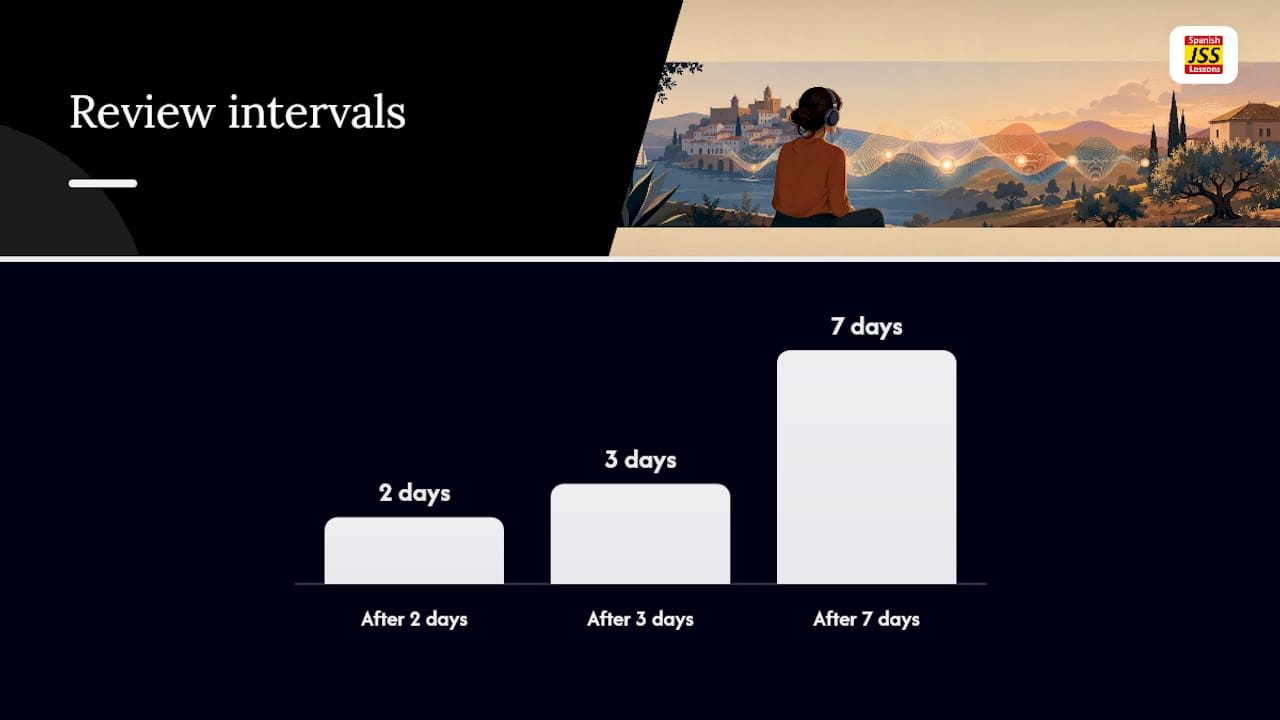
- Space the repetition. Revisit the same short clips two, three, then seven days later rather than drilling one clip to exhaustion in a single sitting.
That last point matters more than most learners assume. James Spanish School’s WordAmigo system builds its Five‑Step Retention Loop around exactly this kind of spaced, looped exposure across reading, listening, speaking, and writing, because repetition spread over time embeds linked forms far more reliably than one long cramming session.
Pro Tip: Pick one three‑second phrase you keep mishearing and shadow it fifteen times over three days rather than once, straight through. The boundary you keep losing usually clicks on repetition four or five, not repetition one.
For structured audio to practise this on, James Spanish School’s spoken Spanish lessons give you graded material built around exactly this kind of segmentation work.
Common confusions, quick fixes and cultural listening tips
The single biggest mistake English‑speaking learners make is expecting every word to be individually audible, the way it would be in a textbook dialogue. It won’t be, and chasing that expectation just leaves you frustrated and one step behind the sentence. Shift the target from “hear every word” to “predict the boundary from grammar and meaning.”
- If a sequence sounds ambiguous, use grammar first: verb endings, articles, and gender agreement usually rule out one reading before you even reach for context.
- Slow the audio down and replay the specific chunk rather than the whole sentence; isolating the trouble spot saves time.
- Check the stress pattern. Spanish stress is far more predictable than English stress, and the stressed syllable is often your anchor point for finding the boundary either side of it.
- If you genuinely cannot separate a phrase, park it and keep listening. Meaning often arrives two or three words later and retroactively clarifies what you missed.
James’s own observation from four decades of daily Spanish is that native speakers do give listeners help, just subtly. A tiny pause before a key word, a slight rise in stress on the word carrying new information: these are small signals, but once you start listening for them specifically, they turn out to be far more common than the “wall of sound” first suggests.
How word separation shifts across Spanish accents
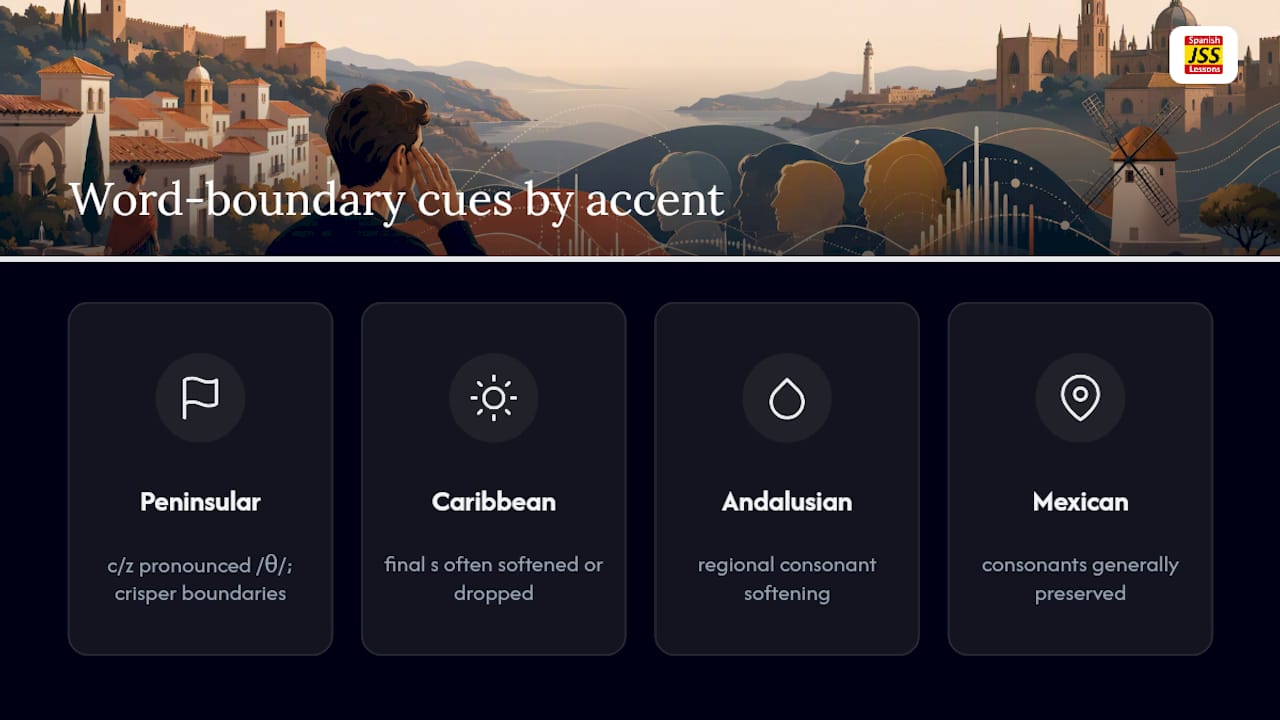
Connected speech rules aren’t identical everywhere Spanish is spoken, and this matters for anyone training their ear on mixed audio sources. Peninsular Spanish, spoken across most of Spain, tends to keep syllable boundaries slightly crisper than many Latin American varieties, partly because of the distinctive Castilian pronunciation of c and z as a soft th sound, which gives certain consonant clusters a harder edge.
Caribbean Spanish (Cuban, Dominican, Puerto Rican) pushes linking further than most other varieties, frequently dropping or softening word‑final s sounds altogether, which removes one of the clearest boundary markers English speakers instinctively rely on. Andalusian Spanish, in southern Spain, does something similar with its own regional consonant softening, while Mexican Spanish generally preserves consonants more clearly and is often recommended as a comparatively gentler starting point for learners still building segmentation skills.
None of this means you need to master every accent before you can separate words confidently. It does mean that if your listening practice mixes a Madrid podcast with a Caribbean vlogger, some of your confusion is the accent shifting under you, not a gap in your skill. Training primarily on the variety you’ll actually hear day to day, whichever region of Spain or Latin America that is, builds faster, more transferable recognition than jumping between accents from the start.
Learn faster with James Spanish School’s ear‑tuning course
Drills work, but a structured course gets you there with less guesswork and no wasted repetition on the wrong material. James Spanish School’s 100‑lesson course splits its time between sentence‑building and dedicated ear‑tuning, so listening practice isn’t an afterthought bolted onto grammar, it’s half the syllabus.
Every lesson is on demand, so you can shadow phrases on your phone during a coffee break or run a full session on a laptop in the evening, repeating any lesson as often as you need with no expiry date pushing you along. Vocabulary and pronunciation are reinforced through the WordAmigo system, an AI‑powered tool built with James Bretherton and long‑term English expats specifically to solve the two problems that stall most adult learners: words that refuse to stick, and pronunciation that native speakers can’t quite parse. Its Five‑Step Retention Loop cycles you through reading, listening, speaking, and writing so linked forms embed rather than fade after one listen.
James also backs the core lessons with a satisfaction guarantee that provides extra practice modules if a lesson does not teach you anything new. Take a look at the full course details and current offers to see where ear‑tuning fits into the wider syllabus, and start with a lesson built around the everyday conversations you’ll actually have, not exam‑style dialogue.
Sources
For the phonological detail behind enlace and sinalefa, OpenLearn’s connected speech guide and its companion OLCreate teaching resource are the clearest starting points. Newcastle University’s sandhi phenomena notes cover the consonant and vowel shifts in more technical depth, and James Spanish School’s why Spanish listening is hard article expands on the diagnostics covered above.
- 4 Connected speech phenomena | OpenLearn
- Teaching Spanish pronunciation: Connected speech phenomena | OLCreate
- Sandhi phenomena in Spanish | I. E. Mackenzie (Newcastle)
- Elon
- Conciencia fonológica — principles for developing phonological awareness (Spanish education guidance)
FAQ
What does “separar palabras en español” mean for listeners?
It means learning to recognise where one spoken word ends and the next begins inside connected, natural‑speed Spanish, rather than splitting written words into syllables.
Why does Spanish sound like one continuous stream of sound?
Native speakers link word‑final consonants onto following vowels (enlace) and fuse adjacent vowels (sinalefa), so the natural boundaries between words disappear in fluent speech.
How can I practise separating words in fast Spanish?
Chunk short audio clips by intonational phrase, shadow them at slowed playback, and drill minimal pairs like tienes alas versus tiene salas until the boundary becomes automatic.
Does word separation differ between Spain and Latin America?
Yes. Peninsular Spanish tends to keep boundaries slightly crisper, while Caribbean and Andalusian varieties often soften or drop word‑final s sounds, pushing linking further than other regions.
Can a structured course actually improve listening comprehension?
A course built specifically around listening, like the ear‑tuning half of James Spanish School’s 100‑lesson programme, gives you graded, repeatable audio practice rather than leaving segmentation skills to chance exposure.