

Escucha activa en español, in the sense that matters for learners, means active listening practice, not the soft communication skill of the same name. The single best routine is the three-pass short-clip loop: listen for gist, listen again with the transcript, then listen once more clean. Stick to clips you already understand roughly 70 to 90 percent, and expect steady, incremental gains rather than overnight fluency.
TL;DR:
- Focusing on clips you understand at 70 to 90 percent comprehension helps avoid plateauing and ensures steady progress without overwhelming your ear.
- Using the three-pass loop, shadowing, and dictation drills enhances understanding of meaning, wording, and speech patterns, accelerating listening skills.
- Consistent daily practice of 15 to 45 minutes, depending on your level, with reusing benchmark clips over a week provides measurable progress.
- Avoiding English subtitles and deliberately predicting content from context improves comprehension by training the brain to process Spanish sounds directly.
- Recognizing Spanish-specific linking and syllable reduction, along with targeted fixes for speed and accent variability, boosts understanding of natural speech.
Table of Contents
- What learner-focused escucha activa means and why Spanish sounds faster
- Three practical approaches: which one fits your day
- Three drills that accelerate comprehension fastest
- A realistic 4-week plan for busy adults
- Common listening obstacles and high-impact fixes
- How James Spanish School and WordAmigo map to these techniques
- How can you guess meaning before you catch every word?
- Can you learn to tell Spanish accents apart?
- What’s the simplest way to track listening progress?
- Why does Spanish sound so squashed together?
- Ready to put these drills into a structured programme?
- Sources
- FAQ
What learner-focused escucha activa means and why Spanish sounds faster
This article treats escucha activa en español purely as listening-comprehension training: exercises that tune your ear to fast, natural spoken Spanish. It has nothing to do with the interpersonal active listening you might have learned in a management course.
Spanish genuinely moves faster than English to an English ear. Native Spanish speech runs at roughly 7.82 syllables per second against English’s 6.19, and Spanish speakers also chain words together into unbroken streams, so “los amigos” becomes something closer to “losamigos”. Nothing is technically wrong with your ear. The language is simply denser and more joined up than you’re used to.
That’s why choosing the right difficulty matters more than sheer effort. Work with clips you already grasp in the 70 to 90 percent comprehension band, the sweet spot where your brain fills gaps from context rather than drowning in unknown words. Too easy and you plateau; too hard and you’re just decoding noise.
Three practical approaches: which one fits your day
Not every listening session needs the same method. Match the approach to your energy and level, and rotate between them across the week.
Listen with transcript (listen + read). Play the audio while reading along, then replay without the text. This suits beginners and anyone tackling unfamiliar topics, because it removes the guesswork about where one word ends and the next begins.
Read then listen. Read the transcript first, predict how it will sound, then play the audio. This works well for A2 to B1 learners who want to test their instincts for stress and linking before hearing the real thing.
Listen then check. Play the clip cold, jot down what you caught, then check against the transcript. Reserve this for B1+ learners who want an honest read on where their ear actually stands.
- Listen + read drill: two passes with text visible, one pass with it hidden.
- Read + listen drill: read once silently, predict aloud, then play twice.
- Listen + check drill: play once with no aids, note gaps, replay twice against the transcript.
Adult learners of European Spanish tend to progress fastest by pairing transcripts with short, level-matched audio rather than jumping straight into native podcasts. Lawless Spanish recommends exactly this graduated sequence, moving from listen+read through read+listen to listen-then-read as confidence builds.
Pro Tip: Hide the English subtitles entirely. Trivia Lingua’s research is clear that English subtitles should be avoided for listening work because your eye reads faster than your ear processes, so you end up reading a translation instead of training comprehension. Spanish subtitles are fine once you’re past A2; they still force your brain to map sound to Spanish text rather than to your first language.
Three drills that accelerate comprehension fastest
Three techniques do most of the heavy lifting once you’ve picked your clip. Each targets a different weak spot: overall meaning, exact wording, and real-time production.
- The 3-pass loop. Pass one: listen once for gist only, no pausing, no notes. Pass two: replay with the transcript, marking every word or phrase you missed. Pass three: play it clean again, checking whether the marked sections now land naturally.
- Shadowing. Play a 10 to 15 second burst, then speak over the recording in real time, matching rhythm and stress rather than perfect pronunciation. Repeat the same burst three or four times before moving on, and only increase playback speed once you can keep pace comfortably.
- Dictation. Take a 5 to 10 second segment, write down exactly what you hear, replay as many times as needed, then compare against the transcript and log every error by type (missed word, wrong verb ending, misheard linking).
Quick reference for your session:
- Gist pass: no pausing, no writing.
- Transcript pass: mark gaps, don’t translate yet.
- Clean pass: confirm the gaps have closed.
- Shadowing: three to four repeats per burst before raising speed.
- Dictation: log errors, don’t just correct and move on.
Shadowing earns its place here because it trains perception and production together, which speeds up how quickly you recognise connected speech patterns when someone else is talking, not just when you’re the one rehearsing.
A realistic 4-week plan for busy adults
Consistency beats intensity. A short daily habit outperforms occasional marathon sessions, and the right daily dose depends on where you’re starting from.
- A1 learners: 15 to 20 minutes a day. One clip, worked through all three passes, five days a week.
- A2 to B1 learners: 20 to 30 minutes a day. Alternate between the 3-pass loop and a short shadowing burst.
- B1+ learners: 30 to 45 minutes a day. Add dictation twice a week and start introducing unscripted native content.
A sample week might run: Monday and Wednesday on the 3-pass loop with a new clip, Tuesday and Thursday on shadowing with the same clip from Monday, Friday on dictation, and the weekend spent on relaxed listening with no drilling at all, just a podcast over coffee.
Reuse one benchmark clip for a full week before moving on. Once you can do a clean pass with minimal gaps, raise the difficulty on the next clip rather than the current one: slightly faster speech, a new regional accent, or genuinely unscripted native content instead of learner audio. Mixing focused drill sessions with unstructured “chill” listening keeps the habit sustainable; all drilling, no relaxed exposure, tends to burn people out within a fortnight.
Common listening obstacles and high-impact fixes
Most listening struggles trace back to a handful of repeat offenders, and each has a fast fix you can apply in the same session.
- Speed: slow playback to 0.75x for one pass, then return to normal speed immediately after.
- Linking (encadenamiento): shadow the exact phrase that tripped you up three times before moving on.
- Missing high-frequency words: chunk the sentence into two or three word groups and replay each chunk separately.
- Accent variability: note which accent threw you and deliberately seek out one more clip in that same accent this week.
- Vocabulary gaps: add only the two or three most useful missed words to your spaced review, not every unfamiliar term.
One-line checklist: gist first, mark the gaps, fix the gaps, replay clean, log what you missed.
How James Spanish School and WordAmigo map to these techniques
The course is shaped around how Spanish is actually spoken in daily life rather than how it’s tested in exams. It includes lessons on sentence-building and ear-tuning, applying a simplification method to strip out complex grammar terminology.
An AI-driven vocabulary system handles retention that pairs naturally with active listening: once a 3-pass loop surfaces new words, spaced repetition and pronunciation practice help keep them from fading quickly. [author_bio] [brand_signal]
How can you guess meaning before you catch every word?
Native listeners rarely decode every syllable. They predict what’s coming based on context, then confirm or adjust as the sentence unfolds, and you can train the same habit deliberately.
Before hitting play, glance at any visual or written cue you have, a headline, a menu, a shop sign, and predict three or four words you expect to hear. In conversation, the setting does this work for you: a waiter’s opening line has a narrow, predictable range of possible sentences. Listening for the shape of a sentence rather than every individual word also helps. Spanish word order flags meaning early: subject, verb, object usually arrives in that sequence, so once you catch the verb, you can often guess what follows even if a word or two gets swallowed by connected speech.
Practise this deliberately with the read-then-listen approach described earlier: predict the content from the transcript’s opening lines, then play the audio to see how close your guess landed. Over weeks, this narrows the gap between what you expect to hear and what actually comes out of a native speaker’s mouth, which is most of what “getting an ear” for a language actually means. It also reduces panic in real conversations, because half-catching a sentence stops feeling like failure once you’re used to filling gaps from context rather than needing every word.
Can you learn to tell Spanish accents apart?
European Spanish alone covers a wide spread: the crisp “th” sound for c and z in Castilian Spanish, the softer, faster southern accents of Andalusia, and the distinctive rhythm of Canarian or Galician-influenced speech. Add Latin American varieties and the range widens further.
Rather than trying to master every accent at once, pick one as your anchor, usually the accent closest to what you’ll hear day to day, and get genuinely comfortable there first. Once a benchmark accent feels stable, deliberately seek out a second accent for a week of focused listening, noting the two or three sounds that differ most (dropped consonants, vowel shifts, speed). Treat each new accent as a mini calibration exercise rather than starting from scratch: the vocabulary and grammar you already know still apply, only the sound mapping shifts.
What’s the simplest way to track listening progress?
A short log beats a vague sense of “getting better”. After each session, note three things: the clip’s source, your rough comprehension percentage on the clean pass, and the number of gaps you had to check against the transcript.
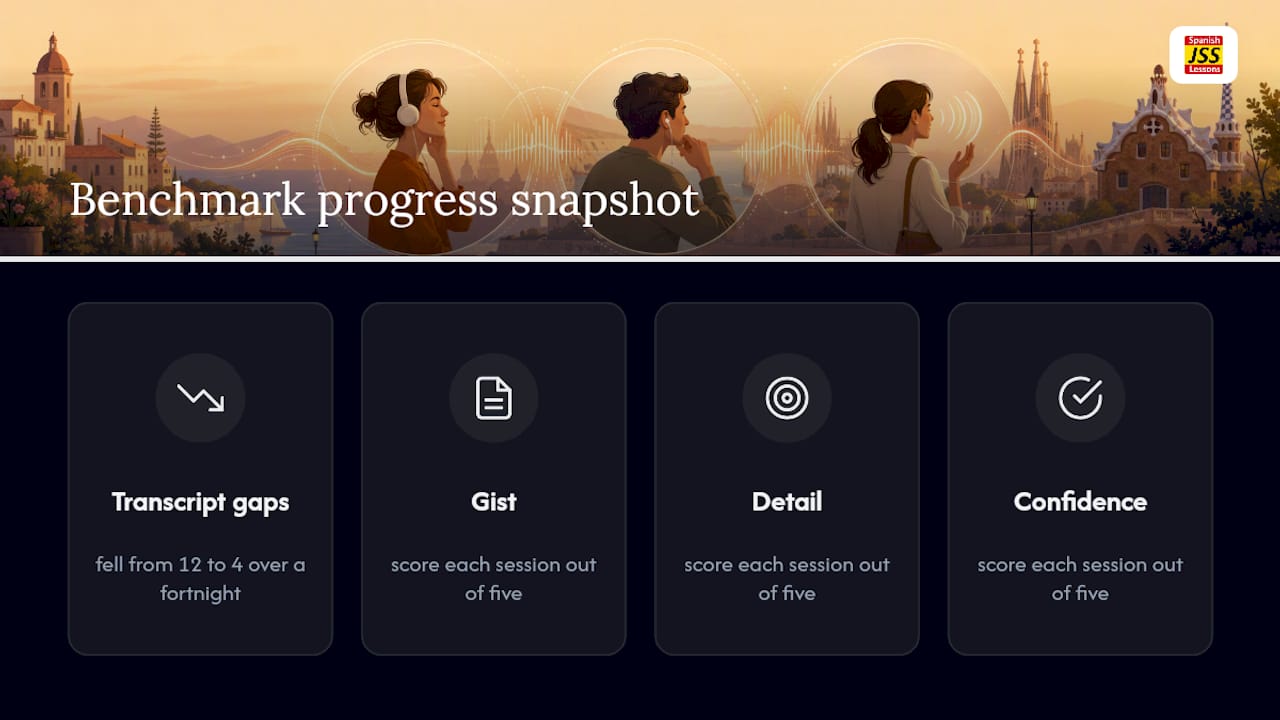
Reusing the same benchmark clip weekly gives you an honest before-and-after: if gaps drop from twelve to four over a fortnight on the identical audio, that’s real, measurable progress rather than guesswork. A simple self-assessment scale works too. Score each session gist, detail, and confidence out of five, and watch which of the three lags behind the others; that tells you exactly where to focus next.
Why does Spanish sound so squashed together?
Two phonetic features explain most of the compression you hear: liaison and syllable reduction. Liaison, or linking, joins the final sound of one word to the first sound of the next whenever they’re compatible, so “el otro” becomes a single flowing “el·otro” rather than two distinct words.

Vowels also blend when they meet across word boundaries, and unstressed syllables get shortened or dropped in casual speech, which is why quick greetings and filler phrases often sound like a single blur of sound rather than several separate words. None of this is sloppy speech. It’s the standard rhythm of the language, and pronunciation awareness of diphthongs, linking, and stress patterns is one of the most direct routes to better listening comprehension, because recognising these patterns by ear lets you mentally reinsert the word boundaries a native speaker never actually pronounces.
Ready to put these drills into a structured programme?
Drilling alone gets you far, but a structured path saves you the trial and error of building your own curriculum from scratch. James Spanish School’s 100-lesson on-demand course pairs sentence-building with dedicated ear-tuning modules, so the listening work described above sits inside a wider system rather than a stack of disconnected exercises.
The course runs entirely on demand, so you fit lessons around your own day rather than a fixed timetable, and lessons can be repeated as often as you like with no expiry date attached. WordAmigo handles the vocabulary side, using spaced repetition and pronunciation feedback so the words your listening drills surface actually stay with you. If you’d rather borrow more free transcript-supported material while you decide, PolishMyGerman’s free resources are worth a look too, though built for a different language pair. When you’re ready to see the full course structure and current offers, visit the James Spanish School shop and take a look at what’s included.
Sources
- How to Improve Your Spanish Listening Comprehension (A1–B1) | Trivia Lingua
- How to Improve Your Spanish Listening Skills: A Practical Guide | Verbalane
- The adults’ guide to learning European Spanish
- Listening tips | Lawless Spanish
FAQ
How long should I practise listening each day?
Short daily sessions adjusted to your proficiency level are recommended. Beginners should start with shorter focused sessions, gradually increasing duration as skills improve, while consistency remains more important than total length for building comprehension.
Do transcripts actually help, or are they a crutch?
Transcripts help enormously at lower levels because they show you exactly where connected speech obscures word boundaries. The goal is to wean off them gradually, moving from listen+read to Spanish subtitles and eventually to no support at all as your comprehension climbs.
When should I move to native, unscripted Spanish content?
Once a clean pass on your current benchmark clip leaves only a handful of gaps, raise the difficulty rather than the volume. That usually means faster speech or a new accent before jumping straight to unscripted native podcasts or television.
How do I know if my listening is actually improving?
Reuse the same clip weekly and log your gap count and rough comprehension percentage each time. A shrinking gap count on identical audio is the clearest, most honest signal of progress you can track.
Does James Spanish School specifically teach listening skills?
Yes. The 100-lesson course dedicates a portion of its structure to ear-tuning alongside sentence-building, and WordAmigo supports the vocabulary retention that follows active listening sessions. Full course details are on the James Spanish School shop page.