

Distinción keeps the sounds /s/ and /θ/ separate, so casa (house) and caza (hunt) sound different; seseo merges both into /s/, the system most of the Spanish-speaking world uses; ceceo merges them into /θ/ instead, a much rarer pattern confined to parts of Andalusia. All three are fully legitimate Spanish, and every one of them is understood everywhere. For you as a learner, the practical fallout is twofold: your ear needs to expect variation, and your spelling can no longer rely on how a word sounds.
TL;DR:
- Seseo merges c, z, and s into /s/, making words like caza and casa homophones in most Latin American and Canary Islands dialects.
- Distinción keeps /θ/ for c and z and /s/ for s, mainly used in central and northern Spain, including Madrid, in formal speech and media.
- Ceceo, primarily found in rural Andalusia, merges all three sounds into /θ/, but it is rare and has lower prestige than seseo or distinción.
- Learners in seseo regions should focus on pattern recognition and linking spelling to root words, as their pronunciation doesn’t distinguish c/z from s.
- Recognizing regional variances and practicing with audio-visual drills helps acclimate to different accents, crucial for comprehension and proper spelling.
Table of Contents
- Seseo vs distinción: a quick comparison
- What distinción sounds like and how to hear it
- What seseo sounds like and why spelling gets tricky
- What ceceo sounds like and where it lives
- Where each pronunciation system is spoken
- How this affects your spelling and listening strategy
- A practical plan for handling regional variation
- A short ear-tuning exercise from James Spanish School
- Sharpen your ear with James Spanish School
- Sources
- FAQ
Seseo vs distinción: a quick comparison
Here’s the contrast stripped down to its bones. Three systems, one set of letters (c before e/i, z, and s), three different outcomes for your ears.
- Distinción: c/z = /θ/, s = /s/. Casa /ˈkasa/ (house) stays distinct from caza /ˈkaθa/ (hunt).
- Seseo: c/z and s all collapse into /s/. Casa and caza both come out as /ˈkasa/.
- Ceceo: c/z and s all collapse into /θ/. Both words would be pronounced closer to /ˈkaθa/.
Distinción carries prestige on peninsular Spanish television and in formal broadcast contexts, but that doesn’t make seseo a lesser cousin. It’s the standard, fully accepted pronunciation across the cultivated norm of Latin America and the Canary Islands. Neither system is more “correct” Spanish; they’re parallel outcomes of the same language, and the Real Academia Española treats all three as historically legitimate consonant subsystems, not deviations from a single “true” Spanish.
What distinción sounds like and how to hear it
Distinción means Spanish keeps two separate phonemes where seseo and ceceo only have one. The /s/ sound is exactly what you’d expect from English “s.” The /θ/ sound is the interdental fricative you already know from English “think” or “bath.” To produce it, place the tip of your tongue lightly between your top and bottom front teeth and push air through gently.
That single articulatory habit is what separates dozens of Spanish minimal pairs. A few to train your ear on:
- cima /ˈθima/ (summit) vs sima /ˈsima/ (chasm)
- casa /ˈkasa/ (house) vs caza /ˈkaθa/ (hunt)
- coser /koˈser/ (to sew) vs cocer /koˈθer/ (to cook)
Pro Tip: Say “think” out loud, then freeze your tongue in that exact position and add a vowel: “th” plus “a” gives you a rough starting point for the Spanish /θ/ in caza.
Most English speakers over-correct at first, turning every c and z into a lisped “th” even where it doesn’t belong, or under-correct and flatten everything to /s/. The fix isn’t grammar, it’s repetition: listen for the pair, say it back, then check whether your tongue actually touched your teeth. Learners aiming at Spanish as spoken in Spain will meet this sound constantly, since it’s the pronunciation modelled on national news broadcasts and in most classroom Spanish taught in Britain.
What seseo sounds like and why spelling gets tricky
Seseo means c (before e or i), z, and s all land on the same sound: /s/. There’s no interdental /θ/ in this system at all. Where a distinción speaker hears casa and caza as two different words, a seseo speaker’s mouth produces the identical /ˈkasa/ for both, and only context tells you which one is meant.
This is where your spelling problems start. Homophone pairs multiply once sound stops signalling letters:
- cocer (to cook) and coser (to sew) both become /koˈser/
- abrazar (to hug) and abrasar (to scorch) collapse into the same sound
- ciento (hundred) and the surname-forming suffix pattern in -ción words lose their auditory cue for c versus s
The dictionary definition of seseo confirms this is a systematic merger, not sloppy speech, which is why it needs a systematic fix. You can’t sound your way to correct spelling in these dialects, so lean on visual memory instead: notice which root a word comes from, spot recurring patterns like -ción and -sión, and build frequency lists of the words you personally keep misspelling.
What ceceo sounds like and where it lives
Ceceo flips seseo on its head: instead of merging everything to /s/, speakers merge c, z, and s into /θ/. So casa and caza both come out closer to /ˈkaθa/, the reverse of the seseo pattern.
The RAE describes ceceo as a dialectal feature typical of some areas of southern Spain, and it is considerably less widespread than seseo. You’ll hear it in scattered towns and rural pockets of Andalusia, rarely on national television, and it generally carries lower social prestige than either distinción or seseo in formal settings.
- Definition: c/z/s all realised as /θ/
- Geography: limited pockets of southern Andalusia
- Learner takeaway: recognise it when you hear it, but there’s little reason to actively train yourself into ceceo unless you’re specifically settling in one of those communities
Where each pronunciation system is spoken
Seseo dominates the map. It’s the pronunciation you’ll hear across nearly all of Latin America, the Canary Islands, and large parts of Andalusia, and it’s the majority system among Spanish speakers worldwide by a wide margin.
Distinción belongs mainly to central and northern peninsular Spain, including Madrid, and it tends to be what you hear on national broadcast media, even though plenty of Spaniards outside that central belt sesean in daily life.
- Seseo: most of Latin America, Canary Islands, much of Andalusia
- Distinción: central and northern Spain, standard on national television
- Ceceo: isolated areas of southern Andalusia
Travel between a few Spanish-speaking regions, or just switch between a Mexican podcast and a Madrid news bulletin, and you’ll notice the shift immediately. Building comfort with that range matters more than mastering one “correct” accent, and the regional accent guide is worth a look if you want the fuller picture beyond just the sibilants.
How this affects your spelling and listening strategy
Here’s the RAE’s own framing: seseo and ceceo create genuine orthographic doubt because sound no longer maps cleanly onto c, z, or s. If you learned Spanish mostly by ear in a seseo region, you can pronounce a word perfectly and still have no idea how to spell it. That’s not a personal failing. It’s built into the dialect.
Three habits fix this over time:
- Learn morphological families rather than isolated words. If you know nación takes -ción, you’ll correctly guess emoción, canción, and dozens more without needing to hear the difference.
- Drill the genuine irregulars separately. A short list of frequent exceptions, revisited on a spaced schedule, beats trying to memorise every word in one sitting.
- Pair every listening session with the written word. Hear the sentence, then look at the transcript immediately, so your brain builds the sound-to-letter link even in a dialect where the sound alone won’t tell you.
Pro Tip: Keep a running list titled “words that betray me” — the handful of homophones you personally keep misspelling. Five minutes a week on that list beats an hour of generic vocabulary drilling.
The RAE’s own orthography guidance backs this approach: it explicitly recommends learners in seseo and ceceo areas build spelling knowledge through pattern recognition rather than pronunciation, precisely because the auditory cue has disappeared.
A practical plan for handling regional variation
You don’t need to “pick a side” between seseo and distinción unless your goals point clearly one way. If you’re aiming at formal peninsular contexts, national Spanish media, or classroom-style exams, training your ear and tongue for distinción’s /θ/ pays off. If you’re settling long-term in Latin America or the Canary Islands, seseo is what you’ll live inside every day, and there’s no benefit to fighting it.
- Set your target deliberately. Choose distinción for peninsular/media contexts, seseo for most of the Spanish-speaking Americas, and treat comprehension of all three as the real finish line either way.
- Run short daily drills. Ten to fifteen minutes of minimal-pair listening, shadowing target sounds out loud, and orthography flashcards for your personal trouble words.
- Build tolerance for variation on purpose. Mix in audio from different regions rather than sticking to one accent, since real conversations won’t stay tidy.
Pro Tip: When a Spanish speaker’s accent throws you, ask “¿Puedes repetirlo más despacio?” (Can you repeat that more slowly?) rather than guessing. It’s a normal, everyday request, not a sign you’re behind.
Guides like why Spanish listening is hard and how to beat it go deeper into building that comprehension muscle across accents, which matters more day to day than perfecting a single pronunciation system.
A short ear-tuning exercise from James Spanish School
A language expert with extensive experience living in Spain has focused his teaching on this problem: the gap between hearing Spanish and correctly spelling it. Try this three-minute exercise. Listen to a recording containing casa and caza spoken by a distinción speaker. Repeat both out loud, exaggerating the tongue position for /θ/. Record yourself, then compare your playback against the original, listening specifically for whether your /θ/ collapsed back into /s/.
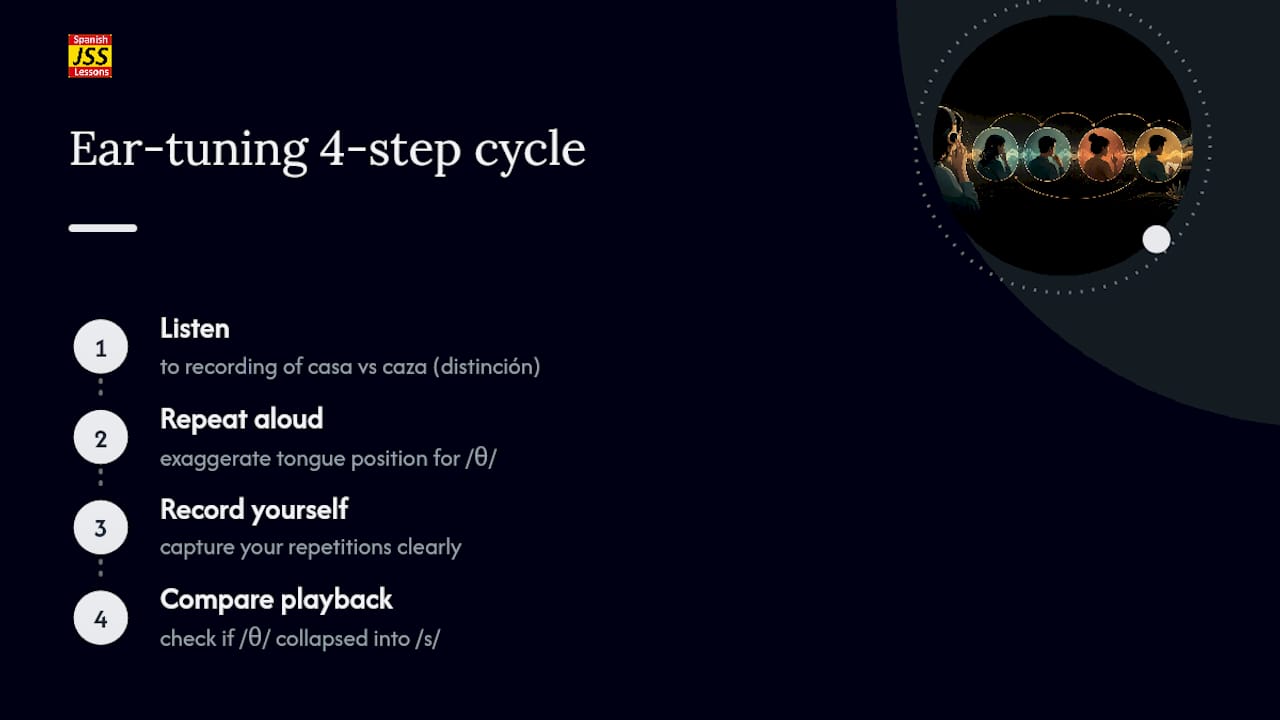
That listen, repeat, record, compare cycle is the backbone of the WordAmigo retention system, which drives pronunciation and vocabulary practice through repeated multimodal exposure rather than one-off memorisation.
Sharpen your ear with James Spanish School
Textbooks can tell you distinción exists; they can’t train your tongue to produce /θ/ on demand or your ear to catch it at native speed. James Spanish School builds that skill directly into its course through the WordAmigo pronunciation tools, which pair audio drills with the same listen-repeat-record loop covered above, and the pronunciation mode audio and PDF materials that let you practise minimal pairs like casa and caza at your own pace.

The 100 lessons build sentence construction and ear-tuning side by side, so you’re not just memorising vocabulary lists but training listening reflexes like those described here, with lifetime access and no countdown clock pushing you through it. That combination is what turns “I understood the grammar rule” into actually following a fast conversation with a neighbour or a shop assistant, regardless of whether they sesean, cecean, or use full distinción. Full course details, including the WordAmigo system and current pricing, are listed at James Spanish School’s course shop.
FAQ
What’s the difference between seseo and ceceo?
Seseo merges c, z, and s into a single /s/ sound, the pattern used across most of Latin America and the Canary Islands. Ceceo does the opposite, merging all three into /θ/, and it’s a much more geographically limited feature confined to parts of southern Andalusia.
What is seseo, with examples?
Seseo is the pronunciation of c (before e/i) and z as /s/, identical to how s already sounds, so caza (hunt) and casa (house) become homophones, both /ˈkasa/. It’s the standard, prestige-accepted system across the cultivated norm of most Spanish-speaking countries.
Do people in Seville sesear or cecear?
Andalusia contains real internal variation, with seseo, ceceo, and distinción all present in different towns and neighbourhoods, and even the exact articulation of the merged sound can shift between speakers. Seville itself leans toward seseo in much everyday speech, though nearby areas of the region show ceceo, so don’t expect one uniform “Andalusian accent.”
Where in Spain is ceceo spoken?
Ceceo appears in scattered pockets of southern Andalusia, notably in parts of Cádiz and surrounding rural areas, rather than across the region as a whole. It is far less widespread than seseo and carries less prestige in formal or broadcast Spanish, which is why national media almost always defaults to distinción instead.