

The Spanish jota represents the voiceless velar fricative /x/, tightened to /χ/ in much of Spain, and softened to an aspirated [h] across many Latin American dialects. Learners preparing for European Spanish should aim for the stronger /x/ sound, the rasping noise you hear in jamón. Both realisations are correct Spanish; the choice depends on where you’re headed.
TL;DR:
- Learners targeting European Spanish should focus on producing the stronger /x/ sound, similar to the “j” in jamón, to blend in more naturally.
- The Spanish /x/ is produced by narrowing the back of the tongue and forcing air through, similar to the Scottish “loch,” requiring specific physical training.
- In Spain, jota is often a harsh scrape /x/ or uvular /χ/, while Latin American dialects soften it to an aspirated [h], which remains a correct regional variant.
- J and g spellings follow a clear rule: j always represents /x/, while g only does so before e or i, making pronunciation guesses easier once learned.
- Consistent practice, listening to native recordings, and guided drills help correct common mistakes like substituting glides for friction or dropping the sound entirely.
Table of Contents
- How to pronounce jota in Spanish: peninsular /x/ versus Latin American /h/
- How to make the Spanish j sound: tongue and breath technique
- When do j and g represent the same Spanish sound?
- Common jota mistakes English speakers make (and how to fix them)
- Weekly jota practice plan and where to hear it
- If you want guided practice: James Spanish School’s pronunciation tools
- Sources
- FAQ
How to pronounce jota in Spanish: peninsular /x/ versus Latin American /h/
Native speakers in Madrid, Castile, and most of northern and central Spain produce the jota as a harsh scrape at the back of the throat, sometimes tipping into a uvular /χ/, particularly with older or more emphatic speakers. Move across the Atlantic and the same letter softens dramatically. In Mexico, Colombia, and much of the Caribbean, jota often comes out as a gentle aspirated [h], closer to the English “h” in “hat” than anything Spain produces.
Neither version is wrong. The Diccionario panhispánico de dudas confirms that /x/ is the standard reference symbol for the phoneme, with the softer [h] recognised as a legitimate regional variant rather than an error. What matters for comprehension is consistency, not policing your own accent into submission. That said, if you’re learning Spanish to live, work, or settle in Spain, adopting the stronger /x/ helps you blend into everyday conversation and tunes your ear to what you’ll actually hear on the street.
Listen for the contrast in these word pairs:
- Jamón (ham) — strong /x/ in Spain, soft [h] in much of Latin America
- Jefe (boss) — same pattern, easy to hear the friction difference
- Gente (people) — g before e triggers the same /x/ sound
- Girar (to turn) — g before i, identical rule
- Trabajo (work) — a good word for practising the sound mid-word
Pro Tip: Search “jota” on Forvo and you’ll find dozens of native recordings tagged by country. Play three or four from Spain back to back, then three or four from Mexico or Argentina, and the regional split becomes obvious within seconds.
How to make the Spanish j sound: tongue and breath technique
Producing /x/ is a physical skill, not a memory exercise. Your tongue and breath need retraining before the sound feels natural.
- Start from /k/. Say the English “k” sound and notice where the back of your tongue meets the roof of your mouth (the soft palate).
- Pull back slightly, don’t touch. Instead of closing that gap fully, leave a narrow channel. Air needs to squeeze through, not stop.
- Force air through the gap. You should hear a rasping, hissing friction, similar to the German “ch” in Bach or the Scottish “loch”. Spanish jota often comes out stronger and further back in the throat.
- Practise the hiss alone first. Forget vowels entirely. Just hold the friction sound for two or three seconds, several times.
- Add vowels one at a time. Move through ja, je, ji, jo, ju slowly, keeping the friction sharp before each vowel lands.
- Attach full words. Try jamón, jefe, jirafa, viejo, working from slow and exaggerated towards normal speaking speed.
This sequence mirrors the method described in Elon, which treats the jota as a controlled airflow exercise rather than a vague imitation game.
Pro Tip: Exaggerate wildly at first. Make the sound louder and rougher than any native speaker would. Once your tongue and throat know where to sit, dial the intensity back down until it matches normal conversational speech. Trying to nail the subtle version from day one usually just produces a mumble.
When do j and g represent the same Spanish sound?
Spanish spelling has one genuinely reliable rule buried in the g/j confusion, and once it clicks, most of the guesswork disappears.
- J represents /x/ in any position — before a, e, i, o, or u. Jamón, jefe, jirafa, joven, jugo all follow this pattern without exception.
- G represents /x/ only before e or i. Gente and girar trigger the fricative; gato, gorra, and gustar do not, because a, o, and u after g give you the hard /g/ sound instead.
- Watch the near-twins. Jirafa and girar look similar but behave identically for pronunciation purposes, since both land on /x/ once you know the rule for g before i.
- Borrowed words break the pattern occasionally. Words lifted from other languages don’t always play by Spanish spelling logic, so treat unfamiliar vocabulary with a little caution.
The RAE’s Ortografía sets this out plainly: j covers every position, while g only borrows the sound in front of e and i. A quick memorisation trick that works for most learners: if you can hear jota but the word is spelled with g, check whether an e or i follows immediately. It almost always does.
Common jota mistakes English speakers make (and how to fix them)
Most learners fall into one of three traps, and each has a fast fix.
- Using the English “y” sound instead of /x/. English speakers often default to a soft glide, turning jamón into something closer to “yamón”. Fix it by drilling the breath-hiss exercise above until friction, not glide, becomes automatic.
- Substituting a hard /g/ for gente or girar. This happens because English g rarely softens. Practise minimal pairs like gato versus gente aloud, exaggerating the difference until your mouth remembers which vowel triggers which sound.
- Dropping the sound entirely, a habit picked up from exposure to Caribbean Spanish, where jota can weaken almost to nothing. If you’re targeting European Spanish, restore the friction by over-pronouncing for a week, then easing off.
Record yourself reading five or six jota-heavy sentences, then compare the clips against native audio on Forvo. The gap between what you think you’re saying and what you actually produced is usually obvious within seconds.
Weekly jota practice plan and where to hear it
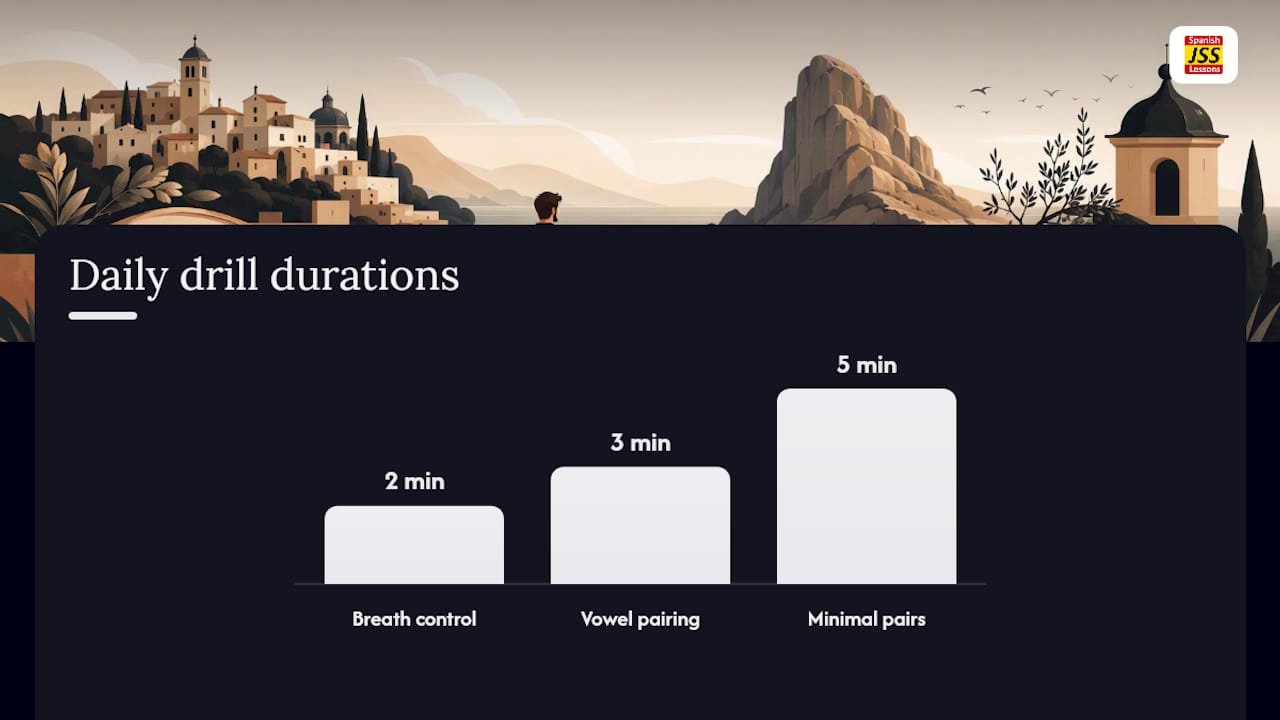
Three short drills, repeated daily, build the muscle memory faster than one long session ever will.
- Breath control (2 minutes): Hiss the isolated /x/ sound ten times, alternating loud and exaggerated with soft and natural.
- Vowel pairing (3 minutes): Cycle through ja, je, ji, jo, ju slowly, then again at conversational speed.
- Minimal pairs (5 minutes): Alternate gato/gente, jirafa/girar, and similar pairs to keep the g/j rule locked into muscle memory alongside the sound itself.
For listening, Forvo remains the most useful free resource, since it lets you filter native recordings by country and compare Spain against Latin American variants side by side. The RAE’s DPD entry is worth bookmarking too, less for audio and more as the reference point when you want to check whether a word’s stress or spelling affects the sound. Structured spaced repetition, pairing short audio bursts with immediate spoken repetition, tends to embed the motor habit faster than passive listening alone, a principle behind James Spanish School’s approach to pronunciation.
Record a short paragraph containing five or six jota words once a week and file the clips somewhere you can compare them chronologically. Hearing your own progress, rather than guessing at it, keeps motivation steady when the sound feels stubborn.
Pro Tip: Pair your breath drills with a short burst of native listening beforehand. Hearing the sound immediately before attempting it yourself locks in the target far better than practising from memory alone.
If you want guided practice: James Spanish School’s pronunciation tools
Getting the jota right on your own is entirely possible with the drills above, but pairing them with structured feedback closes the gap faster, particularly if your ear hasn’t fully tuned to fast, native-speed Spanish yet. James Spanish School’s course was built specifically for English-speaking adults working towards European Spanish, and its ear-tuning lessons target exactly the kind of sound discrimination that makes jota, and every other tricky consonant, click into place.
The WordAmigo system inside the course uses AI-powered strategic repetition to lock vocabulary and pronunciation into memory, tackling the two complaints James Bretherton hears most from expats after decades in Spain: words that vanish the moment you need them, and sounds native speakers struggle to understand. Access is lifetime, with no countdown clock forcing you through lessons faster than you’re ready for. If a core lesson teaches you nothing new, The course credits you with extra practice modules at no cost. Ready to put structured ear-and-mouth training behind your jota? Browse the current course options at James Spanish School and start with the pronunciation modules built for exactly this problem.
Sources
For readers who want to verify the details or hear more examples directly from primary sources:
- j | Diccionario panhispánico de dudas | RAE – ASALE
- Cómo pronunciar jota en Español, Finlandés, Portugués … | Forvo
FAQ
How Do You Pronounce the J in Spanish?
Spanish j represents the voiceless velar fricative /x/, produced by narrowing the gap between the back of the tongue and the soft palate and forcing air through. In Spain it often tightens to a uvular /χ/, while many Latin American dialects soften it to an aspirated [h], according to the RAE’s DPD.
How Do You Pronounce J and G Together in Spanish?
J and g share the same /x/ sound only when g appears before e or i, as in gente or girar. Before a, o, or u, g reverts to the hard sound heard in gato or gustar, a rule confirmed in the RAE’s Ortografía.
What Does the Letter J Mean in Spanish?
J is simply a consonant letter representing the /x/ phoneme, with no independent meaning of its own outside the word it appears in. It functions purely as a spelling choice, distinct from g, which only borrows the same sound before e and i.
How Do You Say the Letter J Out Loud in Spanish?
The letter itself is pronounced “jota” (roughly “HOH-tah”), not “jay” as in English. Practising the name alongside the sound it represents, using drills like breath hissing and vowel pairing, helps many learners connect the label to the correct articulation faster.
Which Spanish J Should English Speakers Learn First?
Learners preparing for life in Spain benefit most from targeting the stronger peninsular /x/, since it matches what you’ll hear day to day in shops, on the radio, and in conversation. Structured courses such as James Spanish School’s pronunciation lessons focus specifically on this variant for exactly that reason.