

Yes, you can learn Spanish at 50, and you can reach a genuinely useful, conversational level. The route that works is daily short practice built around audio-first listening, topic-driven reading, and spaced vocabulary repetition rather than classroom grammar drills. Set your sights on A2 within months and B1 within a year or two of consistent effort, and the whole thing stops feeling like a mountain to climb.
TL;DR:
- Most motivated adults can reach A2 level within five to eight months and B1 within a year and a half with daily practice of 30 to 45 minutes.
- Listening, repetition, and topic-driven reading are the most effective methods, especially when focusing on audio-first lessons and real-life content.
- Resources like audio courses, graded readers, vocabulary systems, pronunciation trainers, and staged conversation practice are key to progress at this stage.
- Consistency and variety in input are crucial, and switching topics or increasing speaking slightly can help overcome plateaus without increasing overall study time.
- Lessons from courses like James Spanish School use plain-English explanations, no expiry, and emphasize speaking and listening, making them suitable for older learners.
Table of Contents
- Why adult learners at 50+ can still make fast, useful progress
- The methods that produce results for 50+ learners
- Sample daily routines and how fast you’ll progress
- Which resources actually help at this stage
- How to choose a Spanish course built for learners over 50
- James Bretherton and what James Spanish School brings to older learners
- Success stories from learners who started later in life
- How to start with James Spanish School
- Sources
- FAQ
Why adult learners at 50+ can still make fast, useful progress
The old fear that “the window has closed” mixes up two very different things. The critical-period hypothesis mainly explains why children pick up a flawless native accent and adults rarely do. It says almost nothing about your capacity to build vocabulary, understand conversations, or hold your own at the market. That’s a different skill set, and adults are often quicker at it than children.
You already have advantages a ten-year-old doesn’t. You recognise cognates instantly (información, hospital, restaurante), you understand grammar concepts from having used English for decades, and you can apply an explanation the moment you hear it rather than absorbing it by osmosis. Adult learners frequently progress faster per hour of study than children do in a classroom.
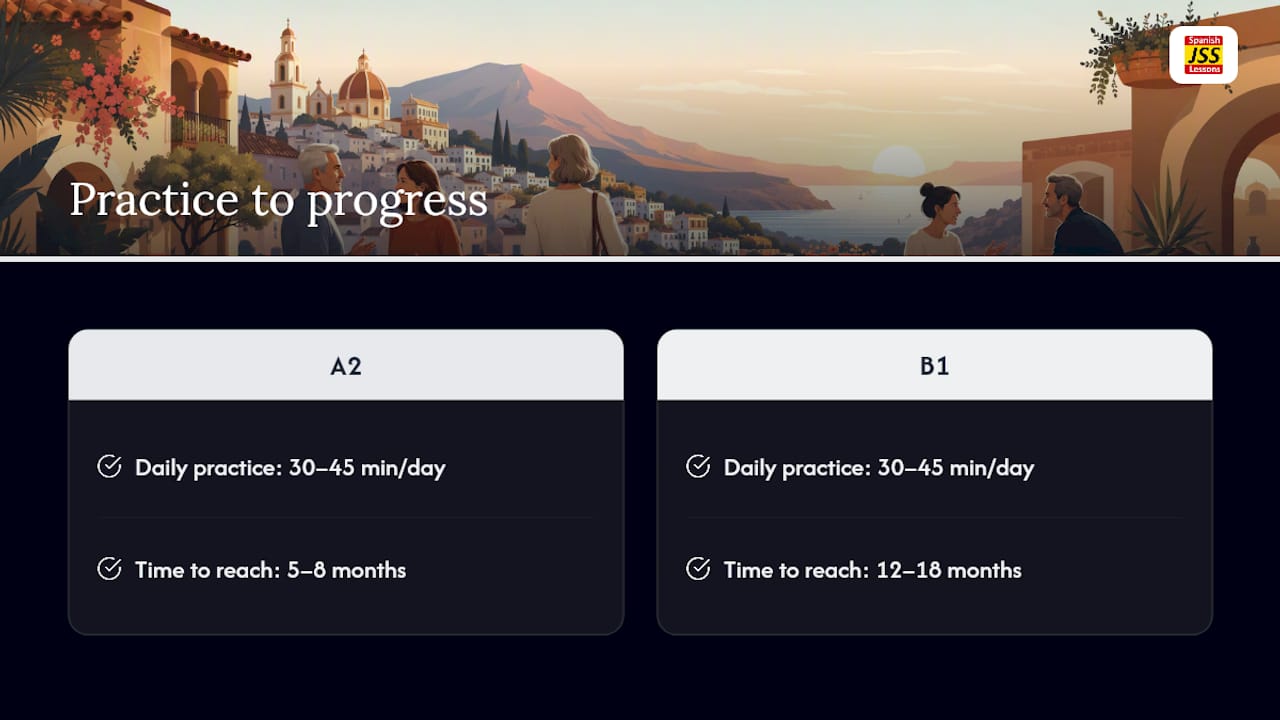
The numbers that matter: with 30 to 45 minutes of daily practice, most motivated adults reach A2 in five to eight months and B1 in twelve to eighteen months. Those ranges come from practitioner and research summaries, not a guarantee, but they hold up consistently for learners who show up daily rather than in occasional bursts.
The methods that produce results for 50+ learners
Forget grammar tables. The methods that actually move the needle for adult learners lean on listening, repetition, and low-stakes speaking rather than memorising verb conjugation charts.
- Audio-first listening. Guided audio Spanish lessons let your ear absorb sentence rhythm and structure before you worry about spelling rules, which suits how adults build intuition for Spanish sentence structure.
- Topic-driven reading and listening. Choose content on subjects you already know. If you followed football for thirty years, a Spanish football podcast will teach you more vocabulary, faster, than a generic beginner text ever could.
- Spaced repetition for vocabulary and pronunciation. Words fade unless they’re reviewed at the right intervals across multiple skills, not just flashcards. James Spanish School built WordAmigo on exactly this idea, an AI-powered system that cycles new words through reading, listening, speaking, and writing so they actually stick, according to the school’s own description of the tool.
- Low-pressure speaking. Shadowing a native speaker’s sentence, brief tutor calls, or rehearsing a fixed script for the bakery all beat freewheeling conversation practice when you’re still nervous about mistakes.
- Plain-English explanations over jargon. James Bretherton, the school’s founder, argues for skipping terms like “subjunctive mood” entirely and teaching sentence-building the way you’d explain anything else in English, in plain, practical steps.
Pro Tip: Read or listen to something on a subject you already love, even if it’s two levels above your current ability. Your background knowledge fills the gaps your Spanish can’t yet cover, and that’s a shortcut nobody talks about enough.
Sample daily routines and how fast you’ll progress
Pick a routine you can actually sustain rather than the most ambitious one. Consistency, not intensity, is what carries you to fluency, and short daily sessions beat occasional long ones for retention.
- 15 minutes: 8 minutes of audio listening, 5 minutes reviewing vocabulary in a spaced-repetition app, 2 minutes repeating phrases aloud.
- 30 minutes: 10 minutes listening, 10 minutes topic-driven reading, 5 minutes vocabulary review, 5 minutes shadowing or speaking practice.
- 60 minutes: 15 minutes listening, 15 minutes reading, 15 minutes vocabulary and pronunciation drills, 15 minutes speaking (tutor session, language partner, or self-recorded practice).
Milestones roughly track the time invested: A1 within six to ten weeks of daily practice at any level, A2 by five to eight months, and B1 by twelve to eighteen months with steady 30 to 45 minute sessions. If progress stalls for more than a fortnight, don’t add more hours. Change the input instead, swap a podcast for a different topic, or add five minutes of speaking, and momentum usually returns.
Which resources actually help at this stage
European Spanish resources fall into a handful of categories, and each does a different job. Mixing two or three rather than relying on one tends to produce the best results.
- Audio courses build listening comprehension and sentence rhythm without demanding you read anything first.
- Graded readers and topic-based articles grow vocabulary through subjects you already understand.
- Spaced-repetition vocabulary systems, such as WordAmigo, lock in words and pronunciation through repeated, varied exposure.
- Pronunciation trainers catch the sounds native speakers struggle to parse, which matters more in daily life than perfect grammar.
- Conversation practice, staged or live, turns passive knowledge into something you can actually use at the counter.
Before committing to any resource, check it against a short list: does it teach European Spanish specifically, does it explain things in plain English rather than academic jargon, does it let you review material as often as you need, and does it build listening skill rather than testing you on isolated words?
How to choose a Spanish course built for learners over 50
Look for a practical conversation focus rather than exam preparation, audio-first lessons, genuine pronunciation practice, and a pace that doesn’t assume you’re twenty and cramming for university.
- Ask for a sample lesson or trial before paying anything.
- Ask whether access expires or whether you can revisit material for as long as you need it.
- Ask what happens if a lesson doesn’t teach you anything useful, some providers offer credits or extra modules as a guarantee.
- Ask whether the course explains grammar in plain English or leans on academic terminology you’ll have to look up separately.
Red flags include rigid schedules with countdown pressure, no audio component, and courses that teach Latin American vocabulary and pronunciation exclusively when you’re heading to Spain. A clear guide to Spanish explanations for adults is worth checking before you commit to anything academic-sounding.
James Bretherton and what James Spanish School brings to older learners
James Bretherton is a dual-native English and Spanish speaker who has lived in Spain for 40 years, and that’s the perspective behind James Spanish School. The school’s 100-lesson course uses what it calls Radical Simplification, stripping out grammar terminology that never comes up in how people actually learn their first language, and replacing it with plain-English explanation.
Alongside the lessons sits WordAmigo, the school’s AI-powered repetition system for vocabulary and pronunciation, plus cultural notes on everyday Spanish life, from queuing etiquette to the builder’s mid-morning coffee break. According to the school, lessons carry no expiry date and can be repeated as often as needed, alongside a guarantee that credits extra practice modules if a core lesson teaches you nothing new.
Success stories from learners who started later in life
Plenty of people assume fluency belongs to the young, then quietly prove themselves wrong. Retirees who moved to Spain with a handful of holiday phrases have, within a year or two of steady practice, reached the point where they can handle a doctor’s appointment, argue good-naturedly with a plumber about a quote, or follow a neighbour’s rambling story about their grandchildren without asking for a repeat.
What these learners tend to share isn’t natural talent. It’s routine. Most describe short daily sessions rather than marathon weekend study, a habit of listening to Spanish radio or podcasts during a walk, and a willingness to sound clumsy in the bakery for the first six months. Several credit topic-driven reading, following news about a hobby or a football club they already followed in English, as the point where vocabulary started sticking rather than sliding away.

Age rarely comes up as the obstacle in these accounts. Inconsistency does. The learners who stall are usually the ones who study intensely for a fortnight and then vanish for a month, not the ones who started at 55, 65, or 72.
How to start with James Spanish School
Everything above points to a simple combination: plain-English explanation, audio-first listening, and repetition that actually sticks rather than fading by Friday. James Spanish School was built around exactly that combination for English-speaking adults, with James Bretherton’s 40 years in Spain behind the plain-language method and WordAmigo handling the vocabulary and pronunciation side.
If you want to see whether the approach suits you, the sensible first step is a sample lesson rather than a full commitment. The role of listening in language mastery explains how the audio-first structure works before you commit to anything, and from there you can browse the full range of lessons and starter packs on the James Spanish School shop. Lessons carry no expiry date, so there’s no clock running against you once you begin.
Sources
Milestone estimates and method recommendations in this article draw on Trivia Lingua’s research summary on learning Spanish at 50, practical guidance from Spain Unfiltered, and adult-learning advice from AARP.
- Learning Spanish at 50 (and Beyond): What the Research Actually Says | Trivia Lingua
FAQ
Is it really possible to learn Spanish at 50 or older?
Yes. Age mainly affects how close you get to a native accent, not your ability to build vocabulary or hold a conversation. With 30 to 45 minutes of daily practice, many adults reach A2 within five to eight months.
How long does it take to become conversational?
Most consistent learners reach a comfortable A2 level in five to eight months and B1, generally considered conversational, within twelve to eighteen months. Progress depends far more on daily consistency than on total hours crammed into occasional sessions.
What’s the best way to practise if I’m nervous about speaking?
Start with shadowing, repeating recorded native speech aloud, before moving to short tutor sessions or staged scripts for specific situations like ordering food. This builds confidence without the pressure of unscripted conversation.
Does James Spanish School work for someone who’s never studied a language before?
The course is built specifically for English-speaking adults with no language-learning background, using plain-English explanations instead of grammar terminology. Lessons and the WordAmigo repetition system are available on demand with no expiry date, according to the school’s own course description.
What if memory or forgetting words is my biggest worry?
Spaced repetition across multiple skills, reading, listening, speaking, and writing, is specifically designed to counter this. Systems like WordAmigo cycle vocabulary through repeated exposure at increasing intervals rather than relying on a single memorisation method.