

Freezing when speaking Spanish
When you freeze mid‑sentence in Spanish, breathe out for longer than you breathe in, right there, before you say another word. Try one round: seven seconds in, eleven seconds out, three or four cycles. Pair it with a short survival phrase like “a ver, espera” while you find your footing. That freeze is your body’s adrenaline response, not proof you don’t know the language, and the routines below will make it happen far less often.
TL;DR:
- Practicing short survival phrases and circumlocution daily helps you buy time and fill gaps without losing conversational flow.
- Structured breathing routines before speaking reduce adrenaline buildup, lowering the likelihood of a freeze response during conversations.
- Regular ear-tuning and sentence repetition build natural fluency, enabling faster response times and more confidence in real exchanges.
- Gradually increasing speaking difficulty through micro-tasks like solo recordings and low-stakes interactions fosters consistent progress and diminishes anxiety.
- Recognizing cognitive patterns like catastrophising and reliance on memorized responses enables deliberate practice that breaks recurring speech blocks.
Table of Contents
- Five quick techniques to recover the turn and keep talking
- Breathing and grounding: stop the adrenaline that causes the block
- Practice that transfers to real conversations: sentence‑building and ear‑tuning
- Graded exposure plan: from micro‑tasks to real conversations
- In‑the‑moment scripts and bridge phrases to use when you lose a word
- When to get extra help: speech therapy, psychology or targeted coaching
- Psychological causes of speech block in Spanish
- Strategies to build confidence and reduce fear of speaking
- The role of listener feedback in improving fluency
- Common cognitive patterns that keep the block in place
- A concise option: organised practice with James Spanish School
- Sources
- FAQ
Five quick techniques to recover the turn and keep talking
The gap between understanding Spanish and producing it under pressure is where bloqueo al hablar español actually happens. You know the word. Your mouth won’t deliver it because your brain has briefly classified speaking as a threat rather than a task, a pattern explored in why you understand Spanish but blank when speaking. Five tactics pull you out of that freeze without breaking the flow of conversation.
- Survival phrases: “a ver” (let’s see), “¿cómo se dice…?” (how do you say…?), “espera, que no me sale la palabra” (wait, the word’s escaping me). Say them slowly and they buy you three or four seconds without sounding lost.
- Circumlocution: describe around the gap. Can’t recall “destornillador”? Say “la cosa para las tornillos” (the thing for screws). Native listeners fill gaps faster than you’d expect.
- Natural fillers: “bueno…”, “pues…”, “o sea…” sound like normal Spanish hesitation, not foreign panic, and they buy genuine thinking time.
- Pronunciation triage: aim for intelligibility, not a flawless accent. Clear vowels matter more than a perfect “r”.
- Signal you’re learning: a quick “estoy aprendiendo, perdona” invites patience and often slows the other person’s speech.
Pro Tip: Rehearse your three survival phrases out loud, daily, until they’re automatic. A phrase you’ve said a hundred times in the shower won’t disappear under pressure the way a new one will.
Breathing and grounding: stop the adrenaline that causes the block
Adrenaline is the actual mechanism behind most speech blocks. It quickens your heart rate, shallows your breathing, tightens your jaw and throat muscles, and can trigger a genuine freeze response, the same one that alters articulation described in work on communication anxiety. Controlled breathing interrupts that chain before it takes hold.
- Breathe in through the nose for a count of seven.
- Hold for one second.
- Exhale slowly through the mouth for a count of eleven.
- Repeat for three to four cycles before you need to speak.
Run a short pre‑speaking routine of three to ten minutes before anything that makes you nervous: a phone call, an appointment, a family gathering. Light movement, a few vocal warm‑ups, or simply this breathing pattern all lower the baseline tension your speech has to fight against.
The evidence is genuinely encouraging here. Structured breathing combined with exposure work reports response rates exceeding 70% in clinical and educational settings for communication‑related freezing, and short breathing routines measurably reduce heart rate when practised anywhere from three to sixty minutes before a speaking event.
Practice that transfers to real conversations: sentence‑building and ear‑tuning
Isolated vocabulary rarely survives contact with a real conversation. Whole sentences do, because they shift your brain’s planning from painstaking word‑by‑word construction to ready‑made frames you can pull out instantly, cutting the translation pause that so often triggers a block.
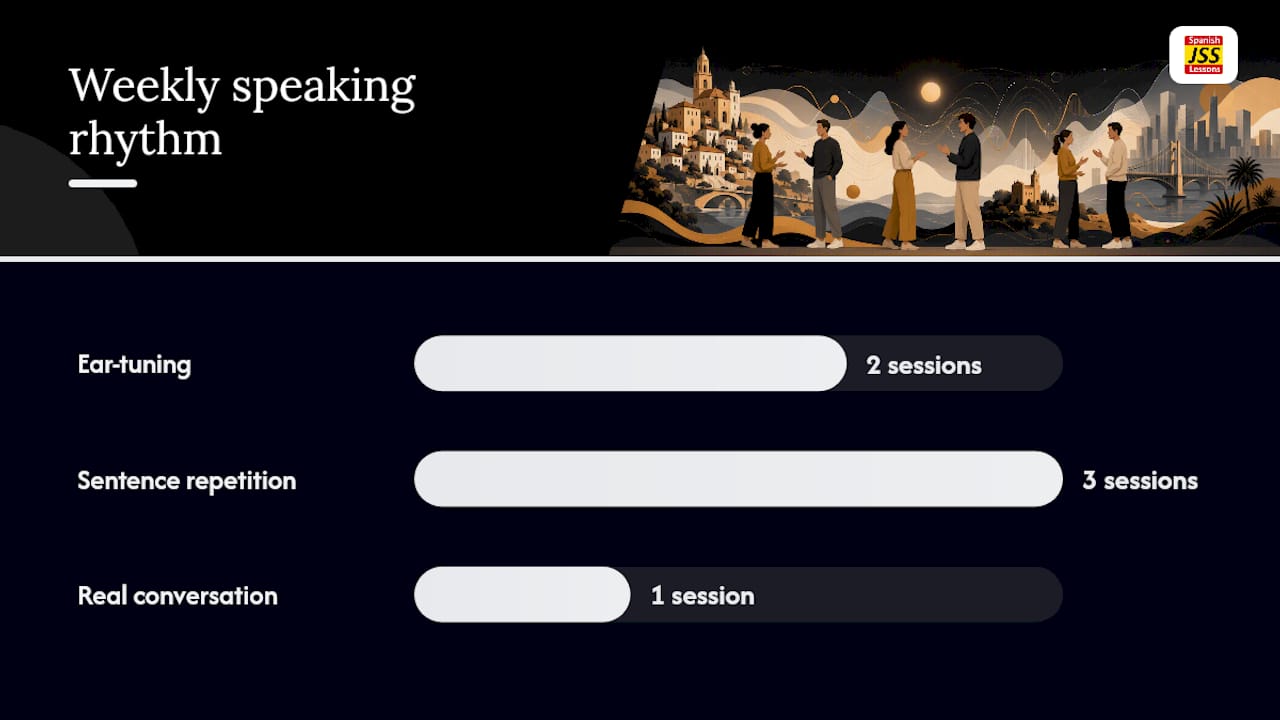
A weekly rhythm that actually builds spoken fluency looks something like this:
- Two sessions of “ear‑tuning”: listening to fast, natural Spanish audio without subtitles, training your ear to catch native speed before you ever try to match it.
- Three short sessions of sentence repetition, saying full useful sentences aloud until they’re automatic, not translating them each time.
- One low‑stakes real conversation, even five minutes with a shop assistant or neighbour.
- Spaced recall: revisiting the week’s sentences two or three days later, when they’ve started to fade slightly.
James Spanish School’s course is built around exactly this split: its 100 lessons divide between sentence‑building and ear‑tuning, so learners spend deliberate time on both halves of the problem, producing sentences and decoding fast spoken Spanish. Its WordAmigo System uses a five‑step retention loop, cycling vocabulary through reading, listening, speaking and writing, to lock in the words and pronunciation patterns that otherwise slip away within days.
Shadowing pushes this further: play a short clip of a native speaker, pause it, and repeat the exact sentence, matching rhythm and stress rather than just meaning. Do this with the same thirty‑second clip for a week and your ear starts predicting what’s coming, which is precisely what lets you keep up in a real exchange.
Graded exposure plan: from micro‑tasks to real conversations
Confidence builds through repeated small wins, not through one heroic conversation you’ve been dreading for months. Structure your practice so difficulty rises gradually while the risk of embarrassment stays low.
- Week one: solo recordings. Speak for thirty to sixty seconds into your phone about your day. No listener, no pressure, just output.
- Week two: low‑stakes exchanges. Order a coffee, ask for directions, greet a neighbour. Single sentences, real people, minimal stakes.
- Week three: structured role plays with a partner or tutor, rehearsing scenarios like a doctor’s appointment or a phone call.
- Week four: timed tasks under mild pressure, such as ordering a full meal or making a booking by phone, where you can’t fall back on writing things down first.
Track progress with three simple metrics: how often you speak Spanish out loud each week, how long each attempt lasts before you switch to English, and a rough anxiety score from one to ten before you start. Small drops in that anxiety number matter more than sounding fluent immediately.
Pro Tip: Stick with one method for at least three weeks before judging it. Switching techniques every few days feels productive but actually resets the habit‑forming process each time.
In‑the‑moment scripts and bridge phrases to use when you lose a word
Three short scripts cover most freezes. Memorise them the way you’d memorise a phone number, without thinking.
- “Perdona, ¿me lo puedes repetir más despacio?” (Sorry, can you repeat that more slowly?)
- “No sé cómo se dice esto en español, pero es como…” (I don’t know how to say this in Spanish, but it’s like…)
- “¿Qué significa [word]? No lo entiendo bien.” (What does [word] mean? I don’t quite understand.)
Circumlocution templates fill the gaps between scripts: “es como…” (it’s like…), “quiero decir…” (I mean…), “es lo que usas para…” (it’s the thing you use for…). Deliver them with a smile and a slight shrug, and most Spanish speakers respond warmly rather than impatiently, especially once they realise you’re genuinely trying rather than giving up into English.
When to get extra help: speech therapy, psychology or targeted coaching
Most blocks respond to breathing, exposure and practice alone. Seek specialist support if you notice panic attacks before speaking, a pattern of avoiding Spanish altogether even in low‑stakes settings, or a block that’s worsening rather than easing over months. A logopeda (speech therapist) works on breathing, articulation and voice control directly, while a psychologist addresses the anxiety underneath it. University language clinics and local logopeda practices often charge less than private coaching, and many online coaches offer single‑session consultations to assess whether the issue is linguistic or purely anxiety‑driven.
Psychological causes of speech block in Spanish
Fear of making mistakes sits behind most blocks, not lack of vocabulary. Many English speakers in Spain understand television, menus and conversation around them perfectly well, then blank the moment they need to produce a sentence themselves, because their brain has quietly filed speaking as a higher‑risk activity than listening, a pattern documented in analysis of why comprehension and production diverge.
Perfectionism intensifies this. Adults who managed complex careers in English often can’t tolerate sounding basic in Spanish, so they stay silent rather than risk an error. A related cause is anticipatory anxiety, worrying about a conversation hours or days before it happens, which primes the nervous system to freeze the moment the real interaction starts. Past embarrassment compounds it further: one awkward exchange in a shop or bank gets generalised into “I’m bad at this,” and that belief then triggers the same physical freeze response in unrelated situations. Communication anxiety itself changes breathing patterns and muscle tension in the throat and jaw, which is why the physiological techniques earlier in this article and the psychological ones here need to work together rather than separately.
Strategies to build confidence and reduce fear of speaking
Confidence tends to follow frequency, not talent. Speaking Spanish often, even in short bursts, does more for confidence than occasional long study sessions, and preparing a handful of short, ready responses for predictable situations, such as ordering food or answering the phone, removes the pressure of improvising from nothing. Both points come from guidance on building speaking confidence that applies just as well to a second language as to public speaking generally.
Watching how native speakers actually pause, hesitate and restart their own sentences helps too. Real spoken Spanish is far less polished than textbook dialogue, filled with “o sea”, restarts, and unfinished thoughts, and noticing that gives you permission to sound imperfect yourself. Rehearsing in the actual physical space where you’ll need to speak, standing at the counter you’ll order from, sitting in the chair where the appointment will happen, also reduces the shock of the moment, a technique borrowed from public‑speaking coaching that transfers neatly to everyday Spanish interactions. Small, deliberately imperfect attempts, made often, beat rare attempts at perfection every time.
The role of listener feedback in improving fluency
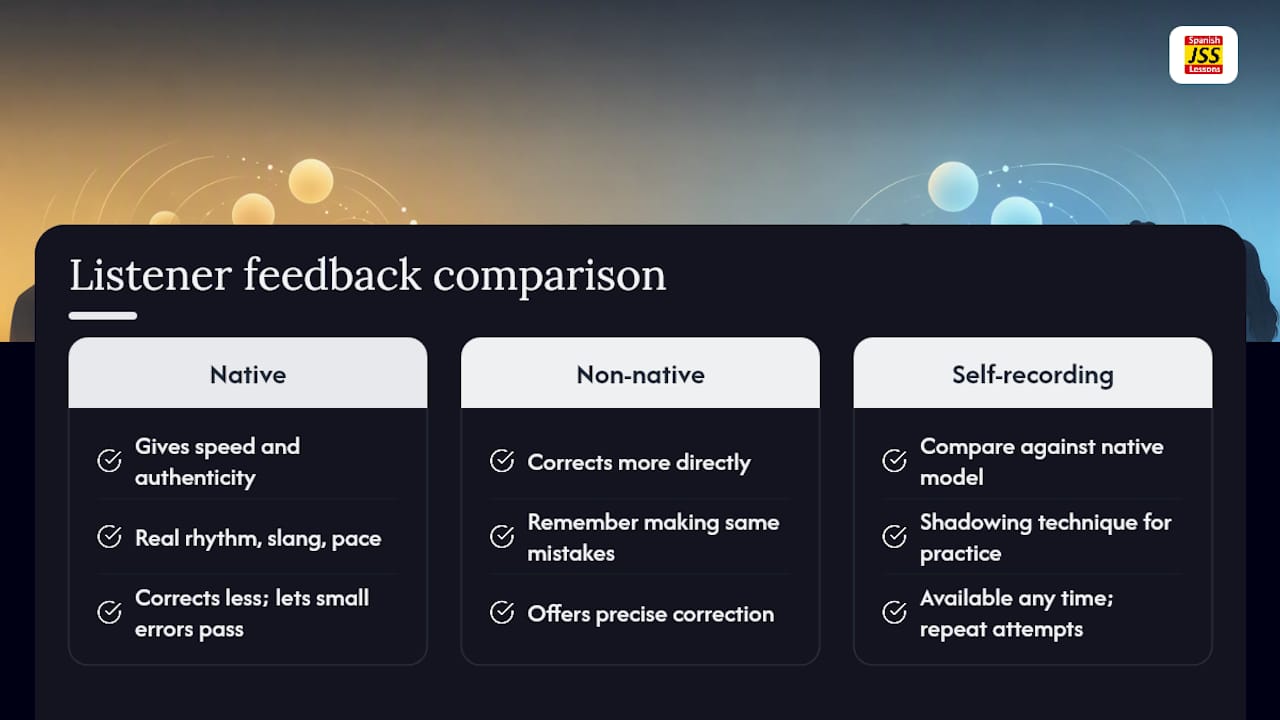
Native speakers give you speed and authenticity: real rhythm, real slang, real pace. But they also correct less than you’d think, often letting small errors pass to keep the conversation moving, which means you can speak with a native for months and never learn that a particular phrase sounds slightly off.
Non‑native listeners, fellow learners, tutors, or a patient partner, tend to correct more directly because they remember making the same mistake themselves. A mixed diet of both is more useful than either alone: native speakers for pace and natural phrasing, non‑native feedback for precise correction. Recording yourself and comparing it against a native model, the shadowing technique mentioned earlier, gives you a third source of feedback that’s available any time, with no one to disappoint if it takes several attempts.
Common cognitive patterns that keep the block in place
A handful of thinking habits quietly keep the block alive long after the original nerves have faded. Catastrophising is the most common: treating one mispronounced word as evidence the whole conversation will collapse, which raises anxiety before you’ve even opened your mouth. Mind‑reading follows closely behind, assuming the listener is judging your accent when they’re almost certainly just waiting for you to finish your sentence.
Then there’s the memorised‑script trap: rehearsing long, perfect answers in advance, which shatters the moment the real conversation veers off script, since exam‑style coaching consistently warns against relying on memorised responses instead of natural, flexible phrasing. Avoidance rounds out the pattern, dodging Spanish‑speaking situations altogether, which feels like relief in the moment but actually starves your speaking practice of the repetition it needs to improve. Deliberately pushing yourself to speak before you feel fully ready, accepting the discomfort of an imperfect sentence, is what breaks each of these patterns; the errors that follow are exactly how you discover which pieces are still missing.
A concise option: organised practice with James Spanish School
Everything above works best inside a structure, and that’s what James Spanish School was built around. The course runs 100 lessons split between sentence‑building and ear‑tuning, the same two skills behind the weekly practice plan earlier in this article, so you’re never guessing what to practise next.
The WordAmigo System handles the vocabulary and pronunciation side, cycling new words through reading, listening, speaking and writing so they stay retrievable under pressure rather than fading after a single lesson. Everything runs on demand, so a session that fits into a coffee break works just as well as a longer weekend one, and lessons can be repeated as often as needed with no expiry date pushing you along. If you’re ready to turn the breathing routines and graded exposure plan above into a structured weekly habit, browse the current courses and pick the format that matches where you’re starting from.
Sources
- Miedo
- How to be a confident speaker | LearnEnglish — British Council
- Ansiedad comunicativa — Logopeda Jessica
- Por qué entiendes español pero te quedas en blanco al hablar — LaPrensa360
FAQ
What Causes a Sudden Block When Speaking Spanish?
Adrenaline triggers a freeze response that tightens breathing and muscle control, often worsened by fear of making mistakes and past embarrassing moments. It’s a physiological reaction, not a knowledge gap, as explained in analysis of why comprehension and speech diverge.
How Do I Stop Freezing Mid‑Sentence In Spanish?
Breathe slowly (seven seconds in, eleven out) and use a short survival phrase like “a ver” while you find your words. Structured breathing paired with regular exposure practice shows response rates exceeding 70% for reducing this kind of block.
Is Bloqueo Al Hablar Español Common Among Learners Who Understand Spanish Well?
Yes. Many learners follow conversations, television and reading with ease yet blank the moment they need to speak, because production carries more perceived risk than comprehension for the brain.
Does James Spanish School Help With Speaking Anxiety Specifically?
The course structures practice around sentence‑building and ear‑tuning, the two skills that reduce hesitation under pressure, alongside the WordAmigo System for vocabulary retention. Current course details and pricing are listed on the James Spanish School shop.
When Should I See a Speech Therapist Instead of Just Practising More?
Seek a logopeda or psychologist if you experience panic attacks before speaking, worsening avoidance of Spanish altogether, or a block that isn’t easing after weeks of regular practice. Communication anxiety can alter breathing and articulation in ways that targeted logopaedic treatment is specifically designed to address.