James Spanish School

Categories
Insights

How to adapt to spanish culture: a practical guide


TL;DR:

  • Adapting to Spanish culture involves adjusting your daily routines, social behaviors, and communication styles.
  • Understanding local schedules, greetings, and customs helps foreigners integrate smoothly into Spanish life.

Cultural adaptation in Spain is the process of reshaping your daily habits, social expectations, and communication style to match the rhythms of Spanish life. For English speakers living in Spain, this means more than learning the language. It means understanding when to eat, how to greet people, when to linger, and when to leave. The gap between knowing Spain exists and actually fitting into it is bridged by specific, learnable behaviours. This guide covers exactly how to adapt to Spanish culture, from meal timing and greetings to tipping and regional identity, so you can move through daily life with confidence rather than confusion.

How to adapt to spanish culture through daily rhythms

The single biggest adjustment for English speakers in Spain is the clock. Spanish daily schedules run significantly later than in the UK or the US. Lunch falls between 14:00 and 15:30, a light afternoon snack called merienda happens between 17:30 and 19:00, and dinner rarely starts before 21:00. Arriving at a restaurant at 19:00 expecting dinner will often earn you a near-empty room and a puzzled look from the waiter.

Infographic illustrating Spanish daily schedule and rhythms

Adjusting your internal clock is not optional if you want to feel part of daily life. Shops close for a midday break in many towns, social plans are made for times that feel late by British standards, and the streets genuinely come alive after 20:00. Fighting this schedule creates constant friction. Accepting it removes most of it.

The concept of sobremesa sits at the heart of Spanish social timing. Sobremesa is the tradition of staying at the table after a meal, talking, laughing, and simply being present together. It can last twenty minutes or two hours. Leaving immediately after eating is considered abrupt and a little rude. Staying at the table is not wasting time in Spain. It is the point of the meal.

One more nuance worth knowing: punctuality in Spain operates on two tracks. Professional and institutional settings expect you on time. A doctor’s appointment, a bank meeting, or a work call runs to schedule. Social occasions are far more relaxed. Turning up thirty minutes after the agreed time for a dinner party is entirely normal.

Pro Tip: Keep two mental clocks. One for work and official appointments, where punctuality matters. One for social life, where flexibility is the norm and arriving early can actually catch your host off guard.

Here is a quick reference for the Spanish daily schedule:

  • 08:00–09:00: Breakfast, usually light (coffee and toast)
  • 11:00–12:00: Mid-morning coffee break, common in workplaces
  • 14:00–15:30: Main meal of the day, often with family
  • 17:30–19:00: Merienda, a light snack or coffee
  • 21:00 onwards: Dinner, often the social highlight of the evening

How do spanish greetings actually work?

Spanish greetings follow clear rules once you know them, but they can feel confusing at first. Among friends and family, the standard greeting is two cheek kisses, starting with the right cheek. This applies between women and between men and women. Two men typically shake hands, though close male friends may embrace. In professional settings, a firm handshake is the norm for both genders.

Physical proximity in Spanish social interaction is closer than most British people expect. Standing at arm’s length can read as cold or disinterested. Expressive gesturing is common and is not a sign of argument or aggression. It is simply how conversation flows. Reading this correctly takes a few weeks, but it becomes natural quickly.

Here are the key points for getting greetings right:

  • Follow the local lead. If someone leans in for two kisses, reciprocate. Do not pull back or offer a hand instead unless you are in a clearly formal context.
  • Say hello to everyone in a room. Entering a bar, a small shop, or a gathering without greeting the people present is considered impolite. A simple buenos días or buenas tardes covers it.
  • Do not overthink the cheek kiss. It is a social ritual, not an intimate gesture. Hesitating awkwardly causes more discomfort than just doing it.
  • Adapt to regional norms. In some parts of Spain, particularly in Catalonia, a single kiss or a handshake is more common. Observe what locals do and mirror it.

Understanding Spanish customs around personal space and physical expressiveness is one of the fastest ways to signal that you are making a genuine effort to fit in. Locals notice, and they appreciate it.

What are the rules for dining and tipping in spain?

Spanish dining culture is built around time and connection, not efficiency. The main meal of the day is lunch, not dinner, and it is treated seriously. A proper lunch can run to two hours with multiple courses. Dinner is lighter and later. Trying to rush either meal will make you stand out immediately.

Sobremesa applies at lunch just as much as at dinner. Post-meal conversation is integral to daily Spanish social life, not a bonus. Scholars and cultural commentators have described sobremesa as a deliberate resistance to industrial-pace living, a way of prioritising human connection over productivity. That framing helps explain why Spaniards genuinely do not understand the British habit of eating quickly and leaving.

Here is how to handle the practical side of dining:

  1. Order at the pace of the table. Do not rush to order or signal for the bill while others are still eating or talking.
  2. Ask for the bill when you are ready. Waiters in Spain do not bring the bill unsolicited. This is a courtesy, not inattention.
  3. Tip modestly and in cash. Tipping in Spain is optional. Staff receive a proper wage, so tips are a gesture of appreciation rather than a financial necessity. A tip of €1–€5 is common for a good meal.
  4. Do not tip for basic service. Many locals do not tip for a coffee, a glass of wine, or a taxi ride. Doing so is not wrong, but it marks you as a tourist.
  5. Stay and enjoy the moment. Leaving immediately after paying is the one behaviour most likely to make a Spanish host feel you did not enjoy yourself.

Pro Tip: If you are dining with Spanish friends, let them set the pace entirely. Watch when they signal for the bill and follow their lead on tipping. You will learn the local standard faster than any written guide can teach you.

Situation Tipping Expectation
Coffee or quick drink No tip expected
Casual lunch or dinner Round up or leave €1–€2
Good restaurant meal €2–€5 in cash
Exceptional service More at your discretion
Taxi ride No tip expected

Practical behavioural tips for fitting into everyday life

Language is the most direct route into Spanish culture, but behaviour matters just as much. A few specific habits will mark you as someone who respects local norms rather than someone who is simply passing through.

Group greeting with cheek kisses outdoors

Queuing in Spain deserves its own mention. Queues in informal settings like bakeries, delis, and market stalls can look chaotic. The phrase ¿Quién es el último? (“Who is last?”) is the standard way to establish your place in line without confusion or confrontation. Ask it when you arrive, and the person who answers becomes your reference point. It is a small phrase with a big social function.

Regional identity in Spain is not a minor detail. Catalonia, the Basque Country, and Galicia each have their own languages and strong cultural identities. Referring to Catalan or Basque people simply as “Spanish” can cause genuine offence. Showing awareness of these distinctions, even just by acknowledging them, earns real respect. If you are living in Barcelona, learning a few words of Catalan alongside Spanish signals serious commitment to local life.

Dress codes in Spain are more formal than many British expats expect. Spaniards generally dress well for social occasions, even casual ones. Turning up to a Sunday lunch or a local fiesta in shorts and a T-shirt when everyone else is smartly dressed is an easy mistake to avoid.

Setting Expected Dress Code
Everyday errands Smart casual
Restaurant lunch or dinner Neat and presentable
Church or formal event Formal attire
Beach or pool Beachwear stays at the beach
Local fiesta Smart casual to formal

Building genuine rapport with Spanish neighbours, shopkeepers, and colleagues comes down to cultural respect and curiosity. Ask about local traditions. Comment on the food. Show that you are interested in Spain as it actually is, not as a backdrop to your expat life. That curiosity is the single most effective social tool you have.

Key takeaways

Adapting to Spanish culture requires adjusting your daily schedule, social behaviour, and communication style to match local norms rather than importing your home habits.

Point Details
Reset your daily clock Lunch runs 14:00–15:30 and dinner starts at 21:00 or later.
Embrace sobremesa Staying at the table after meals builds trust and social bonds.
Master the greeting Two cheek kisses for friends, handshakes in professional settings.
Tip modestly and in cash Tips of €1–€5 are a gesture, not an obligation.
Learn key social phrases ¿Quién es el último? and a basic greeting go a long way in daily life.

Forty years in: what I have actually learnt


The dual timing system is the thing most newcomers get wrong for the longest. They learn that social life runs late, but they do not internalise that professional Spain is completely different. Miss a medical appointment by twenty minutes and you will feel the difference sharply.

What genuinely accelerated my integration was learning Spanish properly, not tourist phrases but real conversational Spanish. The moment you can hold a proper exchange with a neighbour or a shopkeeper, the relationship changes. You stop being the foreigner who lives nearby and start being a person they know. That shift is worth every hour of study.

The cultural nuances in Spanish go deeper than most guides suggest. Spain is not one culture. It is a collection of strong regional identities held together by shared habits. Respect that complexity and people will respect you back.

My honest advice: stop trying to maintain your home routines inside a Spanish life. Eat when Spain eats. Stay when Spain stays. Greet people the way they greet each other. The adaptation is not a loss of who you are. It is an addition.

— James

Learn spanish the way it is actually spoken in spain

If you are living in Spain and want to move beyond basic phrases, James Spanish School offers a 100-lesson online course built specifically for English-speaking adults. James Bretherton, a dual-native speaker with four decades of life in Spain, designed the course around real conversations: with neighbours, tradespeople, health workers, and local officials.

https://jamesspanishschool.com

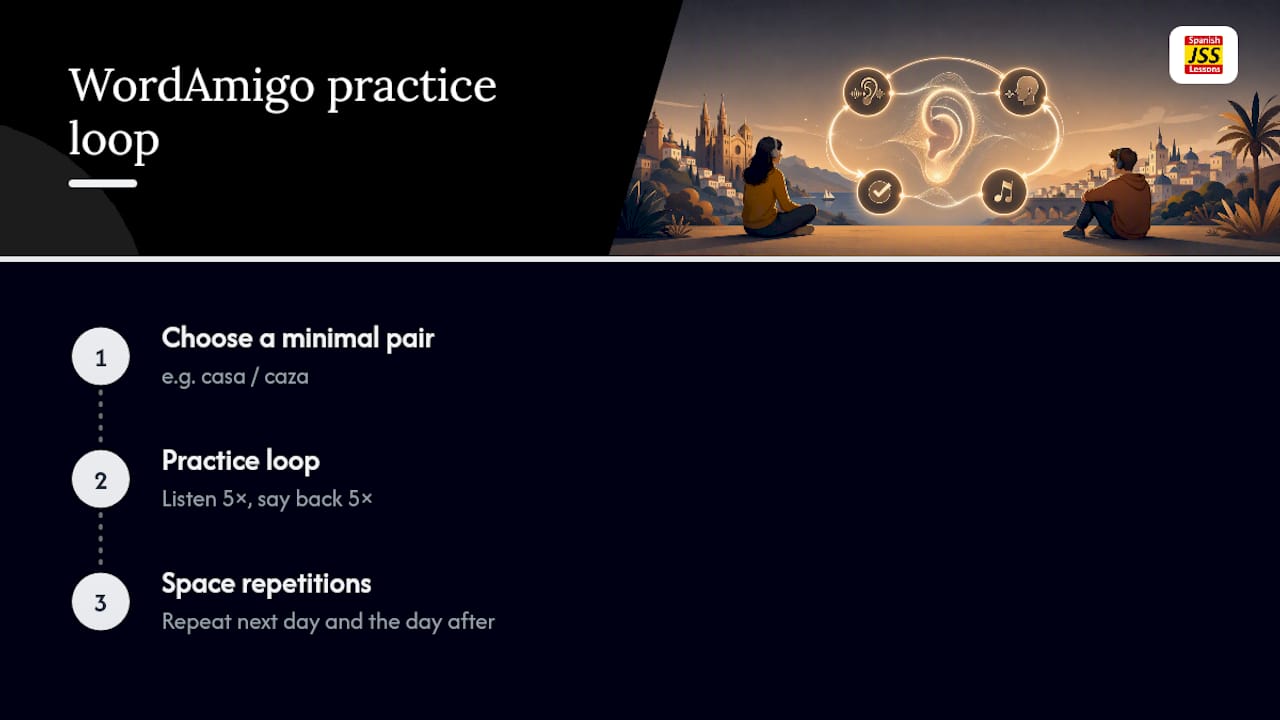
The WordAmigo system handles vocabulary and pronunciation through a five-step retention loop, so words actually stay in memory rather than fading after a week. Everything is on demand, with no expiry date and no pressure. You can explore the full course options here or check out the current special offers for new starters. Real fluency starts with real Spanish, not classroom grammar.

FAQ

What is the biggest cultural difference for english speakers in spain?

The daily schedule is the most disorienting adjustment. Lunch at 14:00–15:30 and dinner after 21:00 are standard, which conflicts sharply with British eating habits.

Is tipping expected in spanish restaurants?

Tipping in Spain is optional. Staff receive a proper wage, so a small cash tip of €1–€5 is a gesture of appreciation rather than a social obligation.

What does sobremesa mean and why does it matter?

Sobremesa is the Spanish tradition of lingering at the table after a meal for conversation. Leaving immediately after eating is considered abrupt, and staying builds social trust.

How should i greet people in spain?

Two cheek kisses are standard among friends and mixed-gender social groups. A handshake is appropriate in professional settings. Always greet everyone present when entering a room.

Do I need to learn spanish to adapt to life in spain?

Language is not strictly required for survival, but it transforms your experience. Speaking even basic Spanish shifts how locals relate to you and opens doors that polite gestures alone cannot.

Categories
Insights

Comprehensive spanish guide for english speakers in spain


What is comprehensive Spanish guide


TL;DR:

  • A comprehensive Spanish guide combines grammar, vocabulary, culture, and conversation into a structured learning system for adult learners. It emphasizes active noticing, contextual vocabulary, and daily practice to develop fluency effectively in European Spanish. Immersion, cultural understanding, and tailored methods are essential for success beyond passive study or generic language apps.

A comprehensive Spanish guide is an all-encompassing resource that combines proven language acquisition methods, cultural immersion strategies, and vocabulary retention systems to help adult learners achieve real fluency in European Spanish. The standard industry term for this type of resource is a structured language learning programme, and the best versions go far beyond grammar tables. They integrate listening, speaking, reading, and cultural understanding into a single, coherent system. Tools like Anki, platforms like Jamesspanishschool, and publishers such as Cambridge University Press each represent a piece of this puzzle. This article explains what a complete Spanish learning resource looks like, which methods actually work, and how to put it all together.

What is a comprehensive spanish guide and why does it matter?

A comprehensive guide to Spanish is defined by what it combines, not what it contains in isolation. Grammar alone does not produce fluency. Vocabulary lists alone do not produce conversation. The most effective Spanish study guide brings together sentence structure, pronunciation, cultural context, and memory retention into one coherent learning path.

For English speakers moving to or living in Spain, this distinction is critical. European Spanish, specifically Castilian Spanish as spoken across mainland Spain, carries regional vocabulary, distinct pronunciation patterns, and social norms that a generic Latin American course will not address. The word vosotros, for example, is used constantly in Spain but absent from most apps built for a global audience.

James Spanish School was built specifically around this gap. Founded by James Bretherton, a dual-native speaker with 40 years of living in Spain, the school’s 100-lesson course focuses on real-life conversations with neighbours, tradesmen, health workers, and local officials. That specificity is what separates a genuine Spanish language guide for beginners from a generic language app.

What are the most effective methods for learning european spanish?

Immersion paired with structured vocabulary systems accelerates fluency faster than either approach alone. That finding, drawn from research by Spanish Hackers in 2024, confirms what experienced teachers have observed for decades. High-volume comprehensible input, meaning Spanish you can mostly understand, trains your ear. Active recall, meaning retrieving words and structures from memory, locks them in.

Language learner practicing Spanish conversation outdoors

Adult learners face one specific barrier that children do not. Subconscious absorption, the way children pick up language through play and repetition, is insufficient for adults. Adults must use ‘Noticing’, which means consciously directing attention to specific language patterns during exposure. When you hear a native speaker use the subjunctive, you need to register it deliberately, not just let it wash over you.

Vocabulary: context beats cramming every time

Contextual vocabulary cards using full sentences are significantly more effective than simple word-to-word flashcards. A card that shows “Voy al médico mañana” (I am going to the doctor tomorrow) builds a mental template for real speech. A card that shows only médico = doctor does not. This exemplar-based approach is the engine room of natural speech production.

Infographic outlining effective Spanish learning steps

Tools like Anki and StudyCards AI both support sentence-level flashcards with spaced repetition. Jamesspanishschool’s WordAmigo system takes this further by automating a five-step retention loop across reading, listening, speaking, and writing. WordAmigo was built by IT experts and long-term English expats in Spain, specifically to solve the two most common frustrations: words that will not stay in memory and pronunciation that native speakers struggle to follow.

Pro Tip: Use bilingual reading, alternating between a Spanish paragraph and its English translation, to build comprehension without a dictionary. This technique accelerates reading speed and trains your brain to process Spanish in chunks rather than word by word.

Pro Tip: Build contextual vocabulary cards around situations you will actually face: at the pharmacy, at the town hall, with a builder. Generic word lists waste study time. Situation-specific cards build the vocabulary you need on day one in Spain.

Spanish also rewards learners who notice word families and prefixes for faster vocabulary growth. Recognising that -ción endings often correspond to English -tion words (nación, situación, conversación) can unlock hundreds of words in a single afternoon.

How does cultural immersion enhance a spanish learning programme?

Immersion is the fastest path to fluency when combined with structured vocabulary study. Living in Spain gives you constant exposure to real speech at natural speed. The challenge is that without a structured framework, that exposure becomes noise rather than input.

Cultural understanding affects tone, formality, and word choice in ways that grammar books rarely address. In Spain, the informal form is used far more widely than in Latin America. Spaniards address shop staff, doctors, and even strangers with in most regions. Using usted with a young shopkeeper in Madrid can sound oddly formal. These are the kinds of details that a genuine Spanish language guide for beginners must include.

Practical immersion strategies that work alongside structured study include:

  • Listening to Spanish radio stations such as Cadena SER or RNE during daily tasks
  • Watching Spanish television series with Spanish subtitles, not English ones
  • Joining local social groups, sports clubs, or community events where Spanish is the only shared language
  • Scheduling one or two weekly conversation sessions with a native speaker, either locally or via an online platform

James Spanish School addresses this directly. James Bretherton shares insider cultural tips throughout the course, from the unwritten rules of queuing at the panadería to the builder’s mid-morning breakfast break, which is a genuine social institution in Spain. These details matter because they determine whether your Spanish sounds natural or merely correct.

Cultural awareness is as important as grammar for effective communication in Spain. A learner who knows every verb conjugation but does not understand regional vocabulary or social register will still struggle in real conversation.

How does a comprehensive guide differ from typical apps or textbooks?

Most language apps and textbooks address one or two dimensions of learning. A complete Spanish learning resource addresses all of them together. The table below shows the key differences.

Feature Typical App or Textbook Comprehensive Spanish Guide
Grammar coverage Rules and tables Rules explained through real examples
Vocabulary method Word lists or translation drills Contextual sentences with spaced repetition
Pronunciation Minimal or text-based Audio modelling with active practice
Cultural context Absent or superficial Integrated throughout every lesson
Progression path A1 to A2 focus A1 through to B1 and beyond
Adult-specific design Rarely considered Built around adult learning barriers

The pure grammar approach produces learners who can pass written tests but freeze in conversation. Fluency depends on combining structured learning with conversational practice, immersive input, and consistency. No single app delivers all three. A blended approach using structured lessons, audio practice, and live conversation is the only reliable route to B1 level and beyond.

Adults often struggle without tailored strategies that integrate Noticing and meaningful practice. This is precisely why Jamesspanishschool uses what James calls Radical Simplification: removing grammar terminology that native speakers never use, and replacing it with plain English explanations of how Spanish structure actually works. The result is a course that feels logical rather than academic.

What daily routines make a spanish study plan actually work?

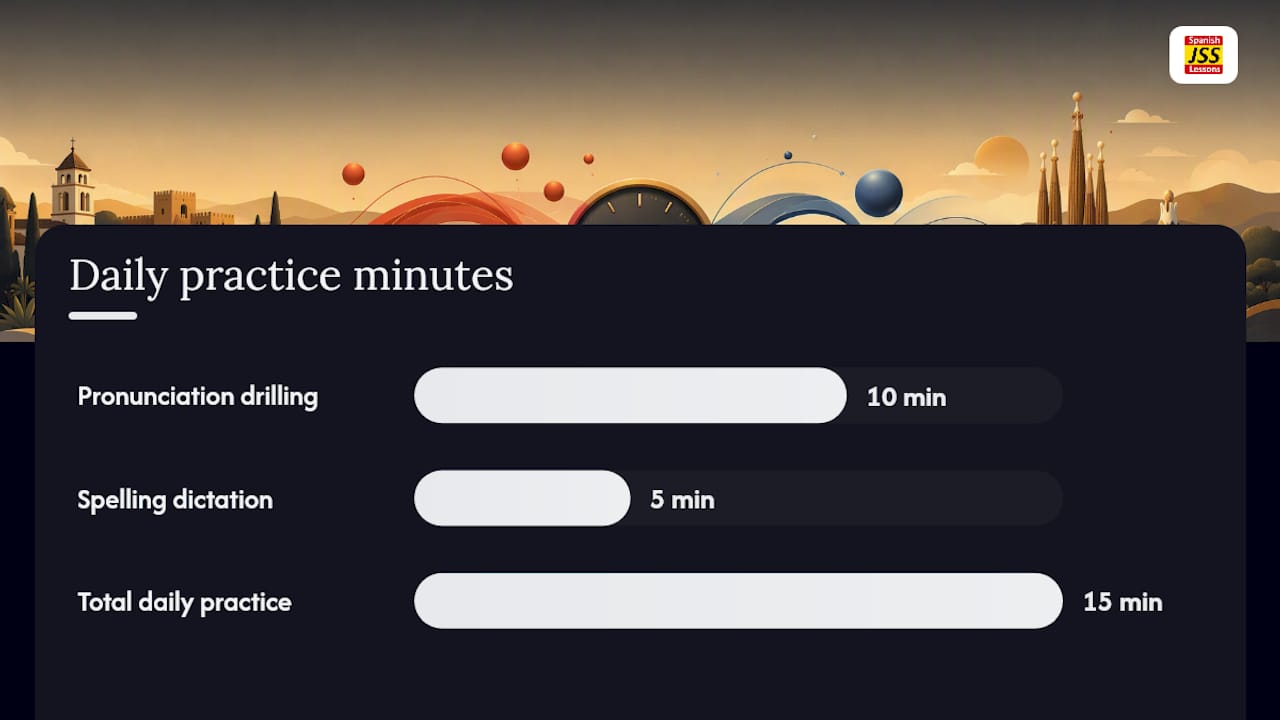
Daily 20–30 minute sessions are more effective than occasional long sessions for retention. Spaced repetition improves retention by up to 200% compared to massed practice. That means 25 minutes every day outperforms three hours on a Sunday afternoon, every time.

A practical daily routine for an English speaker learning European Spanish looks like this:

  1. Morning (10 minutes): Review vocabulary cards in Anki or WordAmigo. Focus on cards due for repetition, not new words.
  2. Midday (10 minutes): Listen to a short Spanish podcast or radio clip. Apply Noticing: identify one grammatical pattern or phrase you have not heard before.
  3. Evening (10–15 minutes): Complete one structured lesson from your course. Jamesspanishschool’s on-demand format means you can do this on your phone, tablet, or laptop at any time.
  4. Weekly (30–45 minutes): One live or online conversation session with a native speaker. Consistent conversation practice solidifies active language use in a way that solo study cannot replicate.

This routine integrates the three pillars of effective learning: structured input, vocabulary retention, and active output. None of the three works well in isolation.

Pro Tip: Avoid isolated grammar drills as your primary study method. Grammar is the skeleton of language, but you build fluency by practising whole sentences in real contexts. Drill a sentence pattern, not a conjugation table.

Organising vocabulary by use and word families accelerates speaking power. Group your new words by situation: health, shopping, home repairs, local government. You will use those clusters far sooner than a random alphabetical list.

Key takeaways

A comprehensive Spanish guide works because it combines structured input, contextual vocabulary, cultural immersion, and consistent daily practice into a single, coherent system.

Point Details
Definition matters A comprehensive guide integrates grammar, vocabulary, pronunciation, and culture, not just one element.
Noticing accelerates adult learning Consciously directing attention to language patterns during immersion is essential for adult learners.
Context beats cramming Sentence-level vocabulary cards with spaced repetition outperform word-to-word flashcards every time.
Culture is not optional Understanding Spanish social norms and regional vocabulary is as important as grammar for real fluency.
Daily consistency wins Short daily sessions of 20–30 minutes produce significantly better retention than occasional long study blocks.

What I have learnt after 40 years of living in spain

After four decades in Spain, I can tell you with confidence that the biggest mistake adult learners make is treating Spanish as a subject to study rather than a skill to practise. Grammar books give you the rules. Living in Spain gives you the pressure to use them. The combination is where real fluency happens.

The concept of Noticing changed how I think about teaching. When I first arrived in Spain, I absorbed the language through sheer immersion. But I was young, and I had time. Adult learners in their 40s, 50s, and 60s do not have the luxury of passive absorption. They need a system that makes every hour of exposure count. That is why I built the WordAmigo system the way I did, with a deliberate five-step loop that forces active engagement rather than passive listening.

I also want to be honest about cultural fluency. You can have perfect grammar and still offend a Spanish builder by not offering him a coffee at 10 in the morning. You can know every verb tense and still confuse a pharmacist because you used a Latin American term for a common medicine. These are not small details. They are the difference between being understood and being truly accepted. If you want to succeed with Spanish as an adult, you need a guide that takes culture as seriously as conjugation.

My honest view is that most complete Spanish learning resources underestimate adult learners. Adults are not slower than children. They are different. They bring life experience, strong motivation, and the ability to understand abstract patterns. The right method uses those strengths rather than fighting them.

— James

How James Spanish School supports your Spanish learning journey

James Spanish School offers a structured, on-demand course built specifically for English-speaking adults who want to speak real European Spanish, not pass an exam. The 100-lesson programme covers sentence construction and ear-tuning in equal measure, so you can both build sentences and follow native speakers at full speed.

https://jamesspanishschool.com

The WordAmigo system sits at the heart of the vocabulary and pronunciation work, using AI-powered spaced repetition to permanently embed the words you need for daily life in Spain. Every lesson is available 24/7 with no expiry date and no countdown pressure. You can explore the full range of online Spanish lessons or browse the complete course catalogue at the JSS course shop. If you are ready to start, the resources are there whenever you are.

FAQ

What is a comprehensive spanish guide?

A comprehensive Spanish guide is a structured learning resource that combines grammar, vocabulary, pronunciation, cultural context, and conversation practice into a single programme. The best versions are designed specifically for the learner’s target region, such as European Spanish for those living in or moving to Spain.

How long does it take to reach conversational fluency in spanish?

With consistent daily study of 20–30 minutes combined with regular conversation practice and immersion, most adult learners reach conversational level within 12–18 months. Progress depends heavily on consistency and the quality of the methods used.

Is european spanish very different from latin american spanish?

European Spanish uses distinct vocabulary, the vosotros verb form, and different pronunciation patterns, particularly the Castilian th sound for c and z. For learners living in Spain, a course focused on European Spanish is significantly more practical than a generic global course.

Why do adults struggle more with spanish than children?

Adults require explicit attention to language forms alongside immersive experience because subconscious absorption alone is insufficient after childhood. The solution is structured Noticing combined with contextual vocabulary practice, which is precisely what tailored adult language courses are designed to deliver.

What is the WordAmigo system?

WordAmigo is an AI-powered vocabulary and pronunciation retention system developed by James Spanish School. It uses a five-step exposure loop across reading, listening, speaking, and writing to permanently embed vocabulary, solving the two most common adult learner frustrations: forgetting words and mispronouncing them.

Categories
Insights

The role of accent in spanish: a learner’s guide


TL;DR:

  • Accent marks in Spanish indicate stress patterns and clarify word meanings by distinguishing homographs. Learning the three default stress rules and practicing with native pronunciation tools helps learners master proper accent placement and improve communication confidence. Correct use of accents signals proficiency and respect for the language, especially in formal settings.

Spanish accent marks are defined as written symbols that indicate which syllable to stress and, in many cases, change a word’s meaning entirely. The role of accent in Spanish goes far beyond decoration. These small marks, called tildes, are a built-in pronunciation guide that makes the language more predictable than English. The Real Academia Española, Spain’s official language authority, governs their use through clear, learnable rules. For English speakers moving to Spain or building everyday fluency, understanding how tildes work is one of the fastest ways to sound clearer and be understood with confidence.

How do spanish accent marks guide correct pronunciation?

Spanish stress follows three default rules based on how a word ends. Once you know these rules, you can pronounce almost any word you see for the first time. A tilde appears only when a word breaks the default pattern, signalling exactly where to place the stress.

The three stress rules per the Real Academia Española work as follows:

  • Words ending in a vowel, n, or s are stressed on the penultimate (second-to-last) syllable. Example: hablan (HAB-lan).
  • Words ending in any other consonant are stressed on the last syllable. Example: hablar (ha-BLAR).
  • Any word that breaks either rule carries a written accent mark to show the true stress. Example: café (ca-FÉ), música (MÚ-si-ca).

Spanish grammarians group words into three stress categories. Palabras agudas carry stress on the final syllable. Palabras llanas carry stress on the penultimate syllable. Palabras esdrújulas carry stress on the third-to-last syllable and always take a written accent mark without exception.

Compare this to English, where stress is largely unpredictable. Consider photograph, photography, and photographic: the stress shifts with no written signal at all. Spanish removes that guesswork entirely. Spanish phonology is built on just five pure vowel sounds, compared to the 12–14 vowel sounds found in many English dialects. That consistency means once you grasp the stress rules, the written language becomes a reliable pronunciation map.

Close-up learner writing Spanish accent marks

Word Type Stress Position Accent Mark? Example
Aguda Final syllable Only if ending in vowel, n, or s café
Llana Penultimate syllable Only if NOT ending in vowel, n, or s árbol
Esdrújula Third-to-last syllable Always música

Infographic illustrating Spanish accent rule categories

Pro Tip: When you encounter a new Spanish word, check the final letter first. That single habit tells you where the stress falls in the majority of cases, before you even look for a tilde.

How do accents affect meaning in spanish?

Accent marks in Spanish do not just guide pronunciation. They distinguish homographs where context alone would fail. Two words can share identical spelling yet carry entirely different meanings depending on the presence or absence of a tilde.

The most common meaning-changing pairs include:

  • (yes) vs. si (if)
  • (you) vs. tu (your)
  • él (he) vs. el (the)
  • más (more) vs. mas (but, archaic)
  • papá (dad) vs. papa (potato or Pope)
  • (tea) vs. te (you, object pronoun)

Question words in Spanish always carry an accent mark when used in direct or indirect questions. ¿Qué? (what), ¿cómo? (how), ¿dónde? (where), and ¿cuándo? (when) all take tildes in interrogative and exclamative contexts. Accents guide intonation and sentence function in both speech and writing, signalling to the reader whether a sentence is a statement or a question even before reaching the punctuation mark.

The practical impact on comprehension is significant. A Spanish speaker reading “¿Donde esta tu papa?” without accents must rely entirely on context to determine whether you are asking about someone’s father or their potato. In fast spoken Spanish, that ambiguity can cause real confusion. Correct accent use removes the guesswork from both reading and listening.

Pro Tip: Practise writing the six most common minimal pairs every day for one week. The muscle memory of typing or writing the accented version will make correct usage automatic far sooner than studying rules alone.

Why does correct accent use signal learner proficiency?

Accurate use of written accents ranks among the top three indicators that native Spanish speakers use to judge a learner’s proficiency. This finding, confirmed in a 2019 study published in the Journal of Spanish Language Teaching, means that getting accents right is not a minor detail. It is a visible marker of how seriously you have engaged with the language.

The comparison to English is instructive. Confusing their, there, and they’re in a professional email signals carelessness or poor education to a native English reader. Omitting accents in formal writing carries the same weight in Spanish. Native speakers in Spain expect correct tildes in academic texts, business correspondence, and official documents. Missing them reads as a significant error, not a minor slip.

“Correctly using accents in formal communication impacts native-speaking perceptions greatly, associating proper use with education and professionalism.” — Spanish Accent Marks Explained: Complete Guide to Tildes

This matters practically for English expats in Spain. Whether you are writing to a local council, a health centre, or a school, correct accent use signals that you respect the language and have made a genuine effort to learn it. That perception opens doors. Native speakers become more patient, more willing to engage, and more likely to treat you as a capable communicator rather than a tourist.

Understanding the distinction between the written accent mark and phonological stress also helps. The written mark and phonological stress are technically separate concepts. The mark on the page is the acento; the emphasis in speech is the estrés. Conflating the two is a common learner error that can muddle both pronunciation practice and writing habits.

What practical strategies help english speakers master spanish accentuation?

Mastering Spanish accentuation patterns requires both written practice and active listening. Theory alone will not embed the rules. The following strategies build the habit quickly and effectively.

  1. Learn the three stress rules first. Before memorising any exceptions, drill the default rules until they are automatic. Write ten new words each day, identify their word type (aguda, llana, or esdrújula), and predict the stress before checking. This trains pattern recognition rather than rote memorisation.
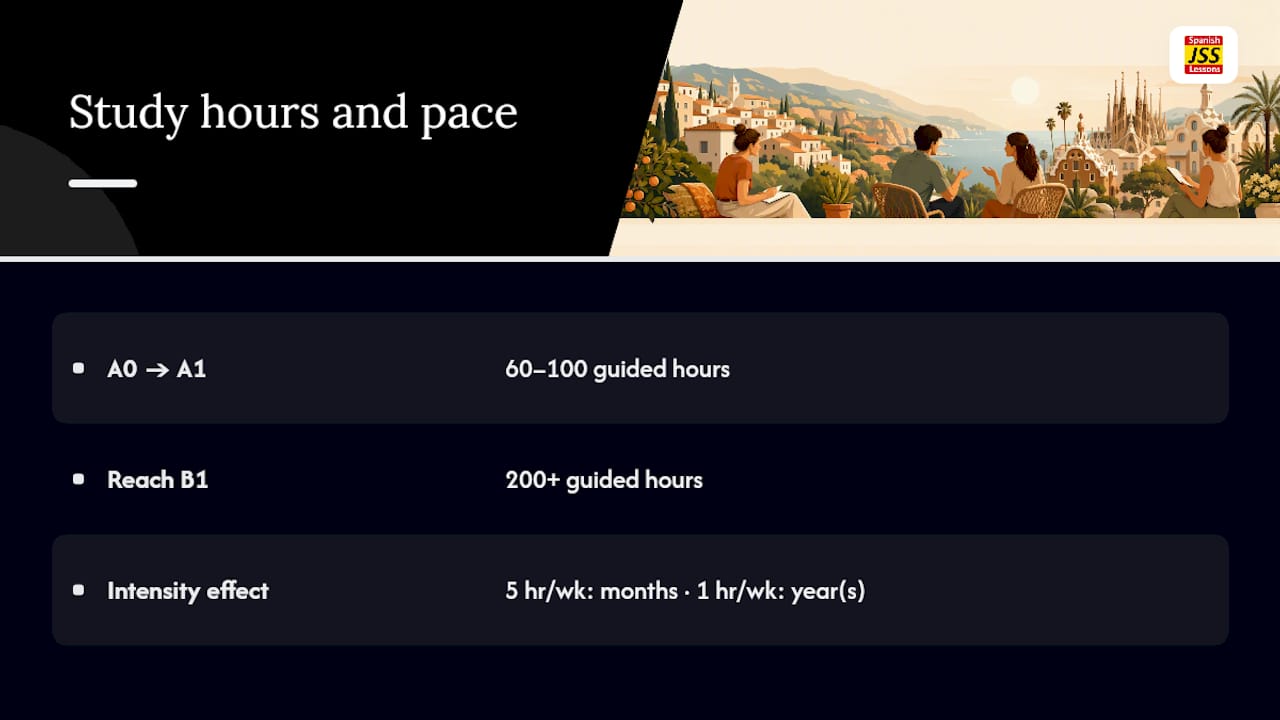
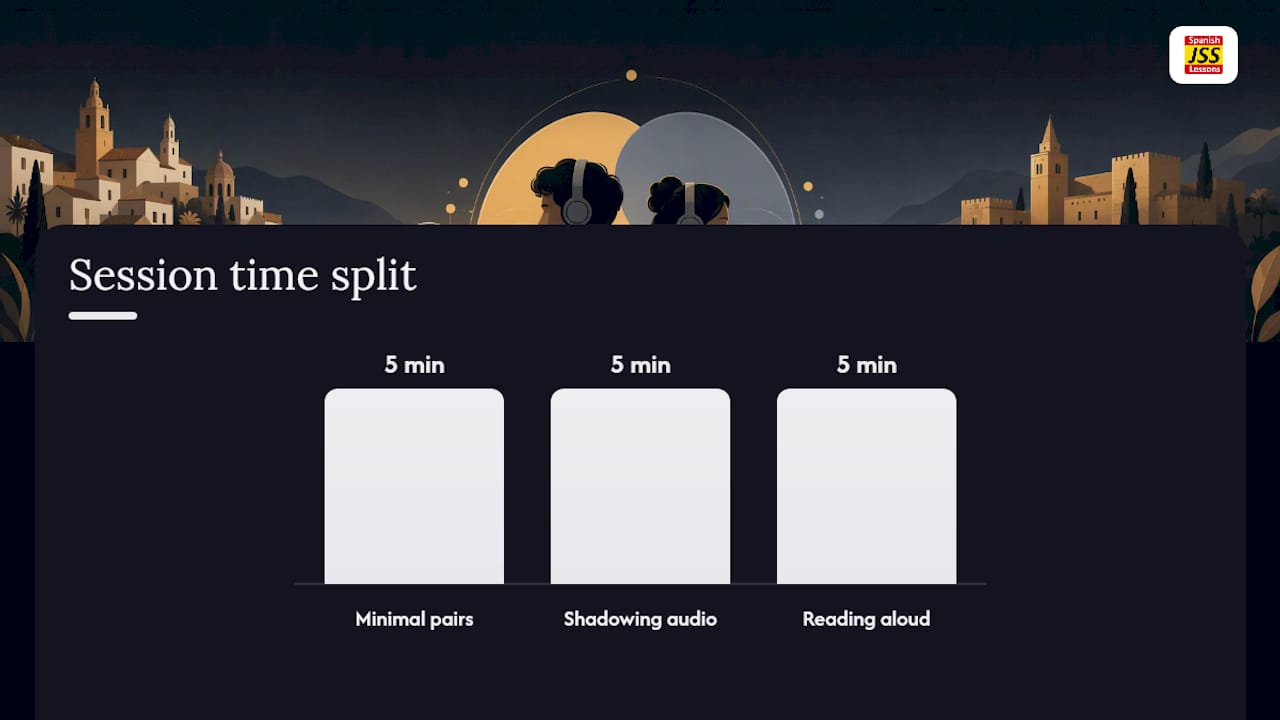
  2. Use shadowing for pronunciation. Shadowing native audio means repeating what you hear immediately after a native speaker, matching rhythm, stress, and intonation. Experts highlight that just five minutes of daily focused shadowing boosts intelligibility noticeably within days. It is the single most effective method for connecting written accent rules to spoken output.
  3. Focus on vowel purity. Spanish vowels do not shift or reduce the way English vowels do. The a in papá sounds the same in every position. Keeping vowels clean and consistent makes stressed syllables stand out naturally, which is exactly what accent marks are signalling on the page.
  4. Practise with ear-tuning exercises. Listening to fast native speech and identifying where stress falls trains your ear to hear accent patterns rather than just individual sounds. Jamesspanishschool builds dedicated ear-tuning lessons into its 100-lesson course precisely because comprehension and pronunciation are two sides of the same coin.
  5. Write, do not just read. Typing or handwriting Spanish forces you to decide whether a word needs an accent mark. Reading passively lets your eye skip over tildes. Writing makes every decision conscious, which accelerates retention.

For a deeper look at how Spanish sentence structure supports correct stress placement, the guide on Spanish structure in English explains the underlying logic in plain terms that English speakers find immediately accessible.

Key takeaways

Accent marks in Spanish are a functional system, not an optional stylistic choice: mastering them improves pronunciation, comprehension, and how native speakers perceive your proficiency.

Point Details
Tildes mark stress exceptions A written accent appears only when a word breaks the default stress rules.
Accents change meaning Pairs like sí/si and tú/tu are distinguished solely by the presence of a tilde.
Proficiency signal Correct accent use ranks in the top three indicators of Spanish learner proficiency.
Formal writing standard Omitting accents in professional or academic texts is treated as a significant error by native speakers.
Shadowing accelerates learning Five minutes of daily shadowing practice improves pronunciation and accent recognition faster than theory alone.

After 40 years in spain, here is what i know about accents

Accents are not decoration. They are the engine of Spanish pronunciation. When you understand the three stress rules and the role of the tilde as an exception marker, the entire written language becomes readable at sight. You stop guessing. That shift happens faster than most learners expect, and it changes everything about how confident you feel speaking.

— James

How Jamesspanishschool helps you master spanish pronunciation

Understanding accent rules in theory is one thing. Hearing them in real spoken Spanish and producing them yourself is another challenge entirely.

https://jamesspanishschool.com

James Spanish School is built around exactly this gap. The 100-lesson course combines sentence-building with dedicated ear-tuning sessions, so you hear how stress and accent marks translate into natural speech at native speed. The JSS Audio Portal gives you on-demand access to pronunciation practice you can repeat as many times as you need, with no countdown clock and no pressure. The WordAmigo system reinforces vocabulary and correct pronunciation simultaneously through strategic repetition, so the right stress patterns become automatic. If you are ready to move from knowing the rules to actually using them, explore the full course materials and see how the method works in practice.

FAQ

What is the role of accent marks in spanish?

Accent marks in Spanish indicate which syllable to stress and distinguish words that share identical spelling but carry different meanings. They function as a built-in pronunciation guide governed by the Real Academia Española.

Do spanish accent marks always change the meaning of a word?

Not always. Sometimes a tilde simply marks an exception to the default stress rules without changing meaning. In other cases, such as versus si or él versus el, the accent mark is the only signal that separates two entirely different words.

Are regional accents in spanish affected by written accent rules?

Written accent rules are consistent across all Spanish-speaking regions and are standardised by the Real Academia Española. Regional accents affect spoken pronunciation and intonation but do not change where tildes are placed in writing.

How quickly can a learner master spanish accentuation patterns?

Most learners grasp the three core stress rules within a few weeks of focused practice. Embedding correct written accent habits takes longer, but daily shadowing practice of just five minutes accelerates both pronunciation and written accuracy significantly.

Is it acceptable to omit accent marks in informal writing?

Native speakers in Spain may omit tildes in casual text messages, but in any formal, professional, or academic context, omitting accent marks is considered a significant error comparable to misusing their and there in English.

Categories
Insights

Immersion in language acquisition: a 2026 guide


TL;DR:

  • Immersion enhances language learning by providing meaningful input and opportunities for active practice, leading to improved fluency. Receptive skills develop faster than speaking, which requires deliberate practice and feedback, especially with European Spanish. Combining immersion with structured grammar instruction yields the best results, even when practicing at home.

Language immersion is defined as the sustained exposure to a target language through meaningful, real-world contexts that require active understanding and response. The role of immersion in language acquisition is central to how adults develop genuine fluency, particularly in European Spanish, where regional accent, rapid speech, and cultural nuance demand far more than textbook study. Research confirms that immersion outperforms traditional classroom methods for overall proficiency, especially in listening comprehension and natural fluency. This guide explains how immersion works, what the evidence shows, and how you can apply it practically.

What is the role of immersion in language acquisition?

Immersion works through a mechanism linguist Stephen Krashen called the Input Hypothesis. The core idea is that learners acquire language when they receive input that is comprehensible but slightly beyond their current level, a concept expressed as “i+1.” This is not the same as simply being surrounded by a language. Immersion without comprehensible input yields little acquisition benefit; context and understanding are what drive progress.

There are two distinct modes of immersion: passive and active. Passive immersion means listening to or reading Spanish without the pressure to respond, such as watching a Spanish television series or listening to a podcast. Active immersion means producing language in real time, through conversation, writing, or structured speaking tasks. Both have value, but active immersion accelerates fluency because it forces the brain to retrieve and apply what it has absorbed.

Meaningful context is the engine room of the whole process. When you hear a Spanish phrase while ordering coffee in Madrid, your brain encodes it differently than when you read it in a grammar table. The emotional and situational context creates stronger memory traces. This is why input that is comprehensible, repeated, and slightly beyond current level across multiple real-world contexts drives genuine acquisition rather than passive exposure.

  • Passive immersion: Listening to Spanish radio, watching films, reading menus or signs
  • Active immersion: Speaking with neighbours, joining conversation groups, writing messages in Spanish
  • Structured immersion: Guided lessons that combine input with explicit feedback on form

Pro Tip: Start with content you already know well in English, such as a familiar film dubbed into Spanish. Familiarity with the plot reduces cognitive load and lets your brain focus on the language itself.

Does immersion outperform traditional classroom learning?

The research evidence is clear and consistent. Immersion learners outperform traditional classroom learners by a moderate margin, with effect sizes in the range of 0.4–0.6 for overall proficiency. That margin is meaningful. An effect size of 0.4 is roughly equivalent to the difference between one year and two years of standard classroom instruction.

The gains are not evenly distributed across all skills, however. Listening and reading improve first and most reliably. Speaking accuracy and grammatical precision lag behind, particularly in the early stages. This is not a flaw in immersion; it reflects how the brain processes language. Receptive skills build the internal model, and productive skills draw on it later.

“Explicit instruction combined with immersion leads to 20–30% higher grammatical accuracy than immersion-only approaches.” This finding matters enormously for adult learners of European Spanish, where grammatical gender, verb conjugation, and subjunctive use are non-negotiable for clear communication.

Skill Area Immersion Advantage Key Limitation
Listening comprehension Strong, develops early Requires quality input sources
Reading fluency Strong, develops early Depends on vocabulary base
Speaking accuracy Moderate, develops slowly Needs explicit grammar support
Grammatical precision Weak without instruction Requires form-focused feedback
Pragmatic fluency Strong over time Needs sustained native interaction

The practical conclusion is that immersion alone is not a complete method. Pairing it with structured attention to grammar produces the best outcomes. James Spanish School addresses this directly through its Radical Simplification approach, which explains Spanish structure in plain English rather than relying on academic grammar terminology.

Infographic comparing immersion and classroom learning

How do listening and speaking skills develop at different rates?

Receptive skills and productive skills follow different timelines in immersion, and understanding this prevents a great deal of frustration. Receptive skills improve earlier than productive skills even in full immersion environments. You will understand far more than you can say, often for months. This is entirely normal and reflects the brain building its internal language model before it can reliably output.

Man recording spoken language practice at home

Speaking development is slower for a specific reason. Sustained interaction with native speakers is often difficult to achieve, even when living in a Spanish-speaking country. Native speakers switch to English when they sense difficulty, conversations stay transactional, and social integration takes time. The result is that many immersion learners develop strong listening skills but plateau in speaking.

Anxiety plays a significant role here. Fear of making mistakes in front of native speakers causes avoidance behaviour, which limits the very practice that would build confidence. Structured speaking activities such as conversation clubs, public speaking tasks, and guided role-play reduce this anxiety by creating a lower-stakes environment for production. The benefits of learning Spanish through active speaking practice extend well beyond fluency; they include confidence in everyday social situations that matter most to expats.

  • Listening: Develops fastest; prioritise quality audio sources with clear European Spanish accents
  • Reading: Builds vocabulary and grammar patterns; use graded readers before native-level texts
  • Speaking: Requires deliberate practice; do not wait until you feel “ready”
  • Writing: Reinforces grammar and vocabulary; even short daily messages in Spanish help

Pro Tip: Record yourself speaking Spanish for 60 seconds each day. Play it back after two weeks. The improvement is often more visible than you expect, and it builds the habit of speaking with confidence without waiting for a native speaker to be present.

How can you apply immersion effectively for european spanish?

Effective immersion is not accidental. It requires a deliberate structure, particularly for adult learners who do not have the luxury of childhood language absorption. The following sequence works for learners targeting European Spanish specifically.

  1. Build a foundation first. Attempting full immersion without a basic vocabulary and grammar framework is counterproductive. Aim for a working knowledge of the 500–1,000 most common Spanish words and core sentence structures before relying on immersion as your primary method.
  2. Use graded media with repetition. Spanish television series, podcasts, and films designed for intermediate learners provide comprehensible input at the right level. Repeating the same content multiple times is more effective than constantly seeking new material. Repeated exposure to manageable content supports retention and production far better than constant novelty.
  3. Create a daily immersion environment at home. Relocation to Spain is not a prerequisite. Daily focused sessions of ten minutes combined with passive environmental exposure, such as Spanish radio in the background, produce consistent gains over time. Change your phone language to Spanish. Label household objects. Make Spanish part of your daily routine.
  4. Schedule active production time. Passive listening alone will not produce a fluent speaker. Join a conversation group, find a language exchange partner, or use structured speaking modules. Jamesspanishschool’s ear-tuning lessons are specifically designed to help you follow the machine-gun speed of native replies, which is the single biggest barrier most adult learners face.
  5. Combine immersion with explicit grammar attention. Use your immersion exposure to notice patterns, then confirm them with structured explanation. This combination produces 20–30% higher grammatical accuracy than immersion alone.
Approach Best For Limitation
Full environmental immersion Listening and pragmatic fluency Speaking accuracy without feedback
At-home immersion programme Consistent daily progress Requires self-discipline
Structured course plus immersion Grammar accuracy and fluency Needs quality course design
Conversation exchange Speaking confidence Uneven input quality

What challenges do immersion learners commonly face?

The most common immersion pitfall is grammatical fossilisation. This happens when learners become fluent enough to communicate but never correct persistent errors, because no one corrects them in natural conversation. Immersion alone is not enough; explicit attention to grammar and form-focused feedback is required for full grammatical competence. Without it, errors become habits.

A second challenge is the difficulty of moving beyond transactional exchanges. Ordering at a bar or asking for directions is manageable. Joining a conversation about local politics or discussing a health concern with a Spanish doctor is a different matter entirely. Learners often struggle to initiate non-transactional conversations with native speakers, which limits the depth of fluency they can achieve. This is a particular concern for English-speaking expats in Spain, who can often function entirely in English within their social circle.

Practical solutions to the most common immersion challenges:

  • Fossilised errors: Seek periodic feedback from a qualified teacher or structured course; do not rely solely on native speaker correction
  • Transactional plateau: Deliberately seek out non-transactional contexts, such as local clubs, volunteer groups, or community events where Spanish is the only option
  • Speaking anxiety: Use structured production activities before attempting open conversation; audio Spanish lessons that simulate real dialogue are particularly effective for building confidence
  • Motivation dips: Set specific, measurable goals tied to real-life situations rather than abstract proficiency levels
  • Uneven skill development: Recognise that listening will outpace speaking for some time; plan your practice accordingly rather than treating the gap as failure

Understanding why adults struggle with Spanish is the first step toward addressing those struggles systematically rather than blaming yourself for slow progress.

Key takeaways

Immersion accelerates language acquisition most effectively when comprehensible input, structured grammar instruction, and active speaking practice are combined deliberately rather than left to chance.

Point Details
Immersion outperforms classroom learning Effect sizes of 0.4–0.6 confirm a moderate but meaningful advantage, especially for listening and fluency.
Receptive skills develop before productive skills Expect to understand far more than you can say; plan speaking practice separately.
Grammar instruction is non-negotiable Combining immersion with explicit grammar attention raises accuracy by 20–30%.
At-home immersion is achievable Daily ten-minute sessions plus passive exposure produce consistent gains without relocating.
Active production reduces anxiety Structured speaking activities build communicative confidence faster than passive listening alone.

What I have learned after 40 years of living in Spain

The research confirms what I have observed directly over four decades of living in Spain and working with adult learners. Immersion is powerful, but it is not magic. The learners who make the fastest progress are not the ones who simply move to Spain and hope for the best. They are the ones who arrive with a working foundation, seek out genuine conversation beyond the expat bubble, and pay attention to the patterns they encounter every day.

The biggest mistake I see repeatedly is treating immersion as passive. People watch Spanish television for months and wonder why they still cannot follow a conversation at the local market. Passive exposure builds a receptive base, but it does not train your mouth or your ear for the speed and rhythm of real spoken Spanish. European Spanish in particular is fast, clipped, and full of regional variation. You need dedicated ear-tuning practice, not just background noise.

The second mistake is avoiding grammar entirely because it feels academic. Grammar is not about passing exams. It is about understanding why a sentence works, so you can build new ones on the spot. When you understand the structural logic of Spanish, immersion becomes ten times more productive because you start noticing patterns rather than just hearing noise.

My honest view is that the most effective immersion approach for adult learners combines a structured foundation, daily real-world exposure, and regular production practice. Technology now makes this possible without leaving home. The WordAmigo system at James Spanish School was built specifically to address the vocabulary and pronunciation gaps that prevent immersion from working as well as it should.

— James

Start your immersion journey with James Spanish School

James Spanish School brings together everything the research recommends: comprehensible input, structured grammar explanation in plain English, ear-tuning for fast native speech, and the WordAmigo system for vocabulary and pronunciation retention. The 100-lesson course is available on demand, 24/7, so you can build your immersion practice around your life rather than the other way around.

https://jamesspanishschool.com

Whether you are preparing to move to Spain, already living there, or simply committed to real conversational fluency, the full course and learning tools at James Spanish School give you the foundation that makes immersion actually work. You can also explore the vocabulary builder introduction to see how the WordAmigo system embeds words permanently through strategic repetition across reading, listening, speaking, and writing.

FAQ

What is the role of immersion in language acquisition?

Immersion accelerates language acquisition by providing comprehensible, contextualised input and opportunities for active production. Research confirms it produces moderate to strong gains in fluency and listening comprehension compared to traditional classroom methods.

Does immersion improve speaking skills faster than listening skills?

No. Listening and reading skills improve earlier in immersion. Speaking accuracy develops more slowly and requires deliberate structured practice alongside environmental exposure to progress reliably.

How can i create immersion at home without moving to spain?

Daily ten-minute focused practice sessions combined with passive exposure, such as Spanish radio or television, produce consistent gains. Changing your phone language to Spanish and labelling household objects also reinforces daily contact with the language.

Is grammar instruction still necessary if I am fully immersed?

Yes. Studies show that combining immersion with explicit grammar instruction raises accuracy by 20–30% compared to immersion alone. Without it, errors become habitual and difficult to correct later.

How long does it take for immersion to produce noticeable fluency?

Most learners notice meaningful improvement in listening comprehension within three to six months of consistent immersion practice. Speaking fluency typically requires longer, particularly for European Spanish, where speed and regional accent add complexity.

Please ask questions
from Lesson pages