

Intermediate Spanish conversational skills
TL;DR:
- Intermediate Spanish is about transforming from memorised phrases to constructing sentences, asking questions, and understanding native speech at a moderate pace. Reaching this level requires consistent study, real-life practice, and structured lessons that develop skills such as spontaneous conversation and cultural understanding. Steady progress often surprises learners, leading to genuine immersion and participation in their local community.
You already know “hola,” “gracias,” and how to order a coffee. But the moment a Spanish neighbour replies at full speed, your mind goes blank. That gap between memorising useful phrases and holding a real conversation is where most learners get stuck. Moving through it is not about cramming more vocabulary. It is about reaching the intermediate stage, where Spanish stops being a collection of isolated words and starts becoming an actual tool for communicating. This article defines what intermediate Spanish truly means, outlines the skills it builds, and gives you a clear path to get there.
Table of Contents
- Defining intermediate Spanish: What it really means
- Key skills and goals at the intermediate level
- How to progress from beginner to intermediate Spanish
- Practical tips and resources for intermediate learners
- Why the journey to intermediate Spanish can surprise you
- Next steps: Practical support for your Spanish journey
- Frequently asked questions
Key Takeaways
| Point | Details |
|---|---|
| Intermediate unlocks real communication | At intermediate Spanish level, you can confidently handle everyday conversations and cultural interactions. |
| Progress relies on structured practice | Completing lesson modules and consistent speaking practice are essential for moving beyond beginner Spanish. |
| Use daily real-life scenarios | Applying Spanish in shops, transport, and healthcare builds practical fluency faster. |
| Resources shape your journey | Effective tools and lesson plans help turn intermediate Spanish skills into meaningful conversation. |
Defining intermediate Spanish: What it really means
Building on our introduction, let us pinpoint what sets intermediate Spanish apart from other proficiency levels.
Most people think of language learning as a single upward slope. In reality, there are three clearly distinct stages, and each one demands something different from you. Understanding where you are on that map is the first step to moving forward confidently.
The three stages at a glance:
- Beginner: You recognise common words, follow very slow speech, and handle scripted exchanges such as greetings and numbers. Context almost always needs to be obvious.
- Intermediate: As the Spanish Core Lessons 21 to 50 outline, intermediate Spanish typically involves handling everyday conversations, expressing opinions, and understanding native speech at a moderate pace. You are no longer dependent on pre-memorised scripts.
- Advanced: You handle abstract topics, regional accents, rapid idiomatic speech, and nuanced cultural references without effort.
The confusion around the “intermediate” label is understandable. Many learners assume that simply knowing more words automatically bumps them up a level. It does not. Vocabulary is raw material, but intermediate Spanish is about what you do with it. It is the stage where you build sentences from scratch, ask genuine questions, and adjust your language when a conversation takes an unexpected turn.
Comparison table: Beginner vs intermediate vs advanced
| Skill area | Beginner | Intermediate | Advanced |
|---|---|---|---|
| Sentence building | Fixed phrases only | Constructs original sentences | Handles complex, nuanced structures |
| Listening | Very slow speech only | Moderate speed, most topics | Fast speech, accents, idioms |
| Opinion expression | Almost none | Clearly states preferences and views | Argues, debates, persuades |
| Everyday situations | Scripted only (café, shop) | Navigates most daily interactions | Effortless in any social context |
| Cultural understanding | Surface level | Growing awareness | Deep cultural fluency |
One of the most important things to recognise is that intermediate learners are not “almost fluent.” They have crossed the engine room of sentence construction, moving from passenger to driver, but they still need regular, structured practice to consolidate what they know. If you are looking for context on the earlier stage before all this, the beginner Spanish guide sets out exactly what you should have in place before pushing forward.
Key skills and goals at the intermediate level
Now that we know what intermediate Spanish means, let us break down the specific skills and communicative goals you will develop at this stage.
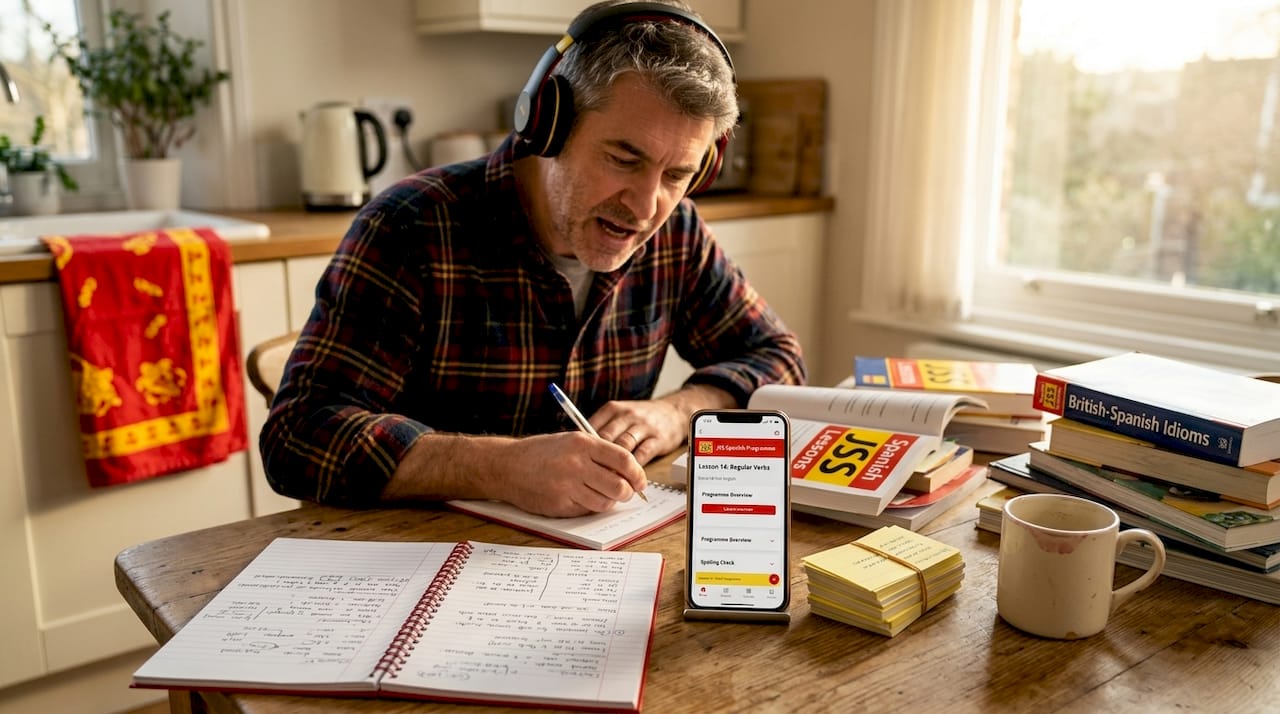
The shift from beginner to intermediate is not dramatic on the outside, but internally it represents a genuine transformation in how your brain processes Spanish. You stop translating word by word and start recognising patterns. Sentences begin to flow rather than stall. As Spanish Core Lessons 11 to 20 confirm, intermediate learners move from basic phrases to constructing sentences, asking questions, expressing preferences, and handling most social interactions. That is a significant leap in practical capability.
Here are the core skills you develop at the intermediate stage:
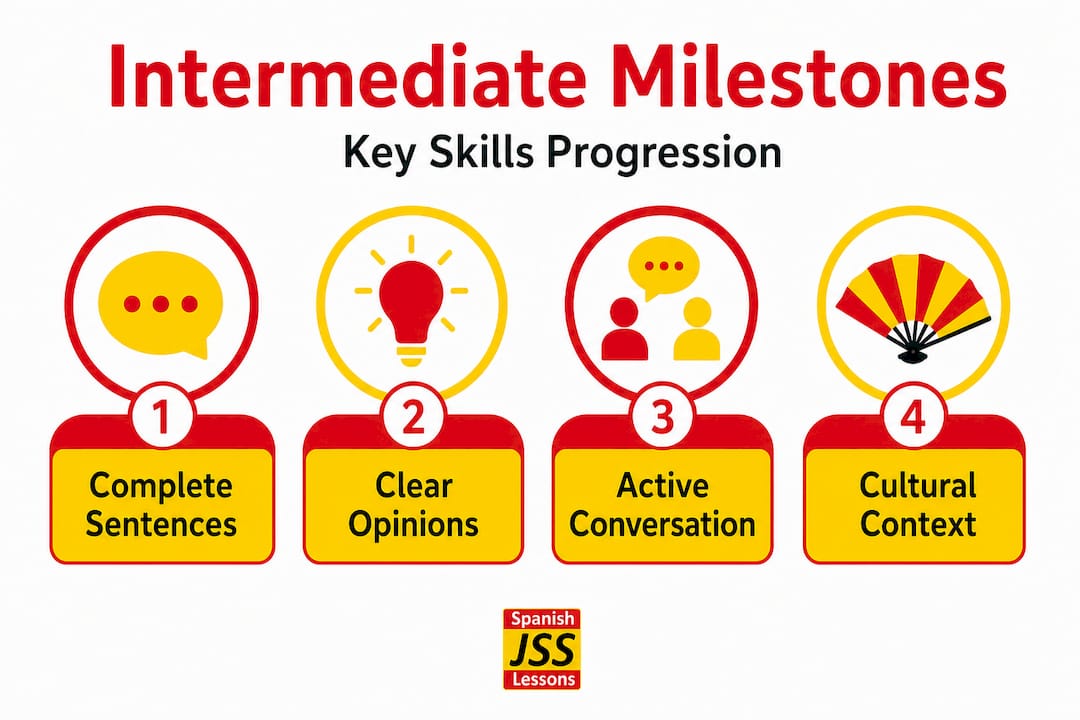
- Constructing original sentences. You can put together a sentence you have never practised before. Instead of reaching for a memorised phrase, you assemble the words yourself using the structural logic you have absorbed.
- Asking genuine questions. Not just “¿Dónde está…?” but open questions about someone’s opinion, their daily routine, or what they would recommend. This skill alone unlocks entire conversations.
- Expressing opinions and preferences. You can say what you think, what you like, and what you would prefer. This is what turns a functional exchange into an actual conversation.
- Following native speakers at moderate speed. You no longer need every speaker to slow down dramatically. You catch the gist and often the detail too, even when vocabulary is slightly unfamiliar.
- Handling everyday situations with confidence. Visits to the doctor, conversations with tradesmen, buying a train ticket, or asking a shop assistant about a product: these no longer feel like tests. They feel like communication.
The jump from Spanish lessons 11 to 20 through to Spanish lessons 21 to 30 maps precisely onto this progression. Early intermediate work focuses on sentence construction and question formation. Later intermediate work builds fluency, introduces more nuanced vocabulary, and sharpens your listening ear.
Pro Tip: One of the fastest ways to consolidate intermediate skills is to use real conversations as your practice arena, not just structured lessons. After each lesson, pick one new structure and deliberately use it in a real interaction that day, whether with a shopkeeper, a neighbour, or a local tradesman. The slightly uncomfortable feeling of using new language in public is actually the signal that genuine learning is happening.
How to progress from beginner to intermediate Spanish
Understanding what intermediate level brings, you will need practical steps to reach this milestone.
Progress rarely happens by accident. Learners who move steadily from beginner to intermediate share a few common habits: they study consistently rather than in occasional bursts, they expose themselves to real Spanish regularly, and they follow a curriculum that builds skills in a logical sequence rather than jumping between random topics.
Steps to make the move from beginner to intermediate:
- Commit to a consistent study schedule. Even 20 to 30 minutes daily beats three-hour weekend sessions. Memory consolidation happens between practice sessions, not just during them. Regular, shorter exposure keeps Spanish active in your mind.
- Follow a structured lesson sequence. Random vocabulary apps fill your head with isolated words but leave the structural logic untouched. A sequenced curriculum builds sentence construction skills methodically, so each lesson supports the next.
- Practise speaking from early on. Many learners delay speaking until they “feel ready.” Waiting too long hardens the habit of silent study. Aim to say something in Spanish every single day, even if it is just narrating what you are doing at home.
- Target real-life scenarios. Practise the Spanish you actually need: conversations with neighbours, visits to the pharmacy, dealing with utility companies. Abstract grammar exercises have their place, but real-life scenarios keep motivation high and skills sharp.
- Use spoken practice tasks alongside core lessons. Research confirms that completing core lesson sequences and regular practice tasks accelerates movement from beginner to intermediate. The combination of sentence-building lessons and spoken output practice is what turns passive recognition into active fluency.
Common intermediate challenges and how to overcome them:
- The plateau feeling. Progress feels fast at first, then slows. This is normal. Keep going. The gains at this stage are deeper, not smaller.
- Understanding fast speech. Native speakers do not slow down for you. Dedicated “ear-tuning” practice using real spoken Spanish at natural speed is essential.
- Forgetting vocabulary under pressure. A spaced-repetition system, rather than one-off word lists, builds lasting recall. The WordAmigo system within JSS is specifically designed for this.
- Losing confidence when conversations go off-script. Embrace the unexpected. An off-script moment is not a failure; it is the best practice you will ever get.
Supplementing core study with spoken Spanish practice tasks gives you the repetition needed to make new structures automatic rather than effortful.
Practical tips and resources for intermediate learners
To ensure steady progress, let us review tips and resource suggestions for intermediate learners.
Reaching intermediate level is one achievement. Staying engaged, building on it, and converting it into genuine cultural fluency is another. The right mix of resources keeps momentum high and prevents the dreaded plateau from settling in.
As Spanish Core Lessons 31 to 40 demonstrate, resource-rich environments and structured lessons can turn intermediate Spanish into genuine conversation and cultural understanding. Access to varied, well-sequenced content is not a luxury at this stage; it is a necessity.
Top practice tips for intermediate learners:
- Listen to Spanish radio or podcasts for ten minutes each morning, even as background sound. Your brain begins filtering and recognising patterns even when you are not actively concentrating.
- Watch Spanish television with Spanish subtitles, not English ones. This forces your ear and eye to work together in Spanish rather than defaulting to translation.
- Keep a short vocabulary journal for new words encountered during real interactions. Reviewing it weekly reinforces retention.
- Find a conversation partner, ideally a native speaker in your local community. Regular informal chats build the spontaneous fluency that no app can replicate.
- Revisit completed lessons. There is no rule that says you must always push forward. Returning to earlier material with fresh eyes reveals details you missed the first time.
Pro Tip: Focus on listening and speaking every single day, even for just a few minutes. Reading and writing are valuable, but for expats in Spain the most urgent skill is understanding fast spoken Spanish and responding naturally. Prioritise your ears and your mouth above all else.
Resource types and their learning impact:
| Resource type | Primary benefit | Best used for |
|---|---|---|
| Structured lesson series | Builds grammar and sentence logic | Foundation and progression |
| Spoken practice tasks | Converts knowledge into active speech | Fluency and confidence |
| Conversation partners | Builds spontaneous, real-world fluency | Social integration |
| Listening resources (radio, TV) | Sharpens ear-tuning for natural speech | Comprehension and accent familiarity |
| Vocabulary retention systems | Locks words into long-term memory | Consistent recall under pressure |
The most effective learners do not rely on a single resource. They combine structured lessons with spoken practice, add real-life immersion, and use a system like WordAmigo to ensure that vocabulary genuinely sticks rather than fading within days.
Why the journey to intermediate Spanish can surprise you
After focusing on the methods and resources, it is valuable to consider what reaching intermediate level truly feels like, because it rarely matches what learners expect.
There is a widespread myth that language learning follows a smooth curve. Many adults expect a point of “sudden fluency,” a moment when Spanish simply clicks and everything flows. In reality, many adults expect rapid progress but steady improvement is always rooted in consistent exposure and actual usage. The click does not arrive all at once. It arrives in small, accumulating moments.
You will notice you understood an entire exchange at the post office without translating a word. A neighbour will laugh at something you said, and you will realise you made a genuine joke in Spanish. A builder will give you a lengthy explanation about the work needed, and you will follow almost all of it. These moments do not announce themselves in advance. They appear quietly, and only afterwards do you realise how far you have come.
The unexpected rewards of reaching intermediate level go well beyond communication. They include cultural immersion in the truest sense. When you understand a shopkeeper’s running commentary about the weather, or follow the chatter at a local bar, you are no longer a foreigner navigating a foreign place. You are a participant in the community around you. That shift in identity is something no textbook prepares you for.
Patience matters enormously here. Learners who measure their progress in weeks often feel frustrated. Learners who measure it in months feel genuinely surprised by how much ground they have covered. The reason why adults struggle with Spanish is rarely a lack of ability. It is usually a lack of the right structure, combined with unrealistic expectations about the timeline. Give yourself the structure, set realistic milestones, and the progress will come.
Next steps: Practical support for your Spanish journey
Having considered the real shape of the journey, here is how you can directly further your Spanish skills with the right support structure behind you.
James Spanish School exists precisely for English-speaking adults in Spain who want to move beyond the beginner plateau and into genuine, confident conversation. The 100-lesson course is built around the real interactions you face every day, from the pharmacy to the town hall, using plain English to explain Spanish structure rather than grammar terms that mean nothing to most adult learners.
Whether you are just starting to build your intermediate skills or consolidating the ones you already have, the range of online Spanish lessons gives you a structured, flexible path forward. Everything is on demand, available 24 hours a day, seven days a week, with no expiry date and no countdown pressure. The module-based learning approach ensures that each lesson connects logically to the next, so your progress builds steadily rather than scattering in every direction. WordAmigo keeps your vocabulary locked in for the long term.
Frequently asked questions
How long does it take to reach intermediate Spanish?
With consistent daily study and regular spoken practice, most adult learners reach intermediate level within 6 to 12 months, and regular practice tasks accelerate that progression noticeably. The timeline shortens significantly when study is paired with real-life Spanish use in everyday situations.
What skills should I focus on at the intermediate level?
Prioritise conversation, listening comprehension, sentence construction, and expressing opinions clearly, since intermediate learners move from fixed phrases to handling a full range of social interactions. Listening is particularly important for expats in Spain, where fast spoken Spanish is the norm rather than the exception.
Do I need to live in Spain to become an intermediate speaker?
No, living in Spain is not a requirement, but immersion and frequent real-life practice speed up progress substantially. Resource-rich environments and structured lesson programmes can replicate much of that immersion effect even without constant daily exposure to native speakers.
What resources best support intermediate Spanish learners?
Structured lesson series combined with regular conversation practice are consistently the most effective tools for intermediate learners. Lesson sequences and regular practice enable rapid progress by building both sentence logic and spoken fluency together rather than treating them as separate skills.