

TL;DR:
- Practical spoken Spanish focuses on real-life conversation, slang, and unscripted speech.
- Sounding natural in Spain requires understanding regional features like the “th” pronunciation and “vosotros”.
- Repeated active practice and embracing mistakes are essential for building confidence and fluency.
Most people who decide to learn Spanish spend months wrestling with verb conjugation tables and gender rules, only to freeze completely when a local speaks at full speed. The gap between classroom Spanish and real spoken Spanish in Spain is wider than most guides admit. What actually gets you through a conversation at the market, the health centre, or the neighbour’s doorstep is not a perfect grasp of grammar. It is the ability to understand unscripted, natural speech and respond with confidence. This guide cuts through the confusion and focuses on what practical spoken Spanish really means, how Spain shapes it, and what you can do to build genuine confidence without the academic stress.
Table of Contents
- What is practical spoken Spanish?
- Key differences in spoken Spanish for Spain
- Cultural nuance and mutual understanding
- Building practical confidence: approaches and real-life strategies
- The uncomfortable truth most Spanish guides miss
- Discover resources to make Spanish learning stress-free
- Frequently asked questions
Key Takeaways
| Point | Details |
|---|---|
| Everyday Spanish matters | Focusing on real conversations builds confidence and fluency faster than focusing on grammar alone. |
| Spain has unique quirks | Knowing Castilian pronunciation, ‘vosotros’ forms and local slang is vital for practical interactions in Spain. |
| Culture shapes communication | Gestures, greetings and idioms are essential for connecting with locals and navigating daily scenarios. |
| Practice is key | Audio lessons, roleplay and daily conversation drills accelerate real-world fluency. |
What is practical spoken Spanish?
There is a common assumption that fluency means knowing the rules. In reality, native speakers break rules constantly. They shorten words, swallow syllables, and string sentences together in ways no textbook ever models. Practical spoken Spanish refers to the natural, conversational form of the language used in everyday interactions, focusing on high-frequency vocabulary, colloquial expressions, slang, regional idioms, and unscripted speech patterns rather than formal grammar or academic structures.
This distinction matters enormously. Classroom Spanish is designed for assessment. It is slow, clear, and structured around rules. Real spoken Spanish is designed for connection. It is fast, flexible, and shaped by context. When a shopkeeper in Seville says “¿Qué va a ser?” instead of the textbook “¿Qué desea usted?”, a grammar-focused learner may not even recognise it as a question.
Practical spoken Spanish is built around several core features that set it apart:
- High-frequency vocabulary: The 1,000 most common words cover roughly 85% of everyday conversation. Knowing these beats knowing rare vocabulary.
- Colloquial expressions: Phrases like “venga” (used as “OK”, “come on”, or even “goodbye” depending on tone) appear constantly in Spain.
- Real conversational rhythm: Sentences overlap, trail off, and get interrupted. This is normal, not rude.
- Slang and filler words: Words like “tío” (mate) and “mola” (it’s cool) are everywhere in informal speech.
- Unscripted responses: Real conversations do not follow scripts. Flexibility matters more than perfection.
“The goal is not to sound like a textbook. The goal is to be understood and to understand. Those are very different targets.”
If you want to build Spanish small talk skills or take your first beginner conversation steps, the starting point is always the same: prioritise the language people actually use, not the language that scores well on tests. Audio lesson formats are particularly effective here because they train your ear for real rhythm from the very beginning.
Key differences in spoken Spanish for Spain
Not all Spanish is the same. The version spoken in Spain, known as Castilian, has specific features that learners living in or visiting Spain need to know. Picking up these features early saves a great deal of confusion and helps you sound far more natural to local ears.
One of the most immediately noticeable features is the distinción, the pronunciation of “c” (before e or i) and “z” as a “th” sound. So “gracias” sounds like “grathias” and “Barcelona” sounds like “Barthelona”. This is not a lisp, as is commonly and incorrectly assumed. It is a distinct regional feature that marks Castilian Spanish clearly from Latin American varieties. As research on Castilian confirms, Spain also uses vosotros for informal plural address, vocabulary like coche (car), ordenador (computer), móvil (mobile phone) and zumo (juice), a faster overall rhythm, and leísmo in central Spain.
Here is a quick comparison to show how Spain’s spoken Spanish differs from neutral or Latin American Spanish:
| Feature | Spain (Castilian) | Neutral/Latin American |
|---|---|---|
| “c/z” pronunciation | “th” sound (distinción) | “s” sound |
| Informal plural | Vosotros | Ustedes |
| Word for “car” | Coche | Carro or auto |
| Word for “computer” | Ordenador | Computadora |
| Word for “juice” | Zumo | Jugo |
| Speech pace | Fast, clipped | Generally slower |
Other features worth knowing include:
- Regional accents: Andalusian Spanish drops final consonants and softens sounds heavily. Madrid Spanish is crisp and fast. Both are very different from what most courses teach.
- Everyday vocabulary: Spain uses words that simply do not appear in Latin American Spanish courses, so learners often feel blindsided by basic items.
- Pace and rhythm: Spanish in Spain tends to run faster than in Latin America, which is why ear-tuning for English speakers is so important from the start.
Understanding these features early means you are not caught off guard when you arrive. Adults who address these Spanish hurdles early in their learning journey make significantly faster progress than those who discover them by accident.
Cultural nuance and mutual understanding
Language does not exist in a vacuum. In Spain, how you say something matters just as much as what you say. Cultural context shapes every conversation, and picking up on these cues makes a real difference to how warmly locals receive you.
Greetings are a good example. In Spain, social customs include two kisses on the cheek (right cheek first) between women and between men and women, while men typically shake hands. Getting this wrong is not offensive, but getting it right signals genuine effort and respect. Body language also carries weight. Spaniards tend to stand closer during conversation than British people are used to, and maintaining eye contact is a sign of engagement, not aggression.
Idioms and slang are another layer entirely. Some common Spanish expressions used in Spain include:
- “No hay mal que por bien no venga” (Every cloud has a silver lining)
- “Estar en las nubes” (To have your head in the clouds)
- “Me importa un pepino” (I couldn’t care less, literally “it matters to me like a cucumber”)
- “Venga, va” (Go on then / alright / see you later, depending on context)
- “Tío / tía” (Mate / pal, used constantly in informal speech)
Accent variation across Spain is significant. Andalusian Spanish, spoken in the south, drops final consonants and blurs sounds together in ways that even advanced learners find challenging. Madrid Spanish is faster and crisper. Catalan-influenced Spanish in Barcelona has its own rhythm. All varieties are mutually intelligible, but the differences are real and worth being aware of.
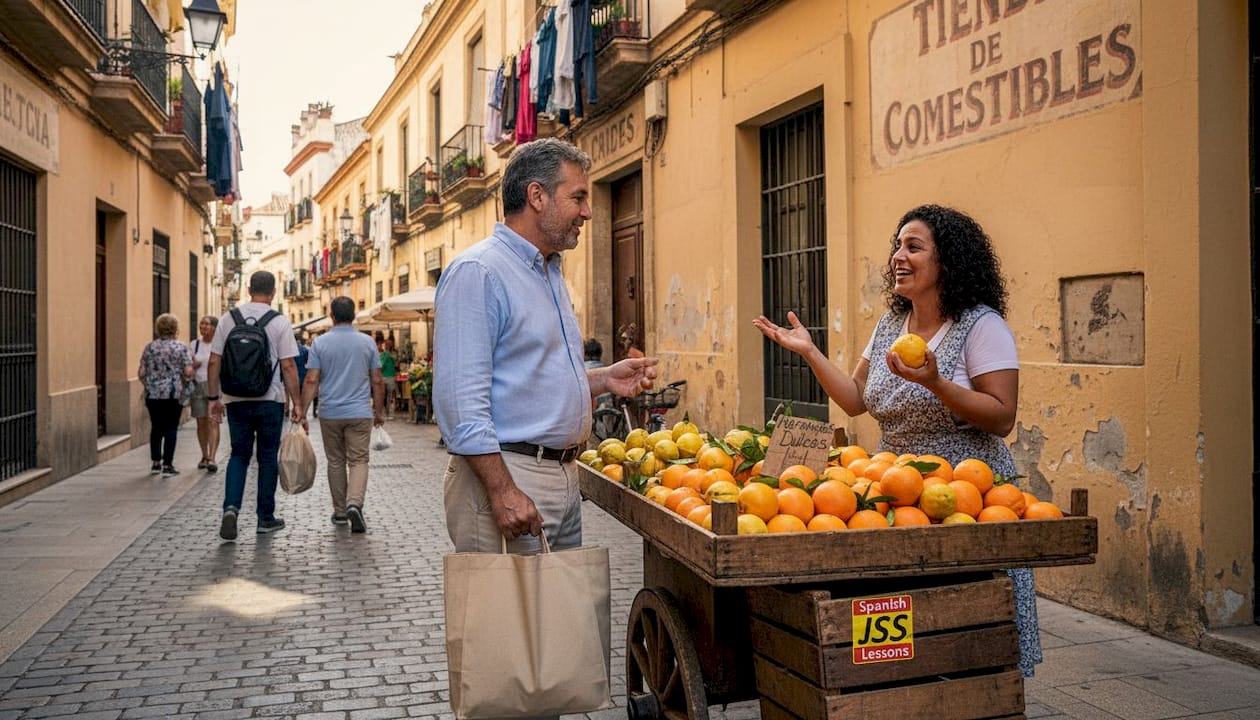
Pro Tip: When you arrive somewhere new in Spain, spend the first few days simply listening. Notice which filler words locals use most, how they greet each other, and how fast they speak. This passive listening is not wasted time. It is your ear calibrating to the local frequency. For more on connecting naturally with locals, explore these fluency tips for Spain.
Building practical confidence: approaches and real-life strategies
Knowing what practical spoken Spanish looks like is one thing. Building the confidence to use it is another. The good news is that the most effective methods are also the most accessible, and none of them require a classroom.
On the question of time, it helps to have realistic expectations. FSI research estimates 600 to 750 hours for English speakers to reach conversational fluency in Spanish, with gains modulated by initial proficiency and contact hours. That sounds like a lot, but spread across consistent daily practice, it is very achievable.
| Method | Estimated hours to impact | Confidence boost |
|---|---|---|
| Audio lessons (daily) | 30 to 50 hours | High |
| Scenario roleplay | 20 to 40 hours | Very high |
| Grammar study alone | 100+ hours | Low |
| Immersive listening | 50 to 80 hours | High |
Here are the steps that make the biggest practical difference:
- Start with high-frequency vocabulary. Focus on the words that appear in almost every conversation before anything else.
- Use scenario-based practice. Rehearse real situations: ordering coffee, asking for directions, speaking to a pharmacist.
- Train your ear deliberately. Listen to audio Spanish lessons at natural speed, not slowed-down classroom recordings.
- Practise roleplay regularly. AI roleplay tools boost self-efficacy for spoken Spanish, giving you a safe space to make mistakes without embarrassment.
- Review and repeat. Confidence comes from repetition, not from getting it right the first time.
For practical fluency in Spain, the most important shift is moving away from passive study and towards active, spoken practice as early as possible.
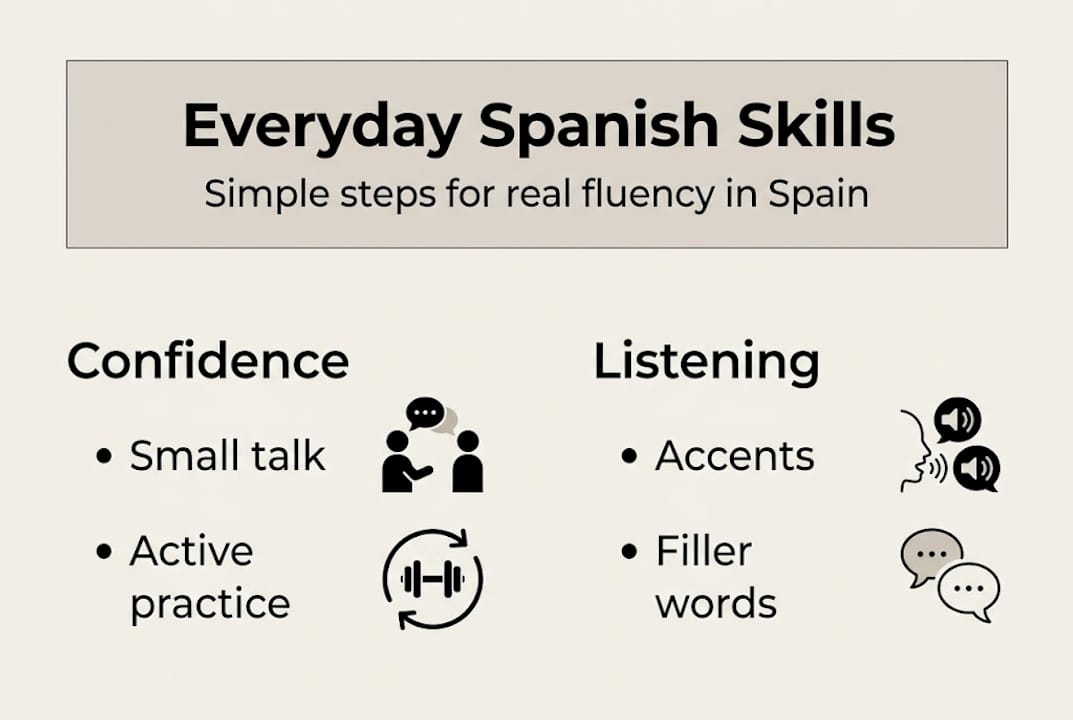
Pro Tip: Record yourself speaking Spanish for 60 seconds each day on any topic. Play it back. You will notice your own patterns, hesitations, and improvements far more clearly than any teacher could point out.
The uncomfortable truth most Spanish guides miss
Here is something most guides will not say plainly: the pursuit of grammatical perfection is one of the biggest obstacles to real spoken fluency. Adults who have spent years in formal education are conditioned to avoid mistakes. In language learning, that instinct works against you.
Every fluent Spanish speaker you admire made thousands of errors on the way there. The locals in Spain are not grading you. They are trying to understand you, and they will meet you more than halfway if you show genuine effort. Study abroad research consistently shows that real-world practice in markets, cafés, and everyday settings yields far greater gains than structured academic study alone.
What actually builds confidence is exposure, repetition, and the willingness to look slightly foolish in the short term. For Spain specifically, focusing on Castilian features like the theta sound and vosotros from the start means you are learning the right version of the language for your actual context. For a fresh fluency perspective that cuts through the noise, the message is simple: speak sooner, correct later, and never let the fear of mistakes stop you from opening your mouth.
Discover resources to make Spanish learning stress-free
If this article has shifted how you think about learning Spanish, the next step is finding resources that match this practical, real-world approach.
At James Spanish School, everything is built around the kind of Spanish you actually need in Spain. From real-life Spanish fluency guides to scenario-based audio lessons, the focus is always on confidence in everyday situations rather than academic performance. Whether you want to chat with your neighbours, handle a visit to the doctor, or simply order lunch without anxiety, you will find practical, adult-friendly support at every step. Explore tips for speaking Spanish with locals and discover how stress-free learning can genuinely be.
Discover much more about the JSS course here.
Frequently asked questions
How is practical spoken Spanish different from textbook Spanish?
Practical spoken Spanish uses real-life expressions, slang, and unscripted speech, unlike the formal grammar and set dialogues found in textbooks. It prioritises being understood over being grammatically perfect.
What are common pronunciation challenges for English speakers in Spain?
English speakers often struggle with Spain’s “th” sound (c/z as distinción), the fast conversational rhythm, and the vosotros verb forms that do not appear in most beginner courses.
How long does it take to reach conversational fluency?
FSI estimates suggest 600 to 750 hours are needed for English speakers to reach conversational fluency in Spanish, though consistent daily practice can make this very achievable over time.
Are regional varieties of Spanish hard to understand?
All Spanish varieties are mutually intelligible, but regional accents such as Andalusian or Catalan-influenced Spanish may take some adjustment, particularly for learners used to neutral or textbook Spanish.
What practice methods boost confidence fastest?
Scenario roleplay and audio lessons are consistently the fastest routes to spoken confidence, as they replicate real conversational conditions rather than passive study.