

Reading simple Spanish texts guide
Start with A1–A2 graded readers, follow a short daily routine, and try the ready-to-use A1 practice text below. That is the whole engine in one sentence. Graded readers are short stories written with a controlled vocabulary, matched to the Common European Framework of Reference (CEFR) scale, so you always know the text is pitched at the right level. Three resources worth bookmarking right now:
- Lingua.com — free A1–B2 texts with built-in comprehension quizzes and audio narration, no registration needed.
- FluentWithStories.com — short bilingual stories with interleaved English translation, ideal for absolute beginners who need a safety net.
- SnappySpanish.com — teacher-created reading passages with printable PDFs and vocabulary support, well-suited to adult learners.
Your suggested session: 15–20 minutes, structured as preview → read for gist → reread and note three phrases → say them aloud. That loop, repeated daily, is what turns a single text into lasting progress.
Key takeaways
Graded A1–A2 texts, a daily 20-minute routine, and spaced phrase review are the three pillars of effective beginner reading practice in Spanish.
| Point | Details |
|---|---|
| Choose the right level | Aim for 80–95% comprehension; stop at A1 if you look up more than one word in five. |
| Follow the 20-minute loop | Preview, read for gist, note three phrases, say aloud, review tomorrow. |
| Use activities, not just reading | Cloze, short-answer retell, and vocabulary matching each build a different skill. |
| Top three free resources | Lingua.com, FluentWithStories.com, and SnappySpanish.com cover audio, quizzes, and PDFs. |
| James Spanish School | Offers a structured 100-lesson course with WordAmigo retention and lifetime access at shop-blg. |
Table of Contents
- How do you pick the right CEFR level for reading Spanish?
- A repeatable six-step reading routine you can use today
- Which practice activities help the most?
- Where can you find graded short texts for A1–A2 practice?
- Ready-to-use A1 practice text with questions, cloze and answer key
- How do you turn one reading session into lasting progress?
- James Spanish School: a structured course that supports your reading practice
- Sources
How do you pick the right CEFR level for reading Spanish?
The CEFR divides language ability into six bands. For reading practice, three matter most at the start:
- A1 uses roughly 500 high-frequency words, present-tense verbs, and very short sentences. Think: “María va al mercado. Compra pan y leche.”
- A2 introduces past tense, slightly longer sentences, and a wider core vocabulary of around 1,000 words.
- B1 adds opinion language, longer paragraphs, and less predictable vocabulary.
Eppika recommends aiming for 95–98% comprehension when reading graded A1 material, meaning you should understand nearly every word before you reach for a dictionary. Italki’s guidance sets a practical floor at 80% comprehension for general beginner reading practice. Between those two figures sits a useful rule of thumb: if you are stopping to look up more than one word in every five, the text is too hard.
Quick self-check for A1:
- Can you follow the main action on the first read without a dictionary?
- Can you retell who did what and where, in English, in two sentences?
- Are you reading aloud with only minor hesitations?
If yes to all three, you are ready to move to A2. If you are reaching for a dictionary every other sentence, stay at A1 and add more texts rather than harder ones.
Pro Tip: Don’t rush the level jump. Spending an extra week at A1 with five different short texts builds far more vocabulary than one frustrating attempt at an A2 story.
A repeatable six-step reading routine you can use today
The routine takes 15–20 minutes and works on any A1–A2 text. Touri’s 20-minute loop confirms that this structure improves retention and suits busy adult learners far better than sporadic longer sessions.
- Preview (2 minutes). Scan the title, any headings, and the first sentence. Predict what the text is about. Note two or three words you already recognise.
- Read for gist (3 minutes). Read the whole text once without stopping. Your only goal is the main idea: who, what, where.
- Reread and extract phrases (5 minutes). Read again, slowly. Underline or note three to five short phrases that carry the meaning, not isolated words. “Va al mercado” is more useful than “mercado” alone.
- Say it aloud (3 minutes). Read the text, or just your noted phrases, aloud. This connects visual recognition to pronunciation and trains your ear at the same time.
- Build your vocabulary list (4 minutes). Add your three to five phrases to a topic-based list (food, home, travel). Group by topic rather than alphabetically; the context helps memory. The how to memorise Spanish vocabulary guide at James Spanish School covers this method in detail.
- Write a two-sentence summary in English (3 minutes). Summarise what happened. If you cannot, reread once more before moving on.
For a 10-minute session, cut steps 5 and 6. For 30 minutes, add a second short text and compare the vocabulary lists.
Pro Tip: Subvocalising (mouthing words silently as you read) is not a bad habit. It actively links the written word to its sound, which matters enormously when you later try to follow spoken Spanish.

Which practice activities help the most?
Reading the text once is the starting point, not the finish line. Four activity types produce measurable gains in comprehension, and each fits a different moment in the routine:
- Multiple-choice comprehension questions. Use these after the first read (step 2). They test whether you caught the main idea without requiring you to produce language. Keep it to three or four questions per text.
- Cloze (fill-the-gap) exercises. Remove every seventh or eighth word from a short paragraph and fill the gaps from memory or a word bank. Do this on the second read (step 3). SpanishStep’s guidance on chunking and recognising high-frequency verbs makes cloze exercises far easier: once you know the 30 most common Spanish verbs, most gaps become predictable.
- Vocabulary matching. Match Spanish words from the text to their English equivalents. A quick five-item matching task at the end of a session reinforces the phrases you noted in step 3.
- Short-answer retell. After step 4 (reading aloud), answer two or three questions in writing: “¿Dónde está María?” or “¿Qué compra Juan?” One sentence per answer is enough. This is the activity that most directly builds the ability to produce Spanish, not just recognise it.
A practical two-minute add-on: after any session, write the three phrases you noted on a small card and stick it somewhere visible. Review it the next morning before you open a new text.
Where can you find graded short texts for A1–A2 practice?
The three sites named at the top of this guide each offer something slightly different.
- Lingua.com covers A1–B2, provides audio narration for every text, and includes built-in multiple-choice quizzes with instant feedback. No PDF download is listed publicly, but texts are printable from the browser. Teacher-created content throughout.
- FluentWithStories.com focuses on A1–A2 bilingual short stories. The interleaved English translation is its defining feature: Spanish and English sentences alternate, so you never lose the thread. Audio is available on most stories.
- SnappySpanish.com publishes teacher-designed reading passages with downloadable PDFs and vocabulary lists. The printable format suits learners who prefer paper over screen.
Beyond those three, several other sources are worth knowing:
- Fabulang — a free collection of A1 short stories categorised by CEFR level, suitable for repeat reading.
- IEsPanol — A1 and A2 texts with multiple-choice questions, cloze exercises, and flashcard review built in. The “Mi familia” and “Mi nueva casa” texts are well-structured examples of the format.
- Eppika — a reading app that combines tap-to-translate, audio narration, and CEFR-level grading. Readers can acquire 5–15 new words per hour when reading graded material with these supportive features, according to Eppika’s own data.
- Graded reader series (available from major booksellers in the UK). Look for series labelled A1 or “beginner” with a word count under 1,000 per story.
If you prefer working with a tutor alongside your reading practice, TUTOROO’s Spanish tutors can help you work through graded texts with guided feedback.
Ready-to-use A1 practice text with questions, cloze and answer key
The text: Un día en el mercado
María vive en un pueblo pequeño en España. Todos los martes, ella va al mercado con su madre. El mercado está en la plaza central del pueblo.
Hoy es martes. María y su madre salen de casa a las nueve de la mañana. Hace buen tiempo. El sol brilla y no hay nubes.
En el mercado, hay muchos puestos. Venden frutas, verduras, pan y queso. María compra dos kilos de tomates y un kilo de manzanas. Su madre compra pan fresco y un poco de queso.
Después, las dos mujeres van a una cafetería pequeña. Piden dos cafés y una tarta de limón. La tarta es deliciosa.
A las doce, María y su madre regresan a casa. María lleva las bolsas. Su madre está contenta porque el mercado tiene productos muy frescos hoy.
Comprehension questions
- ¿Dónde vive María?
- ¿Qué día va María al mercado?
- ¿Con quién va María al mercado?
- ¿Dónde está el mercado?
- ¿A qué hora salen de casa?
- ¿Qué tiempo hace?
- ¿Qué compra María?
- ¿Qué compra la madre de María?
- ¿Adónde van después del mercado?
- ¿Qué piden en la cafetería?
- ¿A qué hora regresan a casa?
- ¿Por qué está contenta la madre?
Cloze exercise
Fill each gap with the correct word from the box below.
martes / mercado / manzanas / cafetería / madre / tomates / sol / pueblo / nubes / pan
- María vive en un _____ pequeño.
- Todos los _____, ella va al mercado.
- El _____ está en la plaza central.
- Hace buen tiempo: el _____ brilla.
- No hay _____ en el cielo.
- María compra dos kilos de _____.
- También compra un kilo de _____.
- La _____ compra pan fresco.
- Su madre compra _____ y queso.
- Las dos mujeres van a una _____.
Vocabulary check
Match the Spanish word to its English meaning.
| Spanish | English |
|---|---|
| pueblo | village / small town |
| puesto | market stall |
| fresco | fresh |
| bolsas | bags |
| tarta | cake / tart |
Answer key
Comprehension answers:
- En un pueblo pequeño en España.
- Los martes.
- Con su madre.
- En la plaza central del pueblo.
- A las nueve de la mañana.
- Hace buen tiempo; el sol brilla y no hay nubes.
- Dos kilos de tomates y un kilo de manzanas.
- Pan fresco y un poco de queso.
- A una cafetería pequeña.
- Dos cafés y una tarta de limón.
- A las doce.
- Porque el mercado tiene productos muy frescos.
Cloze answers: 1. pueblo 2. martes 3. mercado 4. sol 5. nubes 6. tomates 7. manzanas 8. madre 9. pan 10. cafetería
How do you turn one reading session into lasting progress?
A single session is useful. Seven sessions in a row is where real acquisition begins. The principle behind this is spaced review: returning to material at increasing intervals forces the brain to retrieve rather than merely recognise, and retrieval is what cements vocabulary.
The five-step retention loop, drawn from Touri’s 20-minute routine, maps directly onto this:
- Preview the text (activate prior knowledge).
- Read for gist (first exposure).
- Save three to five phrases (selective encoding).
- Say aloud (phonological loop reinforcement).
- Review tomorrow (spaced retrieval).
Step 5 is the one most learners skip. Reviewing yesterday’s three phrases before opening today’s text takes under two minutes and dramatically improves retention. The WordAmigo flashcard system at James Spanish School automates this loop, spacing reviews at the intervals that suit how memory actually works.
A 7-day starter schedule
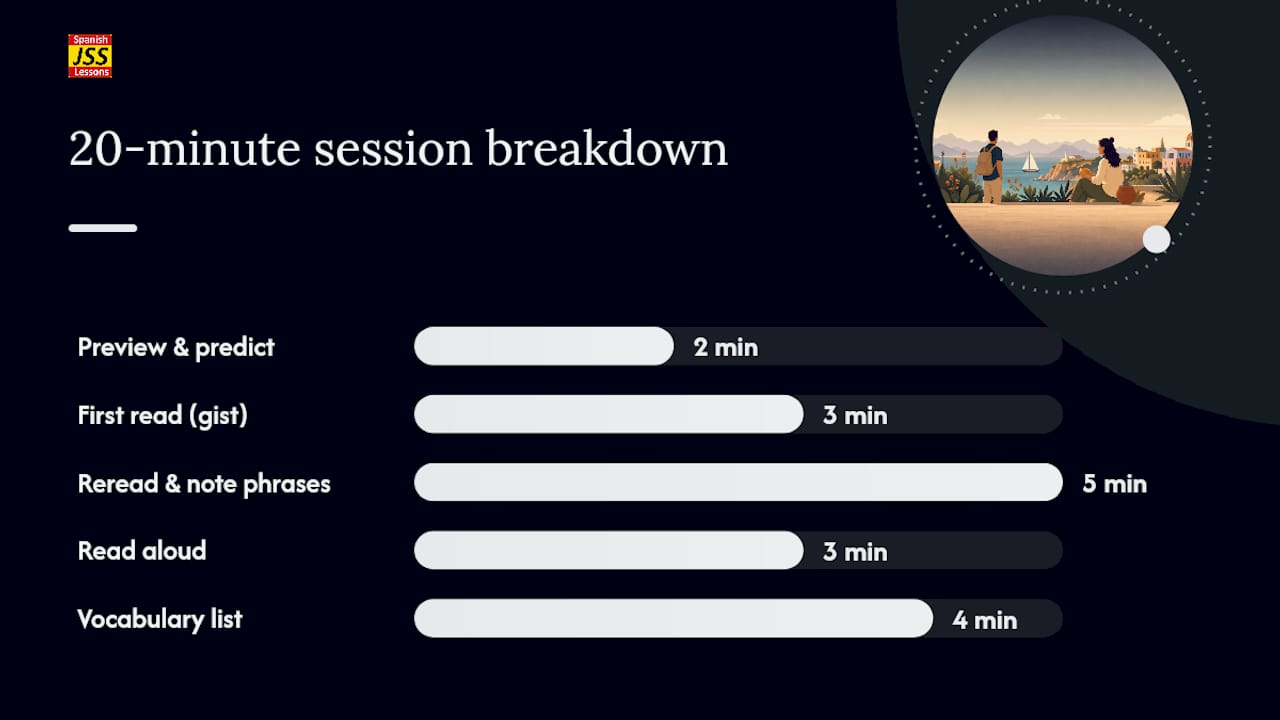
Time breakdown for a 20-minute session
| Activity | Time |
|---|---|
| Preview and predict | 2 min |
| First read (gist) | 3 min |
| Reread and note phrases | 5 min |
| Read aloud | 3 min |
| Vocabulary list | 4 min |
| Written summary | 3 min |
Pro Tip: Consistency beats intensity every time. Twenty minutes daily for seven days produces more measurable progress than a two-hour session at the weekend. The language learning guide for beginners from Tutoroo reinforces this point for adult learners specifically.
Academic research supports the approach: a Cambridge Core review of classroom-based extensive reading finds that graded extensive reading promotes vocabulary acquisition and reading fluency, particularly when learners engage with texts repeatedly at the right level.
James Spanish School: a structured course that supports your reading practice
Reading graded texts daily builds a strong foundation, but pairing that practice with a structured course accelerates progress considerably. James Spanish School is the organised option for adult learners who want graded lessons, lifetime access, and a retention system built around how memory actually works.
Founded by James Bretherton, a dual-native speaker with 40 years living in Spain, the course uses Radical Simplification: no grammar jargon, just plain English explanations of how Spanish sentences are built. What the course gives you alongside your reading practice:
- Graded 100-lesson structure covering sentence-building and ear-tuning for fast spoken Spanish.
- WordAmigo AI retention system that spaces vocabulary and pronunciation review automatically.
- Downloadable texts and audio so reading and listening reinforce each other.
- Teacher-designed exercises including fill-in-the-blank and multiple-choice tasks that mirror the activity types in this guide.
- Lifetime access, no expiry date, so you can revisit any lesson as your reading level grows.
The cast-iron guarantee means that if a core lesson teaches you nothing new, James credits you with extra practice modules at no cost. Browse the current course options at Jamesspanishschool and see which programme fits where you are now.
Sources
- Learn Spanish Through Reading | Eppika – Reading App
- Spanish Reading Practice for Beginners: A 20-Minute Routine – Touri
- Classroom-based extensive reading: a review of recent research — Cambridge Core