

TL;DR:
- Adult learners thrive with flexible, self-paced Spanish study that fits their busy lives.
- Removing deadlines increases motivation, reduces stress, and enhances long-term language retention.
- Combining self-study with real-life practice and milestones builds genuine conversational fluency.
Most adults assume that learning a language without a fixed deadline means drifting aimlessly, making little real progress. That assumption is worth questioning. Research consistently shows that adult learners thrive when they can study on their own terms, free from the anxiety of countdown clocks and rigid timetables. European Spanish, in particular, rewards a relaxed, conversational approach because the goal is real life: chatting with neighbours, ordering at a bar, or navigating a Spanish health centre. This article explores what deadline-free Spanish learning actually looks like, how it works in practice, and why it may be the most effective path to genuine fluency for busy adults.
Table of Contents
- What does Spanish learning with no deadline mean?
- How does flexible Spanish learning actually work?
- Comparing flexible Spanish learning to traditional courses
- How to personalise your deadline-free Spanish journey
- Why most adults thrive with deadline-free Spanish learning
- Start your flexible Spanish journey today
- Frequently asked questions
Key Takeaways
| Point | Details |
|---|---|
| Flexibility matters | Self-paced learning allows you to adapt Spanish study to real life and reduce unnecessary stress. |
| Real conversation counts | Combining solo study with practical speaking boosts confidence and lasting fluency. |
| Assess your style | Pick resources and habits that motivate you, then adjust as life changes. |
| Celebrate milestones | Marking progress—even small wins—keeps momentum strong in deadline-free learning. |
What does Spanish learning with no deadline mean?
With the value of flexibility in mind, let’s clarify exactly how deadline-free Spanish learning stands apart from traditional methods.
Spanish learning with no deadline simply means you set the pace. There is no exam date looming, no course expiry, and no tutor tapping a watch. You move through material when it suits your life, whether that is fifteen minutes on a Tuesday morning or a longer session on a rainy Sunday afternoon. The focus shifts from finishing to absorbing, which is a meaningful difference for adult learners juggling work, family, and everything else.
A common misconception is that removing deadlines removes motivation. In practice, the opposite is often true. When there is no fear of falling behind, learners tend to return to their studies more willingly and more often. Pressure can create avoidance; freedom tends to create curiosity.
Another myth is that self-paced learning is unstructured. Good online Spanish lessons are carefully sequenced, building vocabulary and sentence structure in a logical order. The difference is that you control the speed, not an institution.
Who benefits most from this approach?
- Working adults with unpredictable schedules
- Retirees and expats settling into life in Spain
- Parents who can only study in short windows
- Learners who experience anxiety in formal classroom settings
- Anyone who has previously abandoned a course due to falling behind
| Feature | Flexible, deadline-free learning | Fixed-schedule traditional course |
|---|---|---|
| Pace | Set by the learner | Set by the institution |
| Stress level | Low | Often high |
| Lesson access | On demand, 24/7 | Fixed times and dates |
| Repetition | Unlimited | Usually restricted |
| Focus | Conversational fluency | Often exam preparation |
| Accountability | Self-directed | External pressure |
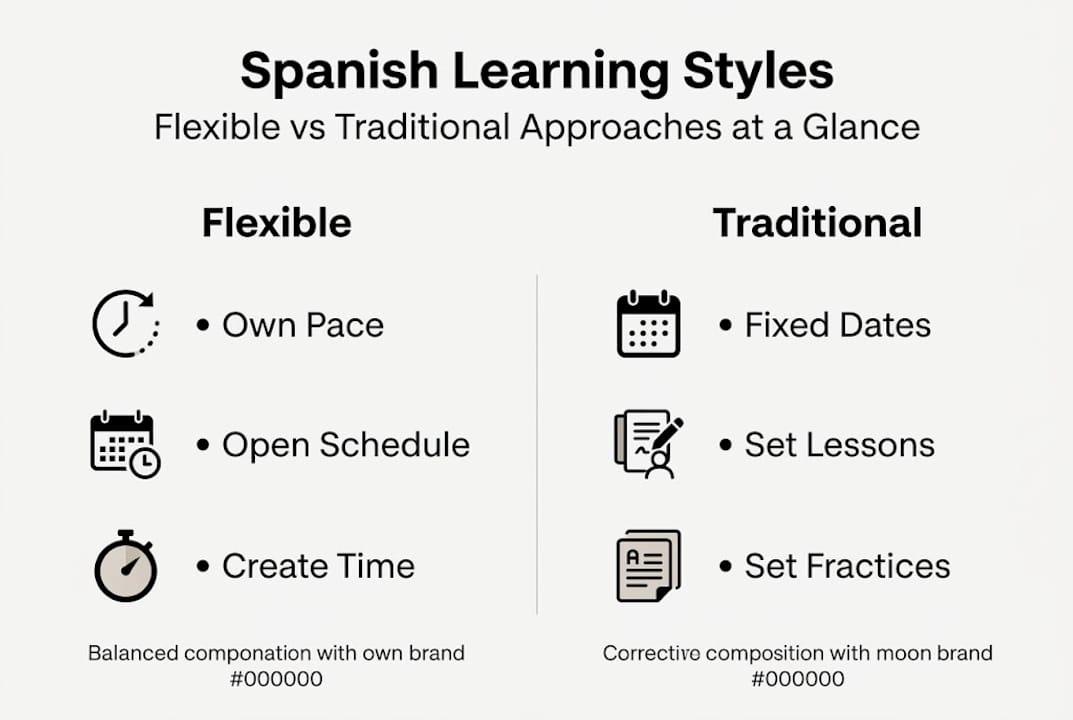
The core Spanish course at James Spanish School is built around exactly this philosophy. Lessons are available whenever you need them, with no expiry date attached. Check out what students say about this course.
Pro Tip: Combining self-paced study with occasional live interaction is more effective than apps alone. Even a short weekly conversation with a Spanish speaker anchors what you have been learning in a way that solo study cannot fully replicate.
How does flexible Spanish learning actually work?
Once you understand what makes self-paced learning unique, it is important to see how it plays out day to day.
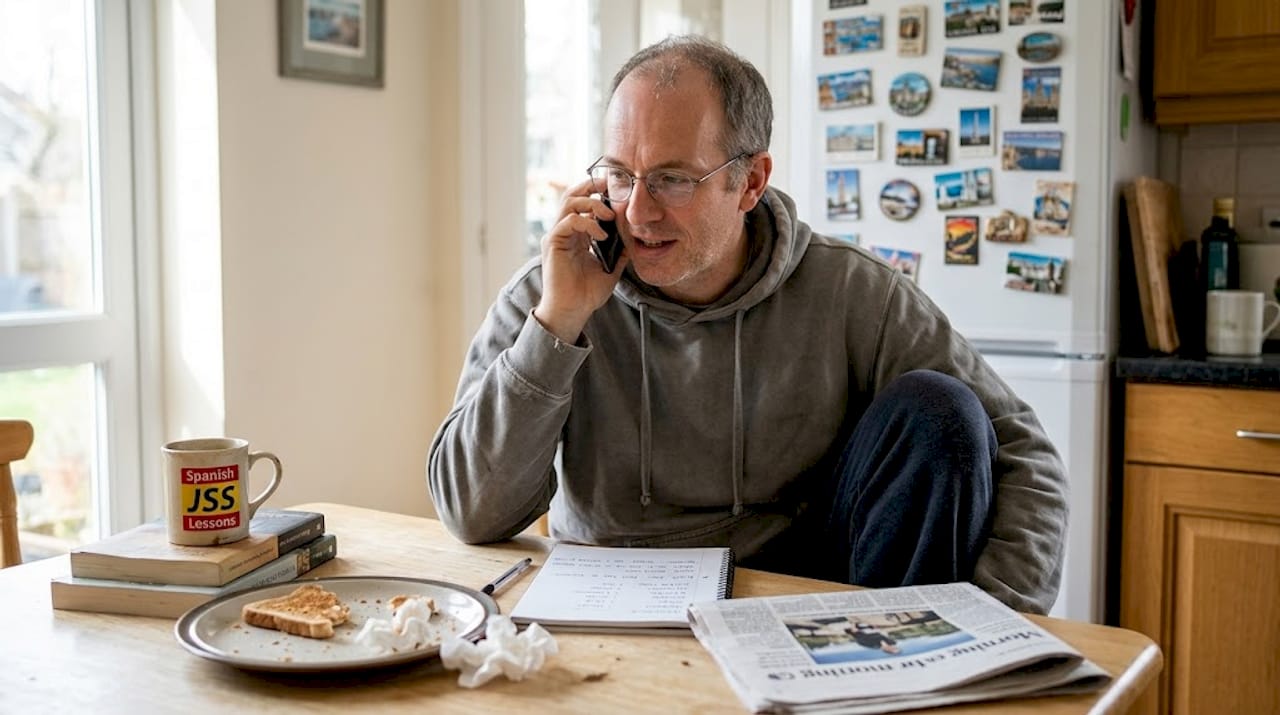
Self-paced language learning boosts motivation and allows for sustained engagement over months and years, rather than the short bursts typical of deadline-driven courses. But that sustained engagement needs a practical framework to keep it moving.
Here are the main steps to get started effectively:
- Choose your core material carefully. Pick a structured course that builds sentence logic progressively. Random YouTube videos and isolated vocabulary lists rarely produce conversational ability on their own.
- Set realistic, personal goals. Rather than “be fluent by March,” aim for “hold a short conversation about directions” or “understand my Spanish neighbour’s greeting.” Small, specific targets feel achievable.
- Track progress casually. A simple notebook or phone note recording new phrases you have used in real life is often more motivating than a formal progress chart.
- Mix your resources. Audio lessons suit commutes; flashcard apps work well in waiting rooms; podcasts in Spanish build your ear for natural speech patterns.
- Schedule real-life practice moments. Order your coffee in Spanish. Ask a question at the local market. These small acts consolidate learning faster than hours of passive study.
For a fuller breakdown, the practical Spanish learning steps guide walks through this process in detail, and the on-demand Spanish learning guide explains how to make the most of flexible resources.
Pro Tip: Avoid getting trapped by purely gamified apps. They are entertaining and useful for vocabulary, but they rarely teach you to construct a sentence under pressure. Prioritise real speech practice, even if it is just talking to yourself in Spanish while cooking.
Comparing flexible Spanish learning to traditional courses
But is deadline-free Spanish learning always better? A direct comparison with traditional courses reveals where each shines.
Gamified apps alone are often insufficient for reaching real-world conversational ability. They can build a useful vocabulary base, but they rarely prepare you for the machine-gun speed of native replies or the cultural nuances woven into everyday Spanish conversation.
| Dimension | Flexible, self-paced | Traditional fixed course |
|---|---|---|
| Learner satisfaction | Generally higher long-term | Can drop sharply if pace is wrong |
| Stress and anxiety | Significantly lower | Often elevated near deadlines |
| Depth of understanding | Higher, due to repetition | Variable, dependent on pace |
| Real-world output | Strong with good resources | Strong with good teaching |
| Suited to | Adults with busy lives | Younger learners, structured environments |
“The richest language learning happens when output, meaning actual speaking and writing, is prioritised alongside structured input. Self-paced environments make it far easier to return to a lesson, repeat it, and truly internalise it before moving on.”
The trade-off is real, though. Fixed-schedule courses offer external accountability, which some learners genuinely need. If you know you will not open a lesson without a deadline, a structured course may suit you better, at least initially. The Spanish Core Lessons 1-50 and the spoken Spanish practice lessons at James Spanish School are designed to bridge this gap, offering structure without rigidity.
The honest answer is that personality matters. Autonomous, curious learners almost always flourish in self-paced environments. Learners who need social pressure to perform may benefit from blending both approaches.
How to personalise your deadline-free Spanish journey
Now that the main approaches are clear, it is time to create your ideal flexible learning pathway.
A mix of structured lessons and real-life conversation is most effective for adults. The key is designing a routine that fits your actual life, not an idealised version of it.
Steps for building your personal pathway:
- Start with a structured course that covers sentence-building logic, not just vocabulary lists
- Add one or two audio or podcast resources for passive listening during daily routines
- Find a language exchange partner or informal conversation group, even online
- Use real-life scenarios as practice: shopping lists in Spanish, labelling items at home, or narrating simple tasks aloud
- Revisit earlier lessons freely. There is no shame in repetition; it is how fluency actually forms
The Spanish Lessons 1-50 module and the Spoken Spanish Practice Lessons1-50 course offer excellent material for this kind of layered, self-directed learning.
Pro Tip: Celebrate milestones, even tiny ones. The first time you understand a full sentence spoken by a native, write it down. The first time you successfully ask for directions and understand the reply, tell someone. These moments build genuine confidence, and confidence is the engine room of conversational fluency.
Avoid the trap of waiting until you feel “ready” to speak. Fluency is not a destination you arrive at before you start talking. It is built through the talking itself, imperfect and hesitant as it may be at first.
Why most adults thrive with deadline-free Spanish learning
Looking back over the evidence and practical experience, one truth stands out: most adults do not fail at language learning because they lack ability. They fail because the system they chose was designed for a different kind of learner.
School-style deadlines made sense when you were seventeen, had few other responsibilities, and were surrounded by peers at the same stage. As an adult, that context is gone. Life interrupts. A deadline missed becomes a reason to quit rather than a reason to catch up.
Deadline-free learning removes that exit ramp. When there is no “behind” to fall, there is no failure to trigger avoidance. Learners who have found fluency through gentle, self-directed momentum often describe the same experience: they stopped dreading their study sessions and started looking forward to them. That shift is everything.
For adults learning Spanish, the most important variable is not speed. It is consistency. And consistency is far easier to maintain when learning fits around your life rather than demanding your life fit around it.
Start your flexible Spanish journey today
If you are ready to make real progress at your own pace, James Spanish School has everything you need to get started without stress or obligation.
The Spanish course resources at James Spanish School are built for exactly the kind of learner described throughout this article: an English-speaking adult who wants practical, conversational European Spanish without the pressure of deadlines or the confusion of grammar jargon. Browse the full range of online lessons at your own pace, revisit any lesson as often as you like, and apply what you learn to real conversations. For practical guidance on speaking confidently with locals, the tips for speaking Spanish fluently resource is a natural next step.
Frequently asked questions
Is learning Spanish without deadlines really effective for adults?
Yes, flexible learning helps adults stay motivated and reduces the stress that often comes with rigid deadlines. Self-paced learning consistently boosts motivation and long-term engagement compared to fixed-schedule alternatives.
How can I ensure progress without a formal schedule?
Mix consistent short sessions with occasional real-life practice and celebrate small milestones to keep moving forward. Combining self-study with live conversation is particularly effective for maintaining momentum.
What resources are best for learning Spanish flexibly?
Audio lessons, podcasts, flashcard apps, and informal conversation exchanges all suit flexible learners well, especially when used together rather than in isolation.
Will I be able to speak Spanish in real life if I learn at my own pace?
Yes, especially if you prioritise speaking opportunities alongside self-study. Real conversation practice is essential for developing the output skills needed for everyday life in Spain.