

TL;DR:
- Most Spanish learners make the mistake of relying on cramming and passive recognition, which impairs long-term memory. Spaced repetition schedules vocabulary reviews at increasing intervals combined with active recall to strengthen recall and embed words into long-term storage. Implementing this method through apps or manual flashcards enhances conversational fluency and makes language learning more efficient and adaptable.
Most Spanish learners make the same mistake. They read through vocabulary lists, feel confident, then discover three days later that the words have completely vanished. This is not a memory problem. It is a method problem. Understanding what is spaced repetition in Spanish learning is the single most valuable shift you can make to your study routine. Rather than cramming everything into one sitting, spaced repetition reviews vocabulary at increasing intervals versus re-reading everything repeatedly, working with your brain’s natural memory processes rather than fighting them. The result is vocabulary that actually stays.
Table of Contents
- What is spaced repetition and how does it work?
- Variations in spaced repetition methods for Spanish learners
- How to optimise spaced repetition for real Spanish conversation skills
- Setting up your spaced repetition schedule: tips and example timelines
- Benefits and long-term impact of spaced repetition for Spanish learners
- Why typical study habits fall short and how spaced repetition truly changes things
- How James Spanish School can support your spaced repetition journey
- Frequently asked questions
Key Takeaways
| Point | Details |
|---|---|
| Spaced repetition explained | It schedules reviews at increasing intervals to embed Spanish vocabulary in long-term memory. |
| Active recall matters | Producing Spanish words from memory strengthens pathways better than passive recognition. |
| Adapt your schedule | Adjust review intervals according to word difficulty and your learning pace for best results. |
| Consistency over cramming | Regular short review sessions beat occasional long study marathons for retention. |
| Use tech wisely | Apps can automate spaced repetition schedules for efficiency but manual systems also work well. |
What is spaced repetition and how does it work?
Spaced repetition is a learning technique that schedules your vocabulary reviews at carefully timed intervals. Instead of reviewing a word once and hoping it sticks, you revisit it multiple times over days and weeks, each time just before your brain is about to forget it. That timing is not accidental. It is the entire engine of the method.
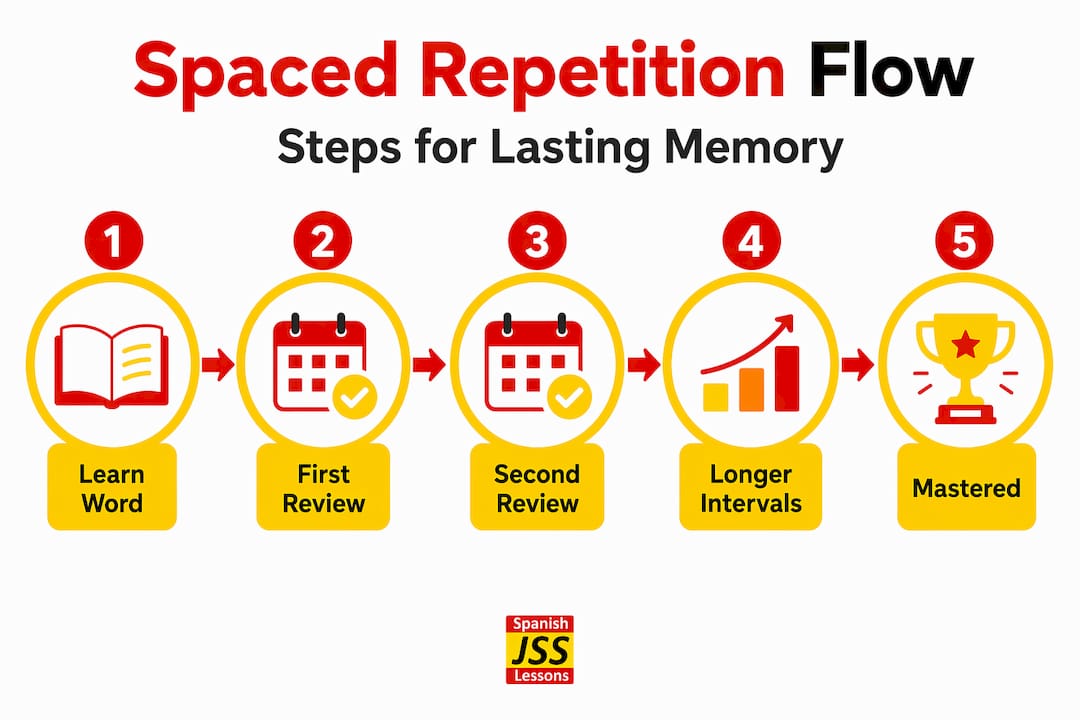
Here is how the memory mechanism works in practice. When you first learn a Spanish word, the memory trace is weak. If you review it the next day, that trace is reinforced before it fades completely. If you wait too long, the trace disappears and you are back to square one. Spaced repetition reviews at gradually increasing intervals, such as after 1 day, 3 days, 7 days, and 14 days, catching the memory at exactly the right moment.
The second ingredient is active recall. This is where many learners go wrong. Passive recognition, which is seeing a word and thinking “yes, I know that one,” creates a false sense of mastery. Active recall means covering the answer and forcing your brain to retrieve the Spanish word from scratch. This retrieval effort is what strengthens memory pathways and makes words accessible in real conversation.
The practical effect for spaced repetition for Spanish learners is significant. Words move from fragile short-term memory into long-term storage, where they become available automatically. That is the difference between laboriously translating in your head and speaking with genuine fluency.
The core mechanics at a glance:
- Review is scheduled before the memory fades, not after it is gone
- Each successful recall extends the next interval
- Failed recall shortens the next interval so the word gets more attention
- Over time, well-known words require less frequent review, freeing up your time
Variations in spaced repetition methods for Spanish learners
Having understood the basic mechanism, let us compare various practical ways you can apply spaced repetition and tailor it to your Spanish learning needs.
Spaced repetition can be applied using either a fixed manual schedule or through apps that adapt intervals based on your actual recall performance. Both approaches work. The question is which suits your lifestyle and learning style.
Manual methods involve physical flashcards sorted into boxes (a classic system called the Leitner box), or a simple spreadsheet where you record review dates. Words you know well move to later boxes with longer intervals. Words you struggle with stay in the early boxes for more frequent review.
App-based spaced repetition software handles the scheduling automatically. When you rate how easily you recalled a word, the app adjusts the next review date accordingly. Words you find easy are pushed further out; harder ones come back sooner.
| Feature | Manual flashcards | Spaced repetition apps |
|---|---|---|
| Setup effort | Low | Moderate |
| Scheduling | You decide | Automated |
| Adaptability | High (your choice) | High (algorithm-driven) |
| Cost | Free | Free to paid |
| Portability | Physical cards needed | Phone/tablet |
| Ideal for | Disciplined self-starters | Busy adult learners |
Adjusting review intervals based on difficulty is critical. A word like agua (water) needs far less attention than aunque (although/even though). Shortening intervals for tricky words and lengthening them for solid ones improves overall learning efficiency considerably.
What works best for most adult Spanish learners:
- Start with app-based tools to get the interval timing right automatically
- Add manual flashcards for high-priority vocabulary such as practical words for a spaced repetition workflow in everyday Spain situations
- Review learning vocabulary with spaced repetition in themed batches, such as food, health, or transport
- Keep your total daily card count manageable so reviews do not pile up
Pro Tip: Set a firm daily time limit of 20 minutes for spaced repetition reviews. If cards pile up beyond that, reduce how many new words you introduce each day. Consistency over many weeks beats marathon cramming sessions every time.
How to optimise spaced repetition for real Spanish conversation skills
To get the most from your spaced repetition practice, it is crucial to align it with your goal of speaking real Spanish confidently.
The most common mistake adult learners make is designing flashcards for recognition rather than production. Seeing the Spanish word farmacia and knowing it means pharmacy is useful. But in a real conversation, you need to go the other way: think “I need a pharmacy” and immediately produce farmacia. Those are two very different cognitive skills, and only one of them helps you speak.
Effective flashcards prompt you to produce the Spanish word or phrase from an English cue rather than simply recognise the Spanish. Set up your cards with the English on the front, Spanish on the back. Then cover the Spanish and speak it aloud before checking your answer. This single adjustment moves your practice much closer to real Spanish conversation practice.
Five practical tips for conversation-ready spaced repetition:
- Write full phrases on flashcards, not just isolated words. ¿Dónde está la farmacia? is more useful than farmacia alone.
- Say the Spanish out loud during every review, not just in your head.
- Include the sound of the word, not just the spelling. Pronunciation is part of the memory.
- Review in short bursts rather than long sessions to keep recall sharp.
- If you miss a session, shorten the interval and retest soon rather than trying to catch up by rereading everything.
Pro Tip: When you encounter a new Spanish word in a real-life situation, such as on a sign, in a conversation with a neighbour, or at the market, add it to your spaced repetition deck that same day. Real-world words carry emotional context, which makes them stick faster.
Setting up your spaced repetition schedule: tips and example timelines
Let us now break down a practical timetable you can follow daily to embed your Spanish vocabulary firmly into memory.
The most important review is the first one. Starting your first review within 24 hours of learning, then repeating at increasing gaps such as 72 hours and one week, is what separates spaced repetition from ordinary study. Miss that first 24-hour window and the memory trace weakens considerably.
How to set up your schedule in five steps:
- Learn new words in a session of no more than 15 minutes. Introduce 5 to 10 new words or phrases maximum.
- Review within 24 hours. Even five minutes the following morning is enough to reinforce the initial memory.
- Review again after 3 days. At this point you are testing whether the memory has begun to consolidate.
- Review after one week. Successfully recalled words now move to a two-week interval.
- Continue extending the interval for well-known words, reducing it immediately for anything you struggle with.
| Review session | Interval | Purpose |
|---|---|---|
| Session 1 | Day of learning | Initial encoding |
| Session 2 | 24 hours later | First consolidation |
| Session 3 | 3 days later | Strengthening the trace |
| Session 4 | 7 days later | Moving to medium-term memory |
| Session 5 | 14 days later | Long-term storage |
| Ongoing | 30+ days | Maintenance review |
Capping daily review time at 15 to 30 minutes prevents the dreaded pile-up of overdue cards, which tempts learners into cramming. A shorter, consistent session every day is worth far more than an occasional two-hour marathon. For setting your spaced repetition schedule, treat it as a daily habit, like brushing your teeth, not as an exam revision sprint.
Pro Tip: If life gets in the way and you miss two or three days, do not panic. Simply pick up where you left off. Any spaced review is better than none, and the method is forgiving of the occasional gap as long as you return to it promptly.
Benefits and long-term impact of spaced repetition for Spanish learners
Having explored how to implement spaced repetition, let us summarise the tangible benefits that make this method indispensable for Spanish learners.
The science behind this is well established. Spaced repetition combats the forgetting curve by reviewing just before you forget, maximising retention and making recall easier each time. Each successful retrieval strengthens the neural pathway slightly more than the last, so the word eventually becomes automatic.
What consistent spaced repetition delivers over time:
- Vocabulary that surfaces instantly in conversation, without conscious translation
- Reduced total study time because you only review words when they need it
- Greater confidence when speaking, because words are genuinely there when you need them
- A growing bank of phrases available for spontaneous use, not just recognition
- Less frustration from forgetting words you thought you had already learnt
Studies show spaced repetition can significantly improve learning efficiency and reduce the total time required to reach fluency. For adult learners with busy lives, that is not a minor benefit. It is the difference between making real progress and feeling stuck.
The spaced repetition benefits also compound over time. The more vocabulary you consolidate, the easier it becomes to acquire new words, because your brain starts to recognise patterns in Spanish structure and sound.
“The goal is not to review more. It is to review smarter. Spaced repetition turns time into an ally rather than an obstacle.”
Why typical study habits fall short and how spaced repetition truly changes things
Let us reflect on why merely spending time on Spanish is not enough and how shifting to spaced repetition can transform your language journey.
Here is an uncomfortable truth: most adult learners feel busy but are not actually learning efficiently. Re-reading a vocabulary list, watching Spanish television passively, and highlighting phrases in a notebook all feel productive. They are not. Re-reading and highlighting do not stick. Retrieval practice combined with spacing study is what actually builds durable memory.
The reason cramming feels effective is that it creates a short-term sense of familiarity. Walk into a conversation 48 hours later and that familiarity has largely evaporated. Spaced repetition with active recall works differently. It builds retrieval pathways that get stronger with each use, which is exactly what conversation demands.
Expanding the time between recall sessions alongside active recall produces significantly better retention than equal-interval reviews or passive methods. This is not opinion. It is consistently supported by memory research.
What this means practically is that the effort of retrieval is the point. When your brain has to work slightly harder to pull up a Spanish word, the memory becomes stronger, not weaker. The slight difficulty you feel is the learning happening. This is why effective Spanish learning tips consistently point toward active methods over passive ones.
The other dimension worth addressing is flexibility. Spaced repetition does not require a rigid timetable. Miss a day and simply continue. Travel, work, and family life will occasionally interrupt your schedule, and that is fine. The method tolerates gaps far better than cramming-based approaches, which demand unbroken study blocks to function at all. For adult learners, particularly those managing a move to Spain or retirement alongside their studies, that flexibility is not a luxury. It is essential.
How James Spanish School can support your spaced repetition journey
Knowing what spaced repetition is and actually applying it to your Spanish learning are two different things. The approach works brilliantly when paired with the right vocabulary, real-life context, and structured conversation practice.
At James Spanish School, the WordAmigo system is built precisely around this principle. It is an AI-powered vocabulary and pronunciation tool that uses strategic repetition to permanently embed words into long-term memory, automating a full loop of reading, listening, speaking, and writing exposure. James Bretherton, a dual-native speaker with 40 years of life in Spain, designed the module-based Spanish learning approach around exactly the conversations adult learners need: with neighbours, tradespeople, health workers, and local officials. Browse the Spanish learning resources shop to see what fits your current level, or explore the learner reviews to find out how other adult learners are making consistent progress.
Frequently asked questions
What is spaced repetition in Spanish learning?
Spaced repetition is a method that schedules reviews of Spanish words or phrases at increasing time intervals to improve long-term memory retention, working with the brain’s natural forgetting curve rather than against it.
How often should I review Spanish vocabulary using spaced repetition?
Start your first review within 24 hours of learning, then repeat after approximately 3 days, one week, and two weeks, with typical schedules following those exact gaps and adjusting based on how confidently you recall each word.
Can I use apps to help with spaced repetition for Spanish?
Yes, apps adapt review intervals based on how well you recall each item, meaning scheduling adjusts automatically to make your learning more efficient and personalised without manual tracking.
Is spaced repetition better than cramming for memorising Spanish?
Yes. Spaced repetition is proven to improve retention and reduce forgetting far more effectively than one-time cramming, because it combats the forgetting curve by reviewing at the optimal moment rather than overloading memory in a single session.
How do I handle missed review sessions in spaced repetition?
Do not try to catch up by rereading. Instead, shorten the interval and retest soon to reinforce the memory pathway, which is far more effective than passively going back through material you have already seen.