

Many adults assume that learning a second language is a monumental struggle, full of impenetrable grammar rules and impossible sounds. Spanish challenges that assumption almost immediately. For English speakers in particular, the path to real conversation is shorter and more straightforward than most people expect. This article explains why Spanish sits at the accessible end of the language spectrum, what the research actually shows about how quickly you can progress, and which practical strategies will move you from hesitant beginner to confident speaker faster than you might imagine..
Table of Contents
- Shared roots: Why Spanish and English overlap
- Clear pronunciation and straightforward grammar
- Real-life learning: Fast progress and proven outcomes
- Common challenges and how to overcome them
- What most guides miss about learning Spanish quickly
- Take your next step: Start learning Spanish today
- Frequently asked questions
Key Takeaways
| Point | Details |
|---|---|
| Shared language roots | Spanish and English share many vocabulary and grammar patterns, making Spanish easier for beginners. |
| Regular pronunciation | Spanish pronunciation features clear, consistent rules few exceptions, helping learners avoid confusion. |
| Rapid progress evidence | Studies show English speakers develop oral Spanish fluency quickly with immersive or structured practice. |
| Common pitfalls solved | English speakers can overcome false friends and rapid speech with focused strategies and resources. |
| Actionable learning advice | Practical conversation routines accelerate confidence and usable skills much faster than rote memorisation. |
Shared roots: Why Spanish and English overlap
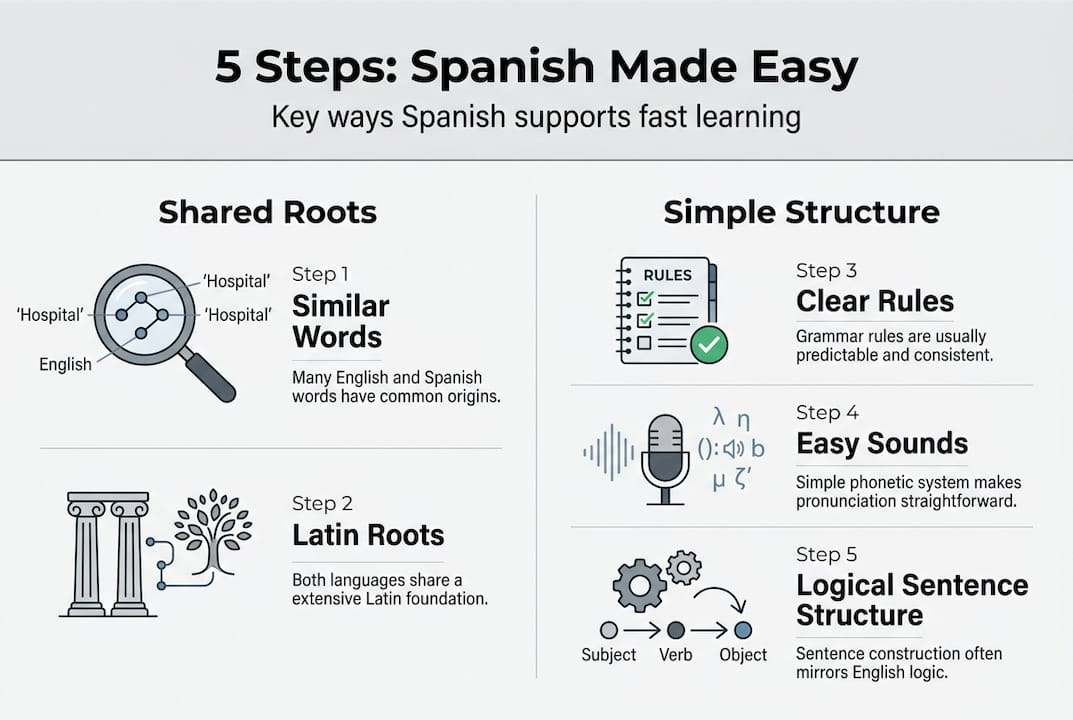
The single biggest advantage you have as an English speaker learning Spanish is the enormous amount of vocabulary you already own without realising it. Both languages draw heavily from Latin, which means thousands of words look and feel familiar from the very first lesson. Words like animal, hotel, hospital, natural, and possible are identical or nearly identical in both languages. That is not a coincidence. It is the result of centuries of shared linguistic heritage. In fact the less common a word is, the more likely the similarity.
Researchers confirm that Spanish oral proficiency is more readily attainable for English speakers than proficiency in most other languages. The structural logic of Spanish sentences also maps reasonably well onto English, especially compared to languages with entirely different word orders or writing systems.
Here is a quick comparison of matched vocabulary to show just how much you already know:
| English | Spanish | Shared root |
|---|---|---|
| Nation | Nación | Latin: natio |
| Possible | Posible | Latin: possibilis |
| Important | Importante | Latin: importare |
| University | Universidad | Latin: universitas |
| Natural | Natural | Latin: naturalis |
Beyond vocabulary, the alphabet is almost identical. Spanish uses 27 letters compared to English’s 26, with the addition of ñ. You are not learning a new script. You are not memorising characters from scratch. That removes one of the biggest early barriers that learners of Mandarin, Arabic, or Japanese face.
Some further overlaps that give English speakers an early boost:
- Both languages have set rules for subject, verb, object sentence order in most cases
- Adjectives and nouns work in recognisable patterns
- Question formation follows a logical structure
- Negation is simple and consistent
Taking your first basic Spanish steps feels far less like starting from zero and far more like building on a foundation you already have.
Pro Tip: Make a list of ten English words ending in -tion (like nation or information). In Spanish, these almost always become -ción words. You have just learned ten Spanish words in under a minute.
Clear pronunciation and straightforward grammar
One of the most frustrating things about English is that spelling and pronunciation often bear no relationship to each other. Consider though, through, tough, and cough. Four words, four completely different sounds, one letter combination. Spanish does not do this to you. Every letter has one sound, and that sound stays consistent. Once you learn the rules, you can read any Spanish word aloud correctly, even if you have never seen it before.

This regularity is not a minor convenience. It fundamentally changes how quickly you can build confidence. FSI data confirms that oral proficiency gains are pronounced in Spanish compared to many other languages studied by English speakers.
Here is how Spanish pronunciation compares to other popular European languages:
| Language | Spelling consistency | Gendered nouns | Verb regularity |
|---|---|---|---|
| Spanish | Very high | Yes (2 genders) | High |
| French | Low | Yes (2 genders) | Moderate |
| German | Moderate | Yes (3 genders) | Moderate |
| Italian | High | Yes (2 genders) | High |
Spanish grammar also rewards learners with a high degree of regularity. Consider these features:
- Regular verb patterns follow predictable endings. Learn the pattern for hablar (to speak) and you can conjugate hundreds of verbs.
- Two genders only. French and Spanish both use two genders, but Spanish gender rules are more consistent and easier to predict.
- No cases. German requires four grammatical cases. Spanish does not use cases in the same demanding way.
- Consistent adjective agreement. Adjectives follow the noun and match its gender and number in a predictable way.
- Phonetic spelling. What you see is almost always what you say.
“The engine room of sentence construction in Spanish is surprisingly accessible once you stop thinking in grammar terms and start thinking in patterns.”
Exploring the best ways to learn Spanish will help you use these structural advantages from day one. And if your schedule is unpredictable, on-demand Spanish learning means you can practise pronunciation at any hour without waiting for a class.
Pro Tip: Record yourself saying five Spanish sentences and play them back. Spanish vowels are short and pure, unlike English vowels which shift and stretch. Training your ear to hear the difference accelerates your speaking accuracy enormously.
Real-life learning: Fast progress and proven outcomes
With the basics clear, it is worth looking at how English speakers actually move from beginner to conversational, and what the evidence says about the pace of that progress.
The Foreign Service Institute (FSI) in the United States classifies languages by difficulty for English speakers. Spanish sits firmly in Category 1, the easiest group, alongside Italian and French. The FSI estimates around 600 to 750 hours of study to reach professional working proficiency. That sounds like a lot, but conversational proficiency arrives much earlier.
Key statistic: Study abroad participants achieved rapid oral proficiency growth in Spanish within a single semester, demonstrating that focused, immersive practice produces measurable results in a short timeframe.
You do not need to move to Spain to replicate this. The strategies that drive fast progress share common features:
- Prioritise spoken practice early. Waiting until your grammar is perfect before speaking is one of the most common and costly mistakes. Conversation builds fluency faster than any textbook.
- Use curated vocabulary lists. The most frequently used 1,000 Spanish words cover around 85% of everyday conversation. Focus there first.
- Engage with real spoken Spanish. Podcasts, films, and radio train your ear to follow natural speech rhythms before you even visit Spain.
- Repeat in short, regular sessions. Thirty minutes daily outperforms three hours once a week in terms of retention and confidence.
- Learn phrases as units. Rather than constructing sentences word by word, learning common phrases as whole units speeds up natural-sounding speech.
For practical, experience-based tips for fluent Spanish, the focus should always be on real conversations, not academic exercises. The goal is to talk to your neighbour, order at a bar, and understand what the plumber is telling you, not to pass a written examination.
Common challenges and how to overcome them
Even with Spanish’s many advantages, certain stumbling blocks catch learners off guard. Knowing what they are in advance means you can prepare for them rather than be derailed by them.
False friends are words that look similar in English and Spanish but mean something different. Embarazada does not mean embarrassed; it means pregnant. Sensible in Spanish means sensitive, not sensible. Constipado is a common cold not constipation. These false cognates cause genuine confusion in real conversations, and the only reliable solution is to learn them explicitly as a category.
Fast spoken Spanish is probably the most common complaint from learners at every level. Native speakers do not slow down for learners, and regional accents add another layer of complexity. The machine gun speed of native replies can feel overwhelming when your brain is still processing the last sentence.
Idiomatic expressions rarely translate literally. No hay mal que por bien no venga (every cloud has a silver lining) makes no sense if you try to decode it word by word. Building up a bank of common idioms takes time but pays off quickly in natural conversation.
Here are the most effective ways to tackle these challenges:
- Study a dedicated list of common false friends before your first trip or conversation
- Practise listening to fast, natural Spanish through audio resources designed for learners
- Ask native speakers to use simpler words rather than asking them to speak more slowly
- Learn idioms in context, attached to a story or situation, rather than in isolation
- Build confidence in specific, real-life scenarios such as shopping, which is why shop Spanish for confidence is such a practical starting point
Research confirms that oral proficiency gains in Spanish are attainable with practice and the right guidance. The challenges are real, but none of them are insurmountable.
Pro Tip: Create a personal false-friends notebook. Every time you encounter a word that tricked you, write it down with the correct meaning and a sentence using it properly. Reviewing this regularly builds reliable instincts over time.
What most guides miss about learning Spanish quickly
Most language guides focus almost entirely on grammar rules and vocabulary lists. What they rarely address is the single biggest obstacle for adult learners: the fear of sounding foolish. Perfectionism slows more learners down than any grammar rule ever has. Waiting until you feel ready to speak means waiting indefinitely.
The learners who progress fastest are not the ones with the best memory or the most natural talent. They are the ones who start using the language in real situations before they feel confident. Structured conversation practice, built around everyday scenarios like greeting a neighbour or asking for directions, builds the kind of instinctive fluency that rote memorisation simply cannot replicate.
Building starter conversation routines into your daily life, even for just ten minutes, creates momentum that compounds over weeks and months. Practical language use, repeated in real contexts, beats hours of passive study every time. The goal is not perfection. It is communication.
Take your next step: Start learning Spanish today
You have seen the evidence. Spanish is genuinely accessible for English speakers, the pronunciation is consistent, the vocabulary overlaps are substantial, and real progress comes faster than most people expect.

At James Spanish School, the 100-lesson course is built around exactly this kind of practical, confidence-first learning. James Bretherton, a dual-native speaker with 40 years of life in Spain, strips away the grammar jargon and teaches you the patterns that matter in real life. Whether you want fluency tips for talking with locals, a structured starter skills course to build from the ground up, or confidence with shop Spanish for your first real interactions, the course meets you where you are and moves at your pace.
Frequently asked questions
How long does it usually take English speakers to become conversational in Spanish?
Most learners achieve basic conversational proficiency within 24 weeks with regular practice. FSI benchmarks confirm that Spanish sits among the fastest languages for English speakers to acquire.
What are the most common pitfalls for English speakers learning Spanish?
False cognates and fast spoken Spanish are the biggest challenges, but targeted practice resolves both. Oral proficiency gains are attainable using the right support and strategies.
Is learning European Spanish different from Latin American Spanish for English speakers?
Both varieties are accessible, with minor pronunciation and vocabulary differences. Spanish oral proficiency grows consistently across regions, so foundational skills transfer well between varieties.
Can I learn Spanish effectively without full immersion?
Yes, structured conversation practice and curated resources drive strong proficiency without immersion. Structured learning provided substantial gains even for learners who did not study abroad.