

TL;DR:
Learn everyday Spanish
- Context-based learning enhances memory, fluency, and real-world conversational abilities in Spanish.
- Real-life situations, cultural understanding, and varied scenarios improve vocabulary and grammar retention.
- Immersive, practical practice helps adult learners break plateaus and speak confidently with locals.
Most adult learners spend months memorising vocabulary lists and grammar tables, only to freeze the moment a native speaker replies at full speed. The frustration is real and remarkably common. What separates learners who break through from those who stall is not effort or intelligence. It is context. Context provides purpose and real-world relevance to language tasks, shifting the focus from rote exercises to genuine communicative proficiency. This guide explains what context-based learning actually means, why it works so powerfully for European Spanish, and how you can use it to hold real conversations with neighbours, shopkeepers, and tradespeople in Spain.
Table of Contents
- Why context matters for Spanish learning
- How context accelerates vocabulary and grammar mastery
- The impact of cultural context on real-life fluency
- Applying context-based strategies in your Spanish learning
- The uncomfortable truth: context, not cramming, wins real-world Spanish
- Take your Spanish further with context-driven resources
- Frequently asked questions
Key Takeaways
| Point | Details |
|---|---|
| Context boosts retention | Learning Spanish in real-life scenarios helps you remember and use vocabulary naturally. |
| Cultural cues accelerate fluency | Understanding when and how to use forms like ‘tu’ and ‘vosotros’ makes conversations smoother. |
| Practical practice outperforms rote study | Contextual, immersive exercises deliver faster gains than memorising lists or grammar rules. |
| Easy strategies for immersion | Simple activities like journaling or themed audio can add essential context to daily Spanish practice. |
Why context matters for Spanish learning
Context in language learning refers to the situational, cultural, and conversational framework surrounding a word or phrase. Instead of learning hablar as an entry on a list, you encounter it inside a sentence, inside a scene: ordering at a bar, asking a builder when the work will be finished, chatting on the bus. That surrounding information is not decoration. It is the mechanism that makes meaning stick.
When you strip language of its setting, you are left with symbols. When you place it back inside a situation, those symbols become tools. This is the shift that transforms rote learning into meaningful communication, and it is the shift that real-life Spanish conversation demands from the very first lesson.
Context-based learning in practice looks like this:
- Dialogue practice based on real scenarios such as visiting a pharmacy or negotiating with a landlord
- Problem-solving tasks where you must communicate to achieve an outcome, not just recite a phrase
- Role-plays that simulate the unpredictability of genuine exchanges
- Listening exercises set in authentic environments, from market stalls to medical waiting rooms
Learning a language by using it in real-life situations works much better than just doing repetitive drills.
The evidence behind this is substantial. A synthesis of research across 145 experiments found that contextual diversity improves word recognition and processing and vocabulary encoding, meaning words encountered across varied real-world situations are processed faster and remembered longer. For adult learners of European Spanish, this is not an abstract finding. It is the difference between knowing a word exists and being able to reach for it mid-conversation without hesitating. To achieve this requires a purpose built tool because its a real challenge.
Starting with beginner conversation basics in context, rather than isolated grammar rules, sets a far stronger foundation for everything that follows.
How context accelerates vocabulary and grammar mastery
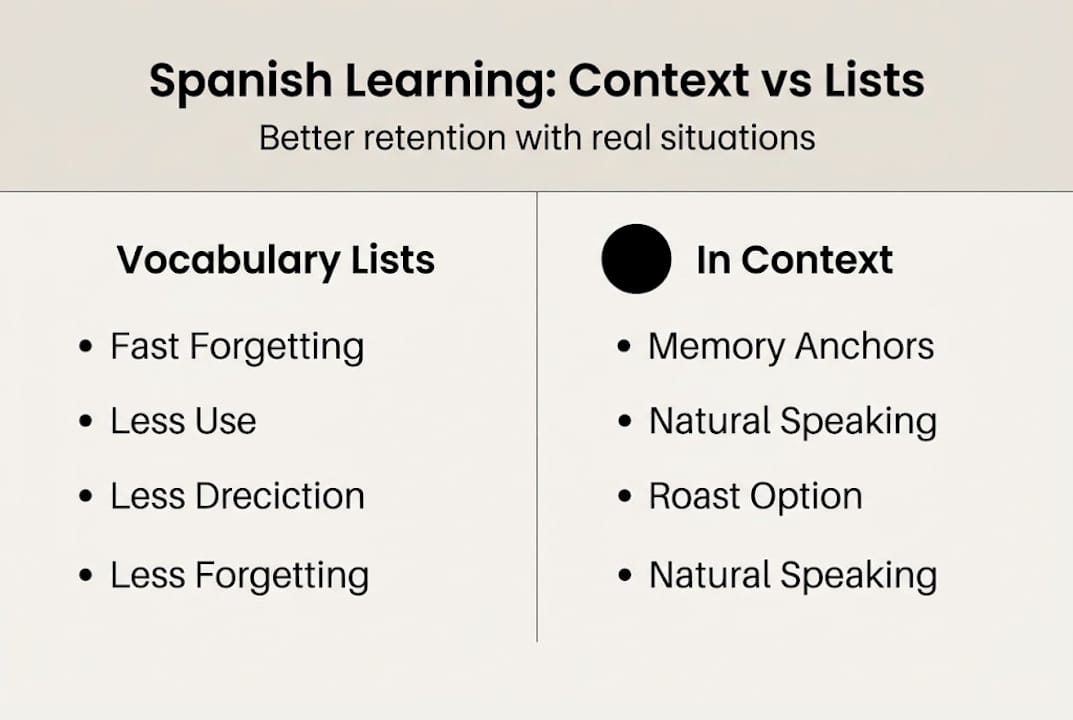
Vocabulary learned in isolation fades quickly. Most people who have studied a language at school will recognise this. You could recall words perfectly for a test on Friday and struggle to find them in a real conversation by Monday. The reason is that isolated memorisation does not build the retrieval pathways that spontaneous speech requires.
Context solves this by creating multiple memory anchors. When you learn la cola while reading about queuing at a Spanish government office, you attach the word to a situation, an emotion, perhaps even a mild sense of impatience. Those anchors make retrieval faster and more reliable under pressure.

Research confirms that contextual diversity facilitates vocabulary encoding, with words encountered across varied settings showing stronger long-term retention than those drilled in uniform exercises.
| Learning method | Retention after 1 week | Spontaneous use in conversation |
|---|---|---|
| Isolated vocabulary list | Low | Rare |
| Single-context repetition | Moderate | Occasional |
| Multi-context exposure | High | Consistent |
The same principle applies to grammar. Grammar-translation methods give you rules, but rules are fragile under the pressure of a fast-moving conversation. Context makes grammar feel natural because you absorb patterns through repeated exposure, the same way you learned English as a child.
Here is a practical sequence for embedding new vocabulary effectively:
- Encounter the word inside a real-life dialogue or scenario
- Use it immediately in a sentence related to your own life
- Review it in a different context the following day
- Revisit it again within a week, in yet another setting
- Apply it in a spoken or written exchange with another person
Pro Tip: Short Spanish podcasts or audio dialogues set in everyday situations are one of the most efficient tools available. Using audio lessons built around real-world scenarios gives your brain both the linguistic input and the situational context it needs to encode vocabulary deeply. Using a tool that improve vocabulary retention and improved pronunciation is essential
Grammar absorbed through context does not need to be consciously retrieved. It simply surfaces when you need it, because you have heard and used it enough times in situations that felt real.
The impact of cultural context on real-life fluency
Language and culture are inseparable. You can know every word in a sentence and still communicate the wrong thing entirely if you misread the cultural register. In European Spanish, this matters enormously. Knowing when to use tú versus usted, or understanding that vosotros is used in Spain but not in Latin America, is not a grammar footnote. It is the difference between sounding natural and sounding odd.
Cultural context enhances retention, motivation, and pragmatic use, including knowing when to use tú or vosotros in European Spanish, which directly affects how locals respond to you.
| Textbook Spanish | Practical immersion Spanish |
|---|---|
| Asking directions using formal script | Asking directions the way locals actually phrase it |
| Ordering food with textbook vocabulary | Understanding the waiter’s rapid reply and regional terms |
| Memorising polite phrases | Knowing when informality is expected and welcomed |
| Learning grammar rules in isolation | Picking up patterns through real conversations |
The cultural settings where this plays out most vividly include:
- The market where vendors speak quickly, use local slang, and expect directness
- The bar where informal register and regional expressions dominate
- The family dinner where warmth, humour, and overlapping speech are the norm
- Public transport where brief, practical exchanges happen at pace
These settings tie memory to emotion and practical necessity, which is precisely why they work. Exploring Spanish travel experiences in real locations accelerates this process considerably.
The motivational effect is equally important. When you successfully navigate a real cultural situation in Spanish, even a small one, you feel capable. That feeling drives further learning far more effectively than a good test score. Practical real-life fluency tips rooted in Spanish culture give you that edge.
Applying context-based strategies in your Spanish learning
Context provides purpose and real-world relevance to language tasks, and the good news is that you do not need to move to Spain to benefit from this approach. You can build context into your practice wherever you are.
Here is how to set up an immersive routine:
- Find a language partner or conversation meetup group focused on everyday topics, not textbook exercises
- Use shadowing to mimic native speakers in short audio clips, matching their rhythm and intonation
- Watch Spanish content with Spanish subtitles, pausing to absorb phrases in their natural setting
- Simulate real scenarios at home before you encounter them in Spain
- Reflect on actual exchanges you have had, noting what worked and what you struggled to express
Everyday scenarios worth practising regularly include:
- Ordering at a café and responding to the server’s follow-up questions
- Asking for and understanding directions in an unfamiliar neighbourhood
- Making a phone call to book an appointment or report a problem
- Greeting neighbours and sustaining a brief, natural conversation
- Shopping at a market and negotiating or clarifying prices
Pro Tip: Keep a language diary. Each day, write two or three sentences in Spanish about something that actually happened to you. This contextualises new words and phrases in your own experience, making them far easier to recall later. Mastering Spanish small talk begins with exactly this kind of low-pressure, personal practice.
Context-based strategies are also the most reliable way to break through a learning plateau. If you feel stuck, the answer is rarely more grammar study. It is more varied, realistic exposure. Try a new scenario, a new setting, or a new conversation partner. Each fresh context creates new retrieval pathways and reignites progress. Explore tips for speaking Spanish fluently with locals to find the scenarios that will stretch you most usefully.
The uncomfortable truth: context, not cramming, wins real-world Spanish
Here is something worth saying plainly. Many motivated, intelligent adults spend hundreds of hours studying Spanish and still cannot hold a basic conversation. This is not a failure of effort. It is a failure of method.
The learners who progress fastest are not the ones who memorise the most. They are the ones who put themselves into situations where Spanish is the only option, even imperfectly, even awkwardly. They make mistakes in front of people. They ask a shopkeeper to repeat something. They fumble through a phone call. And each time, they retain far more than any drilling session would have given them.
Conventional classroom techniques are genuinely useful for understanding structure, but they are built around predictability. Real Spanish is not predictable. Grammar-translation alone is fragile under the pressure of everyday communication, whereas context-trained recall surfaces naturally when you need it.
The learners who succeed are not the ones who studied hardest in isolation. They are the ones who let conversation in practice become their classroom.
If you have been studying for a while and still feel uncertain, the answer is not more vocabulary lists. It is more context, more real situations, and more willingness to use what you know before you feel fully ready.
Take your Spanish further with context-driven resources
Everything covered in this guide points in one direction: real progress in Spanish comes from learning inside context, not around it. James Spanish School was built on exactly this principle.
James Bretherton’s online Spanish lessons are structured around the situations you will actually face in Spain, from conversations with tradespeople to navigating local bureaucracy. The course uses Radical Simplification to make grammar feel intuitive rather than academic, and the ear-tuning lessons prepare you for the machine gun speed of native replies. For Spanish tips for everyday fluency grounded in 40 years of living in Spain, James Spanish School is where context-based learning comes to life. Click here to discover James Bretherton’s top tips for learning Spanish
Frequently asked questions
What does ‘context’ mean in Spanish learning?
Context means situational relevance. Words and grammar are learned within real-life scenarios, not in isolation, so they carry meaning and are easier to recall when you need them.
Does context-based learning really improve Spanish fluency?
Yes. Research shows that context-rich practice leads to better engagement and authentic conversational skills than traditional rote methods, particularly for adult learners.
How does cultural context help me use Spanish like a local?
Cultural context helps you choose the right forms, phrases, and register for each situation. Cultural context enhances pragmatic use, including knowing when tú or vosotros is appropriate, making your Spanish sound natural rather than textbook-formal.
What are some simple ways to add more context to my Spanish studies?
Try journalling about daily events in Spanish, role-playing common situations, or using audio lessons based on real-life scenarios. Contextual diversity facilitates vocabulary encoding, so varying your practice settings consistently delivers stronger results.