

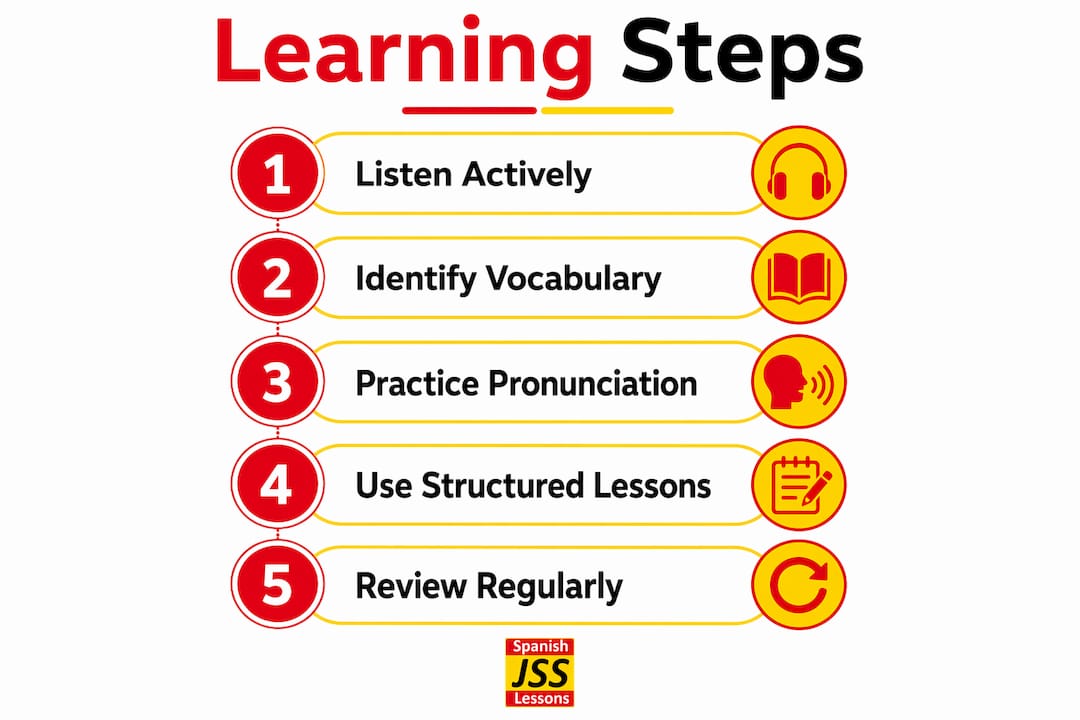
Using Spanish music to learn is most effective when you treat it as active study, not background noise. The method works like this: listen to a song without lyrics first, then follow the lyrics with a translation, sing aloud, and extract vocabulary to practise separately. Rhythm and melody encode words into memory in ways that silent reading simply cannot match. Here is the core process at a glance:
- Listen to the song two or three times without looking at the lyrics
- Read the lyrics line by line while listening, noting how words link together
- Translate the lyrics, focusing on meaning rather than word-for-word accuracy
- Select 8–10 new words or phrases and write them down with their meanings
- Create short sentences using those words to build context
- Sing along, repeating the chorus until the sounds feel natural in your mouth
- Review your chosen vocabulary using spaced repetition over the following days
Why learning Spanish through music actually works
The science here is clear and encouraging. Research by Ludke, Ferreira & Overy (2014) found that adults who sang unfamiliar vocabulary recalled it significantly better than those who simply spoke the same words aloud. Singing engages the motor cortex alongside the language centres of the brain, creating what researchers call “enriched encoding.” That is not a minor advantage.
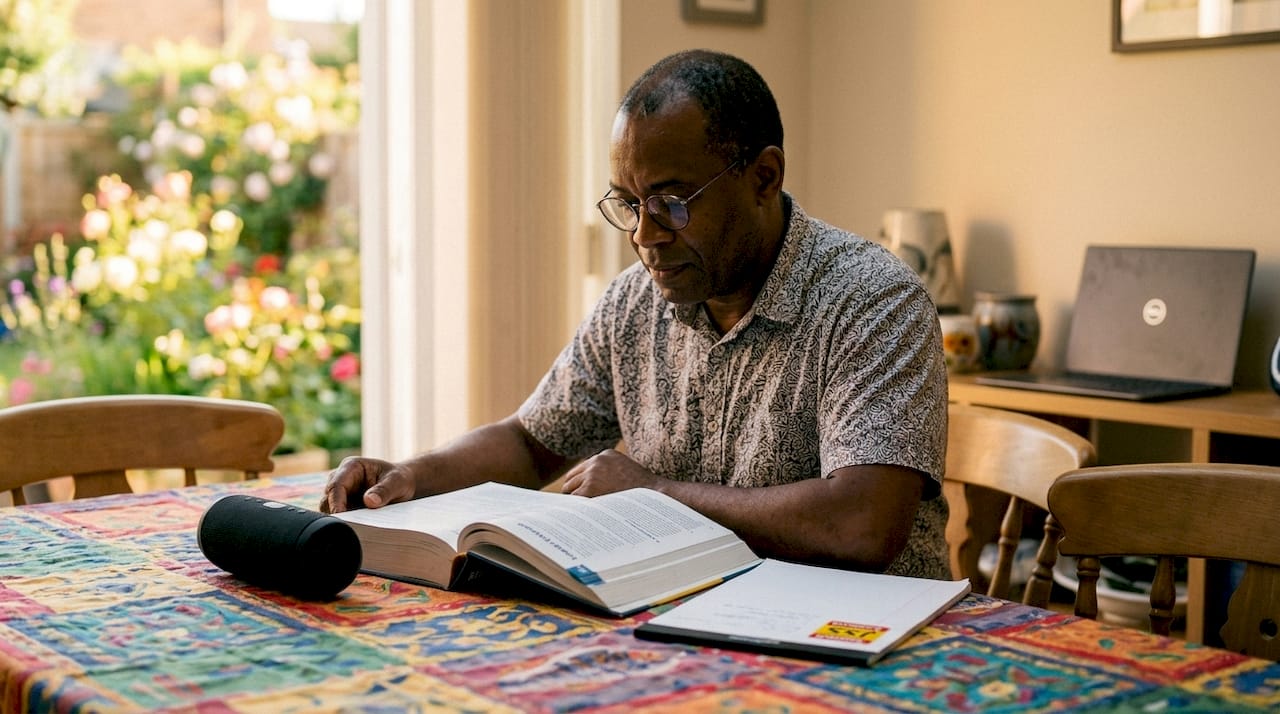
Spanish presents a particular challenge for English speakers: native speakers link words together at speed, making it hard to hear where one word ends and the next begins. Songs slow that process down and impose a rhythmic structure that helps your brain find those boundaries. If you have ever wondered why Spanish listening feels so hard, this word-linking tendency is usually the culprit, and music addresses it directly.
Music also delivers authentic cultural context that textbooks rarely capture. A bachata lyric teaches you how Spanish speakers actually express emotion. A pop chorus gives you the contractions and informal speech patterns that formal lessons skip. The benefits, in short:
- Improved pronunciation through repeated exposure to natural rhythm and stress patterns
- Better word segmentation in fast speech
- Stronger vocabulary recall through melody-linked memory
- Genuine cultural exposure through authentic language
- Higher motivation, which sustains consistent practice over time
One caveat worth stating plainly: music is a supplement, not a full curriculum. Passive listening alone does not build conversational fluency. You pick up sound patterns and catchy hooks, but you will not develop the ability to produce or understand Spanish in conversation without active practice alongside it.
Techniques that turn songs into real Spanish learning
The difference between a learner who improves and one who just enjoys the music comes down to method. Active engagement is everything.

Pro Tip: Sing the vocabulary aloud rather than just reading it. Singing unfamiliar words improves recall more than speaking them, because producing the sounds yourself deepens the memory trace. You do not need to sound good. You just need to open your mouth.
Follow this sequence for each song you study:
- First listen, no lyrics. Notice the rhythm, catch any words you already know, and let your ear adjust to the pace and accent.
- Second listen with lyrics. Read along and observe how words run together. Pay attention to the translation but do not obsess over every single word.
- Vocabulary extraction. Pick 8–10 words or phrases that are new and useful. Write them down, note their meanings, and build a short example sentence for each.
- Sing along. Repeat the chorus and any verse you find difficult. Your mouth learns the movements just as your brain learns the meaning.
- Spaced repetition review. Return to your vocabulary list the next day, then three days later, then a week later. This spacing locks words into long-term memory far more reliably than a single session.
Combine music practice with audio-based Spanish lessons to reinforce what you hear in songs with structured sentence-building. Music gives you the sound; structured study gives you the grammar engine to use it.
How to choose the right Spanish songs for learners in the UK
Song choice matters more than most learners realise. The wrong song at the wrong level produces frustration, not progress.
- Start slow, literally. Ballads and slower pop tracks give you time to hear individual words. Fast reggaeton at beginner level is mostly noise your brain cannot map to meaning.
- Look for clear pronunciation. Artists like Shakira and Enrique Iglesias enunciate clearly. Their tracks are excellent starting points because the words are audible even at natural speed.
- Match the theme to your goals. If you are moving to Spain, songs about everyday life, relationships, and places give you vocabulary you will actually use.
- Progress through genres as you improve. Once you can follow a slow ballad comfortably, move into bachata, cumbia, and eventually reggaeton. Each genre exposes you to different accents, regional slang, and speech rhythms.
- Use reliable lyric sources. Genius.com and AZLyrics carry accurate Spanish lyrics for most popular tracks. For translations, DeepL gives you a solid working version that you can then refine yourself.
- Choose music you genuinely enjoy. Motivation is not a soft concern. Learners who enjoy their practice material study more consistently, and consistency is what produces results.
Pro Tip: Search for “canciones para aprender español” on YouTube. Several channels publish songs written specifically for learners, with controlled vocabulary and clear diction. These are ideal for the first few months before you move to mainstream artists.
How James Spanish School and the WordAmigo System enhance learning through music
James Bretherton, founder of James Spanish School, has lived in Spain for 40 years and speaks Spanish as a dual native. His teaching method, called Radical Simplification, strips out the grammar terminology that native speakers never use when they learn their own language. Instead, he explains Spanish structure in plain English, making the logic of the language accessible to adult learners without the intimidation of academic jargon.
The WordAmigo System is an AI-powered vocabulary and pronunciation tool built specifically for adult learners of European Spanish. It uses a Five-Step Retention Loop to embed words permanently, cycling through reading, listening, speaking, and writing in a sequence that mirrors how memory consolidates new information. This is precisely the kind of active, multi-modal engagement that the research on music-based learning points to as most effective.
The 100-lesson James Spanish School course divides its focus between sentence-building and “ear-tuning,” the latter designed specifically to help learners follow fast spoken Spanish. That ear-tuning component works in direct partnership with music practice: songs train your ear to the rhythm and sound of Spanish, while the course trains you to decode and produce it. The two reinforce each other.
Key features of the James Spanish School approach:
- Radical Simplification: no grammar jargon, plain English explanations throughout
- WordAmigo’s Five-Step Retention Loop for vocabulary and pronunciation
- 100 on-demand lessons available 24/7 on any device
- Ear-tuning lessons focused on fast, natural spoken Spanish
- A cast-iron guarantee: if a core lesson teaches you nothing new, James credits you with extra practice modules at no cost
- Real-life focus on everyday conversations, not academic exams
For UK learners who want to learn Spanish online at their own pace, this combination of structured course work and music-based practice covers every angle: grammar, vocabulary, pronunciation, and listening comprehension.
Ready to put the method into practice? Explore the James Spanish School course and the WordAmigo System at jamesspanishschool.com/shop-blg and start building the Spanish you actually need for real life in Spain.
Key takeaways
Using Spanish music to learn works best when active engagement, structured vocabulary practice, and a solid course sit alongside each other.
| Point | Details |
|---|---|
| Active engagement is essential | Passive listening builds familiarity but not fluency; translate, sing, and review vocabulary every session. |
| Singing beats speaking for recall | Research shows singing unfamiliar vocabulary produces stronger memory retention than speaking it aloud. |
| Song choice shapes progress | Start with slow, clearly pronounced tracks and move to reggaeton and bachata as your ear improves. |
| Music supplements, not replaces, structure | Pair songs with a structured course to develop the grammar and sentence-building skills music alone cannot teach. |
| WordAmigo deepens retention | James Spanish School’s Five-Step Retention Loop automates the multi-modal practice that makes vocabulary stick permanently. |