

Why learn real phrases.
Learning real phrases is the single most direct route to sounding natural in a new language. A “real phrase” is a multi-word lexical chunk — a fixed or semi-fixed expression that native speakers use automatically, without assembling it word by word. Think “I’m so sorry,” “How are you getting on?” or the Spanish “¿Qué tal?” These are not grammar exercises. They are the actual building blocks of fluent speech.
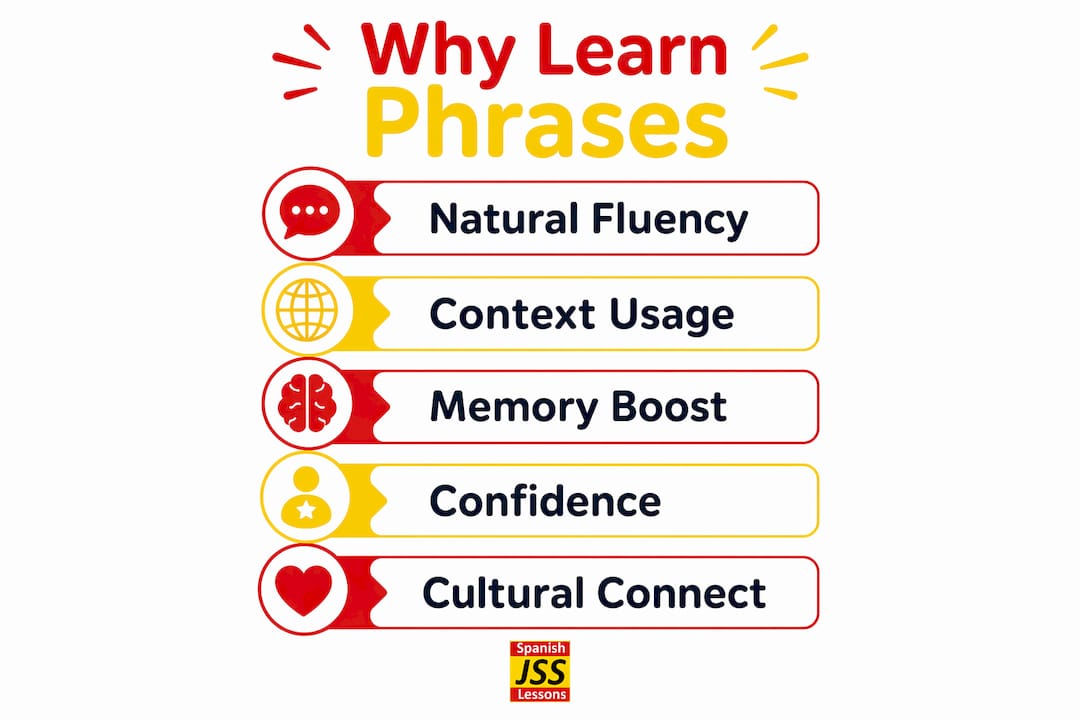
Research from Cambridge ELT confirms three core reasons to prioritise phrase learning:
- Fluency: memorised chunks allow faster processing in both speaking and listening, because retrieving a ready-made expression from memory is quicker than constructing one from scratch.
- Idiomaticity: phrases help you choose the expressions native speakers actually use, rather than grammatically correct but unnatural alternatives.
- Grammar development: phrases learned as wholes later get broken down into frames with slots, giving you the raw material for building new sentences by analogy.
Why learning phrases beats isolated words
The difference between knowing words and knowing phrases is the difference between owning bricks and knowing how to build a wall. You can memorise a thousand individual words and still sound stilted the moment you open your mouth.
Lexical chunks are stored and retrieved as complete units in long-term memory. That means when you need to express agreement, a phrase like “I see eye to eye with you on that” comes out whole, without the mental gymnastics of selecting each word and checking the grammar. Learners who rely on isolated vocabulary, by contrast, are forced to translate word by word, which slows speech and produces unnatural output.
The benefits of phrase learning over word-by-word study are well documented:
- Natural speech: phrases reflect how native speakers actually talk, so your output sounds right even when your grammar knowledge is incomplete.
- Faster recall: ready-made chunks reduce cognitive load during conversation, freeing mental space to listen, plan, and respond.
- Contextual grammar: seeing a phrase in use shows you how grammar works in practice, without needing to memorise abstract rules.
- Practical vocabulary: phrases are aligned with real communication needs, not just dictionary definitions.
- Comprehension gains: phraseological knowledge improves reading and listening comprehension alongside production skills.
The English Vocabulary Profile, built on corpus evidence from over a billion words of real language use, lists phrases as a substantial component of vocabulary knowledge at every CEFR level. Even learners who know the top 2,000 most frequent words will struggle if they do not know how those words combine into phrases.
Practical tips for learning and using real phrases effectively
The gap between knowing a phrase and using it automatically is closed by one thing: deliberate, repeated practice in context. Here is how to do it well.
- Choose phrases with high fixedness and idiomaticity. Teachable, prototypical chunks are easier to memorise and more reusable than obscure idioms. Start with phrases that appear frequently in real conversation.
- Encounter phrases in authentic contexts. Films, podcasts, and real conversations show you not just the phrase but when and how to use it. Context is what makes a phrase stick.
- Use spaced repetition. Reviewing phrases at increasing intervals moves them from passive recognition to automatic production. James Spanish School’s WordAmigo system automates this process across reading, listening, speaking, and writing.
- Recycle phrases actively. Textbooks often introduce phrases once and never revisit them, which is why learners recognise expressions but cannot produce them under pressure. Build in regular review.
- Balance phrase learning with vocabulary and grammar. Phrases are the engine room, but you also need individual words and structural knowledge to generate new sentences. Neither alone is sufficient.
Pro Tip: When selecting which phrases to learn first, prioritise those that contain slots for variable fillers, such as “Can I have a…?” or “I’d like to…”. These generalisable frames give you far more communicative range than a fixed phrase you can only use in one situation.
How James Spanish School approaches real phrases and fluency
James Bretherton has lived in Spain for 40 years as a dual-native speaker, and the method he built at James Spanish School reflects that depth of real-world experience. The course does not teach Spanish through abstract grammar rules. It teaches through the structural logic of how Spanish actually works, using plain English explanations and, critically, the phrases that come up in everyday life in Spain: conversations with neighbours, shop staff, tradesmen, health workers, and local officials.
The WordAmigo system is the vocabulary and pronunciation architecture that sits at the heart of the course. Built by IT experts and long-term English expats working alongside James, it uses AI-driven spaced repetition to permanently embed phrases and vocabulary through a five-step retention loop covering reading, listening, speaking, and writing. Pronunciation is built in from the start, so learners do not just recognise phrases on paper but can produce them in a way native speakers understand.
Key takeaways from the James Spanish School approach:
- Phrase learning is embedded in real-life Spanish contexts, not academic exercises.
- The WordAmigo system automates the full retention cycle, removing the guesswork from review schedules.
- Ear-tuning lessons train learners to follow fast native speech, where phrases are delivered at machine-gun speed.
- The cast-iron guarantee means that if a core lesson teaches you nothing new, James credits you with extra practice modules at no cost.
You can explore practical Spanish fluency tips that align directly with this phrase-first approach.
Examples of real phrases across everyday contexts
Phrases are not abstract. They belong to specific situations, and knowing which phrase fits which moment is what separates a confident speaker from a hesitant one. Here are common phrase categories with examples across different contexts.

Greetings and social contact
“¿Qué tal?” (How are things?), “Mucho gusto” (Pleased to meet you), “¿Cómo le va?” (How are you getting on?). These are the phrases you need within the first thirty seconds of any conversation.
Requests and transactions
“¿Me pone un café, por favor?” (Can I have a coffee, please?), “¿Cuánto es?” (How much is it?), “¿Tiene cambio?” (Do you have change?). Mastering these transforms a trip to a Spanish bar or market from a stressful guessing game into a natural exchange.
Expressing difficulty or misunderstanding
“No entiendo” (I don’t understand), “¿Puede repetir más despacio?” (Can you repeat that more slowly?), “¿Cómo se dice…?” (How do you say…?). These phrases are lifelines, and knowing them reduces anxiety enormously.
Formal and official situations
“Quisiera hacer una consulta” (I’d like to make an enquiry), “¿Podría hablar con el responsable?” (Could I speak to the person in charge?). These matter when dealing with health workers or local government offices.
Learning new language benefits go well beyond the phrases themselves: confidence, cultural connection, and cognitive engagement all follow from being able to communicate naturally.
Common challenges when learning real phrases and how to overcome them
The most common frustration adult learners report is this: they recognise a phrase when they hear it but cannot produce it when they need it. That gap between passive and active knowledge is real, and it has a clear cause.
EFL textbooks at B1 and B2 level typically introduce phraseological units in a limited range of exercises and then never revisit them. Without recycling, phrases stay at the surface of memory rather than becoming automatic. The fix is deliberate repetition across multiple modes, not just reading a phrase once and moving on.
A second challenge is choosing the wrong phrases to learn. Obscure idioms with no obvious logic are far harder to retain than phrases with transparent meaning or a memorable image behind them. Phrases like “jump the gun” become memorable once you understand the sporting reference; without that hook, they are just noise.
A third obstacle is pronunciation. You might know a phrase perfectly on paper but deliver it in a way that leaves native speakers puzzled. This is where audio-based practice, with real native recordings, makes a concrete difference to whether your phrases actually land in conversation.
How to bring real phrases into your daily speaking and writing
The most effective method is also the simplest: use a phrase the same day you learn it. Passive study builds recognition; active use builds production. These habits move phrases from your notes into your mouth.

In speaking: choose two or three phrases each day and find a way to use them, whether in a language exchange, a conversation with a native speaker, or even narrating your own activities aloud. Repeating Spanish lessons reinforces phrase retention far more effectively than moving on to new material before the old material is secure.
In writing: keep a short daily journal in your target language. Aim to use at least one new phrase per entry. Writing forces you to recall a phrase actively rather than just recognise it, which accelerates the move to automatic production.
In listening: pay attention to how native speakers use the phrases you are learning. Podcasts, films, and real conversations all provide this input. When you hear a phrase you have studied, your brain registers it differently than it would an unknown expression, and that recognition reinforces the memory.
For learners working on Spanish small talk, the same principle applies: practise the phrases you need for the situations you actually face, not a generic list from a textbook.
Ready to put real phrases to work?
James Spanish School’s 100-lesson course is built around exactly this principle: real phrases, real contexts, and a system that makes them stick. The WordAmigo AI retention system handles the repetition cycle for you, so you spend your time using Spanish rather than struggling to remember it. There is no expiry date and no countdown clock.
Start learning real Spanish today and hear the difference that phrase-first learning makes from your very first lesson.
Key takeaways
Learning real phrases, rather than isolated words, is the most direct path to fluent, natural-sounding language use.
| Point | Details |
|---|---|
| Phrases enable faster speech | Retrieving a memorised chunk is quicker than assembling a sentence word by word, reducing cognitive load in real conversation. |
| Idiomaticity comes from phrases | Knowing individual words does not guarantee natural expression; phrases carry the patterns native speakers actually use. |
| Recycling is non-negotiable | Phrases introduced once and never revisited stay passive; consistent repetition across reading, listening, speaking, and writing builds automatic production. |
| Choose teachable chunks first | Prioritise phrases with high fixedness and generalisable slots, as these are easier to memorise and more versatile in use. |
| Balance with vocabulary and grammar | Phrase learning is the engine room of fluency, but individual word knowledge and structural understanding are needed alongside it for full communicative competence. |