

Pretérito indefinido vs imperfecto comes down to one question: is the action finished, or was it happening? Indefinido reports completed events; imperfecto paints the ongoing scene around them.
- Indefinido: Ayer comí paella. (Yesterday I ate paella — done, finished, over.)
- Imperfecto: Cuando era niño, comía paella cada domingo. (When I was a child, I used to eat paella every Sunday — a repeated, ongoing habit.)
Before you pick a verb ending, ask yourself: “Am I reporting a finished event, or describing what was going on?” That single question solves most of the confusion.
Key Takeaways
Mastering pretérito indefinido vs imperfecto depends on judging whether an action is complete or ongoing, then reinforcing that judgement through repeated, spoken practice rather than rule memorisation.
| Point | Details |
|---|---|
| Aspect decides the tense | Ask whether the action is a finished event (indefinido) or an ongoing state (imperfecto) before conjugating. |
| Six irregulars carry most weight | Master fui, tuve, estuve, hice, dije first; imperfecto has almost no irregular forms. |
| Signal words are shortcuts | Scan for ayer, de repente (indefinido) or mientras, siempre (imperfecto) before choosing the verb. |
| Meaning-shift verbs need memorising as phrases | Sabía versus supe, conocía versus conocí change meaning, not just tense. |
| Structured repetition builds automatic use | James Spanish School’s sentence-building lessons and WordAmigo drills turn tense choice into instinct rather than calculation. |
Table of Contents
- Why indefinido and imperfecto really differ
- How do you conjugate indefinido and imperfecto?
- What words signal indefinido or imperfecto?
- Verbs that change meaning between tenses
- Practice exercises: indefinido vs imperfecto
- James’s shortcut for choosing the right tense fast
- Telling stories vs setting the scene in Spanish
- The most common mistakes English speakers make
- Do Spanish speakers everywhere use these tenses the same way?
- Signal phrases for interrupted vs simultaneous actions
- Get guided practice with structured Spanish lessons
- Frequently asked questions
- Sources
Why indefinido and imperfecto really differ
The grammar terms sound intimidating, but the idea is not. Spanish speakers use aspect to signal whether an action is viewed as a closed, complete unit (perfective, indefinido) or as an unfolding, open-ended process (imperfective, imperfecto). English does not mark this distinction the same way, which is exactly why it trips up so many learners.
Picture watching an event from two camera angles. Indefinido shoots from outside: you see the whole thing, start to finish, in one frame. Trabajó ocho horas. (She worked eight hours; the shift is complete.) Imperfecto shoots from inside: you are standing in the middle of it, with no clear edges. Trabajaba mientras yo cocinaba. (She was working while I was cooking; both actions are still in motion when the sentence ends.)
The imperfecto does not assert that an action finished. The indefinido carries a terminative feature, meaning it inherently signals completion, according to the Instituto Cervantes.
That distinction explains why native speakers infer completion or non-completion almost automatically:
- Indefinido answers “what happened?” It moves the story forward.
- Imperfecto answers “what was going on?” It sets the scene, describes habits, or gives background detail.
Once you start reading Spanish with that inside-versus-outside lens, the tense choice usually reveals itself, rather than requiring a memorised rule for every sentence.
How do you conjugate indefinido and imperfecto?
The regular endings are worth learning as a fixed set, because once they are automatic, you stop pausing mid-sentence.
Imperfecto (regular):
- -ar verbs: -aba, -abas, -aba, -ábamos, -abais, -aban
- -er/-ir verbs: -ía, -ías, -ía, -íamos, -íais, -ían
Indefinido (regular):
- -ar verbs: -é, -aste, -ó, -amos, -asteis, -aron
- -er/-ir verbs: -í, -iste, -ió, -imos, -isteis, -ieron
Imperfecto has almost no irregulars, which is one small mercy: only ser, ir, and ver deviate. Indefinido is where the irregular verbs cluster, and these six carry most of the weight in everyday conversation:
- ser/ir → fui (“I was” / “I went”)
- tener → tuve (“I had”)
- estar → estuve (“I was” / “I stayed”)
- hacer → hice (“I did/made”)
- decir → dije (“I said”)
Pro Tip: Group the irregulars by shared stem changes (tuve, estuve, and anduve all follow the same pattern) rather than memorising each one alone. Your brain retains families of forms far better than isolated exceptions.
What words signal indefinido or imperfecto?
Certain words act as flags before you even reach the verb, and scanning for them first speeds up both reading and speaking.
| Favours indefinido | Favours imperfecto |
|---|---|
| ayer, anoche, el año pasado | mientras, siempre, a menudo |
| de repente, una vez | todos los días, normalmente |
| durante tres horas (as a closed span) | de niño/a, cuando era joven |
Paired in context: Ayer llovió toda la tarde (yesterday it rained all afternoon, a finished event) versus Mientras llovía, yo leía (while it was raining, I was reading, both ongoing). According to teaching guides that catalogue these markers/09/40_Preterites), spotting the time marker before you conjugate anything is the fastest route to the right tense, because the adverb usually decides the verb, not the other way round.
Verbs that change meaning between tenses
A handful of verbs shift meaning depending on which past tense carries them, and this is where English speakers get caught out most often.
- Saber: imperfecto = “knew” (Sabía la respuesta); indefinido = “found out” (Supe la respuesta ayer).
- Conocer: imperfecto = “knew/was acquainted with” (Conocía a María); indefinido = “met for the first time” (Conocí a María en 2019).
- Poder: imperfecto = “was able to, in general” (Podía nadar); indefinido = “managed to, on that occasion” (Pude terminar el examen).
- Querer: imperfecto = “wanted” (Quería salir); indefinido = “tried, or decisively wanted and acted” (Quise llamarte).
- Tener que: imperfecto = “was supposed to” (Tenía que estudiar); indefinido = “had to, and did” (Tuve que estudiar).
Practise these as short fixed phrases rather than as abstract conjugation drills; the meaning sticks faster when it is attached to a whole sentence. Reported speech follows the same imperfecto logic: Dijo que vivía en Madrid backshifts the present into imperfecto, not indefinido.
Practice exercises: indefinido vs imperfecto
Exercise A. Choose indefinido or imperfecto for each: 1) Ayer (yo/comer) ___ paella. 2) Cuando era niño, (yo/jugar) ___ al fútbol cada tarde. 3) De repente, (ella/gritar) ___. 4) (Nosotros/conocer) ___ a Juan en 2015. 5) Mientras tú (dormir) ___, yo (trabajar) ___. 6) (Yo/tener que) ___ salir temprano ese día. 7) Siempre (ellos/viajar) ___ en verano. 8) (Yo/poder) ___ terminar el trabajo a tiempo.
Answers: 1) comí 2) jugaba 3) gritó 4) Conocimos 5) dormías / trabajaba 6) Tuve que 7) viajaban 8) Pude.
Exercise B. Take a paragraph describing a holiday and rewrite it twice: once so every verb reports a finished action (indefinido), once so it reads as background description (imperfecto). Compare how the mood shifts.
Exercise C. Write two sentences about yesterday: one using indefinido for what happened, one using imperfecto for what was going on around it. Model answer: Salí de casa a las ocho. Hacía mucho frío.
For structured drills built the same way, the spoken practice lessons walk through both tenses inside real conversation contexts rather than isolated grammar tables.
James’s shortcut for choosing the right tense fast
James Bretherton built his teaching method around what he calls Radical Simplification: stripping out grammar terminology that native speakers never think about and replacing it with plain decision rules. Rather than asking “is this imperfect or preterite?”, the question becomes “was it finished, or was it happening?”
Two drills reinforce this quickly. First, sentence-building with audio repetition: you hear a sentence, repeat it aloud, then swap the verb between tenses to feel the meaning change. Second, mixed listening and cloze exercises, where you fill a gap while listening and then say your answer out loud immediately. Translating word-for-word from English is where most errors creep in; shifting to a process-versus-completed mindset closes that gap faster than any rule list, and short, repeated practice with instant feedback beats a single long grammar session every time.
Telling stories vs setting the scene in Spanish
Spanish narrative leans on both tenses working together, and this is where the distinction stops being theoretical and starts sounding like real storytelling. Indefinido drives the plot forward: it names the events that happen one after another, the backbone of what occurred. Imperfecto paints everything around those events: the weather, the mood, what someone was wearing, what was already true when the action started.

A typical narrative passage mixes both within the same paragraph. Eran las diez de la noche. Llovía y hacía frío. De repente, alguien llamó a la puerta. The first three verbs (eran, llovía, hacía) are imperfecto, setting a static scene. The fourth verb (llamó) is indefinido, and it is the moment the story actually moves. Without that shift, the knock would just be more scenery rather than the event that kicks the plot into action.
This split explains why fairy tales so often open with Había una vez… (“Once upon a time there was…”) using imperfecto: the storyteller is establishing a background state, not reporting a single completed event. Once the specific incidents begin, indefinido takes over. Reading graded short stories with this pattern in mind, watching which verbs move the plot and which ones simply describe, trains your ear faster than studying either tense in isolation. The practical Spanish speaking situations list gives you real scenarios where this narrative pattern shows up in everyday speech, not just in books.
The most common mistakes English speakers make
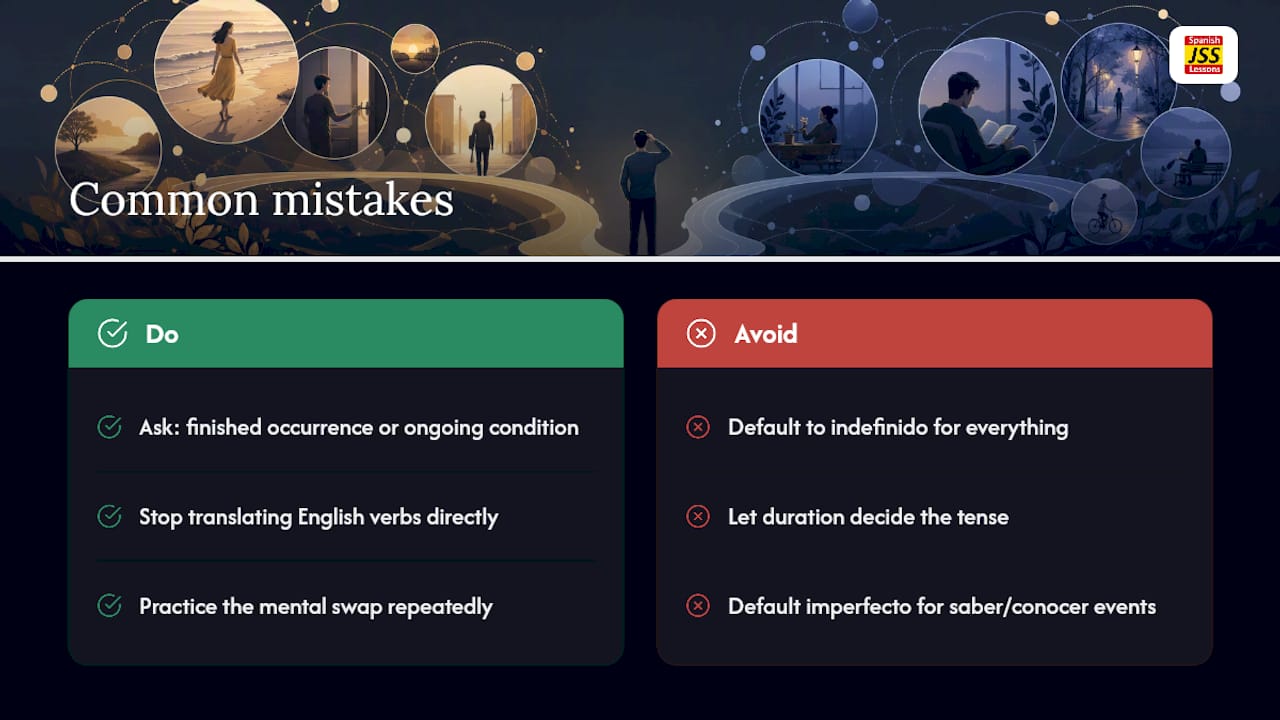
The biggest trap is direct translation. English uses one simple past (“I ate”, “I was eating” aside) for situations Spanish splits into two tenses, so learners often default to indefinido for everything because it feels like the “normal” past tense. That habit produces sentences that sound abrupt or oddly final where a native speaker would expect background description.
A second common error is treating duration as the deciding factor rather than completion. Learners assume that if an action lasted a long time, it must be imperfecto, and if it was quick, it must be indefinido. That is not the rule. Viví en Madrid durante diez años is indefinido despite the decade-long span, because the residency is being reported as a closed, finished chapter. Duration matters far less than whether the speaker is framing the action as complete or as an open backdrop.
A third mistake is misusing the meaning-shift verbs covered earlier, especially saber and conocer, by defaulting to imperfecto because “knowing” feels like a state rather than an event. That instinct is often right, but it breaks down the moment the sentence describes the instant something became known, which calls for indefinido.
The fix in every case is the same: stop translating the English verb and start asking whether the Spanish sentence is naming a finished occurrence or describing an ongoing condition. That mental swap, practised repeatedly, retrains the instinct faster than memorising exception lists.
Do Spanish speakers everywhere use these tenses the same way?
The core aspectual rule (completed versus ongoing) holds across every Spanish-speaking region, but usage habits shift at the edges. In much of Latin America, particularly Mexico and large parts of Central America, indefinido dominates even in contexts where Peninsular Spanish might lean on the present perfect (he comido) for very recent events; this does not change the indefinido-versus-imperfecto choice itself, but it does mean learners hear indefinido used slightly more freely for “just happened” events.
Within Spain, regional teaching guidance generally treats the imperfecto/indefinido split as stable and standard across dialects, since it reflects aspect rather than a regional preference. Where you will notice variation is in storytelling register: some Caribbean and Andean varieties favour a slightly more compressed narrative style with fewer imperfecto scene-setting clauses, while Peninsular Spanish (the variety James Spanish School teaches) tends to use fuller descriptive imperfecto passages before moving the action forward with indefinido.
None of this changes the underlying grammar you need to learn. Focus on mastering the aspectual distinction first; regional flavour is a matter of style you absorb naturally once the core system is automatic, not a separate rule set to memorise.
Signal phrases for interrupted vs simultaneous actions
Two very different sentence shapes both mix indefinido and imperfecto, and confusing them is a frequent source of errors. The first shape signals an interruption: something ongoing (imperfecto) is broken by a sudden, completed event (indefinido). The classic marker is cuando: Yo dormía cuando sonó el teléfono (I was sleeping when the phone rang). The imperfecto sets the ongoing state; the indefinido is the interrupting jolt.
The second shape signals two things happening at once, both framed as ongoing. The marker here is usually mientras: Mientras yo cocinaba, ella leía (while I was cooking, she was reading). Both verbs stay in imperfecto because neither action is presented as complete; they run in parallel.
The practical test: if one action clearly cuts into another and changes what was happening, reach for cuando plus indefinido for the interrupting event. If two actions are simply coexisting in the background with no interruption, reach for mientras plus imperfecto on both sides. Mixing this up, using indefinido on both verbs in a mientras sentence, is one of the more noticeable mistakes English speakers make, because it turns a shared, unfolding scene into two separate, disconnected events.
Get guided practice with structured Spanish lessons
Reading rules is one thing; making the right tense come out of your mouth without hesitating is another. James Spanish School’s course builds past-tense fluency through the same repetition-based method covered above, so the choice between indefinido and imperfecto eventually becomes automatic rather than something you calculate mid-sentence.
The course combines sentence-building lessons with audio drills specifically aimed at past-tense contrasts, so you hear both tenses used correctly before you are asked to produce them yourself. The WordAmigo repetition system then locks in the verb forms and signal words covered in this article through spaced review, rather than a single pass you are expected to remember forever. Every lesson is on demand with lifetime access, so a tricky tense contrast like this one can be revisited as many times as it takes.
- Sentence-building lessons that drill indefinido and imperfecto in real contexts
- Audio repetition to fix irregular forms like fui, tuve, and estuve
- WordAmigo spaced repetition for the signal words and meaning-shift verbs covered above
- Lifetime access with no countdown pressure
Head to the James Spanish School course to see the full lesson structure and start practising these tenses in context today.
Frequently asked questions
Is there a simple trick for indefinido vs imperfecto fácil?
Ask “finished or ongoing?” before you conjugate. If the action is a single completed event, use indefinido; if it describes background, habit, or something in progress, use imperfecto.
When to use imperfect instead of indefinido?
Use imperfecto for repeated or habitual past actions, descriptions (weather, age, feelings), and actions interrupted by another event. Use indefinido for the interrupting event itself.
What is the difference between pretérito and imperfecto in one sentence?
Indefinido reports what happened as a closed, complete event; imperfecto describes what was happening, ongoing or unfinished, at that same moment.
Do saber and conocer always follow the same pattern as other verbs?
No. Imperfecto gives a state (“knew”, “was acquainted with”), while indefinido marks the moment of finding out or meeting someone, so these verbs need separate memorisation from regular aspect rules.
How many exercises does it take to stop hesitating between the two tenses?
There is no fixed number, but consistent short practice, a few minutes daily rather than one long session, builds the instinct far faster than isolated grammar study alone.