

Learning Spanish cost
Expect to pay somewhere between €10 and €50 an hour for live tuition, or a single one-off fee of roughly €50 to a few hundred euros for a self-paced course. The three main routes are private one-to-one tutoring, group or school packages, and self-paced paid courses you complete on your own schedule. Below, you’ll find real euro examples for each, the factors that push prices up or down, and a checklist for judging whether a quote is fair.
TL;DR:
- Private lessons typically cost between €10 and €35 per hour, with discounts available when purchasing multiple sessions or bundles.
- Course prices vary based on teacher experience, lesson length, class size, and specialization, influencing overall value and quality.
- Self-paced courses usually charge a one-time fee from €50 to several hundred euros, often offering better value for disciplined learners.
- To determine if a price is fair, consider your goals, commitment capacity, budget, need for correction, and whether a trial lesson is available.
- Additional costs for materials or exam registration can increase the total spend, so ask for a clear breakdown beforehand.
Table of Contents
- How much does it cost to learn Spanish online?
- Why do prices vary so much between teachers and formats?
- How do you know if a price is fair?
- What’s included in the price, and what gets added later?
- Why James Spanish School is worth comparing against hourly tuition
- Ready to stop paying by the hour?
- Sources
How much does it cost to learn Spanish online?
Private tutors typically charge between $15 and $50 an hour, according to Preply’s pricing guide, though most European platforms and independent teachers land closer to a €10 to €35 hourly band once you account for currency and regional variation, as broader market surveys of Spanish lesson pricing confirm. School-run packages sit higher, often €100 to €600 depending on intensity and hours included. Self-paced courses break the hourly model entirely: you pay once, usually from around €50 to several hundred euros, and the clock never resets.
Real examples make this easier to picture. Some Spanish schools list single online lessons at roughly €28 to €38 each, with 5-lesson packages priced around €150 to €175. Ten-lesson bundles commonly fall between €300 and €360, working out slightly cheaper per session than buying singly. Intensive four-week courses with daily teacher-led hours can range from about €180 to €460, depending on how many hours per day you commit to.
- 1 lesson: around €28 to €38, no discount applied
- 5 lessons: roughly €150 to €175, a modest saving per hour
- 10 lessons: around €300 to €360, the per-lesson price starts dropping noticeably
- 20 lessons: typically the best per-hour rate, often used by learners aiming for a specific milestone
- Intensive 4-week course: roughly €180 to €460 depending on daily hours
Representative benchmark: A single private hour with an online tutor commonly costs between €10 and €35, based on aggregated platform pricing data, while schools packaging that same hour into a 10 or 20-lesson bundle usually shave several euros off each session.
Package discounts exist because schools want continuity as much as you do. Buying in bulk, or as a couple, tends to lower the per-person cost, and continuity itself tends to produce faster, steadier progress than sporadic single bookings.
Why do prices vary so much between teachers and formats?
Two tutors both charging €25 an hour can offer wildly different value. A handful of factors explain the spread, and knowing them stops you overpaying for the wrong thing or underpaying for something that won’t actually get you speaking.
- Teacher qualifications and experience: a newly certified tutor charges less than someone with a decade of exam-prep or business Spanish specialism.
- Lesson length and class size: a 30-minute mini-group session costs far less per head than a 60-minute one-to-one.
- Platform or agency fees: marketplaces take a cut, which pushes the advertised rate above what an independent teacher might charge directly.
- Specialism: exam preparation (DELE, SIELE) or business Spanish tuition commands a premium over general conversation practice.
- Commitment model: subscription or “unlimited” formats, such as the monthly unlimited plan from BaseLang, bundle many hours into one flat fee, which suits daily learners but wastes money on anyone who only manages one session a week.
Recorded, self-paced study sits at the opposite end: no live teacher cost at all, which is exactly why a one-off fee can undercut months of hourly tuition for learners who are disciplined enough to work through material alone.
Pro Tip: Before paying a premium rate, ask for a short sample lesson. A tutor worth €40 an hour should correct your pronunciation in real time, not just chat pleasantly for an hour. If they don’t actively target your mistakes, you’re paying live-tuition prices for what a recorded course could do for less.
How do you know if a price is fair?
Work through these five questions before you commit to anything:
- What’s your actual goal? Passing an exam, chatting with neighbours, or surviving a work call all need different tuition.
- How many hours a week can you realistically commit? Be honest, not aspirational.
- What’s your monthly budget ceiling? Decide this before you start browsing, not after you’ve fallen for a sales page.
- Do you need active correction and pronunciation feedback? If yes, self-paced alone probably won’t cut it without a strong audio component.
- Does the provider offer a trial lesson? Any tutor or school confident in their teaching will let you sample it first.
When you contact a tutor or school, ask directly: what does the advertised price include, is there a package discount, what happens if you need to cancel or reschedule, and how are teachers vetted? Red flags worth walking away from: no trial option, no clear cancellation policy, vague answers about who’s actually teaching you, and pressure to buy a large package before you’ve had a single lesson. Live lessons suit learners who need conversation confidence and correction; self-paced suits those who progress well independently and want to control the pace themselves.
What’s included in the price, and what gets added later?
Most reputable providers include a level test, core didactic material, homework correction, and a certificate of attendance in the headline price. What often isn’t included: printed textbooks, exam registration fees, and extra practice modules, and these can quietly inflate your real spend if you don’t ask upfront, a point worth noting since course pricing breakdowns from Spanish schools consistently flag materials as a separate line item.
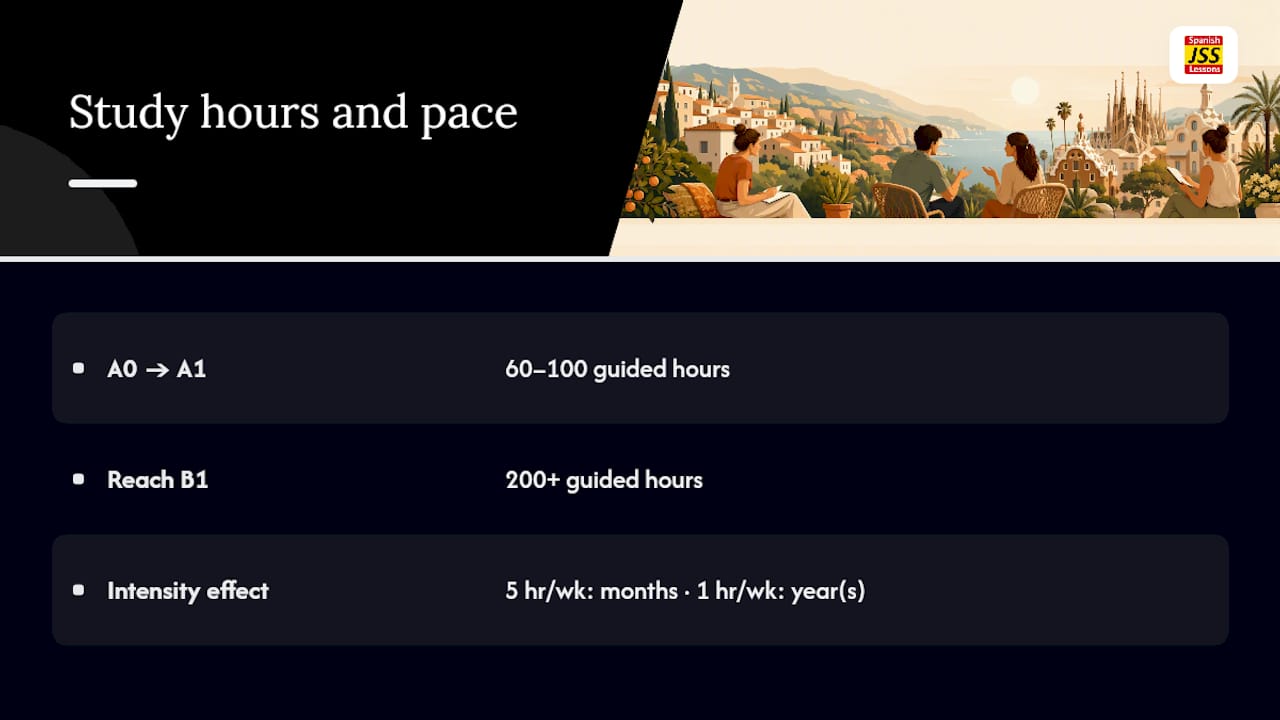
Progress timelines give you a way to sanity-check any quote. Moving from complete beginner (A0) to basic conversational ability (A1) typically needs somewhere in the region of 60 to 100 guided hours; reaching a solid intermediate level (B1) often takes 200 hours or more, spread across months rather than weeks. Intensity changes the calendar, not the total hours: cramming five hours a week gets you there faster in months, while one hour a week stretches the same workload over a year or two.
A rough worked example: at one hour a week for six months (roughly 26 hours) using a mid-range private tutor at €25 an hour, you’d spend around €650, plus any materials. The same budget put toward a one-off self-paced course could cover the entire programme with money left over for a phrasebook.
Why James Spanish School is worth comparing against hourly tuition
James Spanish School was founded by James Bretherton, a dual-native speaker who has lived in Spain for 40 years, and it’s built specifically for English-speaking adults who want to actually speak, not just study grammar. The course structures 100 lessons across sentence-building and “ear-tuning,” the listening work that trains you to follow fast native Spanish rather than the slow, deliberate version textbooks favour.
- One-time payment for lifetime access: no recurring hourly bills, no expiry date, no countdown pressure.
- The WordAmigo System: an AI-powered five-step retention loop covering reading, listening, speaking, and writing, built to solve the two problems that sink most adult learners: vocabulary that won’t stick and pronunciation native speakers struggle to understand.
- On-demand, repeatable: available on phone, tablet, or laptop, any hour, and you can repeat any lesson as often as you need.
Where hourly tutoring charges you every time you review a lesson, a fixed one-off fee removes that anxiety entirely. That model tends to suit learners who value listening comprehension and real conversation practice over exam certificates, since the emphasis sits on how neighbours, tradesmen, and shop staff actually speak, rather than textbook Spanish.
Ready to stop paying by the hour?
If you’ve been weighing up hourly tutors against group packages, there’s a third path worth considering seriously: paying once and never watching the clock again. Private tutoring and school packages both work, but they charge you repeatedly for the same review sessions that a self-paced course lets you repeat for free, indefinitely.
This Spanish school suits adults who want structured, real-world Spanish without juggling booking calendars or budgeting for every extra hour of practice. The 100-lesson course, paired with the WordAmigo System for vocabulary and pronunciation, means you get the correction quality of live tuition with the flexibility of on-demand learning, on your phone, tablet, or laptop, whenever suits you. A satisfaction guarantee is offered: if a core lesson teaches you nothing new, you may receive extra practice modules at no additional cost. Head to the shop to see current pricing and get started with lesson one today.