

Lifetime access : Acceso de por vida español
“Acceso de por vida” simply means you pay once and keep your login for as long as the course exists. What it does not automatically guarantee is future content: whether new lessons, updates or bonus modules are included depends entirely on the seller’s written terms. Some providers build their course around genuine, permanent access rather than a vague promise.
TL;DR:
- Lifetime access generally grants ongoing login to existing content but does not automatically include future updates, new lessons, or bonus modules unless specified.
- Verify if updates are included by checking for explicit terms like “updates included” or “future modules free,” and save proof of these promises before purchasing.
- Confirm support features, download options, device limits, and refund policies to avoid being locked out or charged additional fees later.
- Be cautious with installment plans labeled as “not a subscription,” and scrutinize their terms to prevent recurring charges after payments end.
- Actual legal protection relies on the purchase agreement details; lifetime access is a commercial promise, not a legal right to indefinite content availability.
Table of Contents
- What providers mean by lifetime access to Spanish courses
- Lifetime access versus lifetime updates: reading the fine print
- What to verify before you buy lifetime access
- Pricing shapes: one-off fees, instalments and red flags
- Is lifetime access right for you?
- How James Spanish School delivers lifetime access properly
- Legal and copyright rules behind lifetime access policies
- Where to check the James Spanish School lifetime offer
- Sources
What providers mean by lifetime access to Spanish courses
Most sellers use “lifetime access” to describe a single payment that unlocks perpetual login to the materials as they exist at the point of sale. That is the baseline. Whether it stretches further, into free future updates, extra modules or ongoing support, depends on the specific wording on the product page rather than the phrase itself.
Course platforms are fairly consistent on this point. Udemy’s own support documentation explains that lifetime access is tied to your account on that platform, with a handful of exceptions, such as content removed for policy or copyright reasons. A single-payment purchase rarely covers everything a learner might assume it does. Commonly excluded extras include:
- Live tutoring sessions or one-to-one feedback from a real teacher
- Graded homework or personalised correction of your speaking and writing
- Community access, such as private forums or group calls
- Guaranteed continuity if the provider changes hosting, rebrands, or closes
That last point is the one buyers overlook most. Lifetime access is only as durable as the company behind it, so a course with a long trading history and a stable platform carries less risk than a brand-new seller offering the same promise.
Lifetime access versus lifetime updates: reading the fine print
Plenty of buyers assume “lifetime access” and “lifetime updates” are the same promise. They are not, and the gap between them is where most disappointment happens. Some marketplaces are explicit about it: a Hotmart course listing advertises “acceso de por vida” alongside “actualizaciones futuras” as two separate, named benefits, precisely because sellers know learners need that clarity spelled out.
Before you buy, scan the product page and your confirmation email for phrasing that falls into one of two camps.
- Reassuring wording: “updates included”, “access to future modules”, “future releases free of charge”. These phrases commit the seller to something specific.
- Vague wording: “access for life to current content”, “no extra fees for now”. Both leave room for the seller to charge separately for anything released later.
- Silence: if the page says nothing either way, assume updates are not covered and ask before paying.
Pro Tip: Screenshot the product page and save your confirmation email the day you buy. If a seller ever tries to charge you again for content they implied was included, you’ll have dated proof of what was actually promised.
What to verify before you buy lifetime access
A sales page can say anything. Before you hand over a one-off payment, work through a short verification pass on four fronts: money-back terms, support, ownership, and account limits.
- Refund policy: check the exact window (7 days, 14 days, 30 days), what conditions apply, and how you actually submit a request.
- Support level: confirm whether live tutoring or graded feedback is part of the package, since lifetime access rarely includes ongoing human tuition unless the seller states it plainly.
- Portability: ask whether materials can be downloaded or exported, or whether they only exist inside the provider’s own platform.
- Device and login limits: check how many devices or simultaneous logins your account allows, and whether family or partner sharing is permitted or sold as a separate option.
None of this takes long to check, but skipping it is how buyers end up locked out of content they thought they owned outright.
Pricing shapes: one-off fees, instalments and red flags
A fair one-off price usually reflects the number of lessons, the production quality, and whatever extras (workbooks, retention tools, community access) are bundled in. More lessons and a genuine support system justify a higher figure than a handful of videos with nothing else attached.
Instalment plans complicate the picture. Some sellers offer a single “all-access” price split into instalments and market it as “not a subscription”, a distinction worth checking carefully, since a full-access pass covering multiple courses is a genuinely different product from a recurring subscription that renews automatically. Read the small print to see whether the provider retains authority to charge you again after the instalments end.
Watch for these warning signs:
- Countdown timers or “only X spots left” pressure on a digital product with unlimited capacity
- Payment terms that mention recurring billing anywhere, despite marketing the offer as one-off
- A price far below comparable courses, with no refund guarantee to back it up
Is lifetime access right for you?
The right model depends on your timeline and how you like to study, not on which option sounds more generous.
- Choose lifetime access if you want a reference you’ll return to for years, plan to repeat lessons at your own pace, and are working towards long-term fluency rather than a deadline.
- Choose a subscription if you need live tuition, expect frequent formally accredited updates, or only plan to study intensively for a short stretch.
- Ask yourself: will I still want this content in three years? If yes, a one-off payment usually works out cheaper than years of recurring fees.
Pro Tip: If you’re torn, add up twelve months of a subscription’s cost and compare it directly against the one-off lifetime price. For most learners studying beyond a year, lifetime access wins on cost alone.
How James Spanish School delivers lifetime access properly
James Spanish School’s course is built on the assumption that language learning does not follow a syllabus deadline. It follows your life. The full course runs to 100 lessons, split between sentence-building and the “ear-tuning” work that trains you to follow fast, natural Spanish rather than the slowed-down version used in classroom recordings.
Every lesson is available on demand, with no expiry date and no countdown pressure to finish by a certain point. Against the checklist above, here is what that means in practice:
- No subscription, no recurring charge, and no vague “for now” language on pricing
- Repeat any lesson as many times as you want, on your phone, tablet or laptop
- Vocabulary and pronunciation reinforced through the WordAmigo System, an AI-driven repetition loop built to stop new words slipping out of memory
- A cast-iron guarantee: if a core lesson teaches you nothing new, James credits extra practice modules at no cost
Learning a language isn’t about talent. It’s about exposure that actually sticks, reading it, hearing it, saying it, writing it, again and again until it stops feeling like translation and starts feeling like speaking.
James’s own advice to students is simple: front-load your first month with the sentence-building lessons, then let the ear-tuning modules run in the background on your commute or during chores. Pair that with small doses of real-life immersion, listening for how neighbours haggle, how shop staff greet regulars, how a tradesman explains a delay, and the vocabulary stops being theoretical fast.
Legal and copyright rules behind lifetime access policies
Lifetime access is a commercial promise, not a legal category, and that distinction matters more than most buyers realise. No law obliges a course provider to keep content available forever. What actually protects you is the contract you agreed to at checkout: the terms of service, the refund policy, and any explicit updates clause.
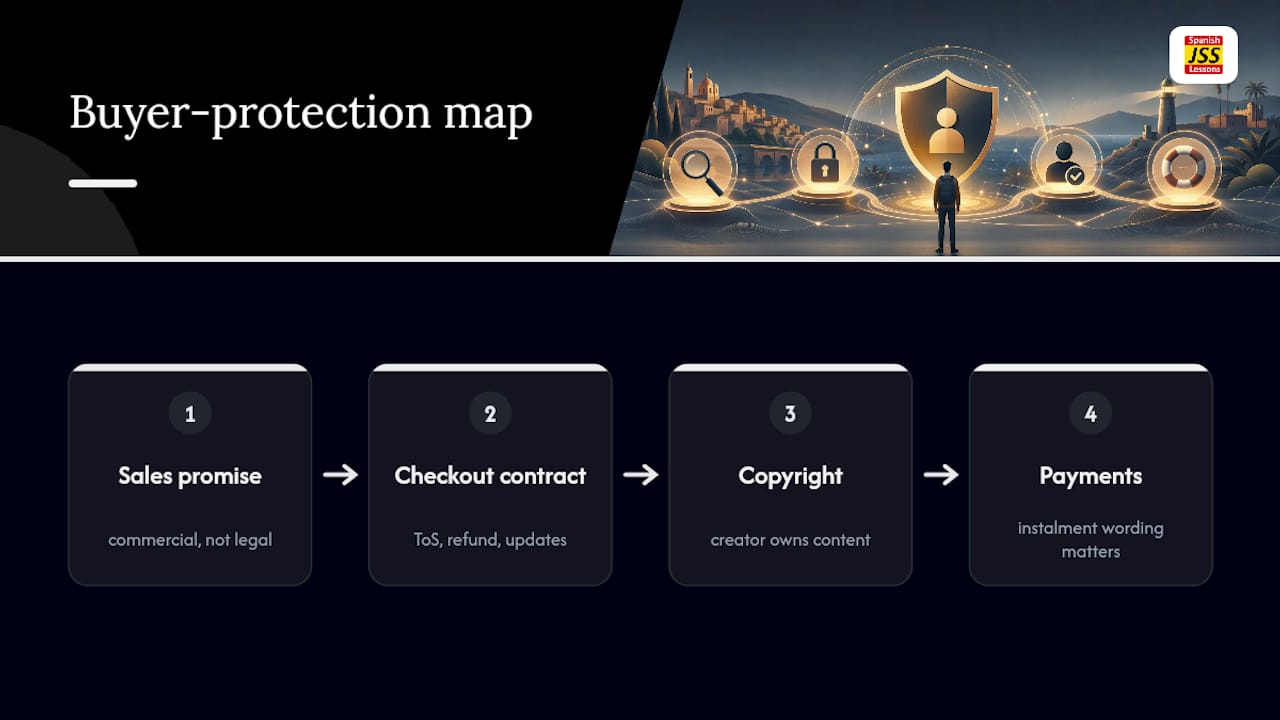
Copyright ownership stays with the course creator in almost every case. Buying “lifetime access” grants you a personal licence to view the material, not ownership of the content itself, which is why most platforms prohibit sharing your login or redistributing downloaded lessons. That licence can also be narrower than it looks: a provider that pulls a lesson for legal, licensing or policy reasons is usually entitled to do so under the same terms that granted you access in the first place, exactly the kind of exception platform FAQs tend to flag.
This is also why instalment plans need scrutiny. A payment plan described as “not a subscription” still needs to specify, in writing, that the seller has no ongoing authority to charge you once the instalments finish. Regulators generally treat recurring-billing language as the deciding factor, regardless of how the offer is marketed, so the wording in the terms matters more than the label on the sales page. If a provider’s terms are silent on what happens after a business closes or a platform migrates, that silence is itself useful information: it tells you how much risk you’re taking on with that one-off payment.
Where to check the James Spanish School lifetime offer
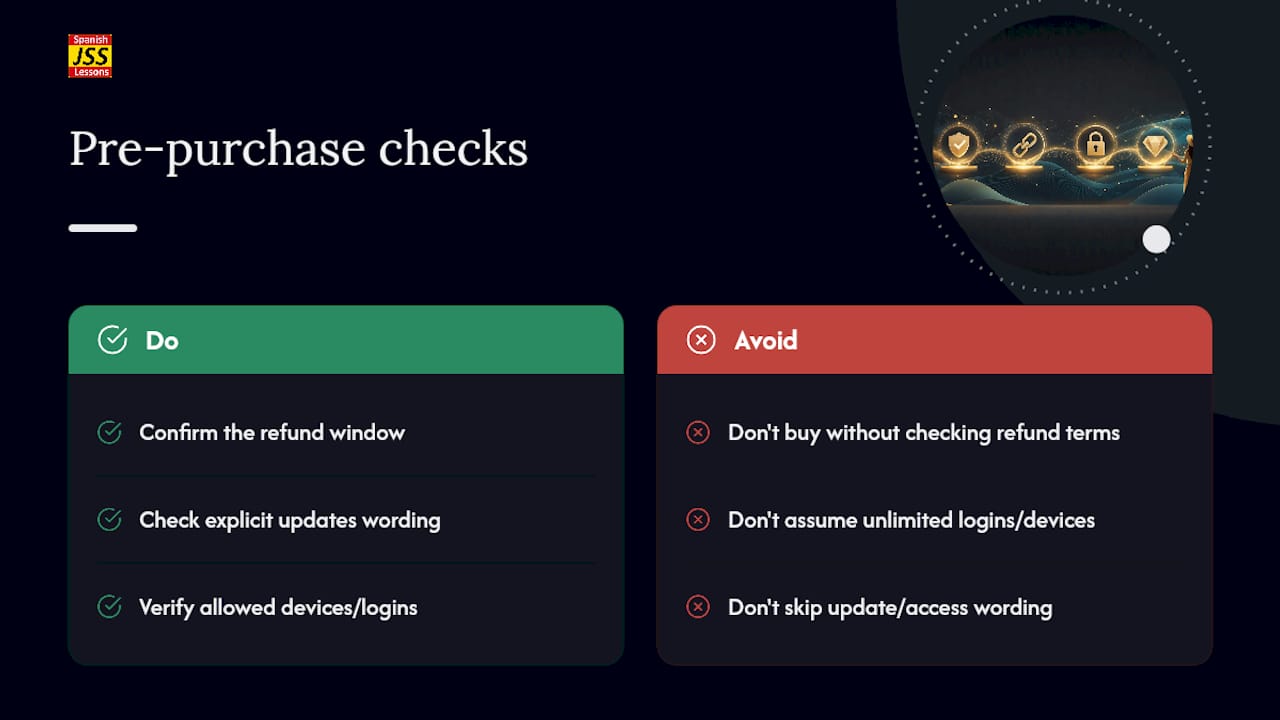
If the checklist above has you ready to commit, the full range of James Spanish School course packages sits on the shop page, where you can compare variants including single and two-person login options. Before paying, run through the same checks covered earlier: confirm the refund window, look for explicit updates wording, and check how many devices or logins your chosen package allows.
James Spanish School is the alternative to slow, classroom-paced courses for anyone who wants Spanish that works outside Spain’s daily rhythms, no fixed timetable, no subscription clock ticking in the background, and no content that vanishes the moment a billing cycle lapses. The course structure gives you 100 lessons split between sentence-building and ear-tuning, backed by the WordAmigo retention system for vocabulary and pronunciation, all under a single payment with no expiry date.
Once you’ve enrolled, start with the early sentence-building lessons to establish the structural logic of Spanish, then bring in WordAmigo daily for short, repeated vocabulary drills. That combination, structure first, retention second, is what turns lifetime access from a stored file into fluency you actually use. Visit the shop page to see current course packages and start your first lesson today.