

Ceceo y seseo en España
Seseo is when a Spanish speaker pronounces both c/z and s as one sound, an alveolar /s/, while ceceo goes the other way, turning s into a soft, interdental /θ/ (like the “th” in “think”). Seseo dominates across many areas of Spain and most Spanish-speaking countries; ceceo is a minority feature limited to certain parts of southern Andalusia. For learners, the practical order is simple: train your ear to catch /s/ versus /θ/ before worrying about which spelling produces which sound.
TL;DR:
- Seseo is the dominant pronunciation across Latin America, the Canary Islands, and most of Andalusia, merging /s/ and /θ/ sounds into /s/.
- Ceceo, mainly a rural feature in southern Andalusia, pronounces /s/ as /θ/, but is socially stigmatized and less widely accepted.
- Most learners should focus on recognizing and producing /s/ versus /θ/ through minimal pairs, shadowing, and deliberate mouth positioning exercises.
- Imitating ceceo can be socially ambiguous or dated within Spain, whereas seseo is fully accepted and neutral worldwide.
- Training your ear involves mixing regional speakers and using spaced repetition to master minimal pair distinctions effectively.
Table of Contents
- Seseo y ceceo en España: the phonetics in plain terms
- Where in Spain do seseo and ceceo actually occur?
- Why ceceo carries less prestige than seseo
- How to train your ear and mouth for these sounds
- How James Spanish School trains this into your ear
- Ready to train your ear on real Spanish, not just the textbook version
- Sources
Seseo y ceceo en España: the phonetics in plain terms
Standard Castilian Spanish keeps two separate sounds where English speakers might expect one. This is called distinción: c and z are pronounced /θ/ (interdental, tongue between the teeth), while s stays /s/ (alveolar, tongue tip near the roof of the mouth). Say “sink” and “think” in English and you have already made both sounds without realising it.
Seseo collapses that distinction. Speakers pronounce c, z, and s all as /s/. So caza (hunt) and casa (house) become homophones. This is not a defect or a shortcut. It is the standard pronunciation across Latin America, the Canary Islands, and much of Andalusia, meaning a large portion of native Spanish speakers use seseo, not distinción.
Ceceo goes the opposite direction. Speakers pronounce s as something closer to /θ/, so casa starts to sound like caza. The Real Academia Española explains that in most of Spain two fricatives are distinguished, while in the Canary Islands, much of Andalusia, and Hispanoamerica these reduce to a single phoneme, realised as [s] in seseo zones and something closer to an interdental sound in ceceo zones.
A handful of minimal pairs make the contrast concrete:
- Casa / caza: house / hunt. Distinguished in Castilian standard; identical under seseo.
- Coser / cocer: to sew / to cook. Same story: /s/ versus /θ/ marks the difference.
- Cereza: cherry. Said with /θ/ in distinción and ceceo areas, /s/ under seseo.
Spelling still reflects an older sound system from before these mergers happened, which is why c, z, and s look different on paper even where they now sound the same. The written language froze a distinction that spoken Andalusian and Latin American Spanish moved past centuries ago.
Where in Spain do seseo and ceceo actually occur?
Geography matters more here than in almost any other feature of Spanish pronunciation, and the map is more specific than most learners expect.
Seseo is the common pattern across large parts of the Spanish-speaking world, and within Spain itself it concentrates in two areas:
- The Canary Islands, where seseo is essentially universal.
- Western and southern Andalusia, covering Cádiz, Huelva, most of Seville, and the centre and south of Córdoba, with pockets extending into parts of Málaga and Jaén.
Ceceo, by contrast, occurs only in some rural and small-town pockets of southern Andalusia and is a genuine minority feature even in its strongest province. Wikipedia’s summary of seseo distribution traces the split back to sound changes in the 16th and 17th centuries, when medieval Spanish had several sibilant sounds that later merged differently depending on region. Beyond Spain, seseo is effectively the norm across Latin America, which is one reason most Spanish learners encounter it long before they ever hear ceceo.
Regional labels are tendencies, not laws. Cities pull towards more standard patterns than surrounding villages, and individual speakers code-switch depending on who they are talking to. Treat any “this province speaks like X” claim as a strong lean rather than a guarantee.
Pro Tip: If you are choosing podcasts or YouTube channels to train your ear, deliberately mix a Canary Islands or Sevillian speaker with a Madrid or Valladolid speaker in the same week. Hearing both patterns side by side trains your brain to recognise the sound shift instead of assuming you misheard a word.
Why ceceo carries less prestige than seseo
The two mergers are treated very differently in Spain, and that difference has real consequences for how you should think about imitating either one.
Seseo has full acceptance in the standard language. The RAE treats it as a legitimate regional and international norm, consistent with its usage by many Spanish speakers worldwide.
Ceceo carries the opposite reputation. Scholarly dialect work, including the Redalyc study on seseo, ceceo, and distinción, notes that ceceo is regionally limited and socially stigmatised, and that educated speakers in ceceo zones often shift towards seseo or distinción in formal settings, interviews, or when speaking to outsiders.
A few practical consequences follow from that:
- Locals in ceceo areas may soften or drop the feature around you without meaning anything by it. It is a register choice, not rejection.
- Imitating ceceo as a learner can land oddly, since it reads as a rural or old-fashioned marker to some Spanish speakers, even within Andalusia.
- Seseo carries none of that baggage. Adopting it, or simply understanding it, causes no social friction anywhere in the Spanish-speaking world.
The safe default for most learners aiming at a neutral, widely understood accent is standard distinción or seseo, rather than ceceo.
How to train your ear and mouth for these sounds
Fixing this is a listening problem before it is a pronunciation problem, so the order of practice matters.
- Start with minimal pairs, not full sentences. Drill casa/caza, coser/cocer, and cereza said both ways, ten repetitions each, before adding surrounding words.
- Shadow real audio. Play a short clip from a Sevillian or Canary Islands speaker, pause every sentence, and repeat exactly what you heard before moving on.
- Build the /θ/ sound deliberately. Pronounce the /θ/ sound by placing your tongue tip lightly between your front teeth and pushing air through, similar to the English “th” in “think”; for /s/, position the tongue just behind the top teeth without touching them.
- Decide your target accent before drilling production. If comprehension across Spain and Latin America is your goal, prioritise recognising /s/ in speech over producing /θ/ yourself. If you specifically want a Castilian accent, practise distinción as your default.
- Use spelling as memorised exception, not logic. Homophone pairs like coser/cocer will not resolve themselves through phonetic reasoning; treat them as vocabulary to memorise directly.
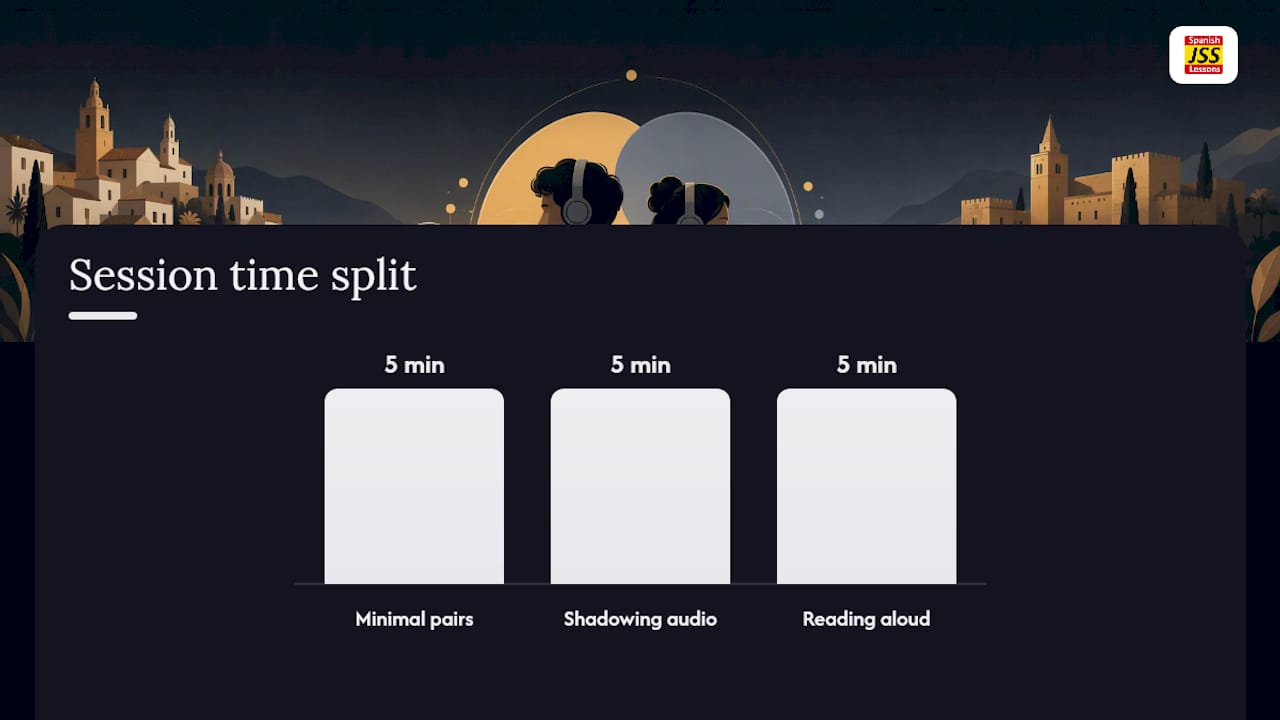
A realistic weekly plan runs two or three short sessions: five minutes of minimal-pair listening, five minutes of shadowing a native clip, and five minutes reading a short paragraph aloud focused on c, z, and s words.
Pro Tip: Record yourself saying casa and caza on different days, then play both back with your eyes closed. If you cannot tell which recording is which, your production is more consistent than you think, and the gap is really about listening confidence.
For structured drills built around exactly this kind of contrast, the practical pronunciation guide from James Spanish School walks through the mouth positions in more depth.
How James Spanish School trains this into your ear
James Bretherton, founder of James Spanish School, is a dual-native speaker who has lived in Spain for four decades, which means the seseo and ceceo split is not academic for him. It is the accent variation he has heard in shops, bars, and government offices across four decades of daily Spanish life.
The school’s WordAmigo system applies strategic, spaced repetition to exactly this kind of minimal-pair problem, cycling casa/caza style pairs through listening, speaking, reading, and writing until the distinction sticks. A simple version of the exercise: pick one minimal pair, listen to it five times, say it back five times, then repeat the loop the next day and the day after. That spaced pattern, rather than one long drilling session, is what the Word Amigo System builds its retention loop around.

Ready to train your ear on real Spanish, not just the textbook version
Understanding seseo and ceceo on the page is one thing; catching them at conversational speed in a Cádiz bar or a Canary Islands shop is another — see Cómo pedir en un bar español sin dudar en la barra for practical language use in real settings. Some Spanish courses pair ear-tuning lessons with strategic repetition systems, integrating pronunciation drills into their lesson structures and allow revisiting tricky sound pairs multiple times.

This suits English-speaking adults already living in Spain, or planning a move, who want to follow fast native speech rather than pass an exam. Rather than hunting down scattered YouTube clips to build your own minimal-pair drills, the course’s audio library and repetition tools do that groundwork for you. To explore lesson structures, browse the course options and choose modules that suit your current Spanish level.
Sources
For primary definitions, consult the RAE’s pages on seseo and ceceo and its consonant subsystems entry. For maps and dialect detail, see Wikipedia’s seseo overview and the Redalyc dialectology study.
- El seseo y el ceceo | Ortografía de la lengua española | RAE – ASALE
- Seseo – Wikipedia, la enciclopedia libre
- Seseo, ceceo y distinción de /s/ y /θ/: El caso de los … – Redalyc